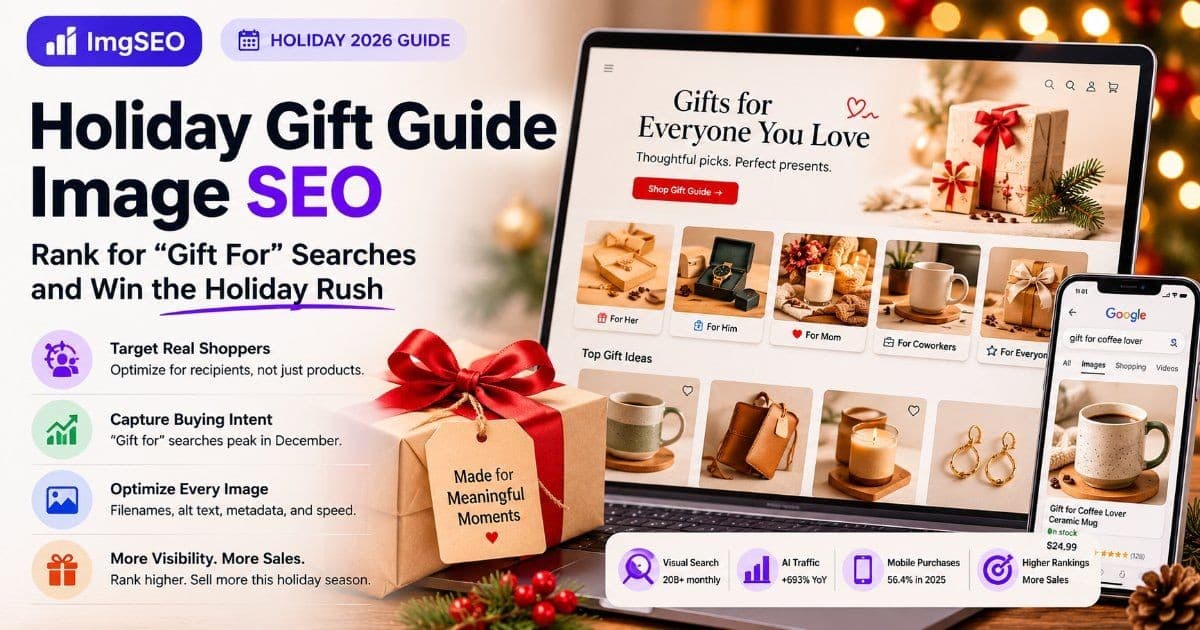
Every December, millions of people type some version of the same desperate phrase into Google: "gift for mom," "gift for coworker," "gift for someone who has everything." These aren't browsers. They're buyers with a deadline and a credit card, and the store whose images show up for their exact search is the store that gets the sale. Most sellers never rank for these queries because they optimize product images for what the item is, not who it's for.
That gap is the opportunity. In 2025, U.S. shoppers spent a record $257.8 billion online over the holiday season, up 6.8% year over year (Adobe Analytics, January 2026). A meaningful slice of that spending starts with a "gift for" search, and a growing share starts with a photo instead of words. This guide shows you how to optimize product images, filenames, alt text, and gift-guide pages to capture recipient-intent searches before the December rush.
Key Takeaways
- Match the recipient, not just the product: an image named
gift-for-coworker-mug.jpgwith matching alt text ranks for "gift for coworker" where a genericmug.jpgnever will.- Publish gift guides early enough to be useful, while recognizing that crawl, indexing, ranking, and seasonal demand timing vary.
- Visual and AI shopping now drive gift discovery: Google Lens handles 20B+ visual searches monthly, and AI-referred retail traffic rose 693% over the 2024 holidays (Adobe, 2026).
Why Are "Gift For" Searches the Holiday Goldmine?
"Gift for" searches are pure buying intent, and they spike hard in December. Google's own Holiday 100, a gifting list built entirely from rising Search trends, shows how sharply this behavior concentrates: queries like "trendy gifts for women" hit their annual peak in December 2025, with near-zero interest the rest of the year (Google, 2025).
That seasonality is exactly why the queries are winnable. A shopper searching "gift for a coffee lover" has already decided to buy. They've named the recipient and the occasion. What they haven't done is choose the product, which means the image that matches their search does the choosing for them. Ranking here isn't about beating a giant retailer on "coffee mug." It's about being the store that shows up for the specific, long-tail, recipient-shaped query the giant ignored.
What we've seen: the sellers who win "gift for" traffic aren't the ones with the best products. They're the ones who named their images and pages after the recipient before the season started. The optimization is simple; the timing is what most people miss.
The catch is that these queries are invisible in your analytics until you rank for them, so most sellers don't know the demand exists. For a broader seasonal plan beyond images, our Q4 image SEO checklist for the holiday rush covers the wider prep timeline.
How Do Shoppers Actually Find Gifts in 2026?
Increasingly, they find gifts with a camera and an AI assistant, not just a text box. Google Lens now handles more than 20 billion visual searches a month, and younger shoppers begin roughly 40% of their product searches visually rather than with typed keywords (Google, 2025). A gift shopper who spots something and thinks "find one like this" is matched on your image, not your product description.
AI shopping assistants are the other shift. Over the 2025 holidays, traffic from AI sources to retail sites rose 693% compared to the prior year, and those AI-referred shoppers spent 45% more time on-site and viewed 13% more pages (Adobe Analytics, January 2026). Higher intent, longer sessions. These assistants read your images and structured data to decide what to recommend.
What both trends share is that they run on your images. Visual search matches pixels; AI assistants parse alt text and schema. Neither cares how clever your product copy is if the image itself carries no recipient context. That's the whole game in 2026: the picture has to say who the gift is for.
For the technical foundations of getting product photos indexed at all, start with our guide on how to rank on Google Images.
How to Optimize Product Images for "Gift For" Queries
Put the recipient in the filename and the alt text. This is the single highest-leverage move for gift-search ranking, and almost nobody does it. A product photo saved as IMG_2048.jpg or even ceramic-mug.jpg tells Google nothing about gifting. The same photo saved as gift-for-coworker-ceramic-plant-mug.jpg with matching alt text competes directly for "gift for coworker" searches.
Here's the difference in practice:
| Element | Generic (won't rank for gift searches) | Recipient-optimized |
|---------|----------------------------------------|---------------------|
| Filename | mug-blue-01.jpg | gift-for-coffee-lover-blue-mug.jpg |
| Alt text | "Blue ceramic mug" | "Blue ceramic mug, a cozy gift for a coffee lover" |
| Title metadata | (empty) | "Coffee Lover Gift Mug" |
| Page context | Product page only | Linked from a "gifts for coffee lovers" guide |
The rule: name the recipient a real person would search for. "Gift for mom," "gift for gamer," "gift for teacher," "gift for someone who has everything." Use the natural phrasing shoppers type, not internal category names. Then make the alt text a full, descriptive sentence that a screen reader and an AI crawler can both use, with the recipient woven in naturally rather than stuffed.
Don't keyword-stuff. One recipient phrase per image, matched to the product, reads naturally and ranks. Three crammed together reads as spam and ranks for none. For the mechanics of writing alt text that works, see our guide on how to write alt text for product images, and for filenames, how to fix bad image filenames for SEO.
How Do You Build a Gift-Guide Page That Ranks?
Build a hub plus dedicated recipient pages only when each page has substantial, distinct products and guidance. Focused pages can match a narrower intent, but they do not automatically rank better than a useful consolidated guide.
Each recipient page should lead with images, because that's what both shoppers and visual search consume first. Structure it as a scannable grid: 6 to 12 curated products, each with a recipient-optimized image, a short reason it fits that person, and a price. The images carry the SEO weight; the copy carries the conversion.
Our finding: gift-guide pages that open with an image grid and recipient-specific filenames tend to pick up long-tail "gift for" impressions within a few weeks of indexing, well before the December peak, because the competition for these exact phrases is thin. The window to claim them is October, not December.
Link every product in the guide back to its full product page, and link the recipient pages back to a central gift-guide hub. This internal structure tells Google the pages are a coherent cluster, which lifts the whole set. For the wider architecture, our e-commerce image SEO strategy guide covers how these pieces fit together across a catalog.
What Technical Image Standards Does a Gift Guide Need?
Speed, because gift-guide pages are image-heavy and holiday shoppers are overwhelmingly on phones. In 2025, 56.4% of online holiday purchases happened on a smartphone, up from 54.5% the year before (Adobe Analytics, January 2026). A gift guide with a dozen unoptimized images will fail its mobile Largest Contentful Paint score and sink in rankings exactly when traffic peaks.
Run this checklist on every gift-guide page before October:
| Standard | Target | Why it matters for gift guides | |----------|--------|--------------------------------| | Format | WebP or AVIF | 12+ images per page; format savings compound fast | | File size | Under ~150KB per image | Protects mobile LCP for the 56% on phones | | Dimensions | Sized to display, not oversized | Avoids shipping 3000px files into a 600px grid | | Lazy loading | Below-the-fold images | First screen paints fast; rest load on scroll | | Alt text | Every meaningful image, context-specific | Accessibility and page-level image context |
Format choice matters most here because of the image count. A gift-guide page carrying a dozen photos benefits from AVIF's 20–30% smaller files more than a single product page does. For the full format decision, see our AVIF vs WebP for e-commerce comparison, and for compression specifics, the image compression guide. A tool like ImgSEO handles the conversion and compression in one pass so the whole guide loads fast.
Do Gift Images Need Structured Data and Metadata?
Yes, because structured data is how your image qualifies for rich results and gets read by AI shopping assistants. Product and ImageObject schema connect your photo to price, availability, and recipient context, which is what Google needs to surface it in Shopping results and image rich results. Given that AI-referred retail traffic jumped 693% over the 2025 holidays (Adobe, 2026), machine-readable product data is no longer optional.
Beyond schema, you may keep descriptive or rights-related XMP in source assets when that supports your workflow. Platforms can remove it during processing, and Google does not document XMP as a standalone ranking factor. Our guide on EXIF and XMP metadata for image SEO explains the standards and limitations.
Use eligible structured data, accurate visible copy, and useful alt text together because they serve different page and accessibility needs. Optional XMP can support source-asset context, but omitting it does not mean a documented ranking signal is lost.
When Should You Publish Your Holiday Gift Guide?
Publish while the guide is useful and inventory is accurate. Search interest can be seasonal, but crawl, indexing, and ranking timing varies; there is no fixed six-to-ten-week ranking window.
Freshness compounds the point. Google favors recently updated content for seasonal queries, so a page published in October and lightly refreshed in November signals active relevance. Update a few products, refresh the images, and touch the updatedAt date. That single refresh can lift a gift guide back up the rankings right as demand builds.
If you sell on Etsy, the timing and tactics shift slightly toward the platform's own search; our Etsy holiday SEO guide for Christmas 2026 covers that pipeline. For Google Images specifically, the Google Images SEO guide for product photos goes deeper on indexing mechanics.
FAQ
How do I rank product images for "gift for" searches?
Match the recipient in your image filename and alt text. A shopper searching "gift for coworker" should find an image named gift-for-coworker-desk-plant.jpg with alt text describing the product as a coworker gift. Recipient-intent keywords in image metadata are the signal that connects your photo to the query, and almost no competitor bothers to add them.
When should I publish my holiday gift guide?
Publish while the guide is useful and inventory is accurate. Refresh it when products, prices, or availability change, without assuming a fixed crawl window or that a cosmetic update creates a freshness ranking signal.
Does visual search matter for holiday gift shopping?
Yes, significantly. Google Lens handles over 20 billion visual searches a month, and younger shoppers begin roughly 40% of product searches visually (Google, 2025). A gift shopper who photographs an item to "find something like this" is matched on your image and its metadata, not your product copy, which makes image optimization the deciding factor.
What image format is best for a holiday gift guide page?
WebP or AVIF, because gift-guide pages are image-heavy and 56.4% of holiday purchases happen on mobile (Adobe, 2026). AVIF runs 20–30% smaller than WebP; both cut load time and protect the Largest Contentful Paint score mobile rankings depend on. On a 12-image guide, the format savings compound into a real speed difference.
Do gift-guide images need structured data?
Yes. Product and ImageObject schema help Google connect your image to price, availability, and recipient context, qualifying it for rich results and Shopping surfaces. Structured data also feeds AI shopping assistants, whose referral traffic to retail rose 693% over the 2024 holidays (Adobe, 2026), so machine-readable images now reach a fast-growing channel.
Can I use one gift-guide page for all recipients?
A hub can organize the collection. Add dedicated recipient pages only when each provides distinct value, then link them clearly; avoid thin pages created solely to target query variations.
How does AI shopping change gift-guide SEO?
AI assistants recommend products directly now, and shoppers arriving from them view 13% more pages and spend 45% more time on-site (Adobe, 2026). Clear, well-labeled images with structured data and embedded metadata make your products easier for these assistants to identify, understand, and recommend to a shopper describing who they're buying for.
Conclusion
Holiday gift-guide image SEO comes down to one shift in thinking: optimize for the recipient, not just the product. The shopper searching "gift for someone who has everything" has money ready and no product chosen, and the store whose images match that exact phrase is the store that closes the sale. Recipient-shaped filenames, alt text, dedicated gift-guide pages, and structured data are what put you in front of that shopper.
Seasonal demand changes quickly, while crawl and indexing timing varies. Publish useful gift-guide content early enough to be discovered, use fast descriptive images and eligible schema, and refresh information when products or availability change. Optional XMP can support source-asset workflows but is not a documented ranking requirement.
ImgSEO helps prepare the image layer: upload product photos to generate reviewable alt text, convert and compress to WebP or AVIF, and optionally embed XMP metadata in supported exports. Review the output and destination-platform requirements before publishing.