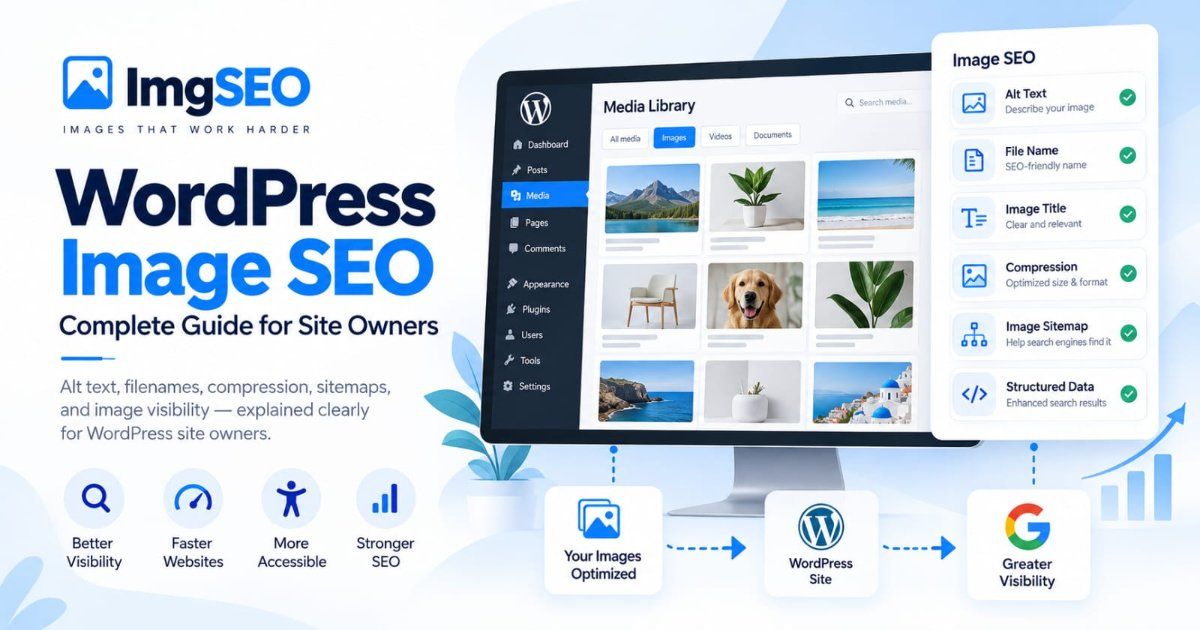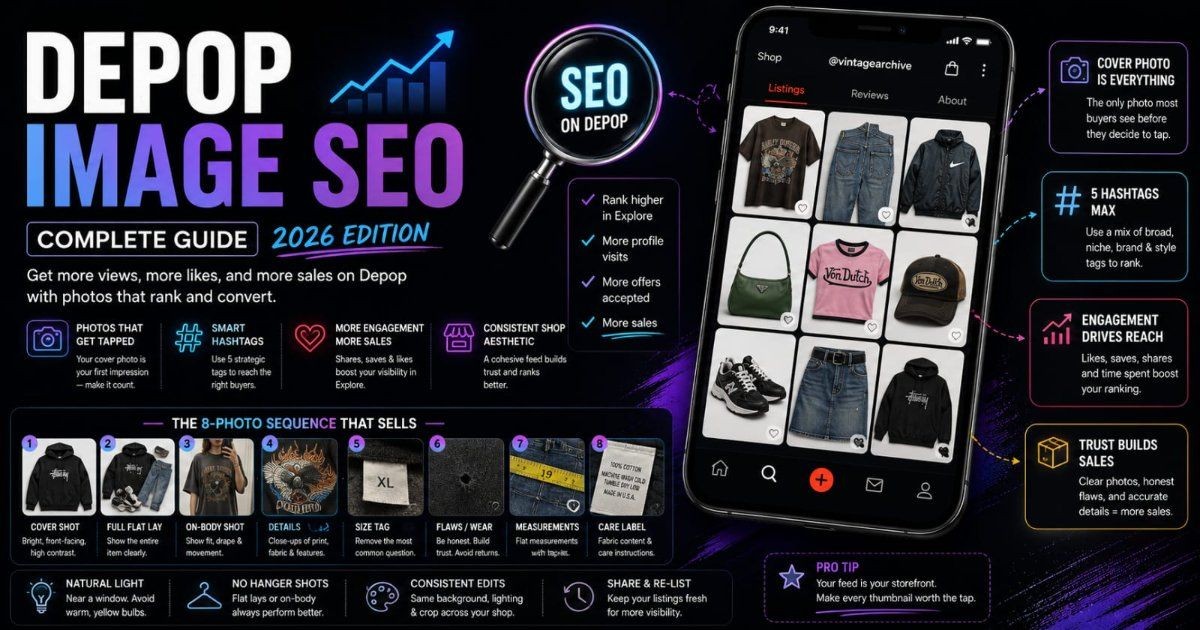

Image SEO is the most underutilized traffic channel in e-commerce. While your competitors are bidding on the same keywords, running the same ads, and fighting for the same text results, Google Images sits largely unclaimed — image search accounts for roughly 22.6% of all web searches (FirstSiteGuide, 2025), and most of that volume goes to buyers who are actively looking at products.
Most sellers focus entirely on text SEO and leave image SEO untouched. Their product photos are named DSC_0042.jpg, missing alt text, and uploaded at 4MB with no embedded metadata. Every one of those gaps is an opportunity for sellers who know what to do.
A complete image SEO strategy — applied systematically across your catalog — can meaningfully grow your Google Images traffic within six months. This playbook gives you the exact framework to do it.
Key Takeaways
- Image search makes up roughly 22.6% of all web searches (FirstSiteGuide, 2025), and most e-commerce sellers never touch this channel.
- The five pillars — technical foundation, naming, alt text, embedded metadata, and platform optimization — reinforce each other; skipping one weakens the rest.
- Embedded EXIF/XMP metadata is the biggest untapped differentiator: in our experience running ImgSEO, well under 5% of sellers use it, which leaves that signal essentially uncontested.
Why Image SEO is Different from Regular SEO
Images are Products — Not Content
In e-commerce, images are not decoration supporting text. They are the product preview. Buyers make purchasing decisions from images before they read a single word of your description. Google understands this.
When someone searches "navy blue linen throw pillow" in Google Images, they are looking to buy. They are comparing products visually, clicking through to product pages, and converting at rates that rival paid search. That is different from a blog reader who might scan a page and leave.
Image SEO treats your product photos as the primary ranking asset they actually are. Every image in your catalog is a potential entry point for a buyer with purchase intent.
The Image SEO Opportunity
The competitive landscape for image SEO is remarkably weak. Most e-commerce operators have never heard the term. Even sellers who invest seriously in text SEO — hiring agencies, building content, doing keyword research — typically upload raw photos with filenames from their camera and call it done.
That leaves the field open. Easy wins are available at every level: large stores that have never touched their filenames, mid-size stores with blank alt text fields, small stores uploading 3MB JPEGs on mobile-first storefronts. Each of those is a ranking disadvantage you can exploit.
Image SEO also compounds. A well-optimized product image ranks, drives traffic, and builds authority over months and years. You optimize once and it pays indefinitely — unlike ads that stop the moment you stop paying.
The Complete Image SEO Framework
Rather than a loose checklist, image SEO is best approached as a structured framework with five interdependent pillars. Each pillar reinforces the others. Skipping one weakens the whole.
5 Pillars Overview
- Technical foundation — format, dimensions, and compression
- Naming strategy — filename conventions that carry keyword signals
- Descriptive signals — alt text and titles that Google reads
- Metadata layer — EXIF and XMP fields embedded in the file itself
- Platform optimization — tactics specific to your selling channel
The first three pillars are widely known but inconsistently applied. The fourth pillar — embedded metadata — is where fewer than 5% of sellers operate. The fifth pillar is where general advice gets translated into platform-specific action.
Pillar 1: Technical Foundation
Image Format Strategy
Format affects both page speed and indexing. The right choice depends on where you are in your store's lifecycle.
New stores should use WebP for everything. WebP delivers 25-35% smaller file sizes than equivalent JPEG at the same visual quality, and Google Images indexes WebP natively. There is no penalty for using it and meaningful performance gains.
Existing stores should not attempt a full catalog conversion immediately. Convert your top-performing and top-revenue products first — the 20% of SKUs that drive 80% of your traffic. That gives you the ranking lift where it matters most without an overwhelming migration project.
Amazon is an exception: the platform requires JPEG for main product images. For any product you sell on Amazon, maintain a JPEG version of your primary image. Supplemental images and lifestyle shots can use other formats in most categories.
For a detailed format comparison with size and quality benchmarks, see our WebP vs JPEG vs PNG guide for e-commerce.
Compression Strategy
File size directly affects your rankings. Google has confirmed page speed as a ranking factor, and large images are the single most common cause of slow product pages.
Choose file weight in relation to rendered dimensions and required detail. Test representative hero, lifestyle, and thumbnail images instead of enforcing one catalog-wide kilobyte rule.
Compare lossy exports at the sizes customers actually see. Encoder quality scales and image complexity differ, so no percentage guarantees imperceptible degradation or a specific resulting file size.
One important sequencing rule: compress before adding metadata, or add metadata after compression. Some tools strip EXIF and XMP data during compression. If you compress after embedding metadata, verify the metadata survived. The safer workflow is to embed metadata last.
See the complete compression workflow in our image compression guide for e-commerce.
Dimension Strategy
Consistent dimensions across your catalog signal professionalism and improve the shopping experience, both of which contribute to lower bounce rates and higher engagement signals.
- Product images: 1200×1200px minimum. Square format works across all platforms and thumbnails.
- Hero and lifestyle images: 1920×1080px. Widescreen format for banner and header use.
- Thumbnails: 400×400px. Used in category pages, search results, and related products.
Do not upload images at dimensions beyond what your store displays. A 4000×4000px image served on a 400×400px thumbnail wastes bandwidth, slows load time, and provides no quality benefit to the buyer.
Pillar 2: Naming Strategy
Filename Convention
Your filename is the first SEO signal Google reads about an image. IMG_4521.jpg tells Google nothing. handmade-ceramic-mug-navy-blue-12oz.jpg tells Google exactly what the image shows, what the product is, and reinforces your page's keyword targets.
The formula for e-commerce filenames:
[brand]-[product-type]-[color]-[material]-[variant].jpg
Rules that matter:
- Lowercase always — no capitals
- Hyphens between words — never underscores, never spaces
- 3-6 descriptive keywords — enough to be specific, not so many it reads as spam
- Unique per product and per variant — two blue mugs should have different filenames if they differ in any way
- Named before uploading — platforms like Shopify rename files on upload, but your original filename informs the alt text suggestions and metadata you generate
For a deep dive into filename repair for existing catalogs, see how to fix bad image filenames for SEO.
Naming at Scale
Consistent naming across hundreds or thousands of SKUs requires a system, not just guidelines.
Build a naming spreadsheet before you begin. Columns: SKU, product name, color, material, variant, generated filename. Fill it out for new products before they go live, and work through existing products systematically.
The practical workflow: name files before uploading, not after. Renaming images after they are live on your store risks breaking links, losing image history, and creating redirect chains. Do it right the first time.
For AI-assisted filename generation at scale — especially useful for stores with hundreds of products — ImgSEO's optimizer generates SEO filenames from the image itself using computer vision, with no manual input required.
Pillar 3: Descriptive Signals
Alt Text Strategy
Alt text is the signal most stores get wrong in two opposite ways: either they leave it blank or they stuff it with keywords until it reads like a list. Neither works.
Every image needs unique alt text — not the same phrase repeated across variants, not your store name appended to every description. Unique because Google treats identical alt text across multiple images as a weak signal.
The formula for e-commerce alt text:
[product type] + [key features] + [color/material]
Examples:
handmade ceramic coffee mug navy blue 12oz— product type, material, color, sizewomen's merino wool cardigan dark green medium— product type, material, color, sizevintage leather messenger bag tan full-grain 15-inch laptop— product type, material, color, feature
Keep alt text under 125 characters. Include your primary keyword naturally — do not force it. Write it for a visually impaired user, and the SEO benefit follows automatically.
For the complete framework on writing alt text that ranks, see our complete alt text guide.
Title and Caption Strategy
Where your platform supports image titles and captions, use them — they add redundant confirmation of what the image shows.
Your image title should match your primary keyword target for that product. It is a secondary signal, not a primary one, but it reinforces your alt text and filename when all three align.
Captions provide visible context on the page. Google reads visible text near an image as a signal about its subject. A short, descriptive caption beneath a product image adds another layer of confirmation that costs nothing to write.
Pillar 4: Metadata Layer
Why Metadata is the Differentiator
This is where most of your competitors stop. Fewer than 5% of e-commerce sellers embed SEO metadata in their image files. That means the sellers who do it occupy essentially uncontested territory.
EXIF and XMP metadata live inside the image file itself. They can carry descriptive and rights-related information, but search engines and destination platforms decide whether those fields are preserved or used. Do not treat embedded keywords as independent ranking signals.
The two standards work in parallel:
- EXIF — embedded in JPEG files at the binary level; fields include title, description, copyright, keywords
- XMP — an XML layer supported by JPEG, WebP, and AVIF; more flexible, more fields, more widely supported by modern crawlers
Embedding both gives you double coverage. Google reads them independently, which means double confirmation of your keyword signals from a single file.
For a full explanation of what each metadata standard stores and the limits of preservation and search use, see what is EXIF metadata and why it matters for SEO.
Metadata Workflow
The metadata workflow follows a specific sequence to ensure both quality and preservation:
- Generate SEO content — title, description, and keywords for the product image using AI or manual research
- Embed EXIF fields — for JPEG images: title, description, copyright, keywords
- Embed XMP fields — for all formats:
dc:title,dc:description,dc:subject(keywords),xmp:CreateDate - Then compress — verify metadata survives compression; re-embed if stripped
- Then upload — to your store or platform
ImgSEO handles steps 1 through 4 automatically: upload your product image, and the tool generates the SEO content using vision AI, embeds EXIF and XMP metadata, and returns an optimized file ready to upload to your store.
For step-by-step manual instructions, see how to add metadata to product images.
Pillar 5: Platform Optimization
Shopify Image SEO Strategy
Shopify handles image delivery through its CDN and processing pipeline, which means some control is abstracted away. Work with the platform rather than against it.
Keep a reviewed source export if embedded metadata matters to your asset workflow. Shopify may transform uploaded files, so verify the served derivative rather than assuming EXIF or XMP survives.
Add alt text in the product editor for every image on every variant. Shopify's admin interface has a dedicated alt text field per image. Leave none blank. If you have existing products with empty alt text, audit them systematically by going through your product list and filling each field.
Use all available image slots. Shopify allows up to 250 images per product. Most products warrant 5-10 images showing different angles, use cases, and details. Each additional image is an additional ranking opportunity.
For a complete Shopify-specific optimization guide, see Shopify image SEO.
Etsy Image SEO Strategy
Etsy gives sellers 10 image slots per listing. Most sellers use 3-5. Use all 10 — each image is indexed separately and each is a separate ranking opportunity.
Etsy labels the alt text field "Describe this photo." That description maps directly to the image alt text Google reads. Write it using the same formula as standard alt text: product type, key features, color, material.
The first image is your thumbnail in Etsy search results and on Pinterest. It is the most important image in the listing for both SEO and conversion. Invest in getting it right: strong visual, optimized filename, complete alt text.
Use a 2:3 vertical ratio for your first image. Etsy listings are shared to Pinterest frequently, and vertical images perform significantly better in Pinterest feeds — which drives additional referral traffic back to your listing.
For the full Etsy optimization breakdown, see Etsy image SEO.
WooCommerce Image SEO Strategy
WooCommerce on WordPress gives you more control than any other platform — and with control comes responsibility to use it.
WordPress commonly retains a recognizable uploaded filename, and its alt text can be rendered by the theme in the image alt attribute. Resizing, re-encoding, plugins, and CDNs may alter filenames or remove embedded metadata, so inspect the final page and served derivative.
Enable lazy loading for product images below the fold. WordPress added native lazy loading support in version 5.5, and WooCommerce applies it automatically to images that are not in the initial viewport. Verify it is not disabled by your theme or a conflicting plugin.
Use WebP with JPEG fallback for maximum compatibility. The <picture> element or a plugin like Imagify handles this automatically — serving WebP to modern browsers and JPEG to older ones.
For the complete WooCommerce image SEO guide including plugin recommendations, see WooCommerce image SEO 2026.
Amazon Image SEO Strategy
Amazon's image requirements are strict and non-negotiable for main images: pure white background (#FFFFFF), JPEG format, minimum 1000px on the longest side, product filling at least 85% of the frame.
Beyond the main image, you have up to 9 total image slots. Use all of them. Amazon rewards listings with complete image galleries with higher placement in search results. Include angle shots, lifestyle photos, detail close-ups, size reference photos, and infographics showing key features.
Your product title on Amazon becomes the alt text Google reads when it indexes your Amazon listing. Optimize your product title for keywords as a direct image SEO tactic — it serves both Amazon's internal search and Google Images simultaneously.
For Amazon, follow the current image requirements and use accurate listing fields. Amazon may transform uploaded files, so do not rely on embedded metadata or a supposed first-crawl window for Google discovery.
For Amazon-specific image optimization tactics including category-specific requirements, see Amazon product image SEO 2026.
Building Your Image SEO Workflow
A strategy is only as good as the workflow that implements it. Here are two workflows: one for new products entering your catalog, and one for auditing what already exists.
New Product Workflow (10 Minutes Per Product)
This workflow handles a single new product from raw photos to fully optimized, uploaded images:
- Take or receive product photos from your photographer
- Resize to 1200×1200px using your preferred tool (Photoshop, GIMP, Squoosh)
- Rename files using your filename convention:
brand-product-color-material-variant.jpg - Upload to ImgSEO — the tool analyzes the image and generates an SEO-optimized title, alt text, keywords, and embeds EXIF + XMP metadata automatically
- Download the optimized files with embedded metadata
- Upload to your store
- Add alt text in your store's admin panel using the generated alt text from ImgSEO
- Done — move to the next product
Ten minutes per product. For a store adding 5 new products per week, that is under an hour of image SEO work weekly. The rankings that result persist for months or years.
Existing Catalog Audit Workflow
For stores with an existing catalog, a full audit is impractical to do at once. Prioritize by impact.
- Export your product list with revenue data from your store or analytics platform
- Prioritize your top 20% by revenue — these products are already working; image SEO improvement here has the highest immediate return
- Check filenames for each priority product — rename anything that is a camera default (
IMG_,DSC_,photo) using your naming convention - Check alt text — log every image with a blank alt text field and fill it using the alt text formula
- Add metadata to priority products using ImgSEO or manual embedding — this is the highest-leverage action that most of your competitors have not done
- Work through the remaining catalog systematically — set a goal of 10-20 products per week until the backlog is cleared
Resist the urge to do everything at once. A systematic, consistent process working through your top products produces better results than a frantic one-time sprint.
Monthly Maintenance
Image SEO is not purely a one-time project. Build a lightweight monthly maintenance routine:
- Verify all new products added during the month have complete image SEO: filename, alt text, metadata
- Check Google Search Console (Search type: Image) for impressions and click trends — watch for images that are gaining impressions but have low CTR, as those may benefit from updated alt text
- Update metadata for products with seasonal relevance: holiday colorways, summer vs. winter lifestyle photos, limited-edition variants
- Add supplemental images (lifestyle, detail, in-use) to high-performing products that still have unused image slots
Measuring Image SEO Success
Google Search Console
Google Search Console is your primary measurement tool for image SEO performance. The workflow:
- Open Search Console for your property
- Click Performance in the left sidebar
- Click Search type at the top of the report
- Select Image
This view shows every image search query that triggered an impression or click for your site, along with impressions, clicks, average position, and CTR — filtered to image searches only.
Key Metrics
Track these four metrics monthly:
- Image impressions — how many times your images appeared in Google Images search results. Your baseline visibility metric.
- Image clicks — how many users clicked through from Google Images to your site. Your traffic metric.
- Click-through rate (CTR) — clicks divided by impressions. Low CTR on high-impression images signals a mismatch between what Google is showing and what buyers want to click; it is a sign to review your primary image.
- Average position — your average ranking position for image queries. A useful trend indicator, but less actionable than impressions and clicks for most stores.
Timeline Expectations
Image SEO is a medium-term investment, not an overnight result. Set expectations accordingly:
- 2-4 weeks — Google re-crawls and indexes your updated images
- Ongoing — monitor crawl, indexing, image impressions, and page performance without assuming a fixed timetable
- 3-6 months — meaningful traffic from Google Images; rankings stabilize
- 6-12 months — compound growth as more products are optimized and authority builds
The compounding dynamic matters. Each optimized product adds a small amount of traffic. Across 200 products, that small amount becomes significant. Across 1,000 products, it becomes a substantial channel.
Image SEO ROI: The Business Case
Traffic Impact
Google Images accounts for roughly 22.6% of all web searches (FirstSiteGuide, 2025) — a volume most e-commerce sellers never optimize for. Within that volume, product searches on Google Images carry significantly higher buying intent than equivalent text searches. A buyer searching "handmade ceramic mug" in Google Images is further along in the purchase journey than the same buyer running a text search.
Each optimized product image is a permanent traffic asset. Unlike a paid ad that delivers traffic only while running, a ranked image delivers traffic indefinitely with no ongoing cost.
Conversion Impact
Image SEO improves conversion in two ways. First, buyers who arrive via Google Images are pre-qualified — they have already seen the product and chosen to click. That pre-qualification typically produces higher on-site conversion rates than cold traffic.
Second, the optimization process itself improves your images. Products with better filenames, alt text, and metadata tend to be products with better images overall — because the optimization process forces you to think carefully about what your images communicate. Better images convert better.
Cost vs. Value
The cost of image SEO is time and a tool. ImgSEO starts with 30 free images — enough to cover your top 30 products with no credit card required. For stores adding new products regularly, a paid plan scales the workflow across your full catalog.
The value compounds indefinitely. A product optimized today ranks for months and years. The ROI calculation for image SEO looks nothing like paid advertising — there is no ongoing cost per click, no auction bidding, no budget that needs to increase to maintain results.
Image SEO Strategy Checklist
Use this checklist to audit any product in your catalog. Every unchecked item is a ranking opportunity.
Technical
- ✅ WebP format for new uploads (or JPEG where required by platform)
- ✅ Exports checked for detail and measured in representative pages
- ✅ 1200×1200px minimum for product images
- ✅ Consistent dimensions across catalog
Naming
- ✅ Descriptive filename with 3-6 keywords
- ✅ Hyphens between words, no underscores or spaces
- ✅ Unique filename per product and variant
Descriptive
- ✅ Alt text on every image
- ✅ Unique alt text per image (not repeated across variants)
- ✅ Primary keyword included naturally in alt text
Metadata
- ✅ EXIF title and keywords embedded (JPEG)
- ✅ XMP dc:title and dc:description embedded
- ✅ Metadata added before final compression and upload
Platform
- ✅ All available image slots used
- ✅ First image optimized for thumbnail CTR
- ✅ Platform-specific technical requirements met (white background for Amazon, etc.)
FAQ
How long does image SEO take to show results? Google publishes no fixed timeline for recrawling updated images, indexing them, or sending traffic. Monitor Search Console and server behavior over time.
Is image SEO worth it for small stores? Small stores often see faster results than large ones because Google can re-crawl a 50-product catalog quickly. The absolute traffic numbers will be smaller, but the relative impact — traffic to a store that previously had none from Google Images — can be transformative.
Should I optimize all products or just top sellers? Start with your top 20% by revenue. The ROI is highest where you already have demand. Work through the remaining catalog systematically over time.
How often should I update my image SEO? Optimize once on upload, then revisit if: a product gets a new photo, the product enters a competitive category where rankings are dropping, or you launch a seasonal variant. Stable products do not need regular re-optimization.
What is the most important image SEO factor? Accurate alt text is a useful place to start when meaningful product images lack it. Next, improve descriptive filenames, page context, crawlability, and delivery. Add embedded metadata only when it supports a real source-asset or rights workflow, not as a presumed ranking differentiator.
Can image SEO work without a blog? Useful articles can provide relevant page context and additional crawlable resources. Image-search visibility depends on many systems; prioritize accessible images, descriptive filenames, useful alt text, relevant page content, and efficient delivery rather than treating embedded metadata as a ranking signal.
How do I know if my images are indexed by Google?
In Google Search Console, go to Performance → Search type → Image. If your images are generating impressions, they are indexed. You can also search site:yourdomain.com in Google Images directly to see a sample of your indexed product images.
What tools do I need for image SEO? At minimum: an image editor or compressor (Squoosh is free and browser-based), and a metadata embedding tool. ImgSEO combines AI SEO generation, metadata embedding, compression, and filename optimization in a single workflow — the fastest way to implement all five pillars without managing multiple tools.
Conclusion
Image SEO is a compounding, permanent traffic asset. Unlike paid channels that stop the moment you stop spending, a well-optimized product image keeps ranking and driving buyers to your store for months and years after you create it.
The five-pillar framework — technical foundation, naming strategy, descriptive signals, metadata layer, and platform optimization — gives you a systematic approach to optimization that covers every signal Google reads. Most of your competitors have not touched any of these pillars. The ones who have typically stopped at alt text and never reached metadata.
Start with your top 20 products this week. Apply the checklist. Run them through the workflow. Within 30-60 days you will see impressions appearing in Search Console for queries you were invisible for before.
ImgSEO automates pillars 2, 3, and 4 in a single step — AI-generated filenames, alt text, keywords, and embedded EXIF and XMP metadata from one upload. Thirty images free. No credit card required. Start your catalog optimization today.