
Your inventory is genuinely good. The vintage Levi's are real, the Y2K baby tee is in great shape, the streetwear piece is a legitimate cop. And it's sitting at 40 views a week while a seller with worse stock is pulling 400. The difference almost never comes down to what you have — it comes down to what your photos do before anyone reads a single word of your listing.
Depop doesn't have a search bar the way Google does, and it definitely doesn't have an alt text field. What it has instead is a scroll-first, thumbnail-first, mobile-only discovery surface where a buyer decides whether to tap your listing in about half a second, based entirely on one square image. That decision — tap or scroll past — is the actual ranking signal. Everything else in this guide exists to help that one photo win.
This is the complete rundown of how photos function as Depop's real SEO layer: the tested photo sequence, cover shot mechanics, hashtag strategy, lighting rules, shop-consistency signals, and the mistakes that quietly bury otherwise-solid listings.
Key Takeaways
- Depop has no alt text field. The cover photo's click-through rate in the Explore feed functions as the ranking signal alt text would provide elsewhere — treat composition as your SEO copy.
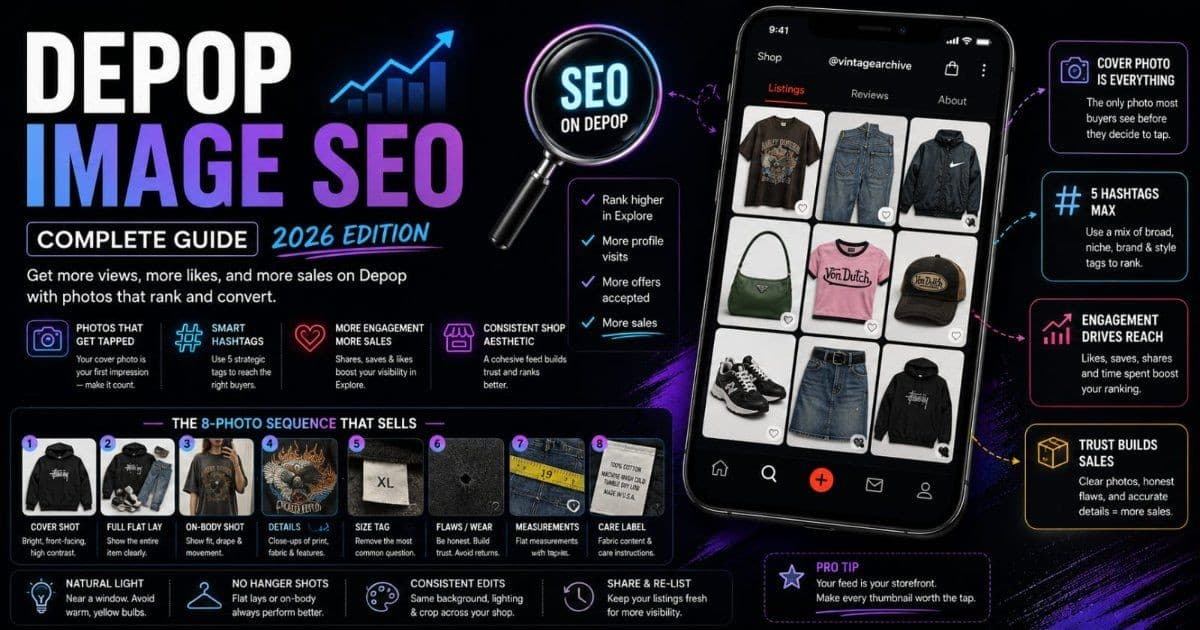
- Use all 8 available photo slots in a tested sequence: cover, flat lay, on-body, detail/flaw, size tag, measurements, care label, and video if the fabric moves or drapes.
- Depop caps hashtags at 5 — mix one broad tag, one niche tag, one brand tag, and one style/aesthetic tag rather than five near-duplicate broad terms.
- Shop-wide visual consistency (same background, same lighting, same edit style) is a real ranking signal Depop's algorithm reads as seller reliability, separate from any single listing's quality.
- Hanger shots, dark bedroom photos, and hidden flaws are the three most common ways good inventory gets buried — all three are fixable without new equipment.
Why Depop Works Differently From Other Marketplaces
Depop is mobile-first, image-first, and built around a scrolling Explore feed rather than a typed search box most buyers actually use. There's no alt text field, no meta description, no keyword-rich product page most buyers ever read closely. The photo isn't supporting the listing — on Depop, the photo functions as the listing.
That's a real shift if you've sold anywhere else. On Etsy or a Shopify store, a strong title and description can partially rescue a mediocre photo. On Depop, a buyer scrolling Explore sees your cover image, and only your cover image, before deciding whether to stop. Captions get read after the tap, not before it.
This isn't a platform quirk to work around — it's the whole game. If you're used to thinking about SEO as words (titles, tags, alt text), Depop asks you to think about SEO as composition: what's in the frame, how it's lit, and whether it reads instantly at thumbnail size.
How Depop Search and Discovery Actually Work
Depop surfaces listings through two channels that feed each other: the Explore feed (algorithmic, engagement-driven) and direct search (keyword and tag-driven). Search reads your title, description, category, subcategory, and brand tag — straightforward keyword matching, not unlike any marketplace. Explore is where photos take over.
Once a listing enters someone's feed, whether they engage with it — a tap, a favorite, time spent on the listing page — feeds back into how often Depop shows that listing again, and to whom. A listing that gets tapped often starts surfacing more broadly; one that gets scrolled past repeatedly quietly stops appearing, regardless of how well-tagged it is.
That means your cover photo's click-through rate isn't just a conversion metric — it's an input to future placement. Two identically tagged, identically categorized listings can end up with wildly different reach purely because one cover photo earns taps and the other doesn't.
The 8-Photo Sequence Top Sellers Actually Use
Depop requires a minimum of 4 photos and allows up to 8. Sellers who stop at 4 are leaving free discovery surface area on the table — each additional photo is another chance to answer a question a buyer would otherwise have to message you about.
Here's the sequence that consistently outperforms a random photo dump, slot by slot:
| Slot | Purpose | |---|---| | 1. Cover | The only image most buyers ever see in Explore — carries all the click-through weight | | 2. Full flat lay or hanging shot | Shows the complete garment, true proportions, no ambiguity about what it is | | 3. On-body or worn shot | Shows fit and drape on an actual body — the detail a flat lay can't convey | | 4. Fabric or design detail | Close-up on print, stitching, hardware, or texture worth zooming into | | 5. Size tag close-up | Removes the single most common pre-sale question on resale platforms | | 6. Flaw or wear documentation | Honest, well-lit shot of any actual flaw — builds trust, reduces returns | | 7. Measurements | Flat measurements with a tape measure, especially for vintage sizing | | 8. Care label | Fabric content and wash instructions, useful for buyers who care about material |
Not every listing needs all 8 in every case, but for vintage and resale specifically — where sizing runs inconsistent and buyers can't try anything on — slots 5 through 8 do real work reducing returns and pre-purchase questions. For a deeper breakdown of why this matters more in resale than new retail, see Image SEO for Vintage and Secondhand Sellers.
Cover Photo Strategy: The Only Photo That Matters in Explore
Your cover photo is the single highest-leverage image you'll shoot for any listing, because it's the only one most buyers ever see before deciding whether to tap through. Everything downstream — the other 7 photos, your description, your hashtags — only gets seen by people your cover photo already convinced.
A few rules hold consistently across sellers who get this right:
Square crop, product filling roughly 80% of the frame. Depop's grid displays a 1:1 crop regardless of what you upload, so shoot or crop for square from the start rather than letting the app guess where to cut your photo.
Clean, consistent background. A cluttered bedroom, a messy floor, or a background that changes wildly listing to listing all cost you recognition speed — the split-second a thumbnail has to register before a thumb keeps scrolling.
Natural light beats a ring light almost every time. Ring lights flatten fabric texture and often shift color slightly warm or cool depending on the bulb. Light from a window, especially indirect daylight, renders both texture and true color more accurately — which matters more on a resale platform than it sounds.
The Depop Aesthetic That Actually Converts
The look that performs best on Depop sits deliberately between two extremes: not eBay-clinical (a plain white background with zero personality), and not Instagram-overproduced (a full studio setup that reads as a retail brand, not a peer seller). Buyers on Depop are shopping peer-to-peer, and photos that look too polished can quietly read as less trustworthy, not more.
Authentic-but-styled is the actual target: a clean, well-lit space with a bit of personality — a consistent backdrop, maybe a plant or a rug in frame, styling choices that feel like a real person's eye rather than a corporate photo studio. Seasonal styling (layering for fall drops, breezier styling for summer pieces) signals an active, attentive shop without requiring new equipment.
Flat lay, on-body, and mannequin each serve a different purpose rather than competing with each other. Flat lays show true proportions cleanly. On-body shows fit and movement. A mannequin sits in between — useful when you want consistent presentation without a model for every single item, though it reads slightly more retail than on-body shots do.
Vintage and Resale Specifics: Honesty as a Ranking Strategy
Documenting wear and flaws honestly isn't just an ethics thing — it measurably reduces returns and the negative reviews that come from a buyer feeling misled. A well-lit close-up of a small stain, a loose thread, or a faded patch, captioned plainly, sets accurate expectations before the sale rather than after a disappointed unboxing.
Size tag close-ups matter more in vintage than in new retail, because vintage sizing runs inconsistent across decades and brands in ways a modern size chart doesn't capture. A photo of the actual tag, paired with a flat measurements shot using a tape measure, answers the question buyers actually have — not "what size is this," but "will this fit me specifically."
Sellers who add a measurements photo consistently report fewer "does this run small?" messages before purchase — the kind of pre-sale friction that costs a sale outright when a buyer doesn't bother asking and just scrolls on instead.
Hashtag SEO for Depop: Making the Most of 5 Tags
Depop caps you at 5 hashtags per listing, which forces real prioritization rather than tag-dumping. The mix that performs best combines four distinct roles rather than five variations on the same idea:
- One broad category tag — something like
#y2kor#streetwear, wide enough to catch general browsing - One niche or micro-trend tag — something more specific like
#y2kbabytee, catching buyers already searching precisely - One brand tag — the actual brand name, for buyers searching that label directly
- One aesthetic or style tag — something like
#coquettecore, tied to a broader style movement your piece fits into - A fifth flexible slot — whichever of the above categories is most relevant to that specific item
Where you place hashtags — in the description itself versus a first comment — matters less than whether your photos actually match the tags you're using. A listing tagged #coquettecore with photos styled nothing like that aesthetic reads as keyword-stuffing to both buyers and, over time, to the engagement signals the algorithm tracks.
Brand and Style Tag Alignment: Photos Have to Match the Words
Depop's discovery system rewards consistency between what you say a piece is and what the photos show it to be. A listing tagged as #grunge needs to look grunge — the styling, lighting, and setting all reinforce the same read a buyer gets from the tags.
This isn't a hard ranking rule Depop publishes anywhere — it's a pattern that shows up in how engagement compounds. A mismatched tag might get an initial click from someone searching that term, but if the photo doesn't deliver on that expectation, they bounce fast, and fast bounces are exactly the kind of engagement signal that works against you over time.
On-Body Shots: Face-In, Face-Out, and Depop's Modeling Culture
On-body photos are one of Depop's defining conventions — sellers modeling their own inventory is normal here in a way it isn't on more clinical resale platforms. Face-in versus face-out is a personal comfort choice, not a ranking factor; plenty of top sellers shoot face-out consistently and do fine.
What does matter is showing the garment on a body close to the size range you're selling, when you can. A buyer shopping a size medium gets far more useful fit information from a medium-framed model than from the same top pinned tightly on a much smaller frame. Where that's not possible, a well-lit flat lay with clear measurements is a legitimate substitute — it's the absence of any fit reference at all that costs you.
Lighting Rules That Actually Work for Vintage
Near a window beats a ring light for almost every vintage and resale use case, mainly because of how each renders color. Ring lights are convenient and consistent, but they can shift a garment's true color warmer or cooler depending on the specific bulb, and vintage buyers are often shopping for a very specific shade.
Avoid warm, yellow-toned indoor bulbs entirely when photographing anything where color accuracy matters — which, in resale, is almost everything. A buyer who receives a garment that reads noticeably different in person than it did in your photos is a buyer likely to open a return, and dye variance between what you shot and what shipped is one of the more preventable causes of bad reviews on the platform.
Shoot near a window during daylight hours when you can, angle the garment to avoid direct harsh sun (which blows out detail the same way a bad flash does), and check your photos against the actual garment in the same light before uploading — not after, when a mismatch is much harder to fix.
The Shop Consistency Ranking Factor
A uniform background, consistent lighting setup, and a repeatable edit style across your whole shop functions as a trust signal that goes beyond any single listing. Depop's feed placement rewards sellers who look active and serious, and visual consistency is one of the fastest ways a shop reads that way at a glance.
This is easy to underrate because it's not something any single listing's engagement metrics directly show you. It shows up over time, in how a browsing buyer's trust builds as they scroll through several of your listings back to back and everything looks like it came from the same careful seller, rather than five different photo sessions with five different vibes.
Picking one backdrop, one general lighting setup, and sticking with it — even loosely — pays off more than chasing a slightly better shot for any individual listing at the cost of shop-wide consistency.
Video Listings: When They Help and What to Show
Add video when a garment's movement, drape, or texture is genuinely part of the sell — flowy fabric, sequins, a slouchy silhouette, anything a static photo undersells. A short clip showing the piece in motion, true color under the same lighting as your stills, closes a gap photos structurally can't.
Video isn't necessary on every listing. A structured, stiff piece like a denim jacket doesn't lose much by staying photo-only. But for anything where "how does this actually move" is the real question a buyer has, a 5-10 second clip answers it faster than a paragraph of description ever could.
Cross-Listing to Poshmark, Vinted, and Etsy
Your cover shot and flat lay generally transfer cleanly across platforms — a clean, well-lit product photo doesn't need to be reshot just because you're listing the same piece on Poshmark or Vinted too. On-body shots transfer less cleanly if the platform's buyer expectations differ; Poshmark's audience skews toward a slightly more polished, retail-adjacent aesthetic than Depop's peer-to-peer feel.
The metadata implications matter more than the photos themselves. Each platform's title, description, category structure, and tag system are separate — a title written for Depop's casual, hashtag-driven format won't automatically read well as an Etsy title or a fashion-ecommerce listing on your own site. For the broader cross-platform picture on fashion image SEO specifically, see Image SEO for Fashion E-commerce.
Off-Depop SEO: Google Indexing and Your Linked Social
Individual Depop listings get indexed by Google inconsistently and often not at all — what tends to show up in a general web search is your shop page, not a specific item, and even that's limited compared to how thoroughly Google indexes a standalone e-commerce site.
That makes your linked Instagram or TikTok a real SEO layer for your Depop shop rather than a separate marketing channel. Content posted there — styled photos, try-on videos, restock announcements — gets indexed and discovered the way individual Depop listings mostly don't, and a well-optimized social profile linking back to your shop becomes the discovery path Depop's own limited Google footprint can't provide on its own.
Common Mistakes That Bury Good Inventory
A handful of avoidable mistakes account for most of the "good stock, no views" problem:
- Dark bedroom photos. Insufficient light is the single most common and most fixable issue — no amount of good styling survives a photo where the buyer can't clearly see the garment.
- Cluttered backgrounds. A busy floor or messy room competes with the product for attention at exactly the size (a small thumbnail) where clarity matters most.
- Hanger shots. Garments photographed still on a hanger consistently underperform flat lays and on-body shots — they show shape poorly and read as the least effort a seller could put in.
- Inconsistent cover styles. Changing your cover photo aesthetic listing to listing undermines the shop-consistency signal covered above, even if each individual photo looks fine on its own.
- Hiding flaws. Omitting a visible flaw doesn't just risk a bad review — it costs future ranking too, since returns and complaints work against the same engagement signals that determine reach.
Measuring What's Actually Working
Depop's own seller insights (available on the paid seller tier) show view counts, favorites, and conversion by listing, which is the most direct read on whether a specific cover photo style is earning clicks. Watching your own Explore feed periodically — searching your own category and seeing whether your listings surface at all — is a rougher but free way to sanity-check visibility.
The most useful pattern to track over time isn't any single listing's performance — it's which cover photo style across your shop tends to accumulate the most saves and favorites relative to views. That comparison, done across a dozen or more listings, tells you more about what your specific audience responds to than any general rule in this guide.
Getting the Fundamentals Right Before You Shoot
Everything above assumes the photo itself is clean, well-lit, and technically sound — the actual file, not just the styling choices around it. If you're batch-processing photos across multiple listings or platforms, getting consistent, well-optimized image files before you upload saves real time over fixing things one listing at a time. ImgSEO handles that layer — clean filenames and metadata across a batch of product photos — for sellers who cross-list beyond Depop and want their image files consistent everywhere they land. For alt text specifically, wherever you do need it (your own site, a cross-listed Etsy shop), How to Write Alt Text for Product Images covers the underlying principles Depop itself doesn't require but other platforms do.
Frequently Asked Questions
Does Depop have alt text? No. Depop has no alt text field anywhere in the listing flow — nothing you type gets attached to an image the way HTML alt text does on a website. The photo itself is the only signal a buyer or the algorithm gets from that image, which is why cover photo composition and thumbnail click-through rate carry the weight alt text would elsewhere.
Why isn't my Depop shop showing up in search? Usually a mix of thin title/description keywords, missing or mismatched hashtags, and a cover photo that isn't earning clicks in the Explore feed. Depop's search and discovery both weight engagement — favorites, clicks, and time-on-listing — so a technically well-tagged item with a weak cover photo still gets buried under items people actually stop to look at.
How many photos should a Depop listing have? Depop allows up to 8 photos per listing and requires a minimum of 4. Use all 8 when you can — a cover shot, a full flat lay or hanging shot, an on-body or worn shot, a fabric or detail close-up, a size tag close-up, a flaw or wear shot if relevant, a measurements photo, and a care label shot round out a complete listing.
How many hashtags can you use on Depop? Depop caps hashtags at 5 per listing. The highest-performing mix combines one broad category tag, one niche or micro-trend tag, one brand tag, and one aesthetic or style tag, leaving a fifth for whichever is most search-relevant to that specific piece rather than padding with near-duplicates.
Should I add video to a Depop listing? Yes, when the garment's movement, drape, or texture is part of the sell — flowy fabric, sequins, a slouchy fit — a short video shows what a static photo can't. Video isn't required on every listing, but items where fit or motion is the main selling point convert noticeably better with one included.
Conclusion
Depop doesn't reward the seller with the best inventory — it rewards the seller whose photos make that inventory obvious in half a second of scrolling. There's no alt text field to fill in, no meta description to optimize. The cover shot, the sequence behind it, and the consistency across your whole shop are the actual SEO layer this platform runs on.
Start with your cover photo: square crop, product filling most of the frame, natural light, a clean and consistent background. Then build out the rest of your 8 slots with intent — flat lay, on-body, details, size, measurements, care label — rather than whatever photos happened to turn out best. Fix the mistakes that quietly bury good stock: bad lighting, hanger shots, hidden flaws, and a shop that looks different listing to listing.
For the fuller picture of how image SEO works across marketplaces beyond Depop specifically, see the Image SEO Guide.