Home decor buyers shop with their eyes before they shop with their wallets. They open Google Images, type "boho bedroom decor" or "minimalist living room accessories," and scroll until something stops them. The product that stops them wins the click — and, more often than not, the sale.
Home decor is well suited to visual discovery because buyers often compare style, scale, color, and room context before they know the exact item they want. Pinterest and Google Images can be discovery channels, but their traffic contribution varies by store and audience.
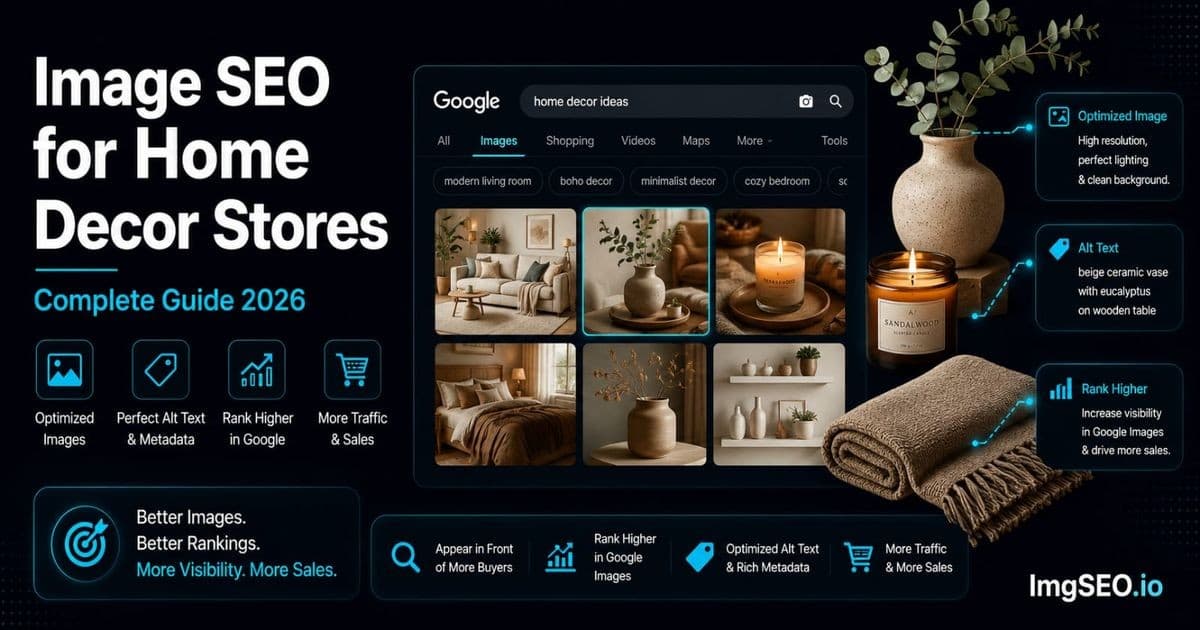
What makes home decor image SEO distinct is the dual role of every image. A ceramic vase needs a white-background shot for search relevance and a styled room shot for conversion. It needs keywords for the object itself (ceramic vase, matte white, 12 inch) and keywords for how buyers find it (minimalist home decor, living room shelf decor, boho ceramics). Combining both layers is what this guide covers.
What you will learn: the photography strategy for home decor, the filename and alt text formulas for wall art, ceramics, candles, and textiles, how to target interior style and room placement keywords, platform-specific implementation for Etsy, Shopify, and WooCommerce, and how to keep your rankings current through seasonal keyword updates.
Key Takeaways
- Every home decor image plays a dual role: a white-background shot for search relevance and a styled room shot for conversion — most sellers only shoot one of the two.
- The alt text formula layers three dimensions — interior style (boho, minimalist, farmhouse), room placement (bedroom, living room), and material or color — since each matches a different buyer search pattern.
- Google Images and Pinterest need different image ratios: a clean square product image indexes best for Google, while a vertical 2:3 styled shot performs best in Pinterest feeds.
Why Home Decor Image SEO Is Different
Style and Aesthetic Searches
Most e-commerce categories have straightforward keyword structures: the buyer knows what the product is and searches for it. Home decor is different because buyers often search by the aesthetic they are trying to create, not the object they need:
- Interior style: "boho bedroom decor," "minimalist living room," "farmhouse kitchen accessories," "coastal bathroom decor," "mid-century modern shelving"
- Color palette: "terracotta home decor," "sage green accessories," "cream and beige living room," "charcoal gray throw blanket"
- Room context: "kitchen wall art," "bathroom shelf decor," "bedroom corner ideas," "home office plant"
A buyer searching "terracotta vase" is describing an object. A buyer searching "terracotta home decor living room" is describing a vision they want to create. Your images need to appear in both searches — and the second search has higher purchase intent because the buyer has already decided on their aesthetic direction.
Use accurate object and style language where it genuinely helps describe the image, including concise alt text and a descriptive filename. Do not stuff every possible attribute into either field or promise rankings for particular queries.
The Inspiration-to-Purchase Journey
The typical home decor buyer's path looks like this: Pinterest → Google Images → product page → purchase. They are browsing for ideas, not actively searching for a specific product. Pinterest surfaces the initial inspiration, they move to Google Images to find something purchasable, and they land on your product page.
This means your images must work in both visual search contexts simultaneously. For Pinterest, vertical 2:3 images with styled room context perform best — they show the product as part of a lifestyle. For Google Images, a clean product-focused image with keyword-aligned alt text performs best — it gives Google enough signal to match the image to a specific query.
The stores that dominate home decor Google Images rankings have both. They use the white-background product shot as the primary indexed image while the styled room shot drives engagement and Pinterest sharing. For a complete guide to Pinterest as a traffic channel, see the Pinterest image SEO guide.
The Scale Challenge
Home decor has a scale problem that jewelry and clothing do not: buyers cannot tell how big something is from a product image alone. A macrame wall hanging that looks statement-sized in the product photo might be only 12 inches wide. A candle that looks substantial could be 4 ounces. The buyer who cannot gauge scale does not buy — or buys, is surprised by the actual size, and returns.
Scale reference images solve this problem and also create additional SEO opportunities. A styled room shot showing a vase on a shelf next to books and a plant gives buyers the size context they need and gives Google the room placement keyword context ("shelf decor," "living room") that pure white-background images lack. Every scale reference image is an additional indexed asset.
Home Decor Photography Best Practices
Shot Types for Home Decor
A complete home decor product listing needs these images to cover both SEO and conversion:
- White background product shot — clean isolation; the primary image for search indexing and platform search results
- Room context/lifestyle shot — shows the piece in a real or styled room; supports room placement and style keywords; drives conversion
- Detail/texture close-up — materials, finish, glaze, weave, grain; supports material keywords and reduces returns by setting accurate expectations
- Scale reference — piece next to familiar objects (books, plant, candle) or with a human element (hand holding, person in room); critical for reducing size-related returns
- Multiple angles — front, side, top-down for flat items like trays and prints; back view for framed art
- Styled vignette — grouped with complementary items to suggest a complete scene; supports "shelf decor," "table centerpiece," and other grouped-use keywords
Each of these shot types supports a different set of search keywords. The white background shot is for the product query; the room lifestyle shot is for the room and style query; the detail shot is for material and finish queries; the scale reference supports dimension-specific searches.
Styling Tips for Room Shots
Room shots are the most influential images for home decor conversion, and they are also the hardest to execute well. A few principles that separate effective room styling from cluttered, confusing shots:
- Choose believable context: real rooms and well-executed composites can both work. Keep scale, lighting, shadows, and included-product details accurate so the scene does not mislead buyers.
- Props should complement, not compete: the product is the subject. Props set context but should be smaller, softer, and more neutral than the piece being sold. A macrame wall hanging does not need a gallery wall behind it.
- Natural light is the right light for home decor: home decor is photographed in the space where it will be used. Natural light from a large window matches that context. Artificial studio lighting can make textiles and ceramics look hard and synthetic.
- Consistent aesthetic across the catalog: buyers who view multiple products from your store should feel a coherent visual identity. Consistent styling signals brand quality and makes collection pages and Pinterest boards cohesive.
Scale Reference Strategy
Scale is best communicated through multiple methods:
- Familiar objects: place the piece next to items whose size everyone knows — a standard novel, a coffee mug, a plant in a common pot size
- Human element: a hand holding a candle, a person reaching up to hang a wall piece — these contextual shots communicate scale instantly
- Dimension callout: a secondary image with the product dimensions overlaid as text is common in home decor and expected by buyers for larger pieces
- Flat lay with ruler: for prints, textiles, and flat items, a flat lay with a fabric tape measure visible gives precise visual scale
Each of these image types generates additional alt text opportunities. "Hand holding 8oz lavender soy candle showing size" is alt text that targets scale-sensitive buyers and supports the "hand poured soy candle" keyword cluster simultaneously.
Home Decor Filenames for SEO
The Home Decor Filename Formula
Home decor filenames need to communicate the item type, the aesthetic style, the color, the material, and the room context — in that priority order:
[item-type]-[style]-[color]-[material]-[room-or-use].jpg
This formula produces readable source filenames that identify the item, style, and material for asset management and page context without promising a ranking effect.
Examples by Product Type
Wall Art
boho-macrame-wall-hanging-large-natural-cotton-bedroom.jpgabstract-canvas-print-modern-living-room-blue.jpgvintage-botanical-art-print-kitchen-green.jpgminimalist-line-art-print-bedroom-black-white-framed.jpgwoven-wall-basket-gallery-wall-natural-rattan-boho.jpg
Vases and Ceramics
handmade-ceramic-vase-minimalist-white-matte-tall.jpgterracotta-clay-pot-succulent-planter-boho.jpgblue-white-porcelain-vase-chinoiserie-vintage-dining-room.jpgspeckled-stoneware-vase-sage-green-handmade.jpgdried-flower-vase-black-ceramic-modern-living-room.jpg
Candles
soy-wax-candle-lavender-scented-8oz-glass-jar.jpgbeeswax-pillar-candle-unscented-natural-rustic-table.jpgconcrete-candle-vessel-minimalist-unscented-home-office.jpgwooden-wick-soy-candle-eucalyptus-amber-jar.jpg
Textiles
hand-woven-throw-blanket-chunky-knit-cream-sofa.jpgmoroccan-cushion-cover-boho-living-room-orange-embroidered.jpglinen-table-runner-natural-farmhouse-dining-table.jpgmacrame-table-runner-boho-wedding-natural-cotton.jpg
Interior Style Keywords in Filenames
Interior style keywords are among the highest-traffic terms in home decor search. Including them in filenames means they appear in the image URL, which Google reads as a relevance signal. The most useful style terms to include:
- Style:
boho,minimalist,farmhouse,mid-century,coastal,scandinavian,industrial,cottagecore - Room:
bedroom,living-room,kitchen,bathroom,home-office,dining-room - Era/trend:
vintage,retro,modern,contemporary,rustic
For guidance on renaming an existing home decor catalog at scale, see the guide on how to fix bad image filenames for SEO.
Alt Text for Home Decor Products
The Home Decor Alt Text Formula
[Style descriptor] + [item type] + [color/material] + [size or dimension] + [room/use context]
The style descriptor leads because home decor buyers filter by aesthetic before they filter by product type. "Boho" before "macrame wall hanging" matches the actual search pattern. Room context closes the alt text because it answers the buyer's implicit question: where does this go?
Examples by Product Type
Wall Art and Prints
- Main (white background): "Large boho macrame wall hanging natural cotton bedroom decor 24x36 inch"
- Detail: "Hand-knotted fringe detail on boho macrame wall hanging natural cotton"
- Room styled: "Macrame wall hanging styled above bed in boho bedroom with warm lighting"
- Scale reference: "Boho macrame wall hanging 24 inch wide shown next to full-size bed for scale"
Vases and Ceramics
- Main: "Handmade ceramic vase minimalist white matte tall 12 inch living room"
- Detail: "Matte white ceramic glaze texture close-up on minimalist handmade vase"
- Styled: "White ceramic vase with dried pampas grass on shelf boho living room decor"
- Top-down: "Top view handmade white ceramic vase opening minimalist"
Candles
- Main: "Soy wax lavender candle 8oz clear glass jar hand poured artisan"
- Lit styled: "Lavender soy candle burning on wooden tray bathroom spa decor"
- Scale: "Hand holding 8oz lavender soy candle showing size glass jar"
Throws and Cushions
- Main: "Chunky knit cream throw blanket handmade wool sofa bedroom cozy"
- Styled: "Cream chunky knit throw draped over gray sofa living room hygge decor"
- Detail: "Chunky knit weave texture close-up cream handmade wool throw blanket"
Style and Room Keywords
Three keyword layers belong in every home decor alt text:
- Interior style — the aesthetic the buyer is curating: "boho," "minimalist," "farmhouse," "coastal." This matches style-driven discovery searches.
- Room placement — where the item lives: "living room," "bedroom shelf," "kitchen windowsill," "bathroom." This matches room-specific searches and supports structured data context.
- Use context — what the item does in the space: "shelf decor," "wall art," "table centerpiece," "sofa throw." This matches use-case searches that buyers type when they know what they need but not what they want.
Combining all three: "Minimalist sage green ceramic planter small succulents desk home office shelf decor" covers style (minimalist), color (sage green), material (ceramic), use (planter, succulents), placement (desk, home office), and use context (shelf decor).
For a complete guide to alt text strategy, see what is alt text: the complete guide.
Metadata for Home Decor Images
Home Decor Keyword Strategy
EXIF and XMP can hold descriptive or rights-related source-asset information, but they should not be used as a hidden keyword matrix or treated as a documented Google ranking input. For home decor, useful buyer-facing descriptors include:
- Style: boho, bohemian, minimalist, farmhouse, mid-century modern, coastal, Scandinavian, hygge, quiet luxury, cottagecore, industrial
- Room: living room, bedroom, kitchen, bathroom, dining room, home office, entryway, nursery
- Material: ceramic, stoneware, terracotta, wood, rattan, cotton, linen, wool, jute, bamboo, concrete
- Color trend: terracotta, sage green, dusty pink, cream, charcoal, warm white, forest green, rust, ochre
- Season/occasion: spring decor, fall decor, Christmas decor, hygge, cozy home, holiday decorating
Color trend keywords are especially valuable because they change annually and most sellers are slow to update. "Sage green home decor" was a rising keyword in 2023 that peaked in 2024. "Warm cream minimalist" is growing in 2026. Including current color trend terms in metadata puts you ahead of sellers who optimized their listings a year ago and have not updated since.
EXIF and XMP Fields for Home Decor
The fields that matter for home decor images:
- Title: the full product name with primary keyword. Example: "Handmade Boho Macrame Wall Hanging Large Natural Cotton"
- Description: a phrase equivalent to your alt text, including room context. Example: "Large handmade boho macrame wall hanging in natural cotton, 24x36 inch, bedroom or living room wall decor."
- Keywords: the full comma-separated keyword array — item type, style, room, material, color, occasion. Example:
macrame, wall hanging, boho decor, bedroom, natural cotton, handmade, wall art, living room, bohemian, fiber art
ImgSEO generates and embeds these fields automatically from your product name, producing a renamed, metadata-optimized file ready for any platform.
For full implementation details on metadata tools and field formats, see the guide on how to add metadata to product images.
Platform-Specific Home Decor Image SEO
Etsy Home Decor
Etsy is the top platform for handmade and artisan home decor — and one of the most Google-indexed storefronts on the internet. Etsy listings for home decor rank well in Google search organically, which means your Etsy image optimization and your Google Images optimization share the same URL.
Key Etsy-specific considerations:
- Lifestyle room shots perform exceptionally well on Etsy: unlike jewelry and clothing where white backgrounds often lead, home decor buyers on Etsy respond strongly to styled room images because they are buying a vision, not just an object. Test a styled room shot as the main listing image alongside the clean product shot.
- Pinterest-oriented creative: a vertical room image can suit Pinterest's feed, but current specifications and account results should determine the format. It does not guarantee a higher click-through rate.
- Seasonal refreshes: Etsy rewards listing activity. Refreshing your listing images seasonally — adding a spring styling shot in March, a cozy fall shot in September, a holiday arrangement in November — keeps listings active and adds seasonal keyword context to your image set.
- Tags: use the currently available tags for accurate style, room, and material phrases. Avoid filler and verify current marketplace limits rather than assuming one phrase always outperforms another.
For a complete Etsy-specific optimization guide, see Etsy image SEO.
Shopify Home Decor Stores
Shopify's image architecture suits home decor stores that sell across multiple aesthetic collections.
- Main image: use the clean white-background or neutral-background product shot as the primary image. This is the image that appears in search results and collection grids — it needs to communicate the product clearly and quickly.
- Secondary image slots: the room lifestyle shot, detail/texture shot, and scale reference all go here. Shopify allows multiple images per product; use all of them.
- Collections: create collections for genuine aesthetic categories such as "Boho Home Decor" or "Coastal Living." Give each useful header image accurate alt text and supporting page copy; indexability and ranking still depend on the page and site as a whole.
- Collection image alt text: "Boho home decor collection — wall hangings, ceramics, and textiles in natural tones" gives Google context for the collection page and supports style category rankings.
For full Shopify image optimization, see the Shopify image SEO guide.
WooCommerce Home Decor Stores
WooCommerce gives home decor stores complete control over their image metadata pipeline — more than either Shopify or Etsy — which is an advantage if you use it.
- Metadata is pipeline-dependent: WordPress, plugins, CDNs, and generated image sizes can handle embedded fields differently. Verify the served derivative if retention matters. Use WordPress alt text and relevant product-page content instead of relying on EXIF or XMP.
- Category pages: WooCommerce category pages (the equivalent of Shopify collections) can have header images with alt text. Add them. "Boho home decor — handmade macrame, ceramics, and textiles" as a category image alt text contributes to category-level search rankings.
- Product gallery: every gallery image on a WooCommerce product page has an alt text field. The room lifestyle shots, detail shots, and scale reference images all deserve individual, keyword-specific alt text — not the same alt text copy-pasted across every image.
For WooCommerce-specific implementation in depth, see the WooCommerce image SEO guide.
Google Images and Pinterest Strategy for Home Decor
Google Images Keywords That Work
Home decor Google Images queries follow predictable patterns that your optimization strategy should address explicitly:
| Query pattern | Example | |---|---| | [style] + [item] + [room] | "boho macrame wall hanging bedroom" | | [color] + [item] + home decor | "terracotta vase home decor" | | [material] + [item] | "handmade ceramic plant pot" | | [room] + [item] + [style] | "living room shelf decor minimalist" | | [season] + [decor type] | "fall home decor cozy" | | [trend aesthetic] + [item] | "quiet luxury candle home" |
Work through your top-selling pieces and verify that each one has alt text targeting at least two of these patterns — the primary product description pattern and at least one style or room placement pattern.
Pinterest as a Traffic Driver
Home decor is Pinterest's single strongest category. Buyers use Pinterest boards as mood boards for rooms they are designing, which means a well-optimized home decor image pinned to a popular board generates ongoing referral traffic for months after it is first posted.
Optimizing for Pinterest alongside Google Images:
- 2:3 ratio as the standard: create or crop your room lifestyle shots to 2:3 vertical (1000×1500px or 1500×2250px). These take up double the feed space of square images.
- Rich Pins for product: Rich Pins pull the product name, price, and availability from your product page and display it on the pin. Shopify supports Rich Pins natively through its Pinterest app. WooCommerce requires Open Graph markup from Yoast SEO or a dedicated plugin.
- Board name optimization: if you manage a Pinterest business account, board names like "Boho Living Room Ideas," "Minimalist Home Decor," and "Farmhouse Kitchen Inspiration" are searchable terms on Pinterest. They drive board-level traffic that flows to the individual pins within them.
- Pin descriptions: mirror your alt text keywords in pin descriptions. "Handmade boho macrame wall hanging in natural cotton — perfect for above-bed wall decor or gallery wall" is a strong pin description that reinforces both the Pinterest algorithm and drives click-through.
For a full Pinterest image SEO guide, see the Pinterest image SEO guide.
Seasonal Content Strategy
Home decor search behavior shifts dramatically by season. A throw blanket searches "cozy" in October; a terracotta pot searches "spring garden" in March. Seasonal keyword updates are not optional maintenance for home decor — they are a significant ranking opportunity that sellers who do not update forfeit to those who do.
A practical seasonal calendar:
- Spring (March–May): fresh florals, pastels, garden decor, spring cleaning, light and airy. Keywords: "spring home decor," "floral vase," "pastel throw," "garden planter."
- Summer (June–August): outdoor living, coastal, light textiles, entertaining. Keywords: "summer home decor," "outdoor candle," "coastal vase," "linen throw blanket summer."
- Fall (September–November): warm tones, hygge, cozy, harvest. Keywords: "fall home decor," "hygge candle," "chunky knit throw autumn," "terracotta fall."
- Winter/Holiday (November–January): Christmas, advent, festive, winter. Keywords: "Christmas home decor," "advent candle," "holiday throw blanket," "cozy winter decor."
The update process is lightweight: add the season to your metadata keywords and update the alt text on your most seasonally relevant images. You do not need new photography — the same ceramic vase can have "spring shelf decor" metadata in March and "hygge home decor" metadata in October.
Image Compression for Home Decor
Home Decor Compression Settings
Room lifestyle shots present a specific compression challenge: they are larger files (more pixels, more color variation) and they contain the texture details — fabric weave, ceramic glaze, wood grain — that buyers are evaluating when they decide to purchase. Compressing too aggressively destroys the detail that justifies the price.
Recommended settings for home decor images:
- Room lifestyle shots: compare exports around gradients, plants, shadows, and fine furnishings; scene complexity changes compression behavior.
- Product-focused shots: simple backgrounds may compress efficiently, but retain clean edges and accurate finish.
- Detail and texture close-ups: preserve glaze, weave, grain, or surface detail. Choose settings by visual inspection rather than a universal percentage or kilobyte target.
- Format preference: WebP preserves texture detail better than JPEG at equivalent file sizes. Shopify serves WebP automatically. For WooCommerce, WebP conversion at upload is handled by ShortPixel, Imagify, or similar image optimization plugins.
For full compression methodology and format comparisons, see the image compression guide for e-commerce.
Home Decor Image SEO Checklist
Use this against every new product listing before it goes live:
- ✅ Clean white or neutral-background product shot as the primary image
- ✅ Room lifestyle shot included in secondary image slots
- ✅ Scale reference image included (next to familiar objects or with human element)
- ✅ Filename follows the pattern: item-type + style + color + material + room
- ✅ Alt text includes style descriptor, item type, and room placement keyword
- ✅ EXIF/XMP metadata keywords include interior style, room, material, and color trend
- ✅ Images shot or cropped to vertical 2:3 ratio for Pinterest
- ✅ Seasonal metadata keywords updated quarterly
- ✅ Detail/texture close-up included for material-sensitive products
- ✅ Exports visually checked at the dimensions the storefront actually serves
FAQ
What is the best alt text for home decor products? Use the formula: style descriptor + item type + color/material + size or dimension + room/use context. Example: "Large boho macrame wall hanging natural cotton bedroom decor 24x36 inch." Cover the aesthetic style (boho), the object (macrame wall hanging), the material (natural cotton), and the room context (bedroom decor). This matches both object-specific and style-driven searches.
Should home decor main image be white background or room shot? Use a product-focused image where it helps identify the item and a room image where context, scale, or styling matters. Follow marketplace requirements and test the order with your audience.
What keywords work best for home decor image SEO? Combine three keyword layers: interior style (boho, minimalist, farmhouse), room placement (living room, bedroom, kitchen), and material/color (ceramic, terracotta, sage green). Style keywords match how buyers discover; room keywords match where buyers are decorating; material and color keywords match buyers who have a specific look in mind. Use all three in every alt text.
How do I optimize for Pinterest and Google Images simultaneously? Use a vertical 2:3 room lifestyle image as your styled shot and a clean product image as your primary indexed image. The 2:3 image performs in Pinterest feeds; the clean product image performs in Google Image search thumbnails. Enable Rich Pins on your platform so product data displays on pins. Mirror your alt text keywords in pin descriptions.
What image size is best for home decor on Etsy? Etsy recommends a minimum of 2000px on the longest side. For vertical Pinterest-optimized images, 1500×2250px (2:3 ratio) at 85% JPEG or WebP quality hits the resolution target without creating oversized files. For square product images, 2000×2000px is the standard.
How do I handle seasonal keyword updates for home decor? Update EXIF/XMP metadata keywords and alt text on your most seasonally relevant products at the start of each season. Four updates per year covers the major shifts. You do not need new photography — add "fall home decor," "cozy autumn," and "hygge" to a throw blanket's metadata in September, and swap to "spring refresh" and "light living room" in March.
Does interior style keyword matter for image SEO? Yes, significantly. "Ceramic vase" is searched by a small number of buyers. "Boho ceramic vase living room" is searched by buyers who have decided on their aesthetic and are actively shopping to complete a room. Style keywords narrow your competition (you are no longer competing against every ceramics seller) and increase purchase intent (the buyer already knows what they want the room to look like).
How many images should home decor products have? Six images minimum for full SEO and conversion coverage: white background product shot, room lifestyle shot, detail/texture close-up, scale reference, at least one additional angle, and a styled vignette with complementary items. Etsy allows up to 10 — use them all. More images mean more indexed assets, more keyword coverage, and higher buyer confidence leading to fewer returns.
Conclusion
Home decor image SEO rewards two things above all else: visual context and keyword specificity. A white-background product shot gets you into search results. A styled room shot keeps buyers on the page long enough to convert. Together they are not just better than either alone — they target different stages of the buyer's journey and different search intents.
The keyword formula is consistent: style descriptor (boho, minimalist, farmhouse) + item type + color and material + room placement. That combination covers both the object-level search ("ceramic vase white matte") and the aesthetic-level search ("minimalist living room decor") that home decor buyers use interchangeably.
Review seasonal merchandising when products, imagery, or buyer language changes. Update visible copy and image fields only when the new wording remains accurate, then measure results rather than assuming a compounding ranking benefit.
ImgSEO generates home decor-aware alt text and embeds EXIF/XMP metadata automatically. Upload your product image, provide the name, and it outputs a renamed, metadata-optimized file with keyword suggestions ready for Etsy, Shopify, or WooCommerce. Try it free — 30 images, no card required.
For a broader e-commerce image strategy that applies across all product categories, see the e-commerce image SEO strategy guide.