Most e-commerce sellers optimize their product titles and meta descriptions, then upload whatever image files came off the camera. That leaves roughly 80% of image SEO opportunity on the table. Google Images drives billions of product discovery clicks every month. If your images are not set up to capture any of that traffic, you are handing those clicks to competitors who did the work.
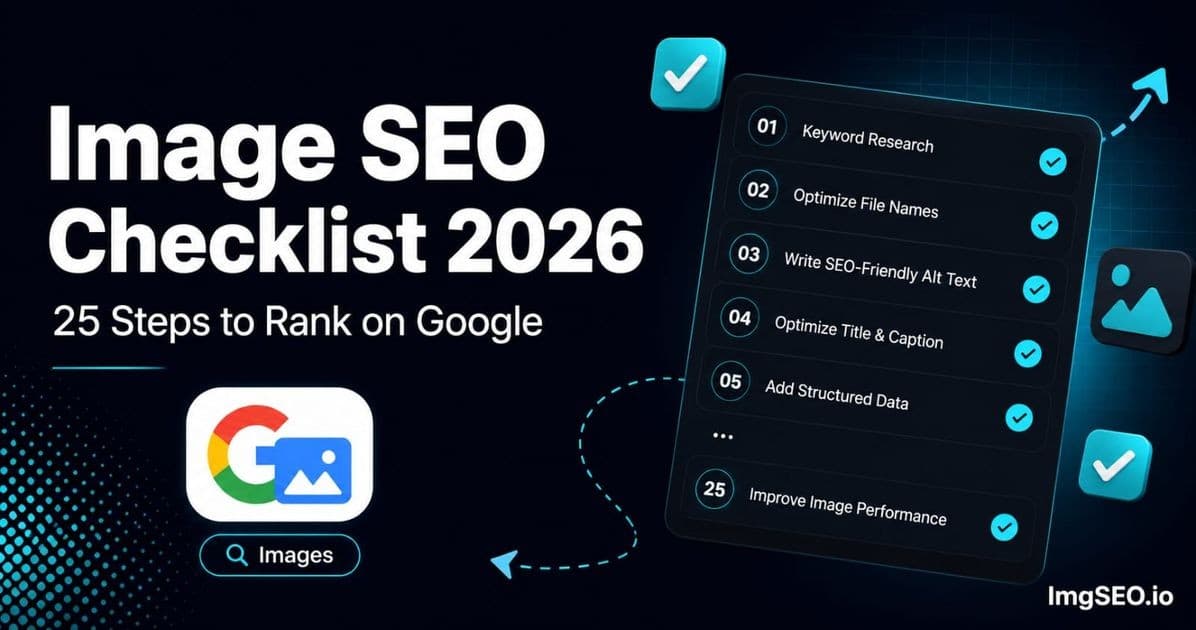
This checklist covers every image SEO lever available to you — from file format choices before you upload to monthly maintenance tasks that keep your rankings healthy. Work through it once on your existing catalog, then run items 1–8 on every new product you add.
Key Takeaways
- 25 steps total, split into before-upload, after-upload, platform-specific, advanced, and monthly maintenance sections — items 1–8 are the core foundation to run on every image.
- Export each image at the dimensions the page serves, write concise contextual alt text, and use a readable descriptive filename before upload where practical.
- Manual image SEO takes 10–15 minutes per product; a tool like ImgSEO cuts compression, metadata, and alt text generation down to under a minute per image.
Before You Upload: Technical Foundation
Set source filenames and export settings before upload where practical. If an established public URL must change, update references and preserve redirects where the stack supports them.
1. Choose the Right Format
Format selection is a ranking factor because page speed is a ranking factor, and the wrong format can add hundreds of kilobytes to every page load.
- New product photos: WebP — 25–35% smaller than JPEG at equivalent quality
- Photos on platforms without modern-format support: use JPEG and choose quality by comparing the actual rendered result
- Logos, icons, anything with transparency: PNG or WebP with alpha
For a full breakdown of when each format wins, see the WebP vs JPEG vs PNG guide for e-commerce.
2. Resize to the Correct Dimensions
Uploading a 4000×3000px raw file and letting the browser scale it down wastes bandwidth on every page load and slows your Largest Contentful Paint score.
| Use case | Target dimensions | |---|---| | Product images | 1200×1200px minimum | | Hero / lifestyle | 1920×1080px | | Thumbnails | 400×400px |
Never upload raw camera files. A typical DSLR raw file is 20–30MB; even after JPEG conversion it lands at 6–10MB. Resize first, then compress.
3. Compress the Image
Use the smallest file that preserves necessary detail at the dimensions the page serves. Product complexity and display size make a universal kilobyte target unreliable.
Compare the export with the master at normal and zoomed display sizes. Adjust the encoder until detail, edges, gradients, and text remain acceptable; quality scales differ between encoders.
The image compression guide for e-commerce covers tools and workflows for batch compression at scale.
4. Create an SEO-Friendly Filename
The filename is the first SEO signal Google reads for an image. Most sellers upload files named IMG_4521.jpg. That tells Google nothing.
Formula: [product]-[color]-[material]-[feature].ext
Examples:
mens-leather-wallet-brown-bifold.jpgwomens-gold-hoop-earrings-18k.webpblue-ceramic-pour-over-coffee-dripper.webp
Rules: hyphens between words, all lowercase, no spaces, no underscores, no special characters. Keep it under 60 characters.
Platforms handle filenames differently. Shopify keeps the filename you upload. Etsy renames files internally but uses your product title for SEO. More detail in the bad image filename fix guide.
5. Add EXIF Metadata (JPEG)
EXIF metadata is embedded directly in compatible image files. It can support asset management and rights information, but it is not a substitute for page-level alt text and is not a documented standalone Google ranking factor.
For product images, fill in:
- XPTitle: your product SEO title (brand + product type + key feature)
- ImageDescription: the alt text you plan to use on the page
- XPKeywords: 5–10 relevant keywords, semicolon-separated
- Copyright: your brand name and year
6. Add XMP Metadata (All Formats)
XMP is the more modern metadata standard and works across JPEG, WebP, and AVIF. If you are using WebP (and you should be), XMP is what you need.
Map your product data to these XMP fields:
- dc:title — same as your EXIF title
- dc:description — product description or alt text
- dc:subject — keyword array
- dc:rights — copyright
The complete guide to adding metadata to product images walks through exactly how to populate these fields manually and automatically.
7. Add Metadata Before Compression
Image tools vary: re-encoding or optimization may preserve, rewrite, or remove embedded metadata. If file-level metadata matters to your workflow, inspect the final exported asset instead of assuming a particular order guarantees preservation.
Correct order: resize → add metadata → compress.
Or skip the sequencing problem entirely: ImgSEO compresses, adds EXIF and XMP metadata, and generates alt text in a single step.
After Upload: Store Optimization
Once the image is in your store, these on-page signals determine how Google interprets and ranks it.
8. Add Alt Text to Every Image
Alt text primarily supports accessibility and can help search engines understand an image in its page context. Write it for meaningful images without treating it as a guaranteed ranking control.
Guidelines:
- Describe what is actually in the image
- Include your primary keyword naturally — do not force it
- Keep it under 125 characters
- Write unique alt text for every image, including secondary product photos
For everything you need to know about writing effective alt text, the complete alt text guide for 2026 covers it end to end.
9. Avoid These Alt Text Mistakes
Knowing what not to do is as important as the positive guidelines.
- No "image of" or "photo of" — Google already knows it is an image
- No keyword stuffing — "brown leather wallet mens wallet bifold wallet RFID wallet" is a spam signal, not an SEO signal
- No empty alt text on product images — empty alt is correct only for decorative images
- No duplicate alt text across multiple images of the same product — each angle, color, and detail shot deserves its own description
10. Optimize the Product Title
Your product title feeds into image SEO on every platform:
- Shopify: the product title influences the URL slug that your image sits on
- WooCommerce: the title is indexed alongside the image and influences contextual relevance
- Amazon: the product title is used as the alt text for your main image
Formula: [Brand] + [Product Type] + [Key Feature] + [Color/Material/Size]
Keep it descriptive. Avoid vague titles like "Premium Watch" — "Minimalist Stainless Steel Men's Watch 40mm Black Dial" tells Google exactly what to rank the image for.
11. Use All Available Image Slots
Every image slot on your product page is a separate SEO opportunity. Each image can rank independently in Google Images.
| Platform | Max images | |---|---| | Shopify | 250 per product | | Etsy | 10 per listing | | Amazon | 9 per ASIN | | WooCommerce | Unlimited |
Most sellers use 2–3 images on products that allow 9 or 10. That is 6–7 missed ranking opportunities per product.
12. Optimize Your First/Main Image
The main product image carries the most weight for click-through rate in search results. It is also the image Google most often uses as the representative thumbnail.
- Product fills 85% or more of the frame
- Clean background (white or light neutral for most categories)
- High contrast between product and background
- Vertical 2:3 ratio — performs best on mobile and in Pinterest search
13. Add Lifestyle Images
Lifestyle images — product in use, in context, in a real environment — help Google understand what the product is for. A coffee mug photographed in a kitchen with morning light tells Google more than a white-background studio shot.
Lifestyle images can demonstrate use and scale. Whether they improve conversion depends on the product and audience, and marketplace ranking effects should not be assumed.
14. Add Detail and Close-up Images
Detail shots showing materials, textures, stitching, hardware, or unique features give Google additional indexable images with distinct visual content. Write specific alt text for each one: "hand-stitched brown leather edge detail" is more valuable than "wallet detail".
Platform-Specific Checklist
Each platform has its own image SEO behavior. Use the relevant section for your store.
Shopify
- ✅ Descriptive source filename set before upload; verify the final Shopify URL and delivered asset
- ✅ Alt text added in the product editor for every image
- ✅ Product title is keyword-optimized (feeds the URL and page context)
- ✅ All available image slots used
For the full Shopify image SEO workflow, see the Shopify SEO guide.
Etsy
- ✅ Alt text added — Etsy calls the field "Describe this photo"
- ✅ First image optimized for thumbnail CTR in search results
- ✅ All 10 image slots used
- ✅ Images shot in vertical 2:3 ratio for Pinterest traffic
Etsy pulls heavy traffic from Pinterest, where vertical images dominate. Shooting in portrait orientation from the start saves a crop later.
See the Etsy SEO guide for listing-level optimization beyond images.
WooCommerce
- ✅ Descriptive filename set before upload; verify the final WordPress media URL
- ✅ Alt text added in the media library (propagates to product pages)
- ✅ WebP format enabled — WordPress 5.8+ supports WebP natively
- ✅ WordPress alt text and product-page context reviewed; optional file metadata verified separately if retention matters
For the full WooCommerce optimization workflow, see the WooCommerce image SEO guide.
Amazon
- ✅ Main image: white background, product fills 85% of frame (Amazon requirement)
- ✅ All 9 image slots used
- ✅ Product title optimized — Amazon uses it as the alt text for your images
- ✅ Metadata added to image files before upload
Amazon is the exception where you have less direct control over alt text. Optimizing the product title and using all image slots are the primary levers.
For a full guide, see the Amazon product image SEO guide.
Advanced Optimization
Once the fundamentals are in place, these technical improvements compound your results over time.
15. Create an Image Sitemap
An image sitemap tells Google about every product image on your site, including images that are embedded in JavaScript or loaded dynamically that Google's crawler might miss.
Each entry should include:
image:loc— full image URLimage:title— product titleimage:caption— brief descriptionimage:geo_location— country or region if relevant
Submit the sitemap through Google Search Console. Shopify and most WooCommerce SEO plugins generate image sitemaps automatically.
16. Enable Lazy Loading
Lazy loading defers off-screen images from loading until the user scrolls toward them. This improves initial page load time and Core Web Vitals scores without changing how images look or rank.
- WordPress / WooCommerce: enabled by default since WordPress 5.5
- Shopify: handled automatically by the platform
- Custom builds: add
loading="lazy"to<img>tags below the fold
Do not lazy-load your main product image or hero image — those are likely your LCP element and should load immediately.
17. Use a CDN
A content delivery network serves images from servers geographically close to each visitor, reducing load time globally.
- Shopify and Etsy: CDN is included automatically
- WooCommerce: use Cloudflare (free tier covers most stores) or a dedicated image CDN like Cloudinary
18. Add Structured Data (Schema Markup)
Product schema markup explicitly tells Google the relationship between your page content and your images. The image property in Product schema can reference multiple images, each of which may be used for rich results.
Shopify and WooCommerce with Yoast SEO or RankMath generate basic product schema automatically. Check that the image property is populated.
19. Monitor in Google Search Console
Search Console shows you exactly how your images are performing in Google search.
Navigate to Performance → Search type: Image. You will see:
- Total impressions for images across your site
- Which queries trigger your images
- Average position for image results
Check this monthly. Images with high impressions but low position are candidates for alt text and metadata improvements.
20. Check Core Web Vitals
Core Web Vitals are a confirmed Google ranking factor. Your hero image is almost always your Largest Contentful Paint element — the one Google measures.
- LCP target: under 2.5 seconds
- Check: run PageSpeed Insights on your most important product pages
- Common fixes: compress the hero image, add
fetchpriority="high"to the LCP image, serve WebP
Monthly Maintenance Checklist
Image SEO is not a one-time setup. These monthly tasks keep rankings healthy as your catalog grows.
21. Audit New Products
Every new product added without proper image SEO is a missed opportunity that compounds over time. Set aside 30 minutes after each product upload batch to verify:
- Filenames are descriptive
- Alt text is complete
- Metadata is present
- All image slots are used
ImgSEO can process a batch of new product images — compression, metadata, alt text — in the time it takes to write this list manually.
22. Check Search Console for Image Impressions
Pull the image performance report monthly. Look for:
- Images with zero impressions — check their alt text and metadata
- Images with rising impressions — double down on similar products
- Queries you are ranking for but not targeting intentionally — update alt text and titles to match
23. Update Seasonal Images
Holiday products, seasonal collections, and time-sensitive inventory should have metadata and alt text refreshed to match seasonal search demand. "Christmas tree ornament set" ranks for different queries in October versus December.
24. Fix Broken Images
Broken image URLs harm users and prevent crawlers from fetching the asset. Monitor crawl and indexing reports, then restore the asset or update references and redirects as appropriate.
25. Run PageSpeed Test Monthly
Visit pagespeed.web.dev and test your top 5 product pages monthly. Target LCP under 2.5 seconds. Track your score over time — a sudden drop often indicates a new image was uploaded unoptimized or a design change introduced a new LCP element.
Complete 25-Step Checklist Summary
Print this or bookmark it. Run it on every product.
Before Upload
- ✅ Choose correct format (WebP for new products, JPEG for legacy platforms)
- ✅ Resize to correct dimensions (1200×1200 minimum for products)
- ✅ Compare the final export at its actual served size
- ✅ SEO-friendly filename using hyphens and keywords
- ✅ EXIF metadata populated (title, description, keywords, copyright)
- ✅ XMP metadata populated (dc:title, dc:description, dc:subject, dc:rights)
- ✅ Metadata added before compression, not after
After Upload
- ✅ Alt text on every image — descriptive, keyword-natural, under 125 characters
- ✅ No alt text mistakes (no "image of", no stuffing, no duplicates)
- ✅ Product title optimized with brand + type + features
- ✅ All available image slots used
- ✅ Main image optimized for CTR (fills frame, clean background)
- ✅ Lifestyle images added showing product in use
- ✅ Detail/close-up images added with unique alt text
Platform-Specific
- ✅ Shopify: filename + alt text + all image slots
- ✅ Etsy: "describe this photo" field + vertical ratio + all 10 slots
- ✅ WooCommerce: media library alt text reviewed + efficient image delivery verified
- ✅ Amazon: white background + all 9 slots + title optimized
Advanced
- ✅ Image sitemap submitted to Google Search Console
- ✅ Lazy loading enabled for below-fold images
- ✅ CDN configured
- ✅ Product schema markup includes image property
Monthly
- ✅ New products audited against this checklist
- ✅ Broken images fixed or redirected
- ✅ PageSpeed tested on top product pages
Frequently Asked Questions
How often should I run this checklist?
Items 1–14 should run on every new product before it goes live. The monthly maintenance section (items 23–25) runs once a month. The advanced section is a one-time setup that you revisit only when you make significant site changes.
Which checklist item has the biggest SEO impact?
Accurate alt text and descriptive filenames are useful places to start, alongside relevant page context, crawlability, and efficient delivery. Crawl, indexing, and ranking timing varies, so do not promise movement within a fixed window.
Do I need to do all 25 steps for every image?
No. Items 1–8 are the core foundation — do those for every image. Items 9–14 add significant value with moderate effort. Items 15–22 are advanced and can be done once across your whole store rather than per-image.
How long does image SEO take per product?
Manually: 10–15 minutes per product when you include renaming, compression, metadata, and alt text. With a tool like ImgSEO: under a minute for compression, metadata, and alt text generation together.
Can I automate any of these steps?
Yes. Compression (item 3), filename sanitization (item 4), EXIF metadata (item 5), XMP metadata (item 6), and alt text generation (item 8) can all be automated. ImgSEO handles all five in a single upload step. Items that require human judgment — product title optimization, choosing which lifestyle scenes to shoot, writing schema markup — still need your input.
Conclusion
Image SEO is a system, not a one-time task. The sellers who win Google Images traffic are not doing anything exotic — they are consistently applying a checklist like this one to every product, every month.
If you are starting from scratch, begin with items 1–8. Those eight steps alone will put your store ahead of most competitors in your category. Then layer in the platform-specific requirements, the advanced technical setup, and the monthly maintenance as you have capacity.
The e-commerce image SEO strategy guide goes deeper on the broader strategy behind these tactics — why each item matters, how they interact, and how to prioritize when you have a large existing catalog.
Ready to automate the most time-consuming steps? Try ImgSEO free — 30 images, no credit card required. Compression, EXIF metadata, XMP metadata, and AI-generated alt text in one click, per image.