Most sellers open their Etsy shop the same way: they pick a shop name, upload a few product photos, write quick titles, and hit publish. Then they wait for sales that never come and wonder what they did wrong.
What they skipped was the SEO foundation. And setting up SEO correctly from day one is not just a minor improvement — it is the difference between a shop that compounds traffic over months and one that stays invisible while paying for ads just to break even.
This checklist covers everything: shop profile, listing SEO, image SEO, and external Google setup. Work through it once, in order, before you publish your first listing. The hour you invest now is worth months of trying to fix a poorly set-up shop later.
Key Takeaways
- A thorough first-time SEO setup — shop profile, policies, titles, tags, image filenames, alt text, and metadata — takes most new sellers 4–8 hours; each listing takes 20–30 minutes to fully optimize.
- Free shipping is a confirmed Etsy ranking factor — Etsy gives search priority to listings offering it, so use the $35+ free-shipping guarantee threshold if flat free shipping isn't sustainable.
- Open with at least 10–15 fully optimized listings before considering the shop launched; each listing is an independent entry point into both Etsy search and Google Images.
Part 1: Shop Profile Setup
Your shop profile is the foundation that everything else sits on. Etsy uses profile completeness as a quality signal — a fully set-up shop gets better default placement than a half-finished one, especially before you have reviews to compensate.
Shop Name
Your shop name is permanent once set, so choose deliberately. A shop name that includes a relevant keyword — "SilverLeafJewelry" or "CedarCandleCo" — provides a small SEO benefit because it appears in your shop URL and page title. But do not sacrifice memorability for keyword cramming. A name that buyers can remember and search for directly is worth more long-term than a keyword-stuffed name nobody recalls.
Before finalizing, check that the same name is available on Instagram and Pinterest. You want consistent handles across platforms to build a recognizable brand presence.
Shop Icon and Banner
Your shop icon appears everywhere your shop name appears across Etsy — search results, buyer receipts, your shop page. Use a clean 500×500px image: a professional product photo, a simple logo, or a clear face photo if you sell as a maker. Blurry or pixelated icons signal an amateur shop before a buyer has read a single word.
Your banner is 3360×840px and is the first visual impression on your shop homepage. Use it to show your best products in a styled arrangement. It does not directly affect Etsy search ranking, but it strongly affects whether a buyer who lands on your shop stays or leaves.
Shop Title (Tagline)
You have 55 characters for your shop tagline. Use them for keywords, not personality. Write what you sell and who it is for in plain language.
Good: "Handmade Sterling Silver Jewelry for Minimalist Women"
Not useful: "Creating with love since 2024 ✨"
The tagline appears on your shop page and contributes to the keyword context Etsy and Google use to understand what your shop sells.
About Section
Write at least 100 words. Etsy explicitly rewards complete About sections with better shop completeness scores, and completeness affects search visibility for new shops.
Include: your story and how you started, your craft and process, the materials you use, and what makes your products worth buying. Write naturally — keywords that describe your work will appear organically without forcing them.
Add 3–5 behind-the-scenes photos. Buyers who read your About section are already interested — give them a reason to trust you with a purchase.
Shop Policies
Fill in every policy section: processing time, shipping methods, returns and exchanges, and payment. Incomplete policies are a red flag for buyers and a completeness penalty from Etsy's algorithm.
Accurate processing times matter doubly: they set buyer expectations correctly (reducing disputes) and feed into Etsy's on-time shipping metric, which affects your Star Seller status and search ranking over time.
Part 2: Listing SEO Setup
Title Optimization
Etsy gives the most weight to the first 40 characters of your listing title. That opening phrase is where your primary keyword must live — the exact phrase a buyer types into Etsy's search bar.
The full title formula: primary keyword + material + style + occasion
You have 140 characters. Use them. A title like "Sterling Silver Minimalist Ring Women — Hammered Band Adjustable Size Stacking Gift for Her" uses the space well. A title like "My Beautiful Ring ✨ Handmade" wastes it entirely.
For a complete title optimization guide, see our article on how to write Etsy titles that rank.
Tags (All 13)
Every listing gets 13 tag slots. Every slot must be filled, every time, with no exceptions. Each tag is an additional search phrase your listing can appear in. An empty tag is a search you cannot appear in.
Rules for effective tags:
- Use phrases, not single words. "gift for her" outperforms "gift" by a wide margin because buyers search phrases.
- Cover different angles: product type, material, style, occasion, recipient, color, use case.
- Do not repeat your title keywords verbatim — use your tags to capture searches your title does not already cover.
For a complete tags strategy, see our guide on how to use Etsy tags for maximum SEO.
Description
Google shows your first 160 characters in search results when your Etsy listing appears on Google. That first sentence is your Google preview, and it needs to start with your primary keyword.
Good opening: "This handmade sterling silver minimalist ring is made from solid .925 sterling silver, adjustable to fit sizes 6–8, and arrives gift-ready in a kraft box."
Not useful: "Welcome to my shop! I hope you love this piece as much as I loved making it."
Your full description should include: what the item is and what it is made of, dimensions and available sizes, care instructions, and shipping notes. Aim for a minimum of 150 words — enough to fully inform a buyer and give Google sufficient text to understand the listing.
For a complete description guide, see how to write Etsy descriptions that rank.
Pricing
Research at least 10 competitors selling similar items before setting your price. Price too low and buyers assume lower quality — handmade products priced below the market rate create distrust rather than attracting bargain hunters. Price should reflect: material cost + time + platform fees + overhead + profit margin.
Shipping
Free shipping is a confirmed Etsy ranking factor — Etsy gives search priority to listings with free shipping for US buyers. If free shipping on every item is not sustainable, offer free shipping on orders over $35 using Etsy's free shipping guarantee feature.
Set processing times conservatively. A processing time you consistently beat is far better than one you occasionally miss. Missed processing times are tracked by Etsy and affect your on-time shipping metric.
Part 3: Image SEO Setup
Main Image Requirements
Your main image is your search thumbnail — the first thing a buyer sees in a grid of competing listings. It needs to communicate immediately at small size.
Requirements for your main image:
- Clean white or neutral background — product only, no props or clutter
- Product fills at least 80% of the frame
- High resolution — minimum 2000px on the long side
- Bright and evenly lit — natural window light is ideal
Dark, moody, heavily styled main images may look beautiful in isolation but they underperform in search grids where buyers are scanning quickly at thumbnail size.
Use All 10 Image Slots
Etsy allows 10 images per listing. Use all of them. Each image slot is a separate entry point in Google Images — 10 images means 10 opportunities to appear in 10 different searches.
| Slot | Shot type | Purpose | |------|-----------|---------| | 1 | Hero product — clean background | Search thumbnail | | 2 | Lifestyle or in-use shot | Show scale and context | | 3 | Detail close-up | Show quality and texture | | 4 | Scale reference | Help buyers judge size | | 5 | Alternate angle | Show form from another side | | 6–7 | Additional lifestyle | Pinterest traffic | | 8 | Size variants or color options | Help buyer choose | | 9 | Gift packaging | Convert gift buyers | | 10 | Styled with complementary items | Aspiration and upsell |
Alt Text on Every Image
Alt text is a written description of each image that Google reads when it crawls your listing. On Etsy, you add it by going to your listing editor, clicking on any image, and filling in the field labeled "Describe this photo for buyers who are visually impaired."
The vast majority of Etsy sellers leave this field blank on every image. That means adding alt text — on every image, in every listing — puts you ahead of most of your competition immediately.
Formula: [material] + [product] + [style] + [occasion]
Write a natural sentence, not a keyword list. Aim for 100–200 characters. Every image slot gets its own unique alt text targeting what is visible in that specific image.
For real examples across every product type, see our complete alt text examples guide.
Image Filenames Before Upload
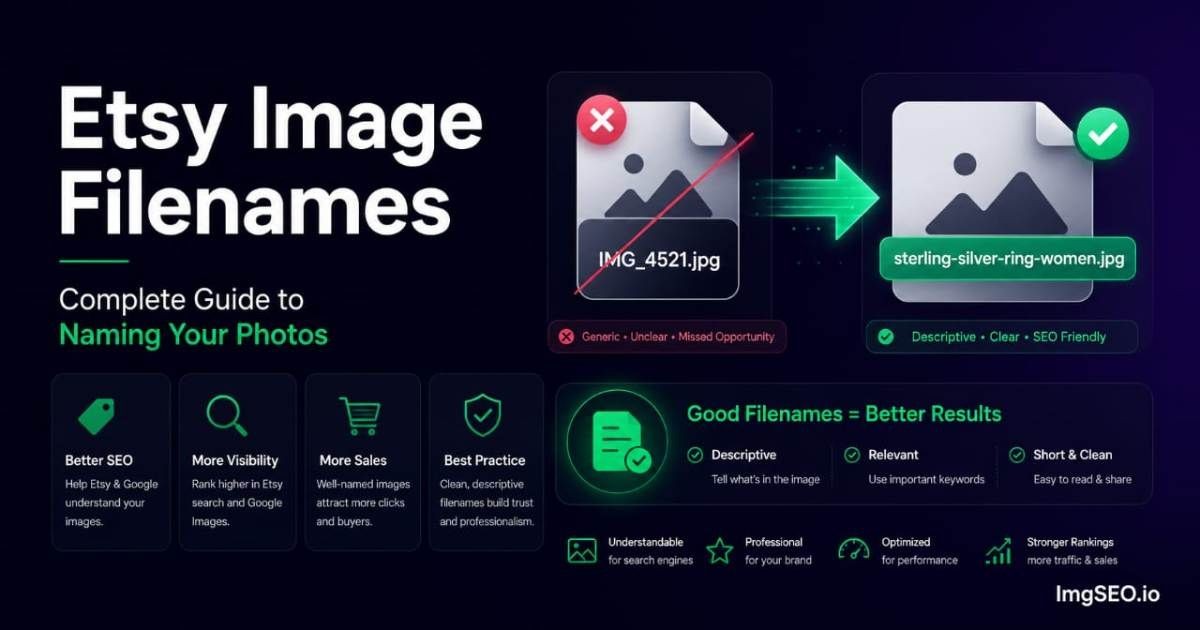
Google reads your image filename when it first discovers and indexes the image. A filename of IMG_4521.jpg tells Google nothing. A filename of sterling-silver-ring-minimalist-women.jpg tells Google exactly what it is showing.
Rename every image file on your computer before uploading to Etsy.
Formula: [material]-[product]-[style]-[occasion].jpg
Examples:
sterling-silver-ring-minimalist-women.jpggold-filled-necklace-dainty-layering.jpgsoy-candle-lavender-8oz-gift.jpg
Use lowercase, hyphens between words, no spaces or underscores. Each image in a listing gets a different descriptive filename to target different keyword variations.
For a full guide on filename strategy, see how to fix bad image filenames for SEO.
Image Metadata Before Upload
Inside every image file is hidden information called metadata — fields that include a title, description, keywords, and technical details about the photo. Google reads this metadata when it first indexes your image.
Etsy strips most metadata when it processes your upload. But Google crawls your listing before Etsy finishes processing, which means metadata you embed before uploading is captured by Google at first contact.
ImgSEO adds this metadata automatically: upload your product image, the AI generates keyword-optimized metadata based on what it sees in the image, and you download the file with everything embedded. Upload that file to Etsy. It takes two minutes per image and gives Google keyword signals that your competitors are not providing.
Part 4: Google SEO Setup
Google Search Console
Google Search Console is a free tool that shows you exactly how your Etsy listings appear in Google search — which queries triggered impressions, which listings got clicks, and how your rankings change over time.
Set it up before you open your shop:
- Go to search.google.com/search-console
- Add a new property with your Etsy shop URL:
https://www.etsy.com/shop/YourShopName - Verify ownership using the HTML tag method (add a meta tag to your Etsy shop)
- Submit your shop URL for indexing
It takes two to four weeks before you see meaningful data, but setting it up now means you have a baseline to measure from once traffic starts arriving.
For a complete guide to ranking your Etsy shop on Google, see our Etsy Google ranking guide.
Pinterest Setup
Pinterest is the most valuable external traffic source for most Etsy sellers, and setting it up correctly from day one costs nothing but an hour.
Steps to complete before your first sale:
- Create a Pinterest business account (free — never use a personal account for a shop)
- Claim your Etsy shop in Pinterest settings to enable rich pins
- Enable rich pins — these pull your listing title, price, and description directly from Etsy and display them on every pin
- Create 5–7 keyword-optimized boards covering your product categories and buyer aesthetics
- Pin every new listing to Pinterest immediately after publishing — the earlier you pin, the more time it has to accumulate saves and clicks
Each Pinterest pin pointing to your Etsy listing is an external link. External traffic to your listings is a signal Etsy's algorithm notices and rewards over time.
For a full Pinterest traffic strategy, see our guide on how to drive Pinterest traffic to your Etsy shop.
Part 5: Star Seller Foundation
Star Seller status is Etsy's quality badge for shops that consistently deliver excellent service. It appears prominently in search results and on listing pages, and it has a meaningful positive effect on conversion rate. Setting up the habits that earn Star Seller from day one is far easier than trying to build them retroactively.
Message Response Rate
Etsy requires a 95% or higher message response rate to maintain Star Seller. Respond to every message within 24 hours — set up Etsy's auto-reply feature to acknowledge messages immediately when you are away. Buyers who get fast responses convert at higher rates regardless of the content of the message.
Shipping and Tracking
Add tracking to every order and ship within your stated processing time. Etsy requires 95% or higher on-time shipping with tracking for Star Seller. The simplest way to hit this consistently: set your processing time conservatively (two to three days rather than one) so you have buffer to ship early rather than risk shipping late.
For image optimization tips specific to Star Seller listings, see our Etsy Star Seller images guide.
Review Strategy
Reviews are the most powerful ranking signal for Etsy listings over the medium term. You cannot ask buyers directly for a five-star review, but you can create the conditions that make leaving one likely.
Include a handwritten or printed thank-you card in every order. Send a follow-up Etsy message three to five days after the estimated delivery date to check that the item arrived safely. Both actions increase the likelihood of a review and signal to buyers that you care about their experience.
Never offer discounts, free items, or any other incentive in exchange for reviews — this violates Etsy's policies and can result in shop suspension.
The Complete Pre-Launch Checklist
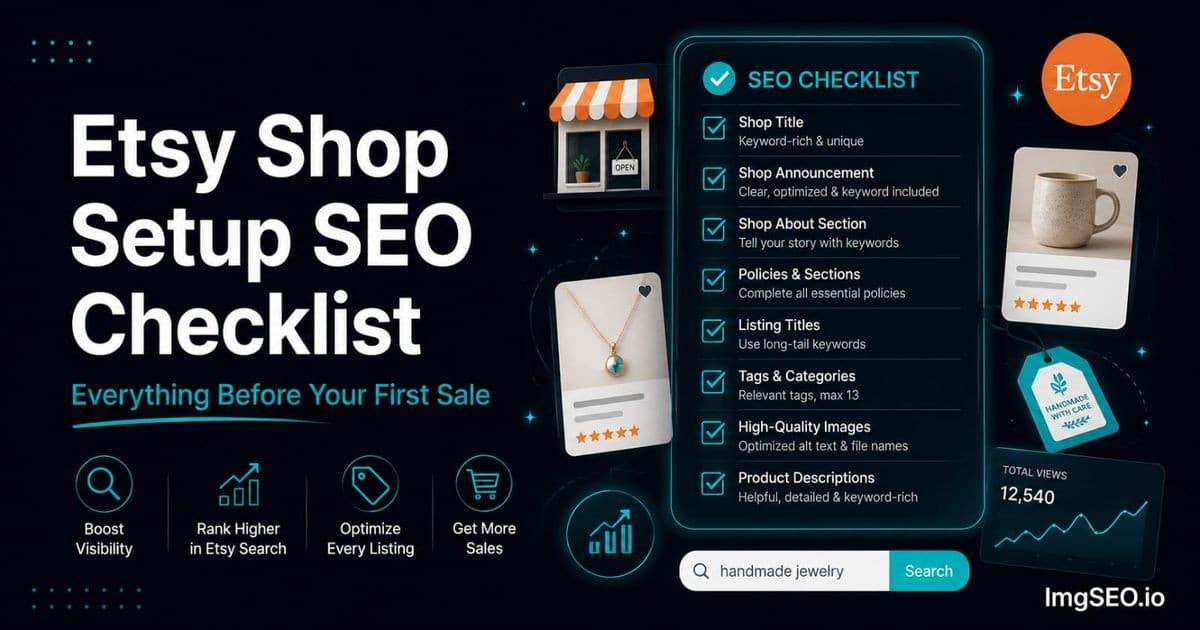
Work through every item below before you open your shop or publish your first listing. Print it out. Check every box.
Shop Profile
- [ ] Shop name chosen, brandable, and available on Instagram and Pinterest
- [ ] Shop icon uploaded at 500×500px — clear, professional quality
- [ ] Banner uploaded at 3360×840px — showing best products
- [ ] Shop tagline written with primary keywords (55 char max)
- [ ] About section complete — minimum 100 words, 3–5 behind-the-scenes photos
- [ ] All shop policies filled in: shipping, returns, exchanges, payment
Listings
- [ ] Primary keyword in first 40 characters of every title
- [ ] All 13 tags filled with multi-word phrases
- [ ] Description opens with primary keyword in first sentence
- [ ] Description is minimum 150 words
- [ ] Processing time set accurately and conservatively
- [ ] Shipping profile configured — free shipping set up if viable
Images
- [ ] All 10 image slots used on every listing
- [ ] Main image: clean background, bright, product fills 80%+ of frame
- [ ] Lifestyle or in-use image included
- [ ] Detail or close-up image included
- [ ] Scale reference image included
- [ ] Alt text written on every image (100–200 characters, unique per slot)
- [ ] All image files renamed before upload with keyword filenames
- [ ] Image metadata added before upload using ImgSEO
External SEO
- [ ] Google Search Console property created for your Etsy shop URL
- [ ] Etsy shop URL submitted for indexing in Search Console
- [ ] Pinterest business account created
- [ ] Etsy shop claimed on Pinterest
- [ ] Rich pins enabled on Pinterest
- [ ] 5–7 keyword-optimized Pinterest boards created
- [ ] First listings pinned to Pinterest immediately after publishing
FAQ
How long does it take to set up Etsy SEO properly?
A complete setup — shop profile, policies, listing titles and tags, image filenames, alt text, and metadata — takes most new sellers 4–8 hours spread across a few days. Each listing takes 20–30 minutes to optimize fully the first time. The investment compounds over months, and sellers who set up correctly from day one consistently outperform those who list first and optimize later.
Should I optimize SEO before or after opening my shop?
Before — always. Etsy gives new listings a temporary visibility boost when first published. If your titles, tags, and images are already optimized at publication, you extract full value from that early window. Google also crawls new listings within days of appearing on Etsy — if your filenames and alt text are not in place at first crawl, Google indexes the unoptimized version.
What is the most important Etsy SEO setup step?
Listing title optimization. The first 40 characters of your title carry the most weight in Etsy's algorithm. Getting your primary buyer search phrase into those 40 characters on every listing is the single highest-return action you can take. After that, filling all 13 tags and adding alt text to every image together compound that foundation.
How many listings should I have when I open my Etsy shop?
At least 10–15 fully optimized listings. Etsy's algorithm uses listing volume as a shop quality signal, and very small shops see limited search visibility. More importantly, each listing is an independent SEO asset — 15 fully optimized listings give you 15 separate entry points into Etsy search and Google Images.
Does Etsy shop name affect SEO?
Modestly. Your shop name appears in your Etsy shop URL and page title, so including a relevant keyword provides a small signal. However, shop name has far less impact than listing titles and tags, and it is permanent once set. Prioritize memorability and brandability over keyword cramming. Work in a relevant term if it fits naturally — but do not sacrifice a good brand name for a marginal SEO gain.
How do I know if my Etsy shop SEO is set up correctly?
Run through the pre-launch checklist above and confirm every item is checked. For a quick diagnostic: open three listings and confirm the first 40 characters of each title contain a buyer search phrase; confirm all 13 tags are filled with multi-word phrases; click each image and confirm the "Describe this photo" field is filled. After two to four weeks live, check Etsy Stats — if a listing shows zero Etsy search views after four weeks, the title or tags are not matching real buyer searches.
What is Etsy shop completeness and why does it matter?
Etsy uses shop completeness as a quality signal that affects search placement, especially for new shops with no reviews yet. Completeness factors include having a shop icon, banner, about section, and policies filled in, plus a minimum number of listings. For new sellers, completeness is one of the few quality signals you can fully control from day one — completing every section is a free ranking improvement.
Can I fix my SEO after my shop is already open?
Yes — and you should if your current setup is not optimized. Updated titles, tags, and alt text are picked up by Etsy within days to weeks. Google re-indexes updated listings within one to four weeks. The one exception is image filenames: since Etsy generates its own internal image URLs on upload, you need to re-upload the image (with a new descriptive filename and added metadata) to get the improved signals for existing listings.
Conclusion
The sellers who build real Etsy businesses are not the ones who got lucky — they are the ones who set up their SEO foundation correctly and let it compound over months.
The checklist is not complicated: complete shop profile, keyword-optimized listing titles and tags, strong descriptions, and fully optimized images. Most sellers skip at least half of it. Most sellers who skip it spend the next six months wondering why their shop is not getting views.
The part most sellers skip entirely is image SEO — filenames, alt text, and metadata. That is your clearest competitive advantage. Your competitors are uploading images named IMG_4521.jpg with blank alt text fields and no metadata. You are not.
ImgSEO handles the filename, alt text, and metadata step in one workflow — upload your product images, download them optimized, upload to Etsy. You get 30 images free to start. Use them before your first listing goes live.
For a broader beginner SEO foundation, start with our Etsy SEO beginners guide.