
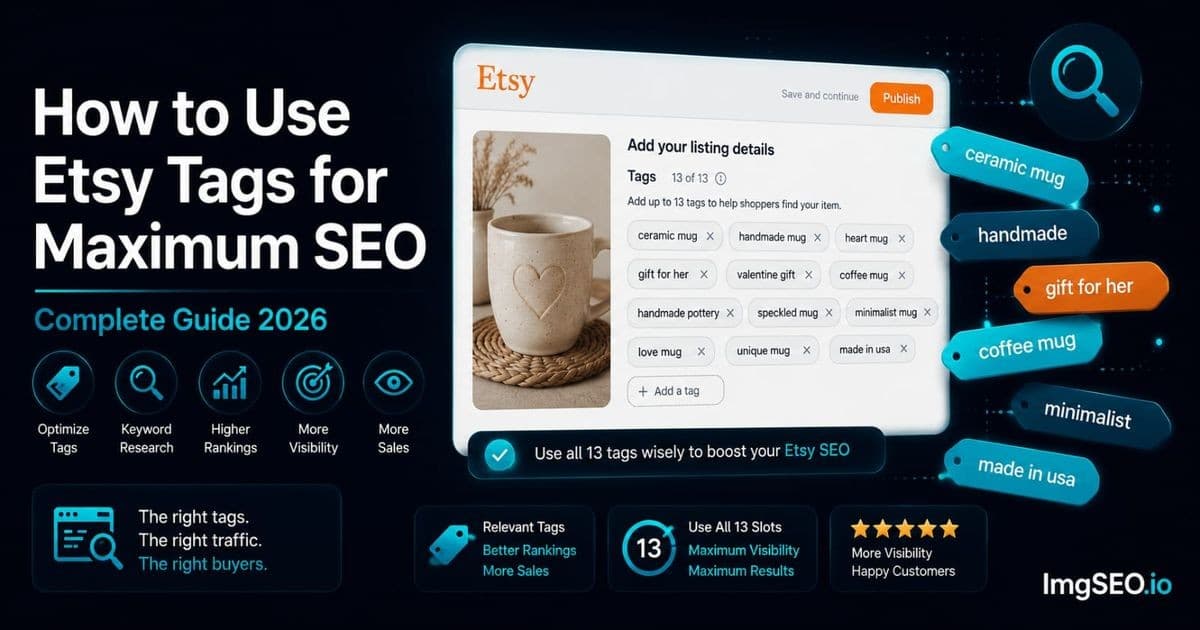
Most Etsy sellers use five to seven tags per listing and leave the rest empty. That is free traffic they are giving away to competitors who bothered to fill the remaining slots. Etsy gives every listing exactly 13 tag slots — not 7, not 10, not "however many feel right." Using fewer than 13 is choosing to appear in fewer searches than you could, for no reason.
Tags are how Etsy's search algorithm extends your listing's keyword coverage beyond the title. Your title handles the primary keyword phrase. Your tags handle the variations, occasions, recipients, styles, and materials that a buyer might use to find the same product from a different angle. Together they determine the full set of searches your listing appears for. This guide covers how tags work, a complete 13-tag strategy, ready-to-use tag sets for five product niches, advanced strategies including seasonal updates and aesthetic keywords, and the direct connection between your tag choices and how well your listing images rank on Google.
Key Takeaways
- Etsy gives every listing 13 tag slots of up to 20 characters each — most sellers use only 5–7, leaving free search coverage on the table.
- The allocation framework: 2–3 product type tags, 1–2 material, 2 style, 2–3 occasion, 1–2 recipient, 1 color, 1 size — always as multi-word phrases, never single words.
- Update seasonal tags six to eight weeks before a holiday (e.g., mid-October for Christmas) so Etsy has time to index the change before peak search volume hits.
How Etsy Tags Work
Tags Are Keyword Phrases
Each Etsy tag accepts up to 20 characters and should be used for a multi-word keyword phrase — not a single word. A single-word tag like "ring" matches every ring listing on Etsy, which means it contributes almost nothing to your ranking for that term. A phrase tag like "sterling silver ring" matches buyers who searched that specific phrase, which is a much smaller competitive pool and a much higher-intent buyer.
Etsy matches exact tag phrases to buyer search queries. When a buyer searches "adjustable silver ring," Etsy looks for listings whose tags or title contain that exact phrase. A tag of "adjustable silver ring" scores a direct match. Tags containing those words individually or in a different order score weaker matches. Phrase precision matters.
Tags and Title Together Equal Full Keyword Coverage
Think of your title and tags as two non-overlapping layers of keyword coverage. Your title covers the primary keyword phrase and two or three supporting phrases. Your tags cover the additional keyword angles that the title cannot fit: all the occasions, recipient types, style variations, color descriptors, and size modifiers that the same buyer might search from a different entry point.
A sterling silver minimalist ring listing with the title "Sterling Silver Minimalist Ring Women Adjustable Boho Jewelry Gift for Her" already covers "sterling silver minimalist ring," "adjustable boho jewelry," and "gift for her." The tags should cover everything else: "dainty ring women," "everyday jewelry," "birthday gift women," "silver ring gift," "boho ring gift," "handmade ring silver" — all the adjacent searches that a different buyer, at a different stage of their search, might use to find the same product.
Tags Are Not the Same as Title Keywords
The most common tag mistake experienced sellers make is repeating exact phrases from their title in the tags. If your title already contains "gift for her," a tag of "gift for her" contributes no additional search coverage — Etsy already knows your listing is relevant for that phrase from the title. That tag slot could have covered "anniversary gift" or "gift for girlfriend" — two related but distinct buyer searches.
Use tags to extend coverage, not duplicate it. Every tag that repeats a title phrase exactly is a wasted slot that could have matched an additional buyer search.
How Tags Affect Image SEO
Tags contribute to the overall keyword context Google reads when crawling an Etsy listing. Google's image indexing does not read alt text in isolation — it reads the full page context, including the listing title, description, and the page metadata that Etsy generates from your tags. A listing with 13 well-chosen tags has a richer keyword context than one with 6 sparse tags, and that richer context strengthens the relevance signal for every image on the listing.
Tags do not directly become image alt text the way the title does — Etsy uses the title for automatic alt text, not the tags. But tags reinforce the listing's topical relevance in ways that benefit Google Images ranking indirectly. For the complete Etsy image SEO picture, including how title, tags, and per-image alt text work together, see our Etsy image SEO guide.
The 13 Tag Strategy
Tag Categories to Cover
A systematic approach to 13 tags allocates slots across the dimensions buyers use to search. Not every listing needs all seven categories — use your best judgment based on what buyers in your niche actually search — but the table below is a practical starting framework:
| Category | Examples | Tags to allocate | |----------|---------|-----------------| | Product type variations | ring, silver ring, women ring | 2–3 tags | | Material | sterling silver jewelry, linen top | 1–2 tags | | Style or aesthetic | minimalist jewelry, boho ring | 2 tags | | Occasion | gift for her, birthday gift | 2–3 tags | | Recipient | women jewelry, mens gift, baby gift | 1–2 tags | | Color or finish | gold jewelry, white wall decor | 1 tag | | Size or variant | small ring, large wall hanging | 1 tag |
This framework ensures you cover the search dimensions buyers actually use to filter. A listing with 13 tags covering only product type and material misses the occasion-driven and recipient-driven searches that account for a significant share of Etsy's transaction volume.
Never Waste Tags On
Single words. "Ring," "necklace," "gift," "art" — these match millions of listings and add almost no meaningful ranking signal. Use the 20 characters for a phrase.
Your shop name. Buyers do not search your shop name in Etsy's product search. It belongs in your shop profile, not in product tags.
Terms Etsy filters separately. "Handmade" and "vintage" are Etsy search filter categories — buyers apply them as filters, not as search terms. Etsy does not use these as tag relevance signals in the same way it uses product keywords.
Exact title phrases. If it is already in the title, it does not belong in the tags. Use those slots for new coverage.
Tag Research Methods
Method 1: Etsy Search Autocomplete
The fastest and most accurate tag research tool is Etsy's own search bar. Go to Etsy, start typing your product type, and read every autocomplete suggestion that appears. Then add a modifier — a material, style word, or occasion — and read the new autocomplete suggestions. Every suggestion that applies to your product is a potential tag.
Run this process systematically: type the base product, the material + product, the style + product, the occasion + product, and the recipient + product. Each combination surfaces different phrase suggestions. Collect all relevant phrases, remove any already in your title, and fill your 13 tags from the results.
Method 2: eRank Tag Research
eRank is the most widely used Etsy keyword research tool and provides search volume and competition data that Etsy's own tools do not expose. The free tier allows a limited number of keyword searches per day, which is sufficient for researching a new listing or auditing low-performing ones. Enter your candidate tag phrases and compare their search volume and competition level.
The ideal tag phrase has reasonable search volume (buyers are actually searching it) and moderate competition (you have a realistic chance of ranking). Tags with very high volume and very high competition are difficult for a new listing to rank for. Tags with very low volume are not worth a slot. The middle ground — specific enough to have intent, popular enough to have volume — is where tag research pays off.
Method 3: Competitor Analysis
Search your primary keyword on Etsy and open the top five to ten listings. On each listing, scroll to the "Explore related searches" section that Etsy displays below the listing description. These related searches are Etsy's own signal of what buyers who viewed this listing also searched — they are validated tag opportunities that Etsy is explicitly showing you.
Also read competitor titles carefully. Phrases in top-ranked competitor titles that are not in your title are tag candidates — they have demonstrated ranking value and are not already covered by your primary keyword approach.
Method 4: Long-Tail Keyword Research
Google autocomplete works for Etsy tag research because buyers who search on Google use the same natural language phrases they use on Etsy. Search "[product] for [occasion]" and "[product] for [recipient]" in Google and read the suggestions: "ring for girlfriend," "wall art for bedroom," "jewelry for mom." These long-tail phrases often have lower competition on Etsy than broader terms and higher buying intent because the buyer has already specified the context.
Tag Examples by Product Niche
Handmade Jewelry — Sterling Silver Minimalist Ring
A complete 13-tag set that covers product variations, style, occasion, and recipient without repeating the title phrases "sterling silver minimalist ring," "boho jewelry," or "gift for her":
adjustable silver ringboho ring womengift for girlfriendminimalist jewelrysilver ring gifthandmade silver ringdainty ring womeneveryday jewelryboho jewelry giftring birthday giftsilver jewelry giftwomen ring giftsimple silver ring
This set covers: product type variations (adjustable silver ring, simple silver ring, handmade silver ring), style (minimalist jewelry, dainty ring, boho ring), occasions (gift for girlfriend, ring birthday gift, silver ring gift, boho jewelry gift, silver jewelry gift, women ring gift), and use context (everyday jewelry).
Home Decor — Boho Macrame Wall Hanging
A complete 13-tag set for a large macrame wall hanging, assuming the title already contains "large macrame wall hanging," "boho bedroom decor," and "natural cotton":
boho wall decorbedroom wall artwoven wall arthousewarming giftboho home decornatural wall decorhandmade wall artnursery wall decorcotton wall hangingwall art bedroomlarge wall decorwall decor giftboho bedroom art
This set covers: product type variations, room context (bedroom, nursery), material angle (cotton, natural, woven), occasions (housewarming gift, wall decor gift), and style variations (boho home decor, boho bedroom art).
Printable Wall Art — Botanical Instant Download
printable wall artinstant download artboho art printbedroom wall decordigital wall artminimalist printdownloadable artbotanical print artgallery wall printart print downloadwall art printablehome decor printmodern wall art
For digital products, tag variations matter particularly because buyers search for the same product using both the format ("printable," "digital," "instant download," "downloadable") and the content ("botanical," "boho," "minimalist"). Cover both dimensions across your 13 tags.
T-Shirt Print on Demand — Cat Mom
cat mom shirtfunny cat tshirtcat lover giftgift for cat momcat mom giftfunny cat giftcat owner shirtcat tshirt womenbirthday cat giftcute cat shirtcat lover shirtfunny cat momcat gift women
Print-on-demand listings benefit from exhaustive occasion and recipient tag coverage because the same design is purchased for many different people and reasons. Notice how this set covers both the product identity ("cat mom shirt," "cat tshirt women") and the gifting context ("gift for cat mom," "birthday cat gift," "cat gift women") — two buyer types, same product.
Canva Templates — Instagram Post Templates
canva templateinstagram templatesocial media templateeditable templatecanva instagram postbusiness templatecanva social mediapost template canvasmall business templatecontent creator templatedigital templateinstagram canva posttemplate download
Digital template tags should cover both the tool ("canva template," "canva instagram post") and the use case ("small business template," "content creator template," "social media template") because different buyers search from these two different angles.
Advanced Tag Strategies
The Long-Tail Tag Strategy
Shorter, broader tags compete against more listings. Longer, more specific tags compete against fewer listings and attract buyers with clearer intent. "Women ring" competes against every ring listing tagged for women. "Minimalist ring women gold" competes against a much smaller set of listings and attracts a buyer who already knows they want a minimalist gold ring.
Use the full 20-character limit purposefully. A tag like "ring gift" has room for three more characters — "ring gift women" is more specific and more useful. The character limit is a ceiling, not a target. Use it when the extra words add genuine keyword value.
Seasonal Tag Updates
Gift searches spike predictably before major holidays. A static set of 13 evergreen tags misses these spikes entirely. The solution is to keep nine to ten core tags evergreen and rotate three to four tags seasonally based on the upcoming holiday:
| Season | Replace with |
|--------|-------------|
| January–February | valentines gift, galentines gift, love gift |
| March–May | mothers day jewelry, mom gift, graduation gift |
| June–August | wedding gift, bridesmaid gift, summer jewelry |
| September–October | fall decor gift, halloween gift, teacher gift |
| November–December | christmas gift, stocking stuffer, holiday gift |
Update seasonal tags six to eight weeks before the holiday — Etsy needs time to index and rank the changes before peak search volume arrives. Set calendar reminders in advance so you do not miss the indexing window.
The Occasion Stack Strategy
A single product is purchased for many different occasions by many different recipients. Each occasion and recipient combination is a separate buyer segment with distinct search behavior. "Gift for her," "birthday gift women," and "anniversary gift jewelry" are three different searches that can all lead to the same sterling silver ring — but only if all three are covered by tags.
Stack occasion and recipient tags deliberately across your 13 slots. For a giftable product, allocate four to five tags to occasion and recipient combinations: "gift for her," "birthday gift women," "anniversary gift," "gift for girlfriend," "wedding gift jewelry." These tags capture the gift-shopping segment, which represents a large and consistently high-converting portion of Etsy's buyer base.
Niche Aesthetic and Style Tags
Beyond generic style descriptors ("boho," "minimalist," "vintage"), specific aesthetic movements drive significant Etsy search volume from buyers who know exactly what aesthetic they want. Niche aesthetic tags have lower overall competition than broad style terms and attract highly self-selecting buyers:
cottagecore jewelry,cottagecore decor,cottagecore giftdark academia ring,dark academia giftgoblincore decor,goblincore jewelryfairycore necklace,fairycore giftwitchy jewelry,witchy giftmaximalist decor,eclectic home decorjapandi decor,wabi sabi home
Monitor aesthetic trends on TikTok and Pinterest — new aesthetic movements emerge regularly, and early adoption of a trending aesthetic tag gives your listing visibility before competition catches up.
Tags and Image SEO Connection
How Tags Strengthen Image SEO
A listing's keyword context — the totality of signals Google reads when crawling an Etsy listing — is built from the title, description, tags, and embedded image metadata. Tags contribute to this context by expanding the keyword vocabulary associated with your listing beyond what the title alone contains.
When Google indexes your listing's images, it considers this full keyword context alongside the image-specific signals (alt text, filename, embedded metadata). A listing with 13 well-chosen tags that cover materials, styles, occasions, and recipients gives Google's image indexing a richer keyword context to associate with your images. That richer context strengthens Google Images relevance for the searches your tags cover.
The Keyword Ecosystem
Complete Etsy and Google image SEO coverage comes from four coordinated elements:
Title — primary keyword phrase; becomes automatic alt text for listing images on Google
Tags — keyword variations and related terms; expands listing relevance beyond what the title covers
Per-image alt text — visual description with image-specific keywords; added in the "Describe this photo" field
Embedded metadata — EXIF/XMP fields embedded before upload; read by Google on first crawl
All four working together produce maximum image SEO coverage. Tags alone do not rank your images. Titles alone do not cover every buyer search path. Alt text alone does not address listing-level relevance. The system works as a whole. For the complete image-side strategy that builds on your tag foundation, see our guide on how to get more Etsy sales with image SEO.
Common Tag Mistakes
Using single words. "Ring," "gift," "art" — these match every listing in the category. Single-word tags are functionally useless for ranking and waste a slot that could have covered a specific buyer search.
Leaving tags empty. Every empty tag slot is a buyer search you chose not to appear for. There is no downside to using all 13 and no benefit to leaving any empty.
Repeating exact title phrases. If the phrase is already in your title, Etsy already uses it for relevance matching. The tag slot adds nothing and could have covered an additional search.
Using irrelevant tags to game the algorithm. Etsy actively monitors for and penalizes listings that use tags unrelated to the actual product. A ceramic vase tagged "sterling silver ring" to capture ring search traffic will be demoted, not boosted. Every tag must accurately describe the listing.
Never updating tags seasonally. A static tag set misses every gift-season traffic spike. Rotating three to four tags for Valentine's Day, Mother's Day, and Christmas costs minutes and captures traffic peaks that static tags miss entirely.
Using only obvious tags everyone uses. "Gift for her" is in millions of listings. It is worth including — but the listings that stand out combine expected tags with less obvious ones like specific aesthetic tags, niche recipient tags, or long-tail occasion phrases that fewer competitors have researched.
Not using occasion and recipient tags. Gift-driven searches account for a large share of Etsy conversions. A listing with no occasion or recipient tags is invisible to buyers searching "[product] gift for [recipient]" — a different buyer segment from those searching the product type directly.
Ignoring aesthetic and style movement tags. "Cottagecore," "dark academia," "goblincore" — these niche aesthetics drive real Etsy search volume from highly self-selecting buyers. A generic "boho" tag competes against millions of listings. A "cottagecore jewelry" tag competes against far fewer and attracts buyers who know exactly what they want.
Using 20 characters inefficiently. A tag of "ring" is 4 characters. "Adjustable silver ring" is 22 characters — too long, but "silver ring women" is 17 and covers the same ground as "ring" plus two additional qualifier words. Use the character limit purposefully.
Copying competitor tags exactly without research. Competitors' tags reflect their product and their research, not yours. Overlap is fine — many listings in a category legitimately share tag phrases. But copying a full tag set without understanding whether each phrase applies to your specific product wastes some slots and may miss better options for your variation of the product.
Monitoring Tag Performance
Using Etsy Stats for Tags
Etsy Stats shows traffic sources for each listing but does not directly identify which tags drove which searches — that level of detail is not exposed. What it does show is the volume of traffic from Etsy search, which is the combined result of your title and tag relevance.
If a listing has strong views from Etsy search, your tags and title are working together to match buyer queries. If Etsy search traffic is low despite being live for several weeks, the tags are likely not matching buyer search behavior — research new phrases and update.
The "Etsy search" traffic source in Stats is your primary feedback signal. A meaningful increase in Etsy search traffic after a tag update confirms the new tags are matching more buyer queries.
eRank Listing Audit
eRank's listing audit feature analyzes your tags and identifies which have measurable search volume and which have effectively zero searches. Tags with zero volume are candidates for replacement — they are occupying slots that could produce actual search matches. The free tier provides limited audits, sufficient for reviewing your top listings periodically.
Use the audit data to make evidence-based decisions: replace zero-volume tags with alternatives that have real search demand, and compare competition levels to identify tags where you have a realistic chance of ranking.
The 90-Day Tag Review
Set a recurring calendar reminder to review every listing's tags every 90 days. The review has three goals: update seasonal tags for the upcoming holiday period, replace any zero-volume tags identified by eRank or reflected in low search traffic, and add new tags based on any emerging search trends or aesthetic movements that have grown since the last review.
Ninety days is long enough for tag changes to produce measurable traffic results in Etsy Stats and short enough to catch seasonal opportunities before they peak. For a comprehensive framework that covers tags as part of a full image SEO audit, see our image SEO audit guide.
Tags for Different Shop Types
New Shops (0–10 Sales)
A new shop has no reviews and no sales history. Etsy's algorithm relies heavily on these signals for established listings. New shops competing for high-volume broad tags ("ring," "gift," "wall art") are competing against listings with years of review accumulation and thousands of sales — a competition they will not win on listing quality score alone.
New sellers should focus on long-tail, specific tags: three to four word phrases with moderate search volume and lower competition. "Adjustable minimalist silver ring" competes against fewer listings than "silver ring" and attracts a buyer with specific intent. The goal for new shops is to appear prominently in lower-competition searches while reviews and sales accumulate to support competitive ranking in broader ones.
Established Shops (100+ Sales)
A shop with reviews and sales history has a listing quality score that allows competing for broader, higher-volume tags. Established sellers can afford to include one or two competitive broad tags ("gift for her," "birthday gift") alongside specific long-tail tags, because their history gives them a meaningful listing quality score advantage over newer competition.
The tag strategy for established shops is a mix: two to three broad competitive tags, four to five medium-specificity tags, and four to six long-tail niche tags. This breadth captures high-volume searches where the listing's history is competitive and lower-volume searches where long-tail specificity wins.
Seasonal Shops
Shops whose primary selling window is a specific season — Halloween costumes, Christmas ornaments, Valentine's gifts — should update all 13 tags, not just three or four, eight to ten weeks before the season peak. Etsy and Google both need time to index and rank changes. Waiting until two weeks before Christmas to add Christmas gift tags means the indexing window has largely passed.
For Christmas: update by mid-October. For Valentine's Day: update by early January. For Mother's Day: update by early April.
Frequently Asked Questions
How many Etsy tags should I use?
All 13, every time. Every empty tag slot is a buyer search you are choosing not to appear for. There is no limit downside to using all 13 — only an upside to covering more searches.
Can I repeat keywords from my title in tags?
Use different keyword phrases in your tags. If your title already contains "sterling silver minimalist ring," a tag of "sterling silver minimalist ring" adds no new search coverage. Use that slot for "dainty ring women" or "everyday silver jewelry" instead.
How long can Etsy tags be?
Up to 20 characters per tag. Use multi-word phrases to fill this space — "adjustable silver ring" (21 chars, just over — "silver adjustable ring" is 22 chars) — aim for 12–19 characters to get a phrase without hitting the limit. Single words waste most of the available space.
Do Etsy tags affect Google ranking?
Indirectly. Tags contribute to the listing's overall keyword context, which Google reads when crawling the page. They also influence Etsy's internal relevance ranking, which affects how prominently Etsy features your listing in its own Google-indexed category and search pages. They do not become alt text automatically the way the title does, but they form part of the keyword ecosystem that strengthens Google Images relevance.
How often should I change my Etsy tags?
Review every 90 days and update seasonally — six to eight weeks before each major gift holiday. Do not change high-performing tags without a reason. Stability allows ranking signals to accumulate. Change low-performing or zero-volume tags when eRank or Etsy Stats data indicates they are not generating search traffic.
What are the best tags for handmade jewelry on Etsy?
It depends on the specific product, but the framework is: two to three product type variations ("adjustable silver ring," "dainty ring women," "simple silver ring"), one to two material tags ("sterling silver jewelry," "handmade silver ring"), two style tags ("minimalist jewelry," "boho ring women"), and four to five occasion and recipient tags ("gift for her," "birthday gift women," "gift for girlfriend," "anniversary gift"). The full 13-tag example in this guide is a complete starting point.
Should I use single words or phrases as Etsy tags?
Always phrases. Single words are too broad to produce meaningful ranking in a competitive category. "Ring" matches millions of listings. "Adjustable sterling ring" matches a much smaller set and attracts a buyer with specific intent. Use every tag slot for a phrase.
How do I research good Etsy tags?
Start with Etsy autocomplete — type your product and modifiers and read every suggestion. Validate with eRank's free tier for search volume data. Analyze competitor titles for phrase patterns you may be missing. Check Google autocomplete for "[product] for [occasion/recipient]" phrases that work on both Etsy and Google. Combine all four methods for comprehensive coverage.
Conclusion
Tags are the most underutilized SEO tool Etsy provides. They are free, they are in your control, and most sellers are leaving half of them empty. Using all 13, covering product type, material, style, occasion, and recipient, and updating seasonally is a complete tag strategy that costs nothing except fifteen minutes of research per listing.
The combination that produces maximum Etsy and Google visibility: a keyword-optimized title covering your primary phrases, 13 tags covering the adjacent searches your title does not reach, per-image alt text added via the "Describe this photo" field for Google Images specificity, and embedded metadata in every image file before uploading. Tags are the second layer of that system — essential, but most effective when the other layers are in place too.
ImgSEO handles the image side of that system automatically — alt text generation and EXIF/XMP metadata embedding in a single workflow, ready for Etsy upload. Try free — 30 images.
For the complete new-seller Etsy SEO system that covers titles, tags, images, and descriptions together, see our Etsy SEO tips for new sellers.


