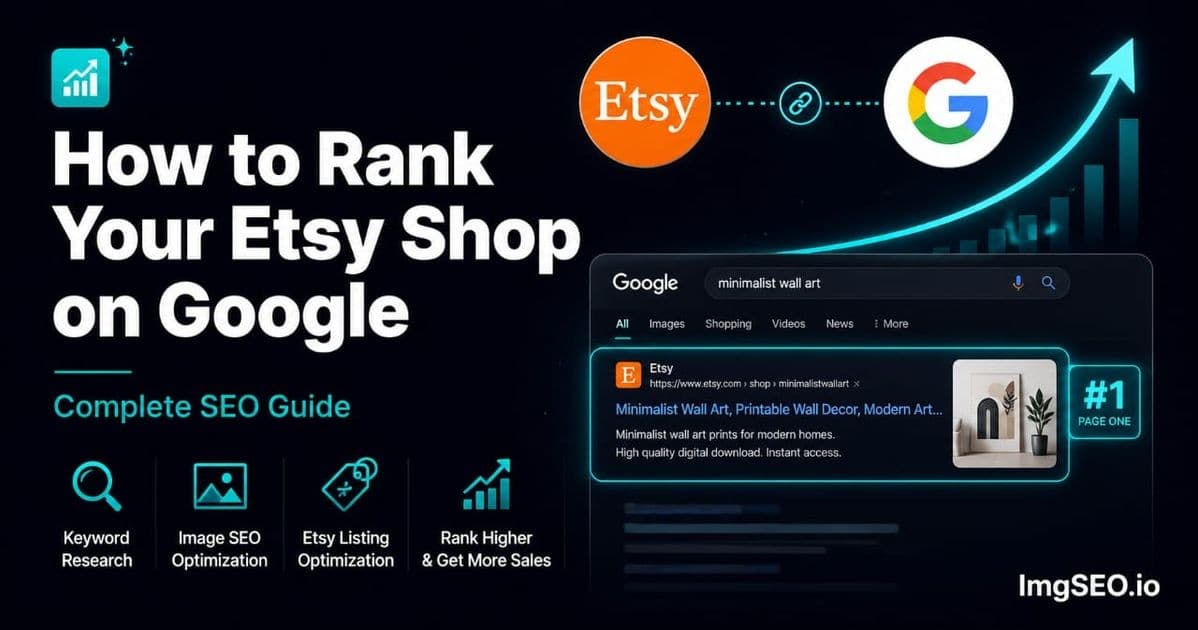
Most Etsy sellers spend hours on Etsy SEO — perfecting titles, researching tags, studying Etsy's algorithm — and then publish their listings and wait. What they never consider is that Google is watching too. Every listing you publish on Etsy.com is also a page on one of the highest-authority domains on the internet, available to be ranked in Google search and Google Images results.
Ignoring Google is leaving half the traffic on the table. This guide explains exactly how the Etsy-Google connection works, what you need to optimize, and how to build a systematic approach to ranking your Etsy listings in both search engines simultaneously.
Key Takeaways
- etsy.com has a domain authority above 90 — in the same league as Wikipedia and Amazon — so a new listing can reach Google page one for a long-tail query within days.
- Etsy may process uploaded images, so embedded metadata preservation and any special pre-processing crawl window should not be assumed.
- Keep listing titles, descriptions, and accurate image alt text clear and consistent so shoppers and external search engines can understand the product.
Why Etsy Listings Rank on Google
Etsy's Domain Authority
Domain authority is a measure of how much a website is trusted by Google, built from years of backlinks, traffic, and engagement signals. etsy.com has a domain authority above 90 — in the same league as Wikipedia, The New York Times, and Amazon.
What this means for you: every listing you publish on Etsy immediately inherits that authority. A new Etsy listing from a one-year-old shop can appear on Google page one for a long-tail search query within days. A brand-new standalone e-commerce site trying to rank for the same term would need months of link-building to compete.
This is one of the genuine advantages of selling on a marketplace. You are borrowing Etsy's authority for every product you list.
How Google Indexes Etsy Listings
Google crawls Etsy frequently because of its size, traffic, and update velocity. Each time you publish or update a listing, Googlebot typically revisits it within 1–7 days.
When Google crawls your listing, it reads the page like a document:
- Listing title → becomes the HTML
<title>tag Google uses in search results - Listing description → becomes the page body content Google reads for relevance
- Listing images → get indexed in Google Images
- Alt text → tells Google what each image depicts
- Image alt text → provides a description external search engines can read
Each element is a separate opportunity to communicate your target keyword to Google. Optimizing all of them consistently is what separates Etsy listings that rank from listings that stay invisible.
Two Types of Google Traffic for Etsy
Etsy listings can generate two distinct streams of Google traffic:
Google web search — when a buyer types a text query and your listing appears in the blue-link results. This is driven by your title, description, and keyword alignment.
Google Images — when a buyer searches in the Images tab or clicks an image from Google's visual search. Descriptive alt text and relevant page context help Google understand image subject matter.
Most Etsy sellers, even those who do some SEO, focus entirely on web search and never think about Google Images. That is a significant opportunity missed — Google Images drives buying-intent traffic from shoppers who are already visualizing the product they want.
How to Optimize Etsy Listings for Google Web Search
The Title-Google Connection
Your Etsy listing title is copied verbatim into the HTML <title> tag of the listing page. This is the single most important on-page SEO element for Google — it tells the algorithm the primary topic of the page.
The critical constraint: Google typically displays the first 50–60 characters of a page title in search results. On Etsy, your listing title can be up to 140 characters. The first 40–50 characters are what buyers see in Google's snippet, and what Google weights most heavily in its ranking.
Put your primary keyword within the first 40 characters of your Etsy title. A title that starts "Lavender Soy Candle Handmade Natural 8oz Gift for Her" will outrank one that starts "Gift for Her Perfect for Birthdays Handmade Lavender Soy Candle" — even if the second title contains more keywords overall.
For a complete breakdown of Etsy title structure, see our guide on how to write Etsy titles that rank on Google.
Description as Google Page Content
Etsy's algorithm weighs your description lightly. Google's algorithm weighs it heavily. The full text of your listing description is the page body content Google uses to understand topic depth, related terms, and relevance to long-tail queries.
Two specific mechanisms matter:
The first 160 characters of your description often appear as the meta description in Google search results — the grey snippet text under the page title. Write the first sentence with the buyer in mind as much as the algorithm: it should be compelling and keyword-relevant.
Beyond that first sentence, a longer, keyword-rich description helps Google rank your listing for variations and related searches. A 30-word description gives Google almost nothing to work with. A 250-word description that naturally uses your primary keyword and related terms gives Google significant depth to rank from.
See our detailed breakdown of how to write Etsy descriptions that rank on Google for sentence-level guidance.
Long-Tail Keywords for Google
Head keywords like "soy candle" or "silver ring" are dominated by Etsy's own category pages and major retail sites in Google web search. Individual listings win on long-tail queries — specific, multi-word phrases that describe exactly what you sell.
"Handmade sterling silver hammered ring adjustable women" is a long-tail keyword. Competition is far lower, buying intent is far higher, and a single well-optimized Etsy listing can reach page one. Build your title and description around these specific phrases rather than the generic category terms that major players already own.
For a systematic approach to finding the right long-tail keywords for your listings, see our Etsy keyword research complete guide.
How to Optimize Etsy Listings for Google Images
Why Google Images Matters for Etsy
Google Images is a product discovery channel. When a buyer searches "minimalist gold hoop earrings" in the Images tab, they are not browsing for ideas — they are looking at options with the intention to buy. The click intent on Google Images results is as high as the intent on any product search.
Etsy listing images appear in Google Images. For many product categories — jewelry, home decor, clothing, art prints — Google Images drives significant product traffic that never touches Etsy's internal search at all. This is traffic your shop is currently either capturing or leaving entirely for competitors.
Alt Text: The #1 Google Images Factor
Alt text is the text attribute attached to an image that tells Google — and screen readers — what the image depicts. Without alt text, Google has only the filename and surrounding page context to understand an image. With descriptive alt text, Google has an explicit keyword-matched description tied directly to the image.
In Etsy's listing editor, the alt text field is labeled "Describe this photo for buyers who are visually impaired." The majority of Etsy sellers leave this blank on every image. Etsy then generates a fallback from your title — but it is generic and applies the same text to every image in the listing, regardless of what each image actually shows.
Write unique alt text for every image in your listing. A reliable formula:
[Material] + [product] + [style/design] + [occasion or use]
For example:
- "Handmade lavender soy candle 8oz glass jar natural cotton wick" (main image)
- "Lavender soy candle close-up natural wax texture" (detail shot)
- "Lavender candle gift packaging kraft paper ribbon" (packaging shot)
Each image now gives Google a different but aligned keyword to index. For a detailed walkthrough of writing alt text that drives Etsy sales and Google traffic, see our guide on how to get more Etsy sales with image SEO.
Image Metadata for Google
ImgSEO embeds XMP metadata directly into JPEG, WebP, and AVIF exports, with EXIF additionally included for JPEG. These fields can carry a title, description, keywords, and copyright information in the exported file.
Etsy may process uploaded images, so metadata preservation in Etsy-hosted versions should not be assumed. Etsy's official guidance does not establish that embedded XMP or EXIF data produces a ranking benefit.
Keep descriptive metadata in your exported source files when it supports your broader workflow. For Etsy, add ImgSEO's generated alt text to the listing-image alt-text field; Etsy recommends descriptive alt text for accessibility and to help search engines understand the image.
Filenames and Google Images
Use descriptive filenames in your source-image library, but do not assume Etsy preserves the original filename or that Google sees it before Etsy processes the upload. The filename sterling-silver-hammered-ring-minimalist-women.jpg is still easier to manage than IMG_4521.jpg.
Generate a concise, descriptive filename before uploading and keep the original export in your source library. Treat Etsy's documented listing fields, not an assumed filename-preservation window, as the platform-level SEO controls.
For a full explanation of how filenames work in Etsy's SEO context, see our guide on how to fix bad image filenames for SEO.
The Keyword Alignment Strategy
Title + Description + Alt Text + Metadata
The reason most Etsy listings underperform on Google is not that any single element is badly optimized — it is that the elements are inconsistent with each other. A title targeting "lavender soy candle" with alt text about "relaxation gift" and a description opener about "aromatherapy" sends Google three different keyword signals for the same page. The combined authority is diluted and the listing ranks for nothing in particular.
Keep your title, description opener, and image alt text accurate and consistent, without keyword stuffing. Embedded metadata can remain in your source export, but Etsy may process the uploaded image and its preservation should not be assumed.
Example: Handmade Soy Candle
Here is what full keyword alignment looks like for a single listing:
- Title: "Lavender Soy Candle Handmade Natural Scented 8oz Gift for Her"
- Description opening: "This handmade lavender soy candle is poured in small batches using 100% natural soy wax and a cotton wick..."
- Main image alt text: "Handmade lavender soy candle 8oz glass jar natural cotton wick"
- Metadata keywords: lavender candle, soy candle, handmade, natural, gift for her
Every element says the same thing to Google: this page is about handmade lavender soy candles. That consistency is what makes a listing rank rather than float at position 50 where no one sees it.
Google Search Console for Etsy Sellers
Setting Up GSC for Your Etsy Shop
Google Search Console is free and it shows you exactly how your Etsy listings are performing in Google — which queries trigger them, how often they appear, and how many clicks they receive. Setting it up takes about ten minutes.
- Go to search.google.com/search-console
- Click Add Property
- Select URL prefix
- Enter:
https://www.etsy.com/shop/YourShopName - Choose the HTML tag verification method
- Copy the meta tag Google provides
- In Etsy Shop Manager, go to Settings → About your shop → find the SEO field
- Paste the meta tag and save
- Return to GSC and click Verify
Once verified, GSC begins collecting data within 24–48 hours.
What GSC Shows You
The Performance report is your most valuable tool. Filter by Search type: Image to see data specifically for Google Images traffic.
The core metrics:
- Impressions: how many times your listing images appeared in Google results
- Clicks: how many times someone clicked through to your listing from Google
- CTR (click-through rate): clicks ÷ impressions — this reflects thumbnail quality and query relevance
- Average position: where in Google results your listing typically appears
Using GSC Data to Improve Rankings
GSC tells you exactly where to focus your optimization effort:
- Low impressions — Google is not ranking your images for relevant queries. The fix is almost always missing or thin alt text, or a title not aligned with how buyers actually search.
- High impressions, low CTR — Google is showing your images but buyers are not clicking. The fix is improving your main image thumbnail quality — a more compelling image angle, better lighting, or clearer product presentation.
- Decent clicks, low position — You are ranking but not at the top. Strengthen alt text on additional images and build more external links to that listing.
Check GSC monthly and prioritize the listings with the most impressions — small improvements to high-impression listings have the largest impact.
Building Google Authority for Your Etsy Shop
External Links to Etsy Listings
Google's ranking algorithm weighs external links — other websites linking to your listing — as votes of authority. Each link from a relevant external source tells Google that your listing is worth ranking.
The most practical external link sources for Etsy sellers:
- Pinterest: pin every listing with a keyword-rich description and a direct link to the Etsy URL
- Blog posts: if you write about your products, products you use, or your creative process, link to relevant listings naturally within the content
- Instagram and TikTok: include your Etsy listing URL in captions and link-in-bio sections; these links count even from social platforms
Pinterest as Google Traffic Amplifier
Pinterest deserves its own section because it works on two levels simultaneously. First, each pin that links to your Etsy listing creates a backlink that passes some authority. Second — and this is the compounding mechanism — Pinterest pins rank in Google Images themselves. A keyword-optimized pin featuring your product image can appear in Google Images results alongside your actual Etsy listing, giving you two separate entries in the same search results.
Pin every new listing to at least one relevant Pinterest board. Write a description using your primary keyword naturally in the first sentence. Add a few related hashtags. This takes under two minutes per listing and creates a durable external signal that continues generating traffic for months.
For a complete strategy on driving Pinterest traffic to your Etsy shop, see our guide on how to drive Pinterest traffic to your Etsy shop.
The Content Flywheel
The most important insight about Google ranking for Etsy is that all the signals reinforce each other over time. More external traffic from Pinterest and social media increases your listing's engagement rate — time on page, bounce rate, return visits — which Google uses as a quality signal. Higher engagement signals push your listing higher in rankings. Higher rankings generate more organic Google traffic. More Google traffic means more Etsy sales. More sales improve your Etsy conversion rate, which is itself a ranking signal within Etsy's own algorithm.
This flywheel is slow to start but compounds aggressively once moving. Sellers who begin building Google optimization into their listing workflow from the start — not as a one-time project but as a consistent practice — see the compounding effect clearly after six to twelve months.
Common Google SEO Mistakes Etsy Sellers Make
Understanding what not to do is as important as knowing the correct approach. These are the seven mistakes that reliably prevent Etsy listings from ranking on Google:
- Never checking Google Search Console — you cannot optimize what you cannot measure. GSC shows exactly which listings are getting Google impressions and which are invisible.
- Generic title openings — "Perfect Gift for Mom Handmade..." puts the keyword at position 40+ in the title. Google sees the generic phrase, not your product.
- No alt text on any listing images — the single most common and highest-impact mistake. Leaving alt text blank means every image is a missed Google Images ranking opportunity.
- Assuming embedded metadata survives Etsy processing — keep metadata in your source exports if useful, but rely on Etsy's documented listing fields for platform-level SEO.
- No description or very short description — a 20-word description gives Google almost no content to rank. A 200-word description that uses the keyword naturally is dramatically more effective.
- No external links to listings — sellers publish listings and wait for Etsy search to do all the work. Pinterest alone can meaningfully accelerate Google rankings.
- Keyword mismatch across elements — title targeting "natural beeswax candle" while alt text says "cozy home decor" and description talks about "self-care gifts." Google sees an unfocused page and ranks it accordingly.
The 30-Minute Google SEO Session for Etsy
You do not need to overhaul your entire shop to start ranking on Google. A focused 30-minute session applied to your top five listings will generate the most impact the fastest.
What to Do
- (5 minutes) Open Google Search Console → Performance → filter by Search type: Image. Identify the five listings with the most Google impressions.
- (15 minutes) In Etsy Shop Manager, open each of those five listings. Click every image and fill in the alt text field with a unique, keyword-aligned description using the formula: [material] + [product] + [style] + [occasion].
- (5 minutes) For your next listing upload, run the images through ImgSEO to generate descriptive filenames and alt text and to embed XMP metadata in the exported files. Add the generated alt text to Etsy's listing-image field.
- (5 minutes) Pin each of those five listings to a relevant Pinterest board with a keyword-rich description.
Expected Timeline
The results from this session do not appear overnight, but the timeline is consistent:
- 1–3 weeks: Google re-crawls the updated listings and picks up the new alt text signals
- 3–6 weeks: First Google Images impressions begin appearing in GSC for the updated listings
- 2–3 months: Measurable Google Images traffic flowing to optimized listings
- 6+ months: Compound effect visible — Google traffic reinforcing Etsy ranking reinforcing sales velocity
The sellers who see the best long-term results treat this as a habit applied to every new listing, not a one-time cleanup project.
Conclusion
Etsy listings can appear on Google. Clear titles, useful descriptions, relevant page content, and accurate image alt text help external search engines understand the listing without relying on unverified metadata-preservation claims.
The opportunity is large precisely because most Etsy sellers ignore it entirely. While your competitors are focused only on Etsy's internal search, you can build a second traffic stream from Google web search and Google Images that operates independently of Etsy's algorithm updates, seasonal ranking fluctuations, and competition for Etsy ad spend.
Start with alt text. Add ImgSEO's generated description to Etsy's listing-image alt-text field, keep optimized exports with embedded metadata for workflows that preserve it, and do not assume Etsy retains that metadata. Set up Google Search Console and check it monthly. Pin every listing to Pinterest.
These are not complicated changes. They are consistent ones. Consistency over six months builds the compound effects that turn a shop with occasional Google traffic into one where Google is a reliable, growing channel.
For a comparison of SEO approaches across different selling platforms, see our guide on Etsy SEO vs Shopify SEO: key differences.