
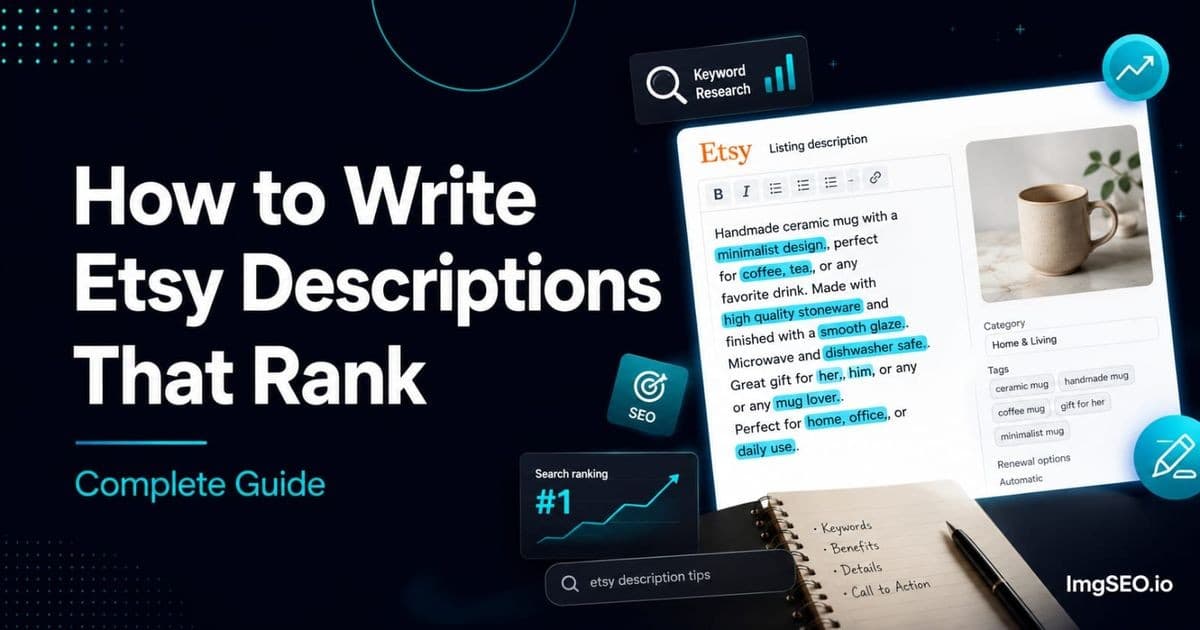
Your Etsy description has three jobs: rank in Etsy search, rank in Google search, and convert the buyer who is already on your page. Most sellers write for one and ignore the other two.
A description that is great at conversion but empty of keywords will not get found. A description stuffed with keywords but written like a robots.txt file will not close the sale. The sellers who do well on both fronts understand that the same 250–400 words can accomplish all three goals simultaneously — if they are structured correctly.
This guide covers the exact structure to use, how the first 160 characters function as your Google ad copy, how to align your description with your image alt text for a compounding SEO signal, and a copy-paste framework you can apply to every listing in your shop.
Key Takeaways
- The first 160 characters double as Google's meta description for your listing, so the opening sentence must carry your primary keyword and read as compelling ad copy.
- The five-section framework — opening, details, use cases, care, shop info — covers SEO and buyer questions in a single 250–400 word description.
- Keyword consistency across title, description, and image alt text compounds the ranking signal; mismatched phrasing across the three weakens all of them.
How Etsy Descriptions Affect SEO
Etsy Internal Search
Etsy's search algorithm weighs signals in roughly this order: title, tags, and then description. Title and tags are the primary ranking factors; descriptions are a secondary relevancy signal. But secondary does not mean irrelevant — when two listings have similar titles and tags, keyword depth in the description is one of the factors that determines which one ranks above the other.
More practically: Etsy uses your description to understand the full context of your product. A detailed, keyword-rich description helps Etsy match your listing to a wider range of relevant search queries that your title alone may not cover.
Google Search
Etsy listing pages are indexed by Google. Your product description is the body content on that page — it works exactly like the body copy on any other webpage. Google reads it, extracts keywords, and uses it to determine which search queries your listing is relevant for.
This means every product you list on Etsy has a Google presence. A well-written description can rank your Etsy listing in Google search results for long-tail product queries that bring buyers directly to your page from outside Etsy entirely.
The first 160 characters of your description are particularly important: Google uses them as the meta description — the two lines of text shown under your listing title in search results. That text determines whether a Google searcher clicks through to your listing.
Image SEO Connection
Description keywords and image alt text work as complementary signals on the same page. When your description repeatedly uses "handmade lavender soy candle" and your images carry alt text containing the same phrase, Google sees consistent, reinforcing keyword signals across both the text and image content of the page. This alignment strengthens the combined SEO impact of both.
For a full breakdown of how product descriptions and image optimization interact, see our guide on product descriptions and image SEO.
The Etsy Description Structure That Works
The 5-Section Framework
A complete Etsy description has five sections in this order:
- Opening paragraph — SEO hook, primary keyword, key product feature
- Product details — materials, dimensions, variants, what is included
- Use cases — who it is for, when to use it, occasions it suits
- Care and handling — how to maintain the product
- Shop information — processing time, shipping, custom orders, returns
Each section serves a different reader and a different purpose. The opening serves Google and impulse buyers. The details section serves deliberate buyers doing their research. The use cases section serves gift buyers searching for occasion-specific keywords. Care and shipping serve buyers who are nearly ready to purchase and just need logistical confidence. Together the five sections cover every stage of the purchase decision.
Section 1: Opening Paragraph (Most Important)
The first sentence is the highest-value real estate in your entire listing. It must do three things simultaneously:
- Contain your primary keyword exactly as a buyer would search for it
- State the key product feature or differentiator
- Read naturally as a compelling product statement
The first 160 characters of your description will appear in Google search results. Write them knowing that a Google searcher will read them before they have ever seen your product.
Here is the formula:
[Primary keyword] + [key feature/material] + [brief value statement]
Applied to a ring listing: "This handmade sterling silver minimalist ring is adjustable from size 5–9, making it a versatile everyday jewelry piece or gift for women who love simple, elegant designs."
That sentence contains: the primary keyword (handmade sterling silver minimalist ring), the key feature (adjustable, sizes 5–9), the use case (everyday jewelry), and the gift occasion keyword (gift for women). It reads like a product description, not a keyword list.
Section 2: Product Details
List the concrete, factual information about the product using bullet points. This is where buyers confirm the listing matches what they are looking for.
Cover: exact materials (sterling silver, not just silver; 100% natural soy wax, not just soy wax), precise dimensions, available colors or variants, and what is physically included in the order. Specificity here reduces returns and buyer questions. A buyer who asks "how big is it?" before purchasing is a buyer who might not purchase at all.
Section 3: Use Cases and Occasions
This section is where long-tail gift and occasion keywords live naturally. Answer three questions: Who is this for? When would someone buy it? Where would it be used?
Examples of phrases that belong here: perfect birthday gift for her, ideal for bridal party favors, great housewarming gift, perfect for everyday wear, ideal desk accessory for home office. These phrases are how gift buyers search. A buyer looking for "birthday gift for sister who loves candles" will not find you unless those words appear somewhere in your listing.
Section 4: Care Instructions
Keep this concise. One to three sentences covering how to clean or maintain the product and how to store it. This section answers a question most buyers have but rarely ask, and answering it proactively builds confidence in the purchase.
Section 5: Shop Information
A brief closing paragraph covering processing time, estimated shipping window, whether custom orders are accepted, and a reference to your return policy. This is not a legal document — a few sentences is enough. It reduces pre-purchase anxiety and cuts down on messages asking the same questions.
Keyword Strategy for Etsy Descriptions
Primary Keywords
Use the same primary keyword that appears in your listing title. It should appear in the first sentence of your description, written exactly as a buyer would type it into search. Do not abbreviate or paraphrase it.
Secondary Keywords
After placing the primary keyword, weave in secondary terms throughout the description naturally:
- Material descriptors: sterling silver, genuine leather, hand-dyed cotton, natural soy wax
- Style descriptors: minimalist, boho, rustic, modern, vintage-inspired
- Occasion keywords: birthday gift, anniversary gift, Christmas gift, wedding favor, housewarming
- Recipient keywords: gift for her, gift for mom, gift for best friend, baby shower gift
Place these where they read as natural product language. A sentence like "Makes a thoughtful birthday gift for her or a meaningful anniversary present" contains three searchable phrases and reads like normal copy.
Long-Tail Keywords in Descriptions
Long-tail phrases — three to five words — often have lower competition and higher purchase intent than head keywords. They belong in your use cases section where natural language creates them organically. Phrases like "handmade jewelry for everyday wear" or "personalized gift for girlfriend birthday" capture specific buyer intent that your title alone cannot.
What to Avoid
Keyword stuffing — repeating the same phrase five times does not improve ranking and does hurt readability. Google has flagged keyword stuffing as a negative signal for years.
Promotional filler — phrases like "Welcome to my shop!" or "I love making these!" use up your first-impression real estate on words that contain no keywords and convert no buyers.
Vague language — "high-quality materials" and "beautiful design" tell buyers nothing. Specificity (14-gauge sterling silver wire, hand-poured in 8oz glass vessel) is both more convincing and more keyword-rich.
Writing for Google: The First 160 Characters
Why 160 Characters Matter
When a buyer finds your Etsy listing through Google — not through Etsy search — the first thing they read is the meta description shown under your title in search results. Etsy uses the first 160 characters of your description as that meta description.
This means your opening is doing double duty as Google ad copy. A buyer who reads a clear, specific, benefit-oriented snippet is far more likely to click through than one who reads a vague or keyword-stuffed opening.
The Perfect Opening Formula
[Primary keyword] + [key feature/material] + [style or size detail] + [brief value statement]
Keep it under 160 characters while including all four elements. Write it as a complete sentence that could stand alone as a product summary.
Examples by Category
Jewelry: "Handmade sterling silver adjustable ring with hammered texture — minimalist design fits sizes 5–9. Perfect everyday jewelry or gift for her." (147 characters)
Home Decor: "Large macrame wall hanging handmade from natural cotton rope — boho bedroom decor measuring 24×36 inches. Ships ready to hang." (127 characters)
Digital Product: "Botanical wall art printable set of 3 — instant PDF download in A4 and 8×10. Boho bedroom gallery wall art ready to print at home." (133 characters)
Candles: "Handmade lavender soy candle poured in small batches from 100% natural soy wax — 8oz glass jar with cotton wick. Clean-burning gift for her." (141 characters)
Each example contains the primary keyword in the first phrase, key product details, and a value statement — all within 160 characters, all readable as natural product language.
The Keyword–Description–Alt Text Triangle
Your Etsy listing page has three main keyword signal sources: the title, the description, and the image alt text. When all three reinforce each other, the combined signal is stronger than any single element alone.
How All Three Work Together
- Title: primary keyword, lead placement, maximum relevancy weight in Etsy search
- Description: primary keyword + secondary keywords, full context, Google body content
- Alt text: visual description of the product image, primary keyword in natural phrase
Practical Alignment Example
Product: Handmade Soy Candle
- Title: "Lavender Soy Candle Handmade Natural Scented 8oz Gift for Her"
- Description opening: "This handmade lavender soy candle is poured in small batches using 100% natural soy wax and pure lavender essential oil..."
- Main image alt text: "Handmade lavender soy candle 8oz glass jar with natural cotton wick"
All three contain "handmade lavender soy candle." Google reads the title, description, and image alt text on the same page and finds consistent, reinforcing keyword signals. This alignment beats a listing where the title says one thing, the description uses different phrasing, and the alt text is left blank.
For a complete guide to writing Etsy titles with the same keyword discipline, see how to write Etsy titles that rank on Google.
Description Length
Recommended Lengths by Goal
| Word Count | What It Achieves | |---|---| | Under 100 words | Insufficient — weak SEO signal, missing buyer information | | 150–200 words | Minimum viable — covers basics, passes SEO threshold | | 250–400 words | Recommended — strong SEO, full buyer information | | 400–500 words | Comprehensive — appropriate for complex or high-ticket products | | Over 500 words | Rarely useful — buyers do not read beyond 400 words |
For most handmade products, 250–400 words is the sweet spot. It provides enough keyword surface area for meaningful SEO while covering everything a buyer needs to make a confident decision without overwhelming them.
A jewelry listing can be fully covered in 250 words. A complex textile piece with care requirements and customization options might warrant 400. A printable digital download rarely needs more than 200.
Seasonal Description Updates
Etsy search traffic spikes dramatically around gift-buying occasions: Christmas, Valentine's Day, Mother's Day, graduation season, and wedding season. Descriptions that include seasonal gift language during these periods capture search queries that your evergreen description misses.
The approach: keep your core product description unchanged. Add a single sentence at the beginning or end during the relevant season. "A meaningful Mother's Day gift, this handmade ring ships with free gift wrapping through May 11." Remove it after the holiday passes.
Make these updates 4–6 weeks before the shopping peak begins — Google needs time to re-index the updated content before peak traffic arrives.
For a complete seasonal SEO calendar, see our Etsy holiday SEO and Christmas guide.
Platform-Specific Formatting
Etsy Description Formatting
Etsy's text editor is simple. You have: line breaks to create paragraphs, dashes to create visual bullet points, and that is essentially it. Bold and italic formatting is not supported. Emoji work and are acceptable in moderation — a single bullet-point emoji (•) or a decorative divider can add visual structure without looking unprofessional.
Use short paragraphs (2–4 sentences) and break up product details into dash-prefixed bullet points. Buyers scan before they read — visual structure helps them find the information they are looking for quickly.
What Etsy Shows vs What Google Reads
Etsy truncates descriptions on the listing page at roughly 500 characters before showing a "Read more" link. Most buyers do not click it. This means your first 500 characters need to work hard for on-platform buyers.
Google reads the full description regardless of truncation. Write for Google with the whole description; structure the first 500 characters for Etsy buyers who will not scroll past the fold.
Common Etsy Description Mistakes
- Generic opening: Starting with "Welcome to my shop!" or "Thank you for visiting!" wastes your most valuable real estate on phrases with zero SEO value
- No primary keyword in the first sentence: If Google cannot find your keyword in the opening, it will not show your listing for that query
- Description under 100 words: Insufficient keyword surface area and missing critical buyer information
- No dimensions or materials: Buyers who cannot find this information either ask (friction) or buy from someone else who included it
- No occasion or recipient keywords: Gift buyers use occasion language to search — if it is not in your description, you are invisible to them
- Copy-pasting the same description across multiple listings: Duplicate content is penalized by Google and reduces the individual relevancy of each listing
- Never updating for seasonal keywords: Missing holiday gift traffic is a significant revenue gap for most handmade sellers
- No care instructions: Creates buyer anxiety and post-purchase dissatisfaction
- Keyword stuffing: Repeating the same phrase unnaturally is a readability problem and a Google spam signal
- Misaligned keywords between description and alt text: Inconsistent signals weaken the SEO impact of both
The Description Template
Copy and adapt this framework for any product:
[Opening paragraph — 2–3 sentences, 160 characters max for first sentence] This [primary keyword] is [key feature/material] — [size/dimension/variant detail]. [Brief value statement — who it is for or what makes it special.]
DETAILS
- Material: [specific material]
- Dimensions: [exact measurements]
- Color/finish: [options available]
- Included: [what ships with the order]
PERFECT FOR [Use cases, occasions, and recipient keywords in 2–3 natural sentences. "Makes a thoughtful [occasion] gift for [recipient]. Ideal for [use context]."]
CARE [1–3 sentences on cleaning, storage, and longevity.]
SHIPPING Processing time: [X business days]. Ships via [carrier]. Estimated delivery [range]. Custom orders: [yes/no and details]. Questions? Message me any time.
Adjust the section headers — Etsy buyers respond to plain language over formal labels. "PERFECT FOR" outperforms "USE CASES." "DETAILS" outperforms "PRODUCT SPECIFICATIONS."
FAQ
Does Etsy description affect SEO? Yes, on both Etsy and Google. Descriptions are a secondary relevancy signal in Etsy search and full page content for Google indexing.
How long should an Etsy description be? 250–400 words for most products. Under 150 words is insufficient for SEO. Over 500 words rarely adds value.
What keywords should I put in my Etsy description? Your primary keyword in the first sentence, then secondary keywords including materials, style, occasion, and recipient terms placed naturally throughout.
Should I use bullet points in Etsy descriptions? Yes, for the product details section. Use dashes to create visual bullets. Use prose paragraphs for the opening, use cases, and closing sections.
Does Etsy description affect Google ranking? Yes. Etsy listing pages are indexed by Google, and your description is the primary body content on that page.
What is the most important part of an Etsy description? The first sentence. It contains your primary keyword, appears in Google search results as the meta description, and determines whether both search engines and buyers engage with the rest of the listing.
How often should I update my Etsy description? Update seasonal gift keywords 4–6 weeks before each major shopping period. Keep the core product description stable to protect existing ranking positions.
Can I use the same description for all my Etsy listings? No. Each listing needs a unique description. Duplicate content is penalized by Google and reduces individual listing relevancy.
Conclusion
Your Etsy description does three jobs: rank in Etsy search, rank in Google search, and convert the buyer on your page. The five-section framework — opening, details, use cases, care, and shop info — covers all three within a single 250–400 word document.
Get the first 160 characters right before anything else. That opening functions as your Google ad copy, your Etsy search snippet, and the first thing every buyer reads. Make it keyword-rich, make it specific, and make it compelling.
Align your description keywords with your title and image alt text. Consistent signals across all three sources compound each other's SEO impact. ImgSEO handles the image metadata side automatically — AI-generated alt text written to align with your product keywords, embedded before you upload.
Update seasonal keywords before each major gift-buying period, write a unique description for every listing, and never open with "Welcome to my shop."
For the keyword research side — finding the exact phrases buyers use before you write a single word of description — see our complete Etsy keyword research guide.


