Searching for an image SEO tool returns dozens of options — browser extensions, standalone apps, AI generators, Shopify plugins, Lightroom presets. Most of them are not built for e-commerce. Some are not really image SEO tools at all, just alt text reformatters that take your product title and rephrase it.
Choosing the wrong tool is not just a waste of money. It is a waste of the time you spend applying output that ranks for nothing because it does not describe what your images actually show.
This guide covers what to look for in an image SEO tool, the red flags that tell you to avoid one, an honest comparison of the main options, and a clear recommendation by use case.
Key Takeaways
- Run the "title-blind test" before buying any tool: upload an image named IMG_001.jpg with no title or description — if the output is vague, the tool is reading your text, not the image.
- A complete image SEO tool does five things: real visual analysis, e-commerce buyer vocabulary, XMP/EXIF metadata embedding, platform-aware output, and multi-image processing. ImgSEO Dashboard modes are Etsy, Shopify, and Other; WooCommerce uses the WordPress integration.
- Manual alt text writing at 3 minutes per image takes 12+ hours for a 250-image catalog; with ImgSEO, larger catalogs require repeated optimization requests of up to five images.
What Is an Image SEO Tool
Definition
An image SEO tool is software that helps optimize product images for visibility in search engines — primarily Google Images and Google Shopping, but also platform search on Etsy, Shopify, and Amazon.
Depending on the tool, this can include:
- Alt text generation — writing descriptive text for the image alt attribute
- Metadata embedding — writing EXIF/XMP data into the image file itself
- Image compression — reducing file size without visible quality loss
- Filename optimization — renaming files for SEO before upload
- Platform-aware output — Dashboard modes for Etsy, Shopify, and Other, with WooCommerce supported through the WordPress integration
Tools range from simple single-image alt text generators to full optimization suites that handle the entire workflow before you upload to your store.
What an Image SEO Tool Should Do
The minimum viable image SEO tool for an e-commerce seller does three things:
- Reads the actual image using computer vision — not your title or filename
- Outputs buyer vocabulary — the words buyers use when searching, not generic descriptions
- Produces platform-appropriate output — Etsy buyers and Shopify buyers search differently
Everything beyond that — metadata embedding, compression, batch processing, filename generation — is added value that compounds as your catalog grows.
The 5 Features That Actually Matter
Feature 1: Visual Analysis — Not Template Generation
This is the single most important distinction between image SEO tools. A real tool uses computer vision to read the pixel content of your image and identify what it actually shows. A fake tool takes your product title or filename and reformats it into alt text syntax.
The difference in SEO output is stark:
Visual analysis output: Sterling silver hammered band ring minimalist adjustable everyday women
Template generation output: Silver ring women handmade gift (sourced from the title "Silver Ring Women Handmade Gift")
The template output contains zero visual detail — no material grade (sterling vs silver-tone), no texture (hammered), no style (minimalist, band), no function (adjustable). These are the specific words buyers actually search for. Without them, the image ranks for nothing competitive.
How to test any tool: Upload a product image with a completely generic filename — IMG_001.jpg — and provide no title or description. If the output accurately identifies the material, texture, product type, and style visible in the image, it is performing real visual analysis. If the output is vague, it is reading metadata you provided.
Feature 2: E-commerce Keyword Mapping
Generic image AI identifies what an object is. E-commerce image AI maps what it sees to buyer search vocabulary.
A generic model sees: "a metallic circular band object on a white surface"
An e-commerce model generates: "sterling silver minimalist ring adjustable women"
The difference is training data. E-commerce AI is trained on buyer search queries and knows that a specific type of metallic sheen on a thin band maps to "sterling silver," that thin bands in that style map to "minimalist," and that buyers searching for this product use "ring for women" or "women's ring" rather than "ring object."
This vocabulary gap is the reason generic captioning tools produce output that looks like alt text but ranks for nothing product-specific.
Feature 3: Metadata Embedding
Alt text is written on the web page, in the HTML attribute of the image element. Metadata is embedded inside the image file itself. ImgSEO writes XMP metadata to JPEG, WebP, and AVIF exports, with EXIF additionally included for JPEG.
Most image SEO tools stop at alt text. Embedded metadata can still be useful for two reasons:
Metadata stays with the exported source file — search engines and destination platforms determine whether that metadata is preserved or used.
Metadata persists across platforms — if you reuse an image across multiple platforms or channels, the metadata travels with the file.
A tool that embeds XMP metadata provides descriptive and rights-related information inside the exported file in addition to its separate alt text output.
Feature 4: Platform-Specific Optimization
Etsy buyers and Shopify buyers use different search language for the same product.
Etsy buyer search for a ring: "handmade ring women gift," "sterling silver ring minimalist gift for her," "adjustable ring handmade"
Shopify buyer search for the same ring: "sterling silver adjustable ring," "minimalist band ring women," "925 silver ring"
Etsy searches include handmade signals, gift intent, and craft vocabulary. Shopify searches lean toward specifications and material grades. An image SEO tool that does not distinguish between platforms produces output optimized for neither.
For Etsy specifically, tag generation matters as much as alt text. Etsy's algorithm uses the 13-tag field as a primary ranking signal — a tool that generates tags alongside alt text from the same visual analysis saves significant manual work.
Feature 5: Batch Processing
For a catalog of 10 products, processing one image at a time is manageable. For 50, 100, or 500 products, it is the primary bottleneck.
Multi-image processing reduces repetitive work. ImgSEO accepts up to five supported images per request and lets you download the processed results as a ZIP; repeat the workflow for larger catalogs.
For a detailed comparison of AI vs manual image SEO workflows at scale, see AI image SEO vs manual optimization.
Red Flags to Avoid
Red Flag 1: Generates from Title Only
This is the most common false "AI" image SEO tool pattern. The tool asks for your product title, takes that text, and reformats it into alt text structure. No image is ever analyzed.
How to spot it: submit two completely different product images — a ring and a candle — with the same product title. If both images produce nearly identical alt text, the tool is reading your title, not your images.
The output looks plausible and is easy to miss as a problem — the words are relevant to your product because they came from your title. But the visual details (material texture, specific style, craft signals) that earn Google Images rankings are absent.
Red Flag 2: No Metadata Embedding
A tool that generates alt text without embedding XMP metadata does not add descriptive or rights-related information inside the exported image file.
Alt text lives on the web page, while metadata lives inside the image file. Search engines and destination platforms determine whether embedded metadata is preserved or used, so prioritize descriptive alt text, filenames, relevant page context, crawlability, and appropriate image performance for image SEO.
Red Flag 3: No Platform Awareness
Generic alt text that uses the same vocabulary for Etsy and Shopify misses the vocabulary differences that actually drive platform-specific search rankings. A tool without platform selection either does not know about these differences or does not think they matter — both are reasons to look elsewhere.
Red Flag 4: No Review Step
Any tool that automatically applies generated alt text without showing it to you first is a risk. AI visual analysis is highly accurate for common product categories but occasionally misidentifies materials, colors, or product types. A ring with an unusual stone might be described as a different gem. A specific shade of blue might be called green.
Good tools generate output for review before application. You should be able to read, edit, and approve every piece of alt text before it goes live on your listings.
The Image SEO Tool Comparison
Full-Suite Tools
ImgSEO — Best for E-commerce
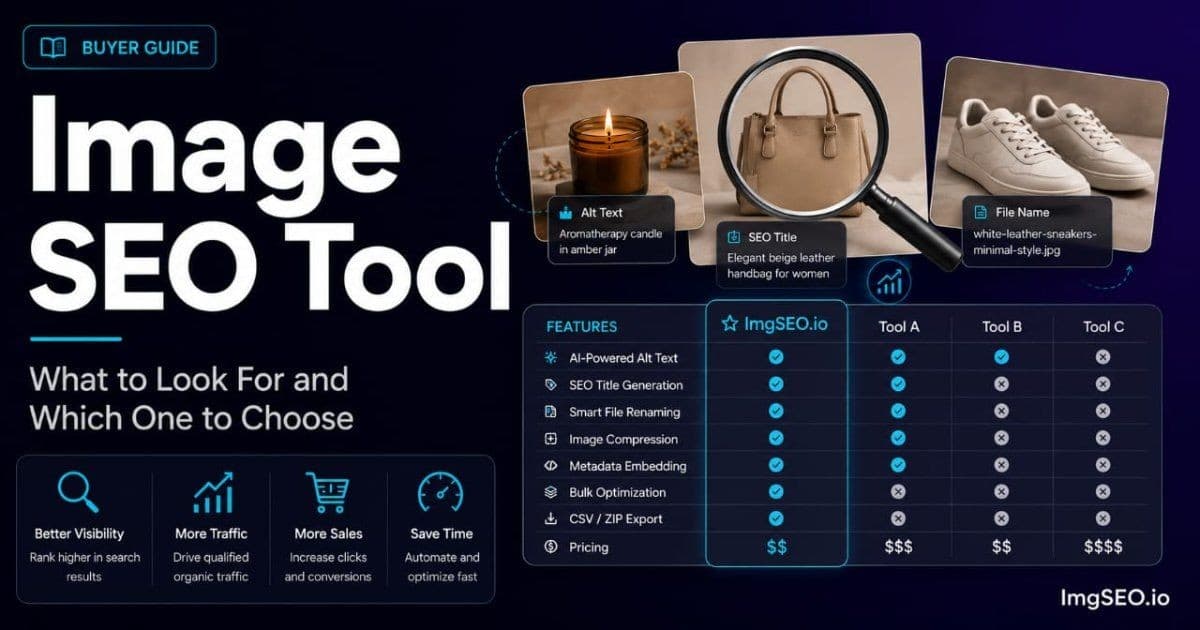
| Feature | Status | |---|---| | Visual image analysis | ✅ Computer vision reads actual image | | Metadata embedding | ✅ XMP/EXIF embedded in downloaded file | | Platform optimization | ✅ Dashboard: Etsy, Shopify, Other; WooCommerce: WordPress integration | | Multi-image processing | ✅ Up to five images per request; ZIP download | | Compression | ✅ JPEG, WebP, AVIF | | Review step | ✅ Review before download | | Free tier | ✅ 30 images one-time, no credit card |
Built specifically for e-commerce sellers. Generates alt text, SEO title, tag suggestions, and XMP metadata from uploaded images. Dashboard output is adjusted for Etsy, Shopify, or Other. Process up to five images per request and repeat for larger catalogs.
Best for: Etsy and Shopify sellers who want complete image optimization — alt text, metadata, compression — in a single workflow.
Alt Text Only Tools
ChatGPT with Vision
| Feature | Status | |---|---| | Visual image analysis | ✅ GPT-4o reads images | | Metadata embedding | ❌ | | Platform optimization | ⚠️ Requires detailed prompting | | Batch processing | ❌ One image per conversation | | Free tier | ✅ Free with daily limits |
Genuine visual analysis with high accuracy. Output quality depends entirely on how specifically you prompt it — a vague prompt gets a vague result. No metadata, no batch, no platform-specific vocabulary without manual prompt engineering every time.
Best for: Sellers with under 20 products who want a free option and are comfortable writing detailed prompts.
Shopify Magic
| Feature | Status | |---|---| | Visual image analysis | ✅ Built into Shopify admin | | Metadata embedding | ❌ | | Platform optimization | ✅ Shopify only | | Batch processing | ❌ One image at a time | | Free tier | ✅ Included with Shopify |
One-click alt text generation directly in the Shopify product media section. Performs real visual analysis but produces generic captions rather than buyer-intent keywords. A useful first draft — not finished SEO output.
Best for: Shopify sellers who want basic coverage on new products quickly, intending to improve the output manually.
SEO Audit Tools
SEMrush / Ahrefs
These are site auditing tools, not image SEO tools. They identify images that are missing alt text, have oversized file sizes, or lack descriptive filenames — but they do not generate alt text or embed metadata.
Best for: Enterprise e-commerce stores with an existing SEO team who need to audit a large site and then use a dedicated image SEO tool to fix the issues found.
How to Evaluate Any Image SEO Tool
The 3-Image Test
Before committing to any tool, run this test:
- Upload three product images from completely different categories — for example, a piece of jewelry, a home goods item, and a clothing product
- Check whether the output for each image is meaningfully different
- Verify that specific materials and styles are mentioned (not just generic category words)
- Ask: would a buyer actually search for these phrases?
A tool that produces distinctly different, material-specific output for each product is performing real visual analysis. A tool that produces minor variations on the same generic structure is templating.
The Title-Blind Test
- Upload a product image with a generic filename:
IMG_001.jpg - Provide no product title, no description, no context
- Read the output
If the tool accurately describes the material, color, style, and product type visible in the image without any text input, it is reading the image. If the output is vague ("a product on white background") or suspiciously similar to your usual title, it is not.
The Keyword Specificity Check
Compare the modifier count between tools:
Generic (4 modifiers): handmade ring silver women gift
Specific (8 modifiers): sterling silver hammered adjustable band ring minimalist women everyday
Count the specific, differentiated descriptors. More specific modifiers mean more search queries the image can rank for — each modifier is a potential keyword combination a buyer might search.
Which Image SEO Tool Is Right for You
For Etsy Sellers
Etsy requires a specific vocabulary: handmade signals, gift keywords, craft terminology, and 13 tags that match buyer search language. No generic alt text generator produces this without being specifically trained on Etsy buyer data.
Best choice: ImgSEO — generates alt text and 13 tags together from visual analysis, with Etsy-specific vocabulary built in.
Budget option for small catalogs: ChatGPT with a prompt that specifies "Etsy buyer vocabulary, include handmade signal, gift keywords, and 13 tags."
For the complete Etsy image optimization workflow, see the Etsy SEO guide.
For Shopify Sellers
Shopify sellers benefit from original filenames persisting in CDN URLs — making pre-upload filename optimization permanently valuable. They also have Shopify Magic as a free baseline, and Product schema built into all themes.
Best choice: ImgSEO for existing catalog optimization (batch processing, metadata embedding, descriptive filenames); Shopify Magic for quick first draft on new individual products.
For the full Shopify image SEO approach, see the Shopify SEO guide.
For WooCommerce Sellers
WooCommerce has no built-in image SEO tool. Filenames persist in WordPress media URLs, making descriptive filenames essential and permanent. Alt text is set per-image in the media library.
Best choice: ImgSEO — the Dashboard generates filenames alongside alt text and metadata using its Other mode for general workflows, while WooCommerce is supported through the ImgSEO WordPress integration.
For WooCommerce-specific image SEO, see the WooCommerce image SEO guide.
For Large Catalogs (500+ Products)
At scale, batch processing and output consistency are the primary requirements. Processing 500 products one at a time in any tool is not viable.
Best choice: ImgSEO paid plan — process up to five images per request, repeat for larger catalogs, and download processed results as a ZIP plus SEO data as CSV.
Combine with: SEMrush or Ahrefs for site auditing to identify which images still need optimization and to track Google Images impressions in Search Console.
The Cost-Benefit Analysis
Free Options
ChatGPT free tier — Genuine visual analysis, daily usage limits, no metadata, no batch. Practical for 10–20 images.
Shopify Magic — Free with Shopify, real visual analysis, Shopify-only, generic output. A starting point that needs improvement.
ImgSEO free tier — 30 images one-time, full features including metadata embedding and batch processing, no credit card required. The most complete free option for e-commerce.
Paid Options
ImgSEO paid — Scales with catalog size. Full feature set including batch processing at volume.
SEMrush / Ahrefs ($130+/month) — Appropriate for enterprise e-commerce with dedicated SEO teams. Not an alt text generator — an audit tool that identifies problems for a separate tool to fix.
ROI Framework
Traffic from a product image varies with query demand, relevance, competition, crawl and indexing behavior, and site authority. Measure impressions and clicks in Search Console instead of relying on a fixed traffic estimate.
The time cost of manual optimization at scale makes dedicated image SEO tools increasingly useful as catalog size grows. At 250 images, manual alt text at 3 minutes per image is 12+ hours. Process larger catalogs through repeated ImgSEO optimization requests of up to five images.
Frequently Asked Questions
What is the best image SEO tool for Etsy? ImgSEO — it generates Etsy-specific alt text and 13 tags from visual analysis in one step, with handmade signals, gift keywords, and craft terminology built into the output.
Do I need a paid image SEO tool? Not to start. ImgSEO's free tier covers 30 images one-time with full features. ChatGPT is also free for small catalogs. Paid tools become necessary above free tier limits or when batch processing consistency matters at volume.
What should an image SEO tool include? Visual image analysis, e-commerce buyer vocabulary, XMP metadata embedding, platform-specific optimization, and a review step before applying output. Batch processing is important for catalogs above 20 products.
Can I use ChatGPT as an image SEO tool? Yes for small catalogs. GPT-4o performs real visual analysis with good accuracy. The main gaps are no metadata embedding, no batch processing, and no built-in platform vocabulary — all of which require manual workarounds that become impractical at scale.
What is the difference between an image SEO tool and an alt text generator? An alt text generator produces one piece of text for one image field. A full image SEO tool generates alt text plus embeds XMP metadata, optimizes filenames, compresses the image, and adjusts output for the specific platform. Alt text is one component; a complete tool addresses the full optimization stack.
How do I know if an image SEO tool uses real visual analysis? Run the title-blind test: upload an image with a generic filename and no title context. If the output accurately identifies specific materials, textures, and product styles from the image alone, the tool is performing visual analysis.
Is Shopify Magic a good image SEO tool? It is a good starting point — free, built-in, real visual analysis. But it is not a complete image SEO tool: output is generic rather than buyer-intent optimized, there is no metadata embedding, no batch processing, and it only works for Shopify.
What image SEO tool works for WooCommerce? ImgSEO supports WooCommerce through its WordPress integration. The Dashboard separately provides Etsy, Shopify, and Other modes, metadata-equipped exports, and descriptive filename generation.
Conclusion
A real image SEO tool reads your actual product images. It does not reformat your title. The output accurately identifies specific materials, textures, and styles that buyers search for — and it embeds that information as both alt text and XMP metadata.
Must-haves:
- Visual analysis (not title-based templates)
- E-commerce buyer vocabulary in output
- XMP metadata embedding
- Platform-specific optimization
Nice-to-have:
- Batch processing for catalogs above 20 products
- Image compression included
- Review step before applying output
Red flags:
- Identical output for different images with the same title
- No metadata embedding option
- No platform selection
- No review step before auto-applying
ImgSEO covers the workflow with visual analysis, metadata embedding, Dashboard modes for Etsy, Shopify, and Other, processing for up to five images per request, and compression. WooCommerce is supported through the ImgSEO WordPress integration. The free tier covers 30 images one-time with no credit card required.
For a broader comparison of AI image SEO tools, see best AI tools for image SEO.