
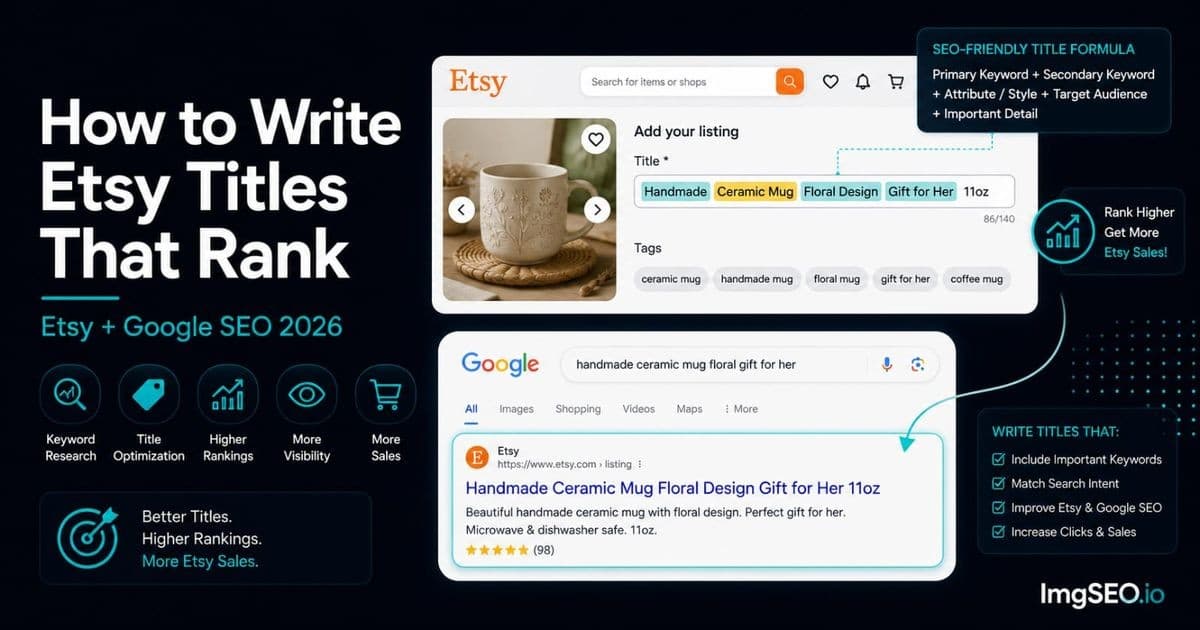
Your Etsy listing title does three jobs at once. It tells Etsy's search algorithm what your product is. It becomes the clickable headline Google shows in search results. And it has to be compelling enough that a buyer scanning a page of results actually clicks it. Most sellers write titles optimized for one of these three jobs and unknowingly undermine the other two.
The counterintuitive part: Etsy's title is not just an Etsy SEO element. When Google indexes your Etsy listing, your title becomes the HTML page title — the primary relevance signal Google uses to rank the page. More directly, Etsy uses your product title as the default alt text for your listing images in Google Images. A keyword-rich title is keyword-rich image alt text, automatically, on every image in your listing. That is why title optimization produces improvements across both Etsy search and Google Images simultaneously.
This guide covers the complete title optimization system: the formula, keyword research methods, category-specific examples, seasonal strategy, and the ten mistakes that cost sellers rankings every day.
Key Takeaways
- Etsy shows roughly the first 40 characters of your title on mobile search and 55–60 on desktop — your primary keyword must sit inside that window, not past it.
- The formula is [Primary keyword] + [material/medium] + [style descriptor] + [size/variant] + [occasion/recipient], filled out to the full 140-character limit.
- Etsy automatically reuses your title as the alt text for every listing image in Google Images, so title keywords become image SEO signals with no separate alt text field required.
How Etsy Titles Affect SEO
Etsy Internal Search
Title is the single highest-weighted field in Etsy's search relevance algorithm. When a buyer searches "sterling silver minimalist ring," Etsy scans listing titles for that exact phrase. Listings whose titles contain the phrase as a contiguous string — not split across words, not buried at the end — score higher on relevance than those that contain the words in a different order or separated by other terms.
Etsy displays approximately the first 40 characters of your title in search results on mobile, and the first 55–60 characters on desktop. Everything beyond that is truncated with an ellipsis. A buyer scanning search results sees those first 40–60 characters and decides whether to click — they never read the full 140-character title unless they open the listing. Your primary keyword must appear in those first 40 characters, not because the algorithm requires it (though it helps), but because the buyer scanning results needs to identify your product immediately.
Google Search
When Google indexes an Etsy listing, the listing title becomes the HTML <title> tag — the element Google uses as the clickable blue headline in search results. Your Etsy title appears in Google results formatted as: Sterling Silver Minimalist Ring Women | Etsy. That headline is what a buyer searching on Google clicks.
Google treats the page title as the strongest signal of page topic. A title that begins with "sterling silver minimalist ring" ranks higher for that query than one that buries it after shop name and marketing language. The Etsy domain already carries significant authority on Google — the title is what converts that authority into relevance for your specific product keyword.
Image SEO Connection
Etsy automatically uses your product title as the alt text for your listing images when Google Images crawls Etsy listings. This has a direct consequence: every keyword in your title is a keyword signal for every image on your listing in Google Images search.
A title of "Sterling Silver Minimalist Ring Women Adjustable Boho Jewelry Gift for Her" gives Google the signals to rank your listing images for "sterling silver ring," "minimalist ring women," "adjustable boho jewelry," and "gift for her jewelry" simultaneously — without you writing a single separate alt text field.
This does not replace dedicated image alt text, which provides additional and more specific signals. But it means title optimization is always the starting point for image SEO on Etsy. For a complete guide to adding image-specific alt text on top of title optimization, see our Etsy image SEO guide.
Understanding Etsy's Search Algorithm
How Etsy Ranks Listings
Etsy's ranking algorithm weighs five factors in descending order of direct seller control:
- Query matching — does your title contain the exact phrase the buyer searched?
- Listing quality score — what is your CTR, conversion rate, and listing completeness?
- Customer experience score — what are your reviews, shipping reliability, and policy adherence?
- Recency — how recently was the listing published or renewed?
- Personalization — what has this specific buyer clicked and purchased before?
Sellers control factors one, two (partially, through image quality and listing completeness), and four. Factors three and five accumulate over time through sales and reviews. Title optimization directly addresses factor one, and a keyword-precise title that matches buyer intent more exactly than competitors' titles also improves factor two by increasing click-through rate.
Where Title Keywords Matter Most
Etsy matches exact phrases, not just individual words. "Sterling silver ring" as a three-word phrase in your title matches a buyer searching "sterling silver ring" more precisely than a title containing "silver" and "ring" separated by other words. Word order matters for this reason — lead with the most-searched phrase as a contiguous unit.
The practical implication: if buyers search "minimalist sterling silver ring" more than "sterling silver minimalist ring," that word order belongs in your title first. Use Etsy autocomplete to verify the actual search phrase buyers use, not the order that sounds natural to you as the seller.
Title vs Tags Relationship
Titles and tags work as a system, not as duplicates. Tags reinforce and extend title relevance — they should cover adjacent keyword phrases that are related but not identical to what the title already contains.
If your title contains "sterling silver minimalist ring women," your tags should cover: "boho ring gift," "adjustable silver ring," "dainty ring women," "gift for girlfriend," "handmade silver jewelry." These add coverage for searches your title does not target rather than repeating phrases it already contains. Repeating exact title phrases in tags is wasted tag space — Etsy already knows those phrases from the title.
The Etsy Title Formula
Formula for Most Products
[Primary keyword] + [material/medium] + [style descriptor] + [size/variant] + [occasion/recipient]
This formula produces titles that match Etsy searches (primary keyword leading), pass Google's relevance check (keyword-rich page title), and give buyers enough context in the visible 40–60 characters to identify the product and decide to click.
Character Limits and Strategy
- Maximum: 140 characters
- Visible in Etsy search (mobile): first 40 characters
- Visible in Google results: first 60 characters
- Strategy: most important keyword phrase in characters 1–40; supporting keywords in 41–140
Do not waste the first 40 characters on your shop name, filler adjectives, or punctuation. Every character in that window is competing for buyer attention in a grid of thumbnails.
What to Include
- Primary keyword — the exact phrase buyers search to find your product type
- Material — sterling silver, organic linen, ceramic, natural cotton, recycled brass
- Style — minimalist, boho, vintage, modern, cottagecore, maximalist
- Occasion — gift, wedding, birthday, graduation, housewarming, holiday
- Recipient — women, men, baby, teacher, dog lover, plant mom
What to Exclude
- Your shop name — buyers do not search your shop name; it wastes keyword space
- Filler words — "beautiful," "amazing," "perfect," "lovely" add no search relevance
- Punctuation — commas, dashes, and pipes can interrupt phrase matching and reduce readability
- All caps — reads as aggressive, reduces CTR, does not improve ranking
- Repeated words — "silver silver ring" is wasted character space and looks spammy
Keyword Research for Etsy Titles
Method 1: Etsy Search Autocomplete
The fastest and most reliable keyword research tool for Etsy titles is Etsy's own search bar. Type your product type and read every autocomplete suggestion — these are real buyer searches ranked by frequency. The suggestions at the top of the dropdown are the phrases buyers use most. Every suggestion that applies to your product belongs in your title, tags, or both.
Run autocomplete searches for multiple entry points: the product type alone ("ring"), the material + product ("silver ring"), the style + product ("minimalist ring"), and the occasion + product ("gift ring"). Each entry point surfaces different phrase combinations that buyers use.
Method 2: Etsy Search Results Analysis
Search your primary keyword on Etsy and open the top five to ten listings. Read their titles carefully. Identify phrase patterns that appear in multiple high-ranking titles — those phrases have demonstrated SEO value because experienced sellers have tested and refined them. Identify gaps: keywords you see in some titles but not others that your product could legitimately claim.
Do not copy titles verbatim. Duplicate content hurts both listings. Use competitor titles as keyword research, then build a title with the validated phrases in a different order and combination that reflects your specific product.
Method 3: eRank Free Tier
eRank provides keyword search volume data specifically for Etsy — something Etsy's own tools do not expose. The free tier allows a limited number of keyword searches per day, which is sufficient for researching a new listing or auditing underperforming ones. Enter your candidate keywords and compare search volume and competition level. High-volume, lower-competition phrases are the primary keyword targets for a new listing trying to establish ranking.
Method 4: Google Keyword Planner
Because your Etsy title becomes your Google page title, Google search volume is directly relevant to Etsy title optimization. Google Keyword Planner (free with a Google Ads account) shows monthly search volume for keyword phrases on Google. A phrase with strong Google search volume that you include in your Etsy title improves both Etsy-internal relevance and Google page ranking simultaneously. Use it to validate that your primary keyword phrase has real search demand on Google, not just Etsy.
Title Examples by Product Category
Handmade Jewelry
❌ Handmade Ring - Silver - Minimalist Design by MyShop
✅ Sterling Silver Minimalist Ring Women Adjustable Boho Jewelry Handmade Gift for Her
The bad title leads with a generic term, wastes characters on the shop name, and uses punctuation that interrupts phrase matching. The good title leads with the exact search phrase "sterling silver minimalist ring," identifies the buyer ("women"), includes style ("boho"), and ends with an occasion keyword ("gift for her").
❌ Gold Necklace Dainty Pretty
✅ Dainty Gold Filled Chain Necklace Layering Women Minimalist Jewelry Birthday Gift
The bad title uses a vague filler adjective ("pretty") and omits material specifics. The good title specifies "gold filled" (the actual material buyers search), includes a popular style format ("layering"), and adds an occasion keyword.
Home Decor
❌ Wall Hanging - Boho - Natural Cotton - Large
✅ Large Macrame Wall Hanging Boho Bedroom Decor Natural Cotton Handmade Woven Wall Art
The bad title uses dashes as separators (interrupting phrase matching) and omits the material type "macrame" — the most-searched term for this product. The good title leads with size ("large") because buyers frequently filter by size, then specifies the product type buyers search ("macrame wall hanging"), room context, and material.
❌ Ceramic Vase White Minimalist
✅ Handmade Ceramic Vase White Matte Minimalist Home Decor Living Room Housewarming Gift
The bad title has no room context, no occasion keyword, and no finish specification. The good title adds "matte" (a specific buyer filter), room context ("living room"), and a high-value occasion keyword.
Clothing and Accessories
❌ Linen Dress Women Summer
✅ Linen Midi Dress Women Oversized Casual Summer Sustainable Slow Fashion Natural
The bad title omits the dress silhouette ("midi"), the fit ("oversized"), and the values keywords that buyers in this category actively filter for ("sustainable," "slow fashion"). These terms have significant search volume from buyers who will not purchase without them.
❌ Tote Bag Canvas Natural
✅ Organic Cotton Canvas Tote Bag Natural Reusable Shopping Market Bag Minimalist Gift
The bad title lacks material specificity ("organic cotton" vs generic "canvas"), use context ("shopping," "market"), and occasion keyword. The good title captures the complete phrase buyers search and adds a gift keyword.
Digital Products
❌ Printable Art - Botanical - Instant Download
✅ Botanical Wall Art Printable Set 3 Pieces Boho Bedroom Decor Instant Download PDF
The bad title leads with the format ("printable art") rather than the content ("botanical wall art") — buyers search the content first. The good title specifies set size ("3 pieces"), room context, and format at the end.
Print on Demand
❌ Cat Mom Shirt Funny
✅ Funny Cat Mom T-Shirt Women Cute Cat Lover Gift Birthday Unisex Cotton Tee
The bad title omits the recipient ("women"), the garment type specificity ("t-shirt" vs "shirt"), and the occasion. The good title includes multiple gift occasion signals and the search-specific term "cat lover gift."
The Google SEO Title Strategy
Your Etsy Title Is Your Google Page Title
Google displays your Etsy listing in search results as: [Your Title] | Etsy. The title portion is limited to approximately 60 characters in Google's display — beyond that, Google either truncates or rewrites the title based on page content. Your most important keyword phrase must appear in the first 60 characters to display intact in Google results.
Write your title to be compelling for human readers scanning Google results, not just for algorithm matching. "Sterling Silver Minimalist Ring Women Adjustable | Etsy" is what a buyer sees in Google results. It needs to communicate product type, material, and a buyer qualifier clearly enough to earn the click from someone who has not yet seen your images.
Optimizing for Google Seasonal Searches
Gift occasion searches on Google follow predictable seasonal patterns, and your Etsy title captures Google traffic for those searches when it contains the right phrases. "Gift for her jewelry sterling silver" ranks for both Etsy-internal gift searches and Google's "[occasion] gift for her" queries. The occasion keywords at the end of the title serve double duty: Etsy search coverage and Google seasonal search coverage.
The Keyword Alignment Strategy
Title → Google page title → automatic image alt text on Etsy: these three elements are linked. A title of "Sterling Silver Minimalist Ring Women Adjustable Boho" produces:
- An Etsy search match for "sterling silver minimalist ring," "adjustable boho ring," and "women jewelry"
- A Google page title that ranks for those same phrases
- Automatic alt text on every listing image containing all of those phrases
The alignment between title, page title, and image alt text reinforces your keyword relevance signal across three indexing mechanisms simultaneously. Adding dedicated per-image alt text through Etsy's "Describe this photo" field builds on top of this foundation with more specific, image-contextual keywords. For guidance on the complete alt text strategy, see our complete guide to alt text.
Seasonal Title Optimization
Why Seasonal Titles Drive Sales
Gift-occasion searches spike predictably around holidays. "Gift for her" searches increase by 300–500% in the weeks before Valentine's Day, Mother's Day, and Christmas. Sellers who add seasonal keywords to their titles before these peaks capture traffic that sellers with static titles miss entirely. A "sterling silver ring women" title captures year-round searches. A "sterling silver ring women Valentine's Day gift" title captures the same year-round searches plus the high-volume seasonal spike.
Seasonal Keyword Calendar
| Season | Keywords to Add | |--------|----------------| | January–February | valentines gift, galentines gift, love gift, anniversary | | March–April | mothers day gift, easter gift, spring decor | | May–June | graduation gift, wedding gift, summer, bridesmaid gift | | September–October | fall decor, halloween, back to school, teacher gift | | November–December | christmas gift, holiday gift, stocking stuffer, hanukkah |
How to Update Titles Seasonally
The practical workflow for seasonal title updates:
- Identify which listings have occasion keywords that map to an upcoming season
- Edit the title to add the seasonal keyword — you may need to remove a lower-priority word to stay within 140 characters
- Update tags to match the seasonal addition
- Set a calendar reminder to revert or update the title after the season ends
Some seasonal keywords remain valuable year-round — "gift for her," "birthday gift," and "wedding gift" have consistent search volume outside peak seasons. Keep these permanently. Spike keywords like "valentines gift" are best added two to three weeks before the holiday and removed or replaced afterward to avoid irrelevance signals.
Title Split Testing on Etsy
How to Test Different Titles
Etsy does not have a native A/B testing feature. The manual approach: create two listings with the same product and different titles, run both with identical pricing and images for 30 days, compare views and conversion rate in Etsy Stats, keep the winner, and close the lower performer.
The limitation of this method is that the two listings split your traffic rather than doubling it. Run split tests on listings that already have enough traffic to produce statistically meaningful data — a listing with 5 views per week is too low-traffic to draw conclusions in 30 days. Use split testing on your top performers where the data accumulates faster and the winning title has the most impact.
What to Test
Primary keyword position — does "Sterling Silver Ring Women Minimalist" outperform "Minimalist Sterling Silver Ring Women"? Buyer search patterns determine word order priority, and autocomplete research gives you a starting hypothesis, but the actual click data tells the truth.
Occasion keywords vs style keywords — does adding "Gift for Her" at the end drive more conversion than adding a second style descriptor? For some products in gift-heavy categories, occasion keywords are the highest-converting element. For others, style specificity converts better. Test to find out.
Long descriptive vs shorter punchy — full 140-character titles are not always the highest performers. Some product categories respond better to titles that read naturally to human buyers at the cost of some keyword density. The scroll test matters: does the title make a buyer want to click?
Common Etsy Title Mistakes
Shop name in the title. Your shop name is not what buyers search. Every character spent on your shop name is a character not spent on a keyword that matches what buyers type. Remove it.
Starting with adjectives instead of product type. "Beautiful handmade sterling silver ring" buries the product type ("ring") behind words that carry no search relevance. Lead with the noun buyers search.
Punctuation that breaks phrase matching. Dashes and commas between words interrupt exact phrase matching in some search configurations. "Sterling Silver - Ring - Minimalist" is not the same as "Sterling Silver Ring Minimalist" for phrase matching purposes.
Keyword stuffing that reads unnaturally. "Ring Silver Sterling Jewelry Handmade Silver Ring Women Adjustable Ring" has obvious repetition and reads as spam. Buyers notice, and lower CTR from human readers hurts your listing quality score.
Ignoring the first 40 characters. Optimizing only the full 140-character title while burying the primary keyword past character 40 means Etsy mobile search results never show the keyword — buyers see a truncated title that does not identify the product.
Never updating titles seasonally. A static title misses every gift-season traffic spike. Seasonal keyword updates take minutes and capture traffic peaks that represent a significant portion of annual Etsy sales volume.
Copying competitor titles exactly. Duplicate content signals dilute both listings' relevance. Use competitor titles for keyword research, then write your own variation.
Using only one-word tags to accompany the title. Single-word tags ("ring," "silver," "gift") match too broadly and compete against millions of listings. Multi-word phrase tags ("sterling silver ring," "boho ring women") match specific buyer searches and reduce irrelevant competition.
Not including recipient keywords. "Gift for her," "gift for him," "gift for teacher" capture the enormous volume of occasion-driven shopping that accounts for a significant fraction of Etsy's total transaction volume. Omitting them means missing a buyer category that was ready to purchase.
Forgetting that the title is your image alt text. Every keyword you omit from the title is a keyword omitted from the automatic image alt text Etsy applies to your listing images. Title optimization and image SEO are not separate tasks on Etsy — they are the same task.
Frequently Asked Questions
How long should an Etsy title be?
Use the full 140 characters when you can fill them with relevant keywords. A title with 60 keyword-rich characters is better than one with 140 characters of filler, but in practice, most products have enough legitimate keyword angles — material, style, size, occasion, recipient — to fill the full limit meaningfully.
Should I use commas in Etsy titles?
Avoid them. Commas can interrupt exact phrase matching and add no search value. Write your title as a flowing string of keyword phrases without punctuation separators.
How many keywords should I put in an Etsy title?
There is no specific number — optimize for keyword-rich natural language rather than a keyword count. A 140-character title written well typically contains four to eight distinct keyword phrases depending on phrase length.
Does Etsy title affect Google ranking?
Directly and significantly. Your Etsy title becomes the HTML page title Google uses as its primary relevance signal. A keyword-optimized Etsy title improves Google ranking for those keywords. A title full of filler words and shop name produces a weak Google page title that ranks for nothing specific.
Should I put my shop name in the Etsy title?
No. Your shop name appears on the listing page without using title character space. Buyers do not search your shop name — they search product types and keywords. Using title characters for your shop name is a direct trade of keyword relevance for zero benefit.
How often should I change my Etsy titles?
Update seasonally — two to three weeks before major gift holidays. Update when Etsy Stats shows a listing with low views despite good tags, which usually indicates a title relevance problem. Do not change well-performing titles frequently — stability allows ranking signals to accumulate.
What is the most important part of an Etsy title?
The first 40 characters. That is what buyers see in Etsy mobile search results before deciding to click. The primary keyword phrase must appear there as a contiguous, correctly ordered string.
Do Etsy titles affect image SEO?
Yes — Etsy automatically uses your product title as the alt text for listing images when Google crawls the page. This means every keyword in your title becomes a Google Images ranking signal for every image on your listing. Optimizing the title is the foundation of Etsy image SEO. Adding per-image alt text via the "Describe this photo" field builds additional, image-specific signals on top of what the title provides automatically.
Conclusion
Your Etsy title is your most powerful SEO lever — it affects Etsy search ranking, Google page ranking, and Google Images ranking simultaneously through a single field. Leading with the primary keyword in the first 40 characters, including material, style, occasion, and recipient keywords in the remaining space, and updating seasonally around gift holidays is a system that works across all three channels without requiring separate optimization for each.
The title-as-automatic-image-alt-text relationship is the most underappreciated aspect of Etsy title optimization. Every keyword you add to a well-crafted title becomes a Google Images ranking signal for every image in your listing, automatically. That is why sellers who focus on titles first see Google Images improvements without touching a single alt text field — the title is doing that work.
Adding dedicated per-image alt text through Etsy's "Describe this photo" field, plus embedded metadata before uploading, extends those signals further. ImgSEO handles the metadata embedding and per-image alt text generation automatically, giving every listing image keyword signals beyond what the title alone provides. Try free — 30 images.
For the complete new-seller Etsy SEO system that builds on title optimization, see our Etsy SEO tips for new sellers.


