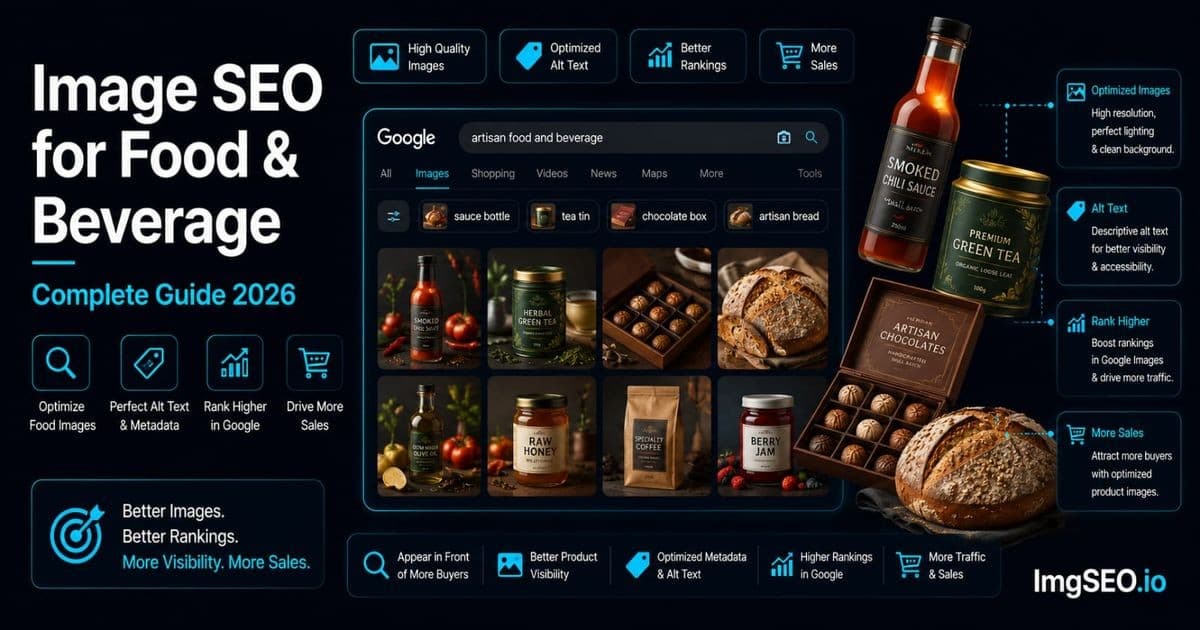
Food is one of the most searched visual categories on Google — and one of the most competitive. Buyers searching for artisan hot sauce, gluten-free cookies, or adaptogenic coffee blends are not browsing casually. They have a specific ingredient in mind, a dietary need to meet, or a gift occasion driving the search. If your product image and its metadata do not match that specificity, you do not appear.
Online food and beverage sales continue to grow at double-digit rates annually. The category spans artisan bakers, small-batch condiment producers, specialty tea importers, craft chocolate makers, and functional beverage brands — all competing in Google Images alongside each other and against large-scale food retailers. The edge for smaller producers is the detail: the buyer searching "small batch habanero hot sauce" is not looking for Tabasco. They are looking for exactly what you make. Your image SEO just needs to tell them you exist.
What you will learn: how to photograph food products for maximum SEO signal, the filename and alt text formulas for baked goods, sauces, beverages, and gift sets, dietary and ingredient keyword strategy, regulatory boundaries for health claims in metadata, platform-specific implementation, and seasonal keyword timing for food gifting peaks.
Key Takeaways
- The alt text formula is
dietary or style descriptor + key ingredient + product type + size/quantity + occasion— specific ingredient terms attract buyers who already know exactly what they want.- Never put health claims (treats, prevents, cures) in alt text or metadata without regulatory substantiation — describe flavor, ingredients, and dietary properties instead, which are equally searchable and fully compliant.
- Use a clear package or product view plus accurate serving-context images. Test the lead image rather than assuming one style always performs better.
Why Food and Beverage Image SEO Is Different
Appetite Appeal vs SEO
Every other product category optimizes images primarily for recognition. Food images must do that and also trigger appetite. A product image of a hot sauce bottle that fails to make the viewer want to taste the contents has failed at its primary job, regardless of how well the alt text is optimized.
Food photography and publishing require separate disciplines. Lighting, styling, and accurate color make the product understandable and appealing. Descriptive filenames, HTML alt text, and relevant page copy provide context; EXIF is not a substitute for those visible and accessible fields.
Google's image recognition systems have been trained on food imagery at enormous scale — more labeled food images exist than almost any other category. This means Google is relatively good at identifying what a food image contains. A clear, high-quality photograph of a sourdough loaf is more likely to be correctly identified as "sourdough bread" by Google's visual AI than a blurry or poorly lit version of the same product. Image quality directly affects how accurately Google classifies your product — which affects whether it surfaces your image for relevant queries.
Regulatory Considerations
Food and beverage image SEO has a constraint that does not apply to other product categories: health claims. In most jurisdictions, stating that a food product treats, cures, or prevents disease requires regulatory approval (FDA in the US, EFSA in the EU). This applies not just to product labels but to all marketing content — including alt text and image metadata.
The practical rule for alt text and metadata: describe what the product is and how it tastes, not what it does to your body. The difference:
- Compliant: "Organic turmeric golden milk blend spicy warming beverage"
- Non-compliant: "Turmeric golden milk anti-inflammatory immune support blend"
The first describes flavor, ingredients, and character. The second makes health claims that require substantiation. Alt text and metadata containing unverified health claims create compliance risk and, increasingly, are flagged by platform automated review systems.
Focus on: flavor, ingredients, occasion, dietary preference, and preparation method. These are high-search-volume keywords and fully compliant.
The Search Intent for Food Products
Food and beverage buyers search with a specificity that reflects genuine dietary and preference needs. The queries are long-tail by nature because buyers have narrowed their requirements before they search:
- "gluten free cookies gift box" — dietary need + product type + occasion
- "artisan hot sauce habanero small batch" — quality signal + ingredient + production method
- "vegan chocolate truffles valentines" — dietary + flavor + occasion
- "adaptogenic mushroom coffee lion's mane" — ingredient + functional + specific compound
- "organic loose leaf green tea japanese" — certification + format + origin
Every dimension in these queries — dietary, ingredient, production method, occasion, origin — is a keyword opportunity that belongs in your filenames, alt text, and metadata.
Food Photography Best Practices for SEO
Shot Types for Food and Beverage
A complete food product listing needs six image types to cover both SEO keyword breadth and buyer conversion:
- Product on clean background — the main image; isolated product against white or neutral; clear product identification for search thumbnails
- Ingredients and components — shows what is inside; fresh habanero peppers for a hot sauce, raw cacao beans for chocolate, whole tea leaves for loose-leaf tea; supports ingredient keyword searches
- Lifestyle and serving suggestion — food in context; sauce on tacos, tea steeping in a pot, bread sliced on a cutting board; shows how the product is used and triggers appetite
- Close-up texture shot — open crumb structure on bread, cacao content visible in chocolate, tea leaf grade and color; communicates quality and supports descriptive keywords
- Packaging and gifting shot — product in its box, pouch, or gift wrapping; essential for gift search conversions
- Serving size reference — a portion on a plate, a single cookie next to a coffee cup, a pour of sauce showing viscosity; reduces size-related surprises that generate returns
Each shot type targets a different search context. The clean product shot covers "habanero hot sauce buy online." The ingredient shot covers "hot sauce made with fresh habanero." The lifestyle shot covers "what to put hot sauce on." The gift packaging shot covers "foodie gift hot sauce."
Lighting for Food Photography
Lighting is the most important variable in food photography — more so than styling or props — because it determines whether the food looks fresh and appetizing or flat and unappealing.
- Natural window light is the reference standard for most food. A large north-facing window (diffused, not direct) produces soft shadows, accurate color, and natural warmth that makes food look freshly made. Position the food at a 45-degree angle to the window with a white foam board reflector on the shadow side.
- Avoid harsh midday direct sun: direct sun creates blown highlights on shiny packaging and hard shadows that make food look flat. Shoot in the morning or late afternoon, or use sheer curtains to diffuse.
- Color temperature: warm light (3000–4000K) is more appetite-stimulating than neutral or cool light for most food categories. Bread, pastries, chocolate, coffee, and warm-toned spices look best in warm light. Fresh produce and beverages can tolerate more neutral light.
- Avoid cool or blue light: the same food photographed under blue-tinted light looks refrigerator-cold and unappetizing. If your images look blue on a calibrated monitor, your light source is too cool.
Color and Styling
Styling choices affect both appetite appeal and the keyword context Google extracts from the image:
- Fresh herbs and garnishes communicate freshness and ingredient quality. A sprig of thyme next to olive oil, fresh basil beside pesto, sliced lemon beside iced tea — each is a visual signal of freshness and a keyword context cue.
- Complementary props should support the product's story, not compete with it. Chopping boards and linen napkins for artisan food, clean ceramic and marble for premium products, kraft paper and twine for handmade and rustic positioning.
- Consistent brand aesthetic: a food brand photographed in wildly different styles across its catalog looks unprofessional and fragments the brand identity. Pick one lighting style, one background palette, one prop vocabulary, and apply it consistently. This builds catalog coherence that Google can associate with your domain and that buyers recognize as brand quality.
Food and Beverage Filenames for SEO
The Food Filename Formula
Food filenames need to capture the product type, the key ingredient or flavor, the variety or format, and the dietary or production descriptor:
[product-type]-[key-ingredient]-[flavor-or-variety]-[dietary-or-style].jpg
Examples by Product Category
Baked Goods
sourdough-bread-loaf-artisan-whole-wheat.jpggluten-free-chocolate-chip-cookies-vegan.jpglemon-poppy-seed-muffins-homemade-6-pack.jpgsourdough-discard-crackers-rosemary-sea-salt.jpgalmond-flour-banana-bread-paleo-keto.jpg
Sauces and Condiments
habanero-hot-sauce-artisan-small-batch-5oz.jpgtruffle-infused-olive-oil-italian-250ml.jpgorganic-raw-honey-wildflower-local-12oz.jpgfermented-garlic-honey-artisan-immune-8oz.jpgcalabrian-chili-paste-imported-italian-7oz.jpg
Beverages
organic-green-tea-loose-leaf-japanese-100g.jpgcold-brew-coffee-concentrate-oat-milk-32oz.jpgadaptogenic-mushroom-coffee-blend-lions-mane.jpgceremonial-grade-matcha-powder-kyoto-40g.jpghibiscus-rose-herbal-tea-blend-caffeine-free.jpg
Snacks
dark-chocolate-sea-salt-bark-vegan-5oz.jpgroasted-cashews-chili-lime-organic-8oz.jpgsourdough-pretzel-bites-sea-salt-homemade.jpgactivated-charcoal-popcorn-himalayan-salt-kettle.jpg
Dietary Keywords in Filenames
Dietary keywords are among the highest-search-volume modifier terms in food e-commerce. Buyers searching "vegan chocolate" and buyers searching "keto chocolate" are different buyers making different purchasing decisions — both are willing to pay a premium for exactly what they need. Including the dietary keyword in the filename covers both the product type search and the dietary-specific search in a single filename.
Priority dietary terms to include when applicable: vegan, gluten-free, organic, keto, paleo, dairy-free, nut-free, low-sugar, raw, whole30.
For guidance on renaming an existing food catalog, see the guide on how to fix bad image filenames for SEO.
Alt Text for Food and Beverage Products
The Food Alt Text Formula
[Dietary or style descriptor] + [key ingredient] + [product type] + [size or quantity] + [occasion or use]
The dietary descriptor leads because it narrows the field immediately for buyers with dietary restrictions — they are filtering first. Key ingredient follows because ingredient-specific searches are common and high-intent. Product type and size establish what is being sold. Occasion or use closes with the context that captures gift and serving-suggestion searches.
Examples by Product Category
Baked Goods
- Main (white background): "Artisan sourdough bread loaf whole wheat large 2 pound hand-shaped"
- Slice/texture: "Sourdough bread slice showing open crumb structure close-up artisan"
- Lifestyle: "Artisan sourdough bread on wooden cutting board with butter morning"
- Ingredients: "Whole wheat flour and sourdough starter ingredients for artisan loaf"
Sauces and Condiments
- Main: "Small batch habanero hot sauce 5oz glass bottle artisan handcrafted"
- Lifestyle (on food): "Habanero hot sauce drizzled over tacos serving suggestion spicy"
- Ingredients: "Fresh habanero peppers and spices used in small batch hot sauce"
- Gift context: "Artisan hot sauce in kraft gift box foodie gift for hot sauce lover"
Beverages
- Main: "Organic Japanese green tea loose leaf 100g resealable kraft bag"
- Brewing lifestyle: "Japanese green tea steeping in ceramic teapot serving suggestion"
- Close-up (quality): "Ceremonial grade green tea loose leaf texture close-up high quality"
- Gift packaging: "Japanese green tea gift set loose leaf in wooden gift box"
Gift Sets
- Main (closed box): "Artisan hot sauce gift set 3 bottles variety pack kraft box"
- Open box: "Hot sauce gift set opened showing habanero jalapeño and mango varieties"
- Occasion: "Artisan hot sauce gift set foodie birthday gift for spice lover"
- Detail: "Three artisan hot sauce bottles 5oz glass lined up small batch"
Dietary and Occasion Keywords
Two descriptor categories deserve attention in food alt text because they can help buyers understand the product:
Dietary keywords attract buyers who are not just browsing but filtering by a non-negotiable requirement. A celiac buyer searching "certified gluten free sourdough bread" is not going to buy something that does not explicitly say gluten-free. If your product is gluten-free and your alt text does not say so, you are invisible to that buyer. Apply every accurate dietary label your product carries: vegan, gluten-free, organic, keto, paleo, dairy-free, nut-free. These are not marketing terms — they are access keywords for buyers who cannot purchase without them.
Occasion keywords capture buyers at the moment of maximum purchase intent. A buyer searching "foodie gift Christmas" or "birthday gift for hot sauce lover" has already decided to purchase — they just need to find the right product. Include gift keywords in alt text for any product that commonly ships as a gift: artisan condiments, specialty chocolates, premium teas, craft coffee, curated snack sets.
For a complete reference on alt text strategy, see what is alt text: the complete guide.
Metadata for Food and Beverage Images
Food-Specific Keyword Strategy
EXIF and XMP metadata fields allow you to embed the full food keyword matrix — more detail than alt text permits and in a structured format that persists through page updates. For food and beverage, organize metadata keywords across five dimensions:
- Ingredient keywords: habanero, truffle, matcha, sourdough, turmeric, lion's mane, cacao, hibiscus, cardamom — specific ingredients are some of the most targeted search terms in food
- Dietary keywords: vegan, gluten-free, organic, keto, paleo, dairy-free, raw, whole30 — as in alt text, these are access keywords for buyers filtering by dietary need
- Occasion keywords: food gift, foodie gift, Christmas hamper, birthday gift, housewarming gift, holiday gift basket, corporate gift — gift framing is a distinct search context with strong purchase intent
- Quality descriptors: artisan, small batch, handmade, locally sourced, single-origin, cold-pressed, stone-ground, wild-harvested — these signal premium positioning and attract buyers willing to pay for quality
- Flavor keywords: spicy, smoky, sweet, tangy, umami, savory, bitter, floral, earthy — flavor searches are common for condiments, teas, chocolates, and specialty beverages
EXIF and XMP Fields for Food Images
The fields to prioritize for food product images:
- Title: brand or shop name + primary keyword. Example: "Small Batch Habanero Hot Sauce 5oz Artisan"
- Description: alt text equivalent with occasion context added. Example: "Handcrafted small batch habanero hot sauce in a 5oz glass bottle, made with fresh habanero peppers. Perfect foodie gift for hot sauce lovers."
- Keywords: full comma-separated array. Example:
hot sauce, habanero, artisan, small batch, handcrafted, spicy condiment, foodie gift, hot sauce gift, gourmet condiment, pepper sauce
One important rule that applies to metadata as much as alt text: do not make unverified health claims. "Organic turmeric" is a factual descriptor if the product is certified organic. "Turmeric immune support formula" is a health claim that requires regulatory substantiation. The metadata keyword field should contain descriptive and search terms, not therapeutic claims.
For full implementation details on metadata tools and field formats, see the guide on how to add metadata to product images.
Platform-Specific Food Image SEO
Shopify Food Stores
Shopify is the most common platform for direct-to-consumer food and beverage brands moving beyond Etsy or farmers markets into scaled e-commerce.
- Product titles: lead with the dietary or quality descriptor when it is a buying driver. "Organic Wildflower Honey Raw 12oz" leads with organic and raw — both high-search-volume modifiers — before the product type. "Honey 12oz Organic Wildflower" buries the modifiers.
- Alt text compliance: Shopify's platform terms, combined with FTC and FDA guidance, mean alt text on food products should avoid unverified health claims. Describe what the product is, what it tastes like, and what it is for — not what it does to your body.
- Collection images: create collections for your major dietary and product categories — "Vegan Products," "Gluten Free Range," "Gift Sets," "Hot Sauces." Add a collection header image with keyword-specific alt text. "Vegan chocolate gift collection — dark chocolate truffles and bark" is better than a blank field.
- Bundle and gift set images: create dedicated images for gift set configurations. A product that sells individually and as part of a gift set benefits from separate images and alt text for each presentation.
For full Shopify image optimization, see the Shopify image SEO guide.
Etsy Food Sellers
Etsy allows food sales from home-based and small commercial producers with appropriate labeling compliance. Food on Etsy skews heavily toward handmade, artisan, and specialty — exactly the positioning where small producers have genuine competitive advantages.
- Lifestyle images provide context: a serving scene can show flavor cues, scale, and use, while a clean package view clarifies what arrives. Choose and test the ordering for the actual product and audience.
- Alt text field (500 characters): use the full length. Food buyers on Etsy search with ingredient and dietary specificity that justifies detailed alt text. "Small batch habanero hot sauce handcrafted 5oz, fresh peppers, vegan gluten free, foodie gift for spice lovers, hot sauce lover birthday gift" uses the character space to cover multiple search angles.
- Tags: all 13 tags, full keyword phrases. Cover: product type, key ingredient, dietary tag, occasion, production method, and flavor profile. Overlap minimally with your title — use tags to cover keyword variations the title cannot include.
- Seasonal refreshes: update listing images and metadata before peak food gifting seasons. A hot sauce set that ships as a Christmas gift needs the "Christmas gift" and "holiday gift basket" keywords visible in its metadata by late October.
For a complete Etsy image optimization guide, see Etsy image SEO.
WooCommerce Food Stores
WooCommerce gives food sellers the most control over their SEO infrastructure — including recipe-style content on product pages that can significantly boost organic rankings.
- Metadata is pipeline-dependent: WordPress, optimization plugins, CDNs, and generated derivatives can handle embedded fields differently. Verify the served file if retention matters, and do not treat preservation as a ranking mechanism.
- Recipe and ingredient content on product pages: a hot sauce product page that includes the key ingredients, suggested uses, and flavor profile creates richer keyword context that Google uses to understand what the images on that page show. A page with "habanero, apple cider vinegar, roasted garlic, Caribbean spices" in the product description is more likely to rank "habanero hot sauce" in Google Images than a page with only the product title and price.
- Category pages: useful category pages such as "Vegan Products," "Hot Sauces," and "Gift Sets" can include an accurate header image and supporting copy. They remain subject to normal crawl, indexing, relevance, and quality considerations.
For WooCommerce-specific implementation, see the WooCommerce image SEO guide.
Google Images Strategy for Food
High-Volume Food Search Queries
Food and beverage Google Images queries follow predictable patterns that your image optimization should target explicitly:
| Query pattern | Example | |---|---| | [dietary] + [product] | "vegan chocolate truffles" | | [ingredient] + [product] | "matcha green tea powder" | | [occasion] + food gift | "foodie gift box christmas" | | [flavor] + [product] | "spicy habanero hot sauce" | | [quality] + [product] | "small batch artisan hot sauce" | | [origin] + [product] | "japanese ceremonial matcha" |
Work through your catalog and confirm that each product's primary image has alt text targeting at least two of these patterns — the product description pattern and the dietary, occasion, or quality modifier pattern most relevant to that product.
Seasonal Food SEO
Food gifting follows a reliable seasonal calendar with predictable search spikes:
- Valentine's Day (peak: mid-January to February 14): chocolate, truffles, artisan candy, sweet condiments. Keywords: "chocolate truffles valentines gift," "artisan candy gift box," "sweet treats for her." Add these keywords to relevant product metadata in the first week of January.
- Mother's Day (peak: April–early May): tea sets, artisan honey, premium olive oil, curated food gift baskets. Keywords: "mothers day food gift," "tea gift set for mom," "artisan honey gift." Update metadata in April.
- Holiday season (peak: November–December): gift sets, hampers, hot sauce collections, gourmet snack packs, specialty cookies. Keywords: "christmas foodie gift," "holiday gift basket gourmet," "christmas gift for food lover." Begin updating in late October.
- Summer (June–August): BBQ sauces, craft hot sauces, cold brew coffee, picnic snacks, grilling condiments. Keywords: "bbq sauce gift summer," "hot sauce for grilling," "cold brew coffee concentrate summer."
Seasonal updates do not always require new photography, but the page and alt text must continue to describe the image accurately. Change buyer-facing copy only when the product genuinely fits the occasion; embedded keywords do not guarantee seasonal traffic.
The Gift Angle
Food gifts represent a substantial and growing search category. "Foodie gift" and its variations ("gourmet gift," "food lover gift," "hot sauce gift for dad") are searched by millions of buyers annually who have made the decision to give food as a gift and are choosing what to give. Capturing this traffic requires that your most giftable products have gift keywords explicitly in their image metadata, not just their product descriptions.
The highest-performing gift keyword structures for food:
- "[product] gift for [recipient]": "hot sauce gift for dad," "tea gift set for mom," "chocolate gift for her"
- "[dietary] gift": "vegan food gift," "gluten free gift basket," "organic gift set"
- "[occasion] food gift": "birthday gift for foodie," "housewarming food gift," "christmas gourmet gift"
Add all three structures to the metadata keywords on every giftable product in your catalog.
Image Compression for Food Products
Food Photography Compression Settings
Food images present a specific compression challenge: the textures that communicate quality — open bread crumb structure, chocolate snap, tea leaf grade, granola chunk — are fine details that aggressive compression destroys into blocky JPEG artifacts.
Recommended settings for food and beverage images:
- Texture-heavy shots (bread crumb close-up, chocolate surface, tea leaf detail): test several export settings at the final display dimensions and choose the smallest file that preserves the detail buyers need.
- Lifestyle food shots: compare exports carefully around steam, gloss, crumbs, labels, and gradients.
- Clean product shots: simple backgrounds may compress efficiently, but label text must remain legible.
- Format choice: use a platform-supported format and compare the rendered output. There is no universal quality percentage or file-size target for every food image.
For complete compression methodology and format comparisons, see the image compression guide for e-commerce.
Food and Beverage Image SEO Checklist
Use this against every new food product listing before it goes live:
- ✅ Clean white or neutral-background product shot as the main image
- ✅ Lifestyle or serving suggestion shot in secondary image slots
- ✅ Ingredients or components shot included for ingredient-focused products
- ✅ Filename includes dietary keyword (vegan, gluten-free, organic) when applicable
- ✅ Alt text includes key ingredient, flavor descriptor, and occasion keyword
- ✅ No unverified health claims in alt text or metadata (describe what it is, not what it does)
- ✅ Gift keywords in alt text and metadata for all giftable products
- ✅ Seasonal keywords updated before peak gift-search periods
- ✅ JPEG quality at 85% for texture-heavy shots; 80–82% for product-only shots
- ✅ Packaging and gift presentation shot included for products sold as gifts
FAQ
What is the best alt text for food products? Use the formula: dietary or style descriptor + key ingredient + product type + size or quantity + occasion or use. Example: "Small batch habanero hot sauce 5oz glass bottle artisan foodie gift." Cover the dietary qualifier first (if applicable), the primary ingredient, the product format, and close with the gift or occasion context that captures high-intent buyers.
Can I include health claims in food image alt text? No — not without regulatory substantiation. In the US and EU, claiming that a food product treats, prevents, or cures a condition requires approval that most small producers do not have. Alt text containing unverified health claims creates compliance risk and can trigger platform policy flags. Describe flavor, ingredients, occasion, and dietary properties instead — these are equally searchable and fully compliant.
What keywords work best for food and beverage SEO? Combine accurate dietary, ingredient, product-type, and occasion language where it naturally describes the item. Specific wording can help qualified buyers understand the offer, but conversion performance must be measured and certifications must be substantiated.
How do I optimize for seasonal food searches? Add the seasonal gift keywords to your metadata before the search spike, not after. Update alt text and EXIF/XMP keywords on your most giftable products six weeks before each major food gift season: Valentine's Day (early January), Mother's Day (April), and the holiday season (late October). No new photography needed — update metadata on existing images.
What image style converts best for food products? Lifestyle shots can show serving context while isolated views clarify the package and included quantity. Test the lead image with your own audience rather than assuming either style has a universal conversion advantage.
How do I write alt text for food gift sets? Write three alt texts: one for the closed gift box (what the buyer sees before opening), one for the open box (what is inside), and one for a detail or lifestyle shot. "Artisan hot sauce gift set 3 bottles variety pack kraft box" covers the gift purchase. "Hot sauce gift set opened showing habanero jalapeño and mango varieties" describes the contents. "Hot sauce gift set foodie birthday gift for spice lover" captures the gifting occasion search.
Should food main images show product or lifestyle? The main image should identify the bottle, jar, bag, package, or food item and accurately show what is included. Supporting lifestyle images can demonstrate use. Follow current marketplace rules and test ordering rather than treating Etsy as a universal exception.
What dietary keywords should I include in alt text? Include every accurate dietary certification your product carries: certified organic, certified gluten-free, vegan, paleo, keto-friendly, dairy-free, nut-free, non-GMO, whole30 compliant. Do not add dietary labels your product does not meet — this is both a compliance issue and a buyer trust issue. For products that happen to meet a dietary requirement without formal certification, you can still use descriptive language ("made without gluten-containing ingredients") while noting the lack of certification.
Conclusion
Food and beverage image SEO is the intersection of appetite and algorithm. The photography must make the product irresistible to a human buyer; the metadata must make the product discoverable to Google. Neither works without the other, and neither is especially difficult once you understand the structure.
The keyword framework is consistent: dietary modifier (where applicable) + key ingredient + product type + quality descriptor + occasion. Applied to filenames, alt text, and EXIF/XMP metadata, this framework covers both the ingredient-specific buyer and the gift-occasion buyer — two of the highest-intent segments in food e-commerce.
The one rule that distinguishes food SEO from every other category: describe what the product is and how it tastes, never what it does to your health. That boundary protects you from regulatory exposure and keeps your metadata focused on the descriptive and occasion keywords that convert.
ImgSEO generates food-aware alt text and embeds EXIF/XMP metadata automatically. Upload your product image, provide the product name and key ingredients, and it produces a renamed, metadata-optimized file ready for any platform. Try it free — 30 images, no card required.
For a broader e-commerce image strategy that applies across all product categories, see the e-commerce image SEO strategy guide.