Organic traffic is shifting toward AI answer engines, and every e-commerce seller is asking the same question. Can my product photos show up in ChatGPT, Perplexity, or Google AI Overviews? The short answer is yes — and the way you get there is mostly good image SEO with tighter factual grounding.
This guide skips the hype. The specific product features change monthly, so we'll focus on durable principles. You'll get how images reach AI answers, what differs from classic image SEO, and a checklist to act on. For the broader shift, see how AI is transforming e-commerce SEO.
Key Takeaways
- Image SEO for AI search isn't a separate discipline. It's classic image SEO plus stronger factual context around every image.
- Alt text matters more, not less. AI engines read it as the image's caption when they retrieve your page without seeing the pixels.
- Complete Product schema and cite-worthy page context are what let an engine trust your image enough to show it.
Product behaviors below are described as of writing. The engines change fast, so treat the mechanisms as durable and the screenshots in your head as temporary.
What GEO means for images
Generative engine optimization (GEO) is the practice of making your content easy for AI answer engines to retrieve, trust, and cite. For images, GEO means giving each product photo enough surrounding context and structured data to identify it. The engine can then attach it to a real, buyable product in its answer.
It overlaps heavily with classic image SEO but isn't identical. Classic image SEO aims to rank an image in a results grid. GEO aims to get an image pulled into a generated answer, where the engine has to trust the page enough to cite it.
The practical difference is grounding. A ranking image needs relevance signals. A cited image needs relevance plus verifiable facts nearby — brand, specs, price, reviews — so the engine isn't guessing what it's showing.
Where AI engines show product images
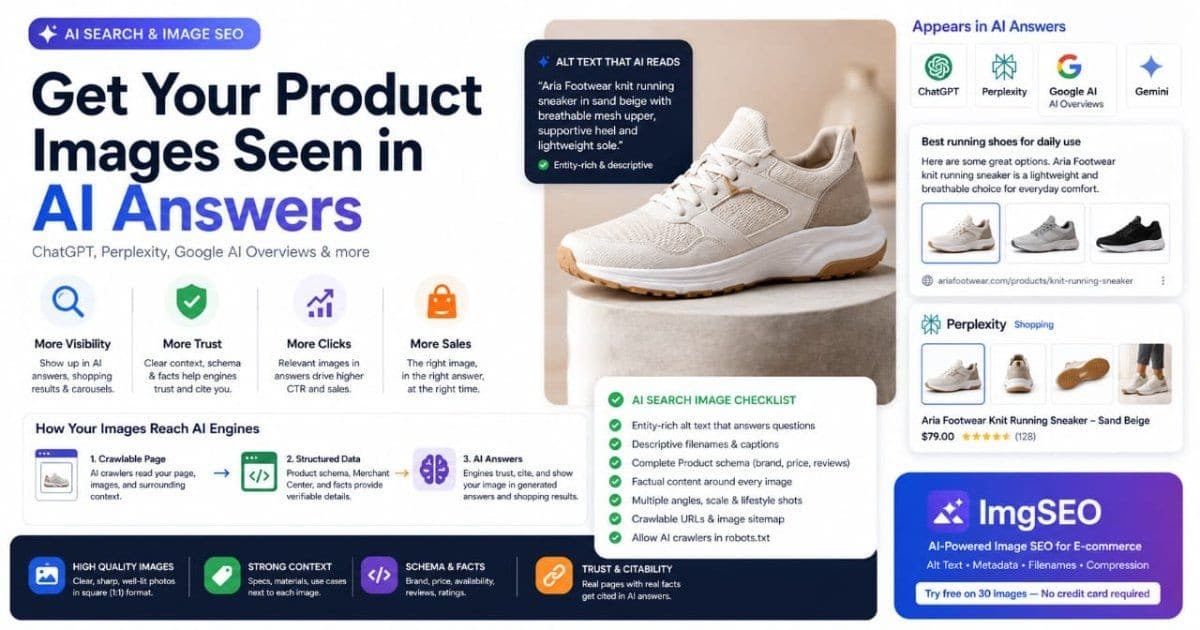
As of writing, product images appear across several AI surfaces. Google AI Overviews can show a product carousel, ChatGPT surfaces Shopping-style cards, Perplexity has a Shopping tab, and Gemini returns product results. Each pulls from a mix of the open web and structured commerce data.
- Google AI Overviews. Draws on Google's index and Shopping data, so both your crawlable pages and your Merchant Center feed feed the carousel.
- ChatGPT. As of writing, shows product cards from retrieved web pages and commerce partners, favoring pages it can read and cite.
- Perplexity. Cites sources openly and pulls product images from pages in its retrieval set, with a dedicated Shopping view.
- Gemini. Leans on Google's product understanding, so the same structured data that powers Shopping helps here.
The common thread: every engine rewards images that sit on pages it can crawl and facts it can verify.
The two paths an image takes into an AI answer
Product images reach AI answers by two routes. The first is the open web: an engine crawls your page and reads the image with its classic indexing signals. The second is structured product data: your image travels through Merchant Center, schema.org Product markup, or a PageMap that hands the engine clean facts.
Most sellers should cover both:
- Open-web crawling. Your image lives on a crawlable page with alt text, a descriptive filename, and an image sitemap entry. This is classic image SEO, and AI engines lean on it.
- Structured product data. Your image is tied to complete Product schema and, for Shopping surfaces, a healthy Merchant Center feed. This hands engines verified facts.
Cover one path and you might appear. Cover both and you're readable no matter which door the engine uses.
Why alt text matters more for AI, not less
Alt text gains importance in AI search because engines often read it as the image's caption. When a model retrieves your page as text, or can't fully process the pixels, the alt text is the canonical description it works from. It's how the engine knows what the image shows.
Vision models do look at pixels. But retrieval systems still match on text embeddings alongside pixel embeddings, so your alt text and caption feed the same relevance math. Strong text describing the image widens the set of questions your photo can answer.
This is why "alt text is just accessibility" is outdated thinking. For a deeper look at the mechanics, read how AI reads product images. The takeaway: the words around your image do real retrieval work.
What actually changes from classic image SEO
The foundation is the same, but four things carry more weight in AI search: caption context, factual grounding, Product schema completeness, and multi-image variety. AI engines reward images they can explain and verify, not just images that match a keyword.
- Caption context. The paragraph around the image should describe and name the product, not sit unrelated to it.
- Factual grounding. Put verifiable facts in that same paragraph — material, size, use case — so the engine can ground its answer.
- Schema completeness. Brand, price, availability, and review data attached to the image tell the engine it's a real product.
- Multi-image variety. A set showing angles, scale, and use gives the engine more ways to answer different questions.
None of this is exotic. It's classic image SEO with the facts pulled closer to each photo.
The retrieval reality: cite-worthy pages win
AI engines prefer images from pages they can cite with confidence. A thin product page with a photo and a one-line title gives an engine little to stand on. A page with clear specs, real reviews, and descriptive context around each image gives it plenty — so that page's images win the placement.
Think about it from the engine's side. It's assembling an answer it has to justify. It reaches for sources where the facts are explicit and consistent, because a vague page is a citation risk.
So the highest-leverage move isn't a clever image trick. It's making the page around the image genuinely informative: specs, honest reviews, and context that a human — or a model — can trust.
Does llms.txt help image discovery?
Here's the honest take: as of writing, llms.txt is a proposed convention for pointing AI tools at your key content, and adoption is limited. It may help engines find your important pages, but there's no evidence it's a reliable lever for getting specific product images into AI answers.
Don't build your image strategy around it. If you add an llms.txt file, treat it as a low-cost experiment, not a substitute for crawlable pages, alt text, sitemaps, and schema. Those fundamentals are what engines actually rely on today.
The durable principle stands: make your images discoverable through the channels engines already use, and revisit emerging conventions as real adoption data appears.
Blocking vs allowing AI crawlers
You control whether AI crawlers can access your site through robots.txt, and the choice is a genuine tradeoff. Blocking bots like GPTBot, PerplexityBot, Google-Extended, and ClaudeBot protects your content from training use. Allowing them raises your odds of appearing in those engines' answers.
- Block them if keeping content out of model training matters more than visibility in AI answers.
- Allow them if you want your products eligible to appear when shoppers ask these engines for recommendations.
There's no universally right answer. But for a seller whose goal is traffic and discovery, blocking the crawlers that feed AI shopping answers usually works against you. Decide deliberately, and revisit as the engines evolve.
The optimization checklist that's actually different
Most image SEO advice still applies, but a few tactics matter more for AI search. The theme: write text around your images that answers questions and names entities, instead of just describing pixels.
- Entity-linked alt text. Name the brand, product type, and material — "Aria Ceramics matte stoneware dinner plate" beats "white plate." Entities help engines connect the image to a known product.
- FAQ-style captions. Caption images in a way that answers a likely question ("How big is it?" → a scale shot captioned with dimensions).
- Comparison-friendly sets. Provide images that support "X vs Y" answers, since AI engines often generate comparisons.
- Alt text that answers, not lists. Describe what the image shows in a natural phrase. Keyword lists read as spam to a model.
For the fundamentals of writing strong alt text, see how to write alt text for product images. The AI-search twist is simply entity clarity and question-shaped phrasing.
How to measure whether your images show up
There's no single dashboard for this yet, so measurement is part manual, part inference. The practical approach has three parts. Test your products by hand across the major engines, watch referral traffic for AI sources, and check Search Console for AI Overviews impressions where reported.
- Manual testing. Ask each engine — ChatGPT, Perplexity, Google AI Overviews, Gemini, and one more you care about — a buyer-style question, and see if your product and image appear.
- Referrer patterns. Watch analytics for visits from AI domains. A rising trickle from those sources is a signal you're being cited.
- Search Console. Where AI Overviews impressions are surfaced, they hint at whether your pages feed those answers.
Track direction, not vanity precision. The goal is knowing whether your visibility is rising, not chasing an exact number that doesn't exist yet.
Common mistakes
The biggest errors come from misunderstanding what AI search rewards. Sellers treat it as a separate campaign, over-optimize alt text into keyword lists, or skip Product schema entirely. Each one quietly caps how often your images get cited.
- Treating AI SEO as a separate project. It isn't. It's classic SEO with tighter grounding — the same pages, made more verifiable.
- Stuffing alt text with keywords. Models penalize this when generating answers. A natural, entity-rich phrase outperforms a keyword pile.
- Skipping Product schema. Without brand, price, and review data, an engine can't confirm your image is a real product, so it hesitates to show it.
Avoid these three and you're ahead of most catalogs, because most sellers haven't adapted at all.
Frequently asked questions
Does ChatGPT use my product images?
It can, when it retrieves your page as a source. As of writing, ChatGPT shows product images in Shopping-style cards pulled from crawlable pages and product data. If your page is blocked or thin, your images are far less likely to appear.
Should I block AI crawlers?
Only if training-data protection matters more than visibility. Blocking GPTBot, PerplexityBot, or Google-Extended keeps content out of models, but it also lowers the chance your products appear in those engines' answers. For most sellers chasing traffic, allowing them is pragmatic.
Does schema help AI search?
Yes. Complete Product schema — brand, price, availability, and reviews next to the image — gives engines the structured facts to cite your product confidently. Schema doesn't guarantee inclusion, but it's a clear signal that your image belongs to a real, buyable product.
Start where AI search actually rewards you
Image SEO for AI search rewards the least glamorous work: crawlable pages, honest alt text, complete Product schema, and real context around every photo. Do that, and your images become eligible across ChatGPT, Perplexity, AI Overviews, and Gemini at once — no separate campaign required.
The one tactic worth automating first is entity-rich alt text at scale. Try ImgSEO free — 30 images, no credit card required. It reads each photo and writes alt text and metadata around the brand, product type, and material. That's exactly the entity clarity AI engines reward. For the full workflow across classic and AI search, our complete image SEO guide ties it together.