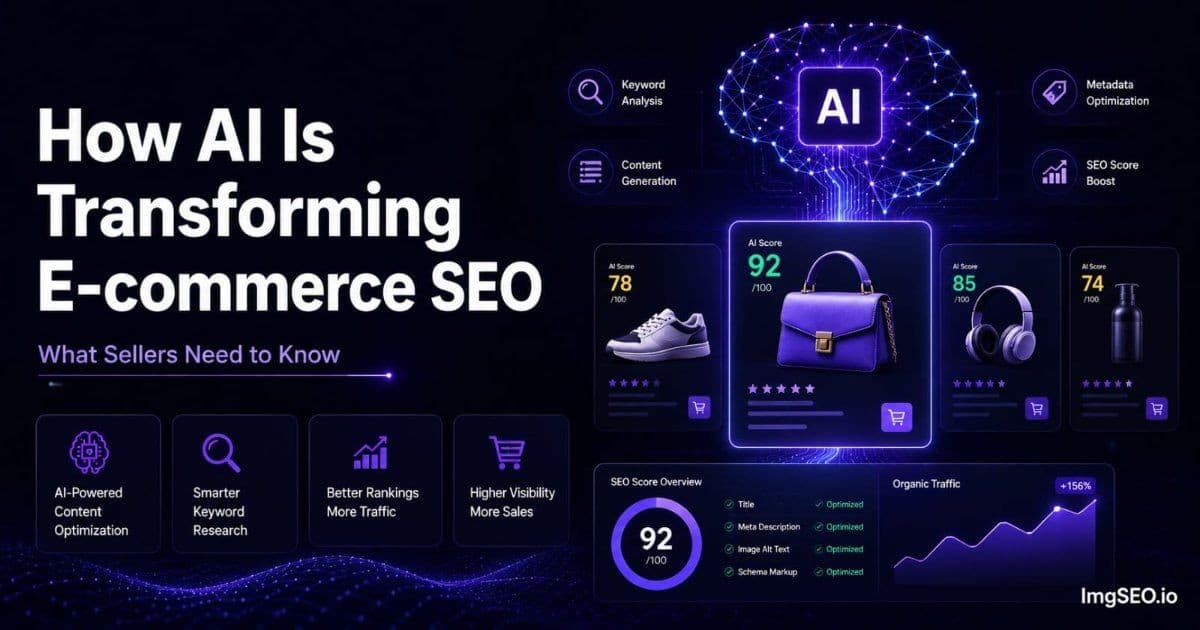
The e-commerce sellers who will dominate search in the next three years are already using AI today. Not because AI is a magic solution — but because they understand what is actually changing underneath e-commerce search, and they are building toward it while most sellers are still doing things the way they did in 2020.
AI is not replacing SEO. The fundamentals — relevance, quality, authority — still drive rankings across Google, Etsy, and Shopify. What AI is doing is making SEO more powerful and more accessible than it has ever been. Automated image optimization, AI-powered search engines, and visual product discovery are not trends. They are the new infrastructure of e-commerce.
This article explains what is actually changing, what it means for Etsy and Shopify sellers practically, and what you need to do about it today.
Quick Summary
- Google Lens now handles around 12 billion visual searches a month, roughly 4x its 2021 volume, and reads image alt text to match photos to listings (Semrush).
- Etsy auto-fills blank alt text with generic AI text that gives no competitive edge (eRank) — so the real gap is specific, keyword-rich alt text, not missing alt text.
- A batch tool can optimize a 200-product catalog in about two hours, work that once required an SEO team or months by hand.
How AI Is Changing Search Itself
Google's AI Overviews
Google launched AI Overviews in May 2024, and their reach climbed fast: from about 6.5% of US queries in January 2025 to a peak near 25% in July before settling back (Search Engine Land, 2025). These AI-generated summaries synthesize information from multiple sources and present an answer before the user ever sees a traditional result.
Search-result layouts vary by query and can change. Google Images and AI-generated result features use Google's systems, but merchants should focus on crawlable images, accurate page content, and eligible structured data rather than asserting a metadata-and-authority formula.
This is an opportunity. While AI Overviews compete for attention on text searches, well-optimized product images benefit from a channel that AI summarization has not absorbed.
AI-Powered Search Engines
AI search systems can synthesize indexed and retrieved content. Their product-selection mechanisms differ and are not fully public, so provide clear product pages, accurate images, useful alt text, and structured facts without assuming that every system reads embedded image metadata.
Products with descriptive, keyword-specific metadata appear in these answers. Products with blank or generic alt text are invisible to them — not because they lack authority, but because AI engines have no readable product signal to work with.
Visual Search Growth
Visual-search tools can help buyers explore photographed products and inspiration. Their matching systems are proprietary; do not assume they read embedded metadata or assign a known weight to alt text.
A buyer who photographs a ceramic mug and uses Google Lens is not typing keywords. Visual-search systems can compare visible characteristics with indexed content, while the surrounding page provides additional context. Accurate imagery and descriptive page fields can help users and crawlers understand a product, but AI image optimization does not control proprietary ranking systems.
How AI Is Changing Image SEO
Before AI: Manual and Inconsistent
Until recently, image SEO for e-commerce meant writing alt text manually — three to five minutes per image if done properly, multiplied across a catalog of hundreds or thousands of products. Most sellers either skipped it entirely or wrote generic descriptions that provided no keyword signal.
EXIF metadata — the structured data embedded inside image files — was virtually never set by small sellers. It required technical knowledge that most e-commerce operators do not have. Keyword quality varied wildly across catalogs, because individual sellers brought different levels of SEO knowledge to different products on different days.
Here's the part most guides get wrong. It's not that Etsy listings have no alt text. When a seller leaves the field blank, Etsy auto-fills it with generic AI-written text (Etsy Help). That auto-text is often wrong about materials and color, and every seller who skips the field gets the same bland output (eRank).
So the real gap isn't missing alt text. It's the missing specific, keyword-rich alt text that actually separates one listing from the next. Writing that by hand, across hundreds of listings, was never laziness. It was a resource constraint. Manual image SEO at scale is genuinely difficult.
After AI: Automated and Consistent
AI image optimization changes all three constraints simultaneously. Computer vision reads every image in seconds, identifying materials, colors, styles, and contexts that inform keyword generation. The resulting alt text, title, and tags are consistent in quality and keyword structure across an entire catalog, not just the listings a seller happened to optimize carefully.
Metadata is embedded automatically before upload. The seller never touches an EXIF field. Every listing benefits from the same level of optimization regardless of when it was added to the catalog.
For sellers comparing AI image SEO versus manual methods, the performance gap is not marginal. It is the difference between consistent execution across hundreds of products and inconsistent execution across a handful.
The Democratization Effect
Before AI, only large brands with dedicated SEO teams had fully optimized product image catalogs. A solo Etsy seller with 200 products simply could not afford the time to write quality alt text for every image on every listing.
That constraint is gone. A single seller can run their entire catalog through AI optimization in two hours and have consistent, keyword-specific alt text and embedded metadata on every product image. The playing field between a solo seller and a brand with a five-person SEO team has compressed dramatically.
AI Turns Product Photos Into Keywords
Traditional Keyword Research
Manual keyword research for e-commerce has always been time-intensive. Tools like Ahrefs and SEMrush provide accurate search volume data but cost hundreds of dollars per month — prohibitive for most small sellers. Research sessions that took hours produced keyword lists that became outdated as search trends evolved.
The knowledge gap was real: sellers who understood keyword research outperformed those who did not, because the research itself was a skill that took time to develop.
AI-Powered Keyword Generation
AI eliminates most of this friction. Modern AI optimization tools analyze the product image and the product category simultaneously, generating buyer-intent keywords from visual data rather than requiring the seller to know what buyers search for.
This is a meaningful shift. A seller who does not know the difference between "short-tail" and "long-tail" keywords can still end up with keyword-optimized listings, because the AI is doing the research implicitly through image analysis. For a comprehensive approach to Etsy keyword research, AI-generated keywords provide the foundation that manual refinement can then improve.
The Long-Tail Advantage
Long-tail keywords — specific, multi-word phrases with lower search volume but higher buying intent — have always been the highest-value targets for small e-commerce sellers. Less competition, more qualified buyers.
The problem was that identifying the right long-tail combinations required research expertise and pattern recognition that most sellers lacked. A seller might settle for "handmade mug" (generic, extremely competitive) when the actual buyer-intent phrase was "wheel thrown stoneware mug speckled glaze 12oz" (specific, low competition, purchase-ready intent).
AI finds the specific phrase. Computer vision reads the image, identifies the wheel-throwing marks, the stoneware texture, the speckle pattern, and the approximate volume from the image dimensions. The resulting keywords reflect what buyers searching for that exact product would type — not what the seller guesses.
Product Discovery Is Going Visual
Why Visual Search Rewards Clean Images
Visual search is changing how buyers find products in a way that has no equivalent in text-based search. When a buyer sees a product they want — in a magazine, on a friend's shelf, in a social media post — they can now photograph it and find it. No words required.
This purchasing behavior favors sellers whose product images are optimized for visual matching. High-quality images with clear backgrounds, accurate alt text, and complete metadata index better in visual search and surface more frequently in Lens results. The metadata tells the engine what the image depicts; the image quality determines how well it matches visual queries.
AI Product Recommendations
Amazon, Etsy, and Shopify all use AI recommendation systems to surface products to buyers based on browsing behavior, purchase history, and engagement signals. These systems feed on the same metadata that search engines use: product titles, descriptions, image alt text, and tags.
Better image optimization means more accurate recommendation matching. More accurate matching means appearing in front of buyers who have already demonstrated interest in products like yours — the highest-value position in product discovery.
Social Commerce AI
TikTok Shop and Instagram Shopping use AI to match products to viewers in real time. The matching algorithm reads product data — including image metadata — to determine relevance to a given viewer's interest profile. Well-structured product data performs better in these systems than poorly structured data, regardless of how compelling the creative content is.
The Sellers Who Will Win (and Lose) with AI
Winners: Early Adopters
Sellers using AI image optimization now are building catalog authority that compounds over time. Google indexes optimized product images, and that indexing improves with age and engagement. A seller who optimizes their catalog today builds authority that a late-moving competitor can need a year or more to close.
That head start is real. Search authority does not reset when a competitor catches up — it accumulates. The gap that exists today between optimized and unoptimized catalogs will be larger next year than it is now.
Winners: Consistent Optimizers
The sellers who win are not necessarily those with the largest catalogs or the highest-quality products. They are the ones who optimize consistently. Every new listing added to an AI-optimized catalog extends the authority of the whole. Every product added to an unoptimized catalog adds to the eventual remediation backlog.
Starting optimized is dramatically easier than retroactive optimization at scale.
Losers: Wait-and-See Sellers
The most common response to any SEO change is "I'll optimize later, once I see if it makes a difference." This is the correct posture for experiments that might not pan out. It is the wrong posture for a structural shift in how search works.
AI-powered search is not an experiment that might be rolled back. Google AI Overviews are expanding. ChatGPT Search is growing. Visual search is accelerating. Sellers who wait for certainty before optimizing are letting competitors build authority that will take years to close.
Losers: Generic Description Sellers
"Product image" is not alt text. "Mug" is not a keyword. As AI search grows, generic metadata becomes functionally invisible — not because the algorithms penalize it, but because AI engines cannot use it to match products to queries.
As explored in the guide to AI-generated and generic alt text, specific descriptions are generally more useful than generic labels for accessibility and context. Search traffic effects vary and should be measured rather than projected.
Practical AI Tools for E-commerce SEO Today
Image SEO
ImgSEO automates alt text generation, metadata embedding, and image compression in a single workflow. Upload your product images, receive optimized files with SEO data embedded, and upload those files to your store. No technical knowledge required. See the complete AI image optimization guide for a step-by-step walkthrough.
Google Vision AI (via the Cloud Vision API) is useful for understanding how Google's computer vision reads your product images. Most sellers will not use this directly, but it illustrates what AI is doing when it processes your listings.
Content SEO
Claude and ChatGPT are effective for writing or expanding product descriptions with keyword intent. Feed them your AI-generated keywords plus your product details and they produce listing copy that would take hours to write manually.
Jasper offers templates specifically for e-commerce copywriting at scale, useful for sellers with large catalogs who need consistent description quality across hundreds of products.
Analytics
Google Search Console is the best free tool for tracking AI Overview appearances and image search impressions. The "Search type: Image" filter shows which product images are getting impressions and clicks — directly measurable signal for image SEO performance.
PostHog provides behavior analytics on product pages — scroll depth, click patterns, session recordings — that reveal how buyers engage with listings after finding them through search.
The Minimal AI Stack for Etsy and Shopify Sellers
If you want to start without tool proliferation, the best AI tools for image SEO post covers the full landscape. For most sellers, the minimal effective stack is:
- ImgSEO for image optimization — the highest-impact action available
- ChatGPT for listing descriptions — useful but optional if you write well
- Google Search Console for monitoring — free, essential, should already be set up
The Next Three Years: What to Expect
AI Search Will Continue Growing
ChatGPT Search and Perplexity are gaining users every month. Google AI Overviews are expanding to more query types. The share of product discoveries that involve AI interpretation at some point in the buyer's journey will increase regardless of how any individual platform evolves.
Well-optimized product metadata benefits from all of these channels simultaneously, because they all read the same signals.
Visual Search Will Become Mainstream
Google Lens is being integrated deeper into mobile shopping experiences. Pinterest Lens is driving measurable traffic to Etsy. As mobile becomes the primary shopping device for more buyers, visual search — which is inherently mobile-native — will grow with it.
Clear imagery and complete product-page information support a useful visual-search destination. Future ranking behavior and the role of embedded metadata should not be predicted as established facts.
AI Optimization Will Become Table Stakes
In early 2024, AI image optimization was a competitive advantage. By late 2026, it will be an expected baseline for any seller who wants to be discoverable. By 2027 and beyond, sellers without AI-optimized catalogs will be visibly disadvantaged relative to those who have been building catalog authority for two or three years.
The window for competitive advantage is not closed — but it is narrowing. The sellers who act in 2026 will be the ones with established authority when AI-optimized listings become the norm rather than the exception.
What This Means for You
Start now. Every optimized image adds to catalog authority that compounds. Optimize new listings immediately, before they are uploaded, so there is no retroactive backlog to deal with later. Monitor your image search impressions in Google Search Console so you can see the impact accumulating.
The structural shift in e-commerce search is not something sellers can wait on and then catch up to later. Authority builds slowly and compounds. The sellers winning on visual search and AI-powered discovery in 2028 are the ones building that foundation today.
Conclusion
AI is transforming e-commerce SEO from manual and inconsistent to automated and scalable. The sellers winning in 2026 started optimizing with AI in 2024 and 2025, and they are now compounding that early investment into catalog authority and search visibility that competitors cannot close quickly.
Visual search, AI-powered product discovery, and AI search engines all read the same signals — image quality, alt text accuracy, metadata completeness — and they are all growing simultaneously. Image optimization is no longer a nice-to-have. It is the single highest-impact SEO action available to e-commerce sellers today.
The window for first-mover advantage is still open. The sellers who act now will be the ones with established authority when AI-optimized listings become the expected baseline.
Start your AI image optimization today — free for your first 30 images, no technical setup required.