
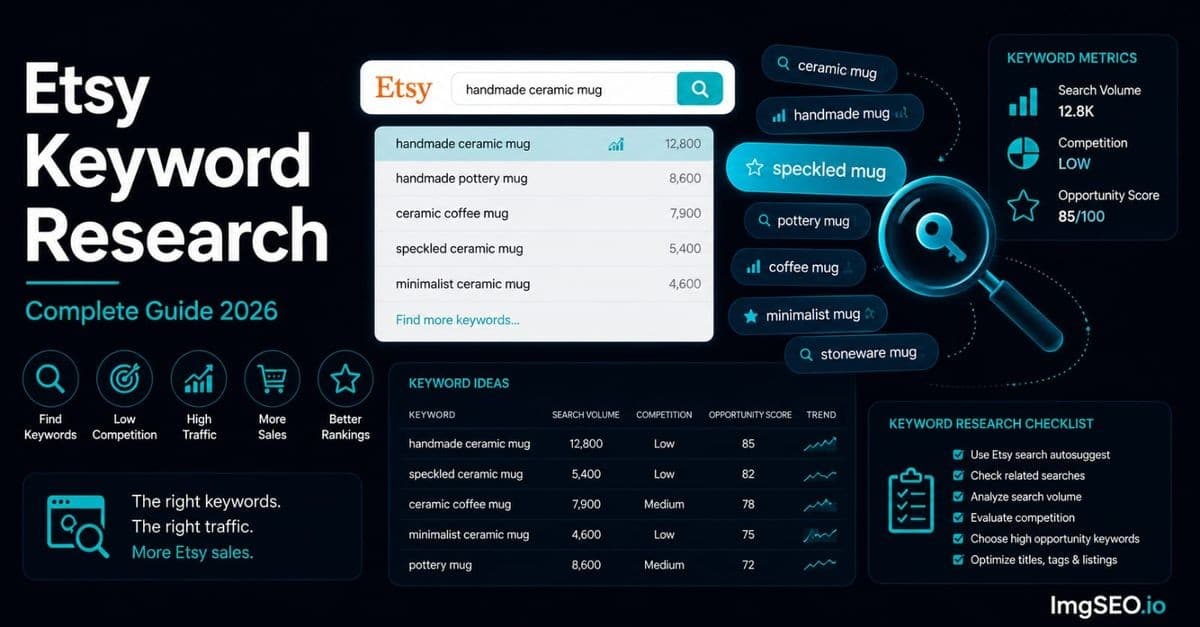
The difference between a listing that gets 10 views a month and one that gets 1,000 is almost always keywords. Not product quality. Not photography. Not price. Keywords determine whether Etsy and Google surface your listing to buyers — or bury it below 40,000 competitors selling something nearly identical.
Most Etsy sellers guess at keywords. They type in what they think sounds right, publish the listing, and wonder why traffic never arrives. Top sellers do something different: they research keywords systematically before writing a single word of copy, and they run that research through their titles, tags, descriptions, and image metadata in a coordinated way.
This guide walks through the full keyword research process — free methods, paid tools, the long-tail advantage, seasonal timing, and how your keyword list connects directly to image alt text and metadata for compound SEO impact.
Key Takeaways
- Long-tail keywords (three-plus words) convert at three to five times the rate of single-word head terms — lower traffic, but far more of it buys.
- Etsy's own search bar autocomplete is the most reliable free keyword source; eRank ($5.99–$9.99/mo) and Marmalead ($19/mo) add volume estimates and competition scoring once free methods max out.
- Keep titles, tags, descriptions, and image alt text accurate and consistent; do not rely on embedded metadata surviving Etsy processing or creating a ranking benefit.
How Etsy Keyword Research Works
Two Keyword Ecosystems
Etsy SEO lives in two separate but connected systems. The first is Etsy's internal search: what buyers type into the search bar on etsy.com. The second is Google: what buyers type into google.com when looking for something to buy. These are not the same.
A buyer searching Etsy for "sterling silver hammered ring" and a buyer searching Google for "sterling silver hammered ring etsy" are using slightly different language, with different intent signals attached. The best keywords are the ones that appear prominently on both platforms — they bring in both the direct Etsy browse traffic and the external Google referral traffic that Etsy actively rewards in its search algorithm.
What Makes a Good Etsy Keyword
Not every keyword is worth targeting. A good Etsy keyword has four qualities:
Search volume — buyers actually search for it, not just once a month but consistently. A keyword nobody types delivers no traffic regardless of where you rank.
Low to medium competition — if the first page is filled with shops that have 5,000 sales and thousands of reviews, ranking there as a newer seller is close to impossible. Keywords with manageable competition give you a real shot.
Buying intent — the buyer is close to a purchase decision. "What is a ring" is curiosity. "Sterling silver adjustable ring women gift" is someone about to buy.
Long-tail specificity — the more specific the phrase, the more clearly it signals intent and the lower the competition.
The Long-Tail Keyword Advantage
"Ring" has millions of results on Etsy. Ranking anywhere visible is essentially impossible without years of sales history and a massive number of reviews. "Sterling silver hammered ring minimalist women" has far fewer results, lower competition, and is searched by someone who already knows what they want and is ready to buy.
Long-tail keywords — phrases of three words or more — convert at three to five times the rate of single-word or two-word head terms. They bring in less raw traffic, but more of that traffic buys. For Etsy sellers building a business, that conversion rate difference matters far more than raw view counts.
Free Keyword Research Methods
You do not need a paid tool to start keyword research on Etsy. These five methods cost nothing and generate genuinely useful keyword data.
Method 1: Etsy Search Bar Autocomplete
This is the most powerful free keyword method available, and most sellers ignore it. Etsy's autocomplete shows real buyer searches — not estimated volume, not algorithmic guesses, but actual phrases people have typed recently enough to appear as suggestions.
Open Etsy and type your core product into the search bar. Do not press Enter. Watch the dropdown suggestions populate. Write every one down. Then try variations:
- "[product] for women"
- "[product] gift"
- "[material] [product]"
- "handmade [product]"
- "[product] minimalist"
For a silver ring, this gives you: silver ring women, silver ring minimalist, silver ring adjustable, silver ring stacking, silver ring gift — each one a validated buyer search phrase, each one a potential keyword to build a listing around.
Method 2: Etsy Category Browse
Etsy's category structure is a keyword map. Go to Etsy.com, browse the categories closest to your product, and click subcategories until you reach your niche. The labels Etsy uses — the exact words it chose to name each subcategory — are keywords buyers use to navigate. They are also keywords Etsy's algorithm recognizes as topically relevant.
A handmade ring seller might browse Jewelry → Rings → Statement Rings, noting "statement rings" as a keyword Etsy itself uses to describe that product type.
Method 3: Competitor Analysis
Search your main keyword on Etsy. Click the top five ranked listings — not the paid ads, but the organic top five. Read their titles carefully. Note the patterns: which words appear repeatedly across multiple top listings? Which combinations of material, style, occasion, and recipient show up?
Then check the "More like this" section Etsy shows below each listing. These algorithmically related listings often use keyword variations you have not thought of yet. Build a list of every keyword pattern that appears in multiple top-ranking listings — those are validated terms the algorithm responds to.
Method 4: Google Autocomplete for Etsy Keywords
Go to Google and search your product keyword with "etsy" appended: "silver ring etsy", "handmade candle etsy", "linen shirt etsy". Google's autocomplete and related searches at the bottom of the page show how buyers phrase external Etsy searches — often with different language than pure Etsy autocomplete.
Also search the product keyword without "etsy" for Google Images traffic. Google Images is a significant traffic source for visual products, and the keywords that rank in Google Images are often slightly different from Etsy-specific terms.
Method 5: Pinterest Search
Pinterest drives substantial traffic to Etsy. Sellers who ignore it miss one of the highest-intent visual search audiences on the internet. Search your product on Pinterest and look at the colored keyword filter chips that appear below the search bar — these are Pinterest's suggested related searches, and they represent high-intent visual queries from buyers who think and shop visually.
For more on combining Pinterest with image SEO strategy, see Pinterest Image SEO: How to Drive Traffic to Your Etsy Shop in 2026.
Paid Keyword Research Tools for Etsy
Free methods get you started. Once your shop is generating consistent sales, paid tools allow systematic optimization at a scale that manual research cannot match.
eRank (Most Popular Etsy SEO Tool)
eRank is the most widely used Etsy keyword research tool. The free tier allows a limited number of keyword searches per day — enough for a new seller getting started. Paid plans run $5.99 to $9.99 per month.
What eRank provides that free methods cannot: actual Etsy search volume estimates, competition scoring, trend data showing seasonality, and a listing audit that identifies specific SEO gaps in your existing listings. The keyword explorer is the starting point — enter a product, filter by competition level, and sort by the volume-to-competition ratio to find the best opportunities.
Marmalead
Marmalead at $19 per month is positioned as the premium Etsy SEO tool, with no free tier. Its keyword grading system scores each keyword from A to F based on the ratio of search volume to competition. The Storm feature generates keyword variations automatically, useful for finding combinations you would not think to search manually.
Marmalead is worth the cost for sellers who take SEO seriously and want a structured keyword grading workflow rather than manual sorting through data.
Sale Samurai
At $9.99 per month, Sale Samurai combines Etsy keyword research with competitor analysis. It pulls real-time Etsy search data and shows what keywords competing listings are actually using. Useful for high-volume sellers managing multiple listings across several product categories.
When to Use Free vs Paid Tools
- New seller (0–10 sales): Free methods are sufficient. You need to learn the basics before optimizing at scale.
- Growing seller (10–100 sales): eRank's free tier gives you enough data to identify the biggest optimization gaps.
- Established seller (100+ sales): eRank paid or Marmalead pays for itself through the ranking improvements it enables.
The Keyword Research Process
Step 1: Seed Keywords
Start with three to five obvious product keywords — the most straightforward descriptions of what you sell. For a handmade ring seller: ring, silver ring, handmade ring, women ring, jewelry. These are not your target keywords — they are your research starting points.
Step 2: Expand with Modifiers
Take each seed keyword and expand it with modifiers in four categories:
- Material: sterling silver, gold filled, rose gold, brass, copper
- Style: minimalist, boho, vintage, art deco, dainty, chunky, stacking
- Occasion: gift, birthday, anniversary, wedding, everyday wear, bridesmaid
- Recipient: women, men, teen, sister, girlfriend, mom, best friend
Each seed plus each modifier generates a new candidate keyword to research.
Step 3: Find Long-Tail Combinations
Combine seed keywords with two or more modifiers to create long-tail phrases: "sterling silver minimalist ring women", "handmade boho ring gift girlfriend". Run autocomplete checks on each combination to confirm they generate real suggestions — meaning real buyer searches exist.
Target phrases of three to five words with clear buying intent. Shorter phrases are too competitive; longer phrases often have too little search volume.
Step 4: Validate Search Volume
Take your long-tail candidates to eRank or your tool of choice. Check which combinations have real monthly search volume and which return nothing. Eliminate zero-volume keywords — no matter how logical they sound to you, if buyers are not searching for them, they will not bring traffic.
Prioritize keywords with medium search volume and low to medium competition. High-volume keywords are usually dominated by established shops; low-competition keywords at medium volume are where new and growing sellers can actually rank.
Step 5: Organize by Priority
Sort your validated keywords into three tiers:
- Primary keyword: highest volume, most directly describes the product, goes in the title
- Secondary keywords: variations and style modifiers, fill out the title and first several tags
- Long-tail keywords: occasion, recipient, and style specifics, used in remaining tags and description
Keyword to Image SEO Connection
Most sellers treat keyword research and image SEO as separate tasks. They are the same task done in sequence. The keyword list you build feeds directly into every image optimization decision.
Your Keywords Feed Your Image Alt Text
Each image in your listing needs alt text — and that alt text should use your validated keywords, not generic descriptions. The primary keyword goes in the main product image alt text. Secondary keywords populate alt text for additional images. Seasonal keywords appear in image metadata.
For a complete guide on aligning your keywords with your visual content strategy, see How to Write Etsy Product Descriptions That Rank in 2026 and How to Write Etsy Titles That Rank on Google in 2026.
The Keyword Alignment System
Use your validated keywords naturally across Etsy's documented listing fields: title, tags, description, and accurate image alt text.
Keep those fields consistent without keyword stuffing. Embedded metadata can remain in the exported source file, but Etsy may process the image after upload, so preservation and use should not be assumed.
- Title: primary keyword + top modifiers
- Tags: keyword variations and long-tail phrases
- Description: primary and secondary keywords woven naturally into copy
- Alt text: primary keyword + visual description of the specific image
- Embedded metadata: descriptive information retained in your source export
ImgSEO embeds XMP metadata directly into JPEG, WebP, and AVIF exports, with EXIF additionally included for JPEG. Etsy may process the image after upload, so metadata preservation should not be assumed.
Seasonal Keyword Research
Etsy is heavily seasonal. Gift-giving peaks, holidays, and aesthetic trends create predictable spikes in specific keyword searches. Sellers who update their keywords before these peaks capture traffic that sellers with static listings miss entirely.
The Seasonal Keyword Calendar
| Month | Gift Keywords | Occasion/Style Keywords | |-------|---------------|-------------------------| | January | valentines gift, galentines gift | love, romance, hearts | | February–March | mothers day gift | spring, easter, pastel | | April–May | graduation gift | spring decor, garden | | May–June | fathers day gift | summer, outdoor, beach | | July–August | back to school | summer gift, boho | | August–September | halloween decor | fall, autumn, cottagecore | | October–November | christmas gift, holiday gift | festive, holiday decor | | November–December | stocking stuffer, last minute gift | winter, new year, cozy |
How to Add Seasonal Keywords
Update three to four tags with seasonal terms six to eight weeks before the peak — not the week of. Etsy's algorithm takes time to index and rank changes. Add the seasonal keyword to your title when it fits naturally, and update image alt text only when the seasonal context accurately describes the photo.
ImgSEO's metadata embedding lets you update keyword sets across multiple images quickly when seasonal rotations happen.
Evergreen vs Seasonal Balance
Never replace all your evergreen keywords with seasonal ones. The right balance: eight to ten evergreen keywords in your title and core tags that describe the product year-round, and three to five rotating seasonal tags that you swap in and out around peak periods. Your listing needs to rank continuously, not only during holiday spikes.
Niche and Trend Keywords
Beyond standard product and occasion keywords, Etsy buyers increasingly search by aesthetic — and those aesthetic keywords can drive significant traffic to the right products.
Aesthetic Keywords That Drive Etsy Traffic
Trend-driven terms like cottagecore, dark academia, goblincore, coastal grandmother, quiet luxury, old money aesthetic, and indie sleaze generate substantial Etsy searches when they peak on TikTok and Pinterest. A shop selling linen shirts that adds "coastal grandmother aesthetic" during that trend cycle captures buyers who would never have found the listing through standard product keywords alone.
How to Find Trend Keywords
Monitor TikTok and Pinterest for emerging aesthetic trends. When you spot a trend gaining traction, search for it on Etsy: do results exist? Is there competition? Check eRank for search volume if available. Add relevant trend keywords to titles and tags while the trend is still ascending — early movers capture the most traffic.
Niche Community Keywords
Identity-based keywords — "plant mom gift", "dog mom jewelry", "bookworm gift", "cat dad mug" — drive some of the highest conversion rates on Etsy because the buyer identifies personally with the keyword. They are not just looking for a product; they are looking for something that speaks to who they are. Listings that nail this connection convert at dramatically higher rates.
Keyword Research for Different Product Types
The keyword framework is universal, but the specific modifiers and angles shift by product category.
Physical Handmade Products
Focus on the combination of material, style, occasion, and recipient. The "handmade" prefix carries weight with Etsy buyers who specifically want non-mass-produced items. Craft technique keywords add another dimension: "hand-stamped", "hand-dyed", "wheel-thrown", "hand-poured" signal authenticity and skill.
Digital Products and Printables
Format keywords are essential: "printable", "instant download", "digital download", "editable template". Platform-specific terms like "canva template", "svg for cricut", "silhouette cut file" target the specific tools buyers use. For image SEO strategy on digital products, see Image SEO for Digital Products and Printables in 2026.
Vintage Items
Decade keywords ("70s", "80s", "mid century modern") and style era terms ("art deco", "victorian", "edwardian", "bohemian vintage") help buyers find the specific aesthetic they are looking for. Condition descriptors like "deadstock", "never worn", "mint condition", "original tags" add credibility signals buyers search for explicitly.
Print on Demand
Niche plus product plus occasion produces the most effective print on demand keywords: "cat mom coffee mug birthday gift", "funny nurse mug coworker gift". Humor keywords ("funny", "sarcastic", "witty", "relatable") appeal to buyers shopping for gifts with personality. See Image SEO for Print on Demand Sellers in 2026 for format-specific image optimization.
Building Your Keyword Master List
A keyword master list is a central reference document that prevents you from redoing research for every listing and ensures consistent keyword application across titles, tags, alt text, and metadata.
The Master List Structure
Build a spreadsheet with these five columns:
| Column | Contents | |--------|----------| | Keyword phrase | The exact phrase | | Search volume | eRank monthly estimate | | Competition level | Low / Medium / High | | Where used | Title / Tags / Alt text / Metadata | | Priority | High / Medium / Low |
Populate the spreadsheet with your validated keywords from Steps 1–5 of the research process. Assign priority based on the volume-to-competition ratio: high volume with low or medium competition = high priority.
How to Use Your Master List
When creating or updating a listing:
- Title: pull the top one to three keywords by volume and direct product relevance
- Tags: fill thirteen tags from the next tier — variations, long-tail phrases, occasion and recipient terms
- Alt text: primary keyword plus a visual description of what is literally in the image
- Metadata keywords: the full list of ten to fifteen keywords, embedded in the image file
Review and update the master list quarterly: check whether search volumes have shifted, whether new trend terms deserve addition, and whether seasonal terms need rotation.
Common Keyword Research Mistakes
- Targeting only high-volume head terms — they are too competitive for most sellers to rank for
- Never using long-tail keywords — missing the easiest ranking wins and highest-converting searches
- Copying competitor keywords without validation — their keywords may not have volume, or may be saturated
- Not updating for seasonal peaks — leaving gift-season traffic on the table
- Using keywords irrelevant to the actual product — Etsy penalizes mismatched keywords as a relevance signal
- Ignoring Google keywords — external traffic from Google is a significant portion of Etsy referrals
- Never using a validation tool — guessing at search volume wastes effort on zero-traffic keywords
- Using identical keywords for every listing — different products need different keyword sets
- Not connecting keywords to image alt text and metadata — leaving the most durable SEO signals empty
- Treating keyword research as a one-time task — search behavior shifts; quarterly updates are the minimum
FAQ
What is the best free keyword tool for Etsy? Etsy's own search bar autocomplete is the most reliable free source of real buyer keyword data. It shows actual recent searches, not estimated volumes. Google autocomplete searched with "etsy" appended is a strong second option.
How many keywords should I target per Etsy listing? Target one primary keyword (for the title), twelve to thirteen secondary and long-tail keywords (for tags), and the full set of ten to fifteen keywords in your image metadata. Etsy gives you thirteen tag slots — fill all of them.
Should I use the same keywords in title and tags? Yes and no. Your primary keyword should appear in both the title and at least one tag. But the remaining twelve tags should be variations and long-tail phrases that expand coverage rather than repeat what is already in the title. Etsy's algorithm combines title and tag signals.
How do I find low-competition Etsy keywords? Use long-tail phrases (three-plus words), focus on specific niches, and use eRank's competition filter to eliminate high-competition terms. The sweet spot is medium search volume with low to medium competition — not the most popular keywords, but ones where you can realistically reach the first page.
Do Etsy keywords affect Google ranking? Etsy listing pages can appear in Google results. Use clear titles and descriptions plus accurate image alt text; Etsy may process uploaded images, so embedded metadata preservation or a ranking benefit should not be assumed.
How often should I do Etsy keyword research? Review your keyword master list quarterly. Run a full seasonal update six to eight weeks before each major gift-giving peak. If you notice a trend keyword gaining traction, add it immediately rather than waiting for a scheduled review.
What are the best keywords for handmade jewelry on Etsy? The most effective jewelry keywords combine material (sterling silver, 14k gold fill, brass), style (minimalist, boho, vintage), occasion (gift, birthday, anniversary), and recipient (women, girlfriend, mom, sister). Long-tail combinations of all four dimensions — "sterling silver minimalist ring gift girlfriend" — outperform any single-dimension keyword.
How do seasonal keywords work on Etsy? Seasonal keywords spike in search volume at predictable times each year. Adding them six to eight weeks before the peak gives Etsy's algorithm time to index your updated listing before buyers arrive. Remove or rotate them after the peak to avoid irrelevance signals during off-season.
Conclusion
Keyword research is the foundation of every other Etsy SEO decision. It determines what goes in your titles, what fills your tags, how you write your descriptions, what alt text you give your images, and what metadata you embed in every image file. Get the keyword research right first, and everything downstream becomes more effective.
Start with free methods: Etsy autocomplete, competitor analysis, Google autocomplete, and Pinterest. These deliver real buyer data at zero cost and are sufficient for new and growing sellers. Graduate to eRank or Marmalead when your shop needs systematic optimization across multiple listings.
Connect validated keywords naturally to accurate image alt text and Etsy's other documented listing fields. Keep metadata in the exported source files when it supports your broader workflow, without assuming Etsy preserves or uses it.
Update seasonally. Etsy's gift-buying peaks are predictable and significant. Sellers who rotate their seasonal keywords before each peak consistently outperform sellers with static listings.
ImgSEO embeds XMP metadata directly into JPEG, WebP, and AVIF exports, with EXIF additionally included for JPEG. Add ImgSEO's generated alt text to Etsy's listing-image alt-text field, and keep the exported files for workflows that preserve their metadata.
For next steps on applying your keyword research, read How to Use Etsy Tags for Maximum SEO in 2026 for tag strategy, and How to Write Etsy Titles That Rank on Google in 2026 for putting your primary keywords to work in titles.


