Etsy SEO and Shopify SEO look similar on the surface — both involve keywords, titles, images, and descriptions. Under the hood, they are entirely different disciplines with different algorithms, different ranking signals, and different strategies for winning.
Sellers who treat them the same way make predictable mistakes. They stuff Etsy tags with keywords that belong on a Google product page. They write Shopify meta descriptions using Etsy's 13-tag vocabulary. They optimize images for one platform and wonder why the other is not performing. The platforms reward different things.
Understanding the differences does not mean choosing one over the other. Most serious product sellers run both — Etsy for immediate marketplace traffic and the built-in trust that comes with it, Shopify for brand building and long-term Google authority. Knowing how the SEO works differently on each platform is what lets you win on both simultaneously rather than splitting attention between two half-optimized presences.
This guide covers every major SEO dimension — images, keywords, titles, domain authority, content, structured data, and traffic — compared directly between Etsy and Shopify, with practical guidance on which matters where.
Key Takeaways
- Etsy operates on an established marketplace domain, while a Shopify store builds visibility on its own domain. Google performance and timing vary, so neither platform has a guaranteed ranking schedule.
- Etsy may rename or process uploaded images, so source filenames and EXIF/XMP metadata should not be assumed to remain intact. Etsy documents seller-editable listing-image alt text of up to 250 characters.
- Etsy listing fees run 20 cents per listing versus Shopify's monthly subscription, but Shopify gives full control over meta title, meta description, and URL slug — fields Etsy auto-generates for you.
The Fundamental Difference
Etsy: Marketplace SEO
When you optimize for Etsy SEO, you are operating inside Etsy's closed ecosystem. Etsy controls the search algorithm, the domain authority, the traffic, and the rules. You do not have a website — you have a storefront on someone else's platform.
Etsy listings are published on an established marketplace domain, while independent stores build visibility on their own domains. That distinction can affect discovery, but it does not guarantee that a new Etsy listing will rank on Google's first page or appear within a fixed number of days.
The downside is equally significant: you share that advantage with millions of other Etsy sellers, all optimizing for the same algorithm. Etsy can change ranking factors without notice, can suppress listings that violate evolving policies, and can increase competition in your niche by changing how categories and search filters work. You own none of your traffic and none of your customer relationships. Etsy does.
Shopify: Website SEO
When you optimize for Shopify SEO, you are playing Google's game on your own domain. Your store is an independent website that Google crawls, indexes, and ranks according to its own algorithm — the same algorithm it applies to every other website on the internet.
The tradeoff here is the mirror image of Etsy's. A new Shopify store starts with a Domain Authority of roughly 1. Google does not trust a brand-new domain. It takes consistent work — quality content, backlinks from other sites, technical SEO, sustained publishing — to build enough authority to rank competitively in organic search. Most Shopify stores see meaningful Google traffic only after 6–12 months of active SEO effort.
The upside, however, is ownership. You own your domain. You own your traffic data. You own your customer email list. You can run retargeting ads to everyone who visited your store. When your Shopify store ranks for a keyword, that ranking is yours — not shared with millions of other sellers on the same domain.
The Two-Game Problem
The fundamental reason Etsy SEO and Shopify SEO require different strategies is that they are literally different games with different rules:
Etsy sellers compete in Etsy's algorithm. Etsy's ranking factors include listing quality score, recency, customer reviews, conversion rate, and keyword relevance across title, tags, and description. None of these are Google ranking factors.
Shopify sellers compete in Google's algorithm. Google's ranking factors include domain authority, page authority, content quality, backlink profile, Core Web Vitals, structured data, and keyword relevance across title tags, meta descriptions, headings, and body content. Most of these do not exist in Etsy's ecosystem.
Optimizing for Etsy using Google's playbook produces mediocre results on both platforms. Understanding which game you are playing on which platform is the prerequisite for everything else.
Image SEO: Etsy vs Shopify
This is where the differences are most concrete and most consequential for day-to-day optimization decisions.
Etsy Image SEO
Etsy's image handling has one major limitation that most sellers do not realize: Etsy renames your uploaded images. The carefully crafted filename hand-thrown-ceramic-mug-speckled-glaze.jpg becomes a string of random characters when it hits Etsy's servers. For Etsy's internal search algorithm, the filename is irrelevant.
What does matter on Etsy is the listing-image alt text field. Etsy documents a limit of 250 characters and says alt text supports accessibility and can be read by external search engines. Etsy may add AI-generated alt text to some US sellers' listing images when it is omitted, and sellers can edit it at any time.
The metadata situation is platform-controlled. Etsy may process uploaded images, so do not assume EXIF or XMP remains intact or is indexed before processing. Embedded metadata can still serve as portable descriptive and rights-related information in the exported source file, while Etsy listing-image alt text remains the safer actionable field.
For the complete Etsy image SEO strategy, see Etsy image SEO 2026.
Shopify Image SEO
Shopify's image handling is the opposite of Etsy's in the most important dimension: Shopify keeps your filename exactly as uploaded. This makes filenames a direct, indexable SEO signal. A file named hand-thrown-ceramic-mug-speckled-glaze.jpg on your Shopify store is read by Google exactly as you named it, every time the page is crawled.
Alt text on Shopify is set in the product editor with no character limit restrictions in practice. You control it completely, per image, across every product. Google reads every alt text field on your Shopify product pages as part of its understanding of your content.
Shopify also automatically converts uploaded images to WebP format for browsers that support it, which improves page load speed and Core Web Vitals scores — both Google ranking factors. Etsy does not do this automatically.
Shopify may transform uploaded images, so embedded-field preservation should be verified rather than assumed. For multi-platform work, keep a descriptive master asset and apply appropriate alt text in each platform's own field.
Image SEO Comparison Table
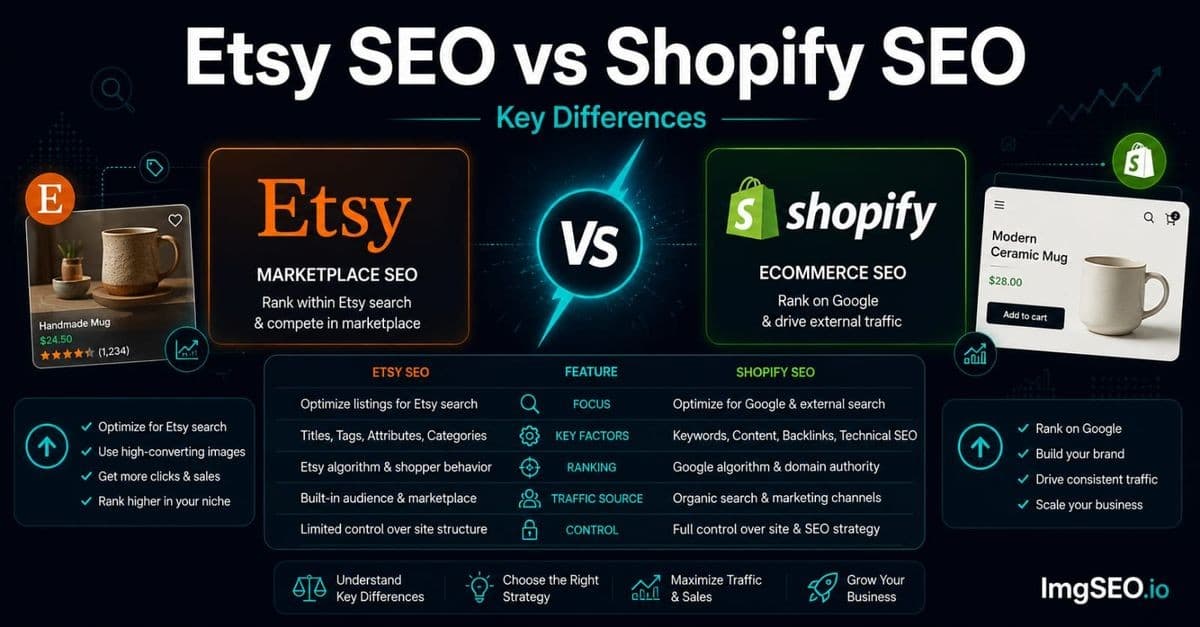
| Factor | Etsy | Shopify | |--------|------|---------| | Filename control | ❌ Renamed on upload | ✅ Kept exactly as uploaded | | Alt text control | ✅ 250 chars per listing image | ✅ Platform-controlled | | Metadata preservation | ⚠️ Not guaranteed; platform-controlled | ⚠️ Not guaranteed; platform-controlled | | Auto WebP conversion | ❌ No | ✅ Yes | | CDN included | ✅ Yes | ✅ Yes | | Google indexes images | ✅ Via etsy.com domain | ✅ Via your own domain | | Image SEO difficulty | Medium (alt text critical) | Higher (full control, full responsibility) |
The practical implication: on Shopify, every image optimization lever is available to you. On Etsy, alt text is your primary lever. Use it accordingly.
Keyword Strategy: Etsy vs Shopify
Etsy Keyword Strategy
Etsy's keyword system is built around two fields: the title (140 characters) and tags (13 tags, up to 20 characters each). The description contributes to keyword relevance but less directly. Your entire Etsy keyword strategy must fit within these constraints.
Etsy search is almost exclusively product-specific with buying intent. Users search for "chunky knit wool blanket," "personalized silver necklace," "boho macrame wall hanging" — not "how to choose a blanket" or "types of silver jewelry." Informational searches do not drive Etsy traffic. Transactional and product-specific searches do.
Long-tail keywords are essential on Etsy because competition is enormous. There are thousands of ceramic mugs on Etsy. "Ceramic mug" as a tag competes with all of them. "Wheel-thrown stoneware mug speckled glaze Portland" competes with significantly fewer. The more specific your keyword targeting, the more relevant the buyers you attract — and the higher your listing conversion rate, which Etsy's algorithm rewards.
Seasonal keywords are disproportionately important on Etsy. "Gift for her," "Christmas gift," "Mother's Day jewelry" — these phrases drive a massive portion of Etsy's total search volume. Sellers who incorporate seasonal keywords into titles and tags see significant traffic spikes around gift-giving periods. For a complete keyword research system, see Etsy keyword research complete guide 2026.
Shopify Keyword Strategy
Shopify keyword strategy maps to Google's algorithm, which rewards keyword relevance across multiple fields: product title (H1), meta title (the title that appears in Google search results), meta description (the snippet text), URL slug, image alt text, and body content on the product page and blog.
A Shopify store can publish informational content and link it naturally to relevant products, while an Etsy seller works within Etsy's marketplace content surfaces. A useful guide may earn search visibility, but it does not automatically increase every linked product's ranking.
Head terms (shorter, higher-volume keywords like "silver ring") matter on Shopify in a way they rarely do on Etsy — because with sufficient domain authority, ranking for competitive short keywords is achievable. That authority takes time, but once established, a single page ranking for "handmade silver ring" generates traffic that no Etsy listing can match.
Keyword Research Tools by Platform
| Tool | Etsy | Shopify | |------|------|---------| | eRank | ✅ Primary Etsy research tool | ❌ Not relevant for Google SEO | | Marmalead | ✅ Yes — Etsy-specific | ❌ Not relevant | | Google Keyword Planner | ⚠️ Secondary (for Google-indexed Etsy listings) | ✅ Primary | | Ahrefs / Semrush | ⚠️ Limited value for Etsy internal search | ✅ Primary for competitor and backlink analysis | | Pinterest search | ✅ Valuable for visual product discovery | ✅ Valuable for visual and social traffic |
Title and Meta SEO: Etsy vs Shopify
Etsy Titles
Etsy titles have a 140-character limit, with the first 35–40 characters displayed in Etsy search results and used as your Google page title when Etsy indexes the listing. You have no separate control over the meta title or meta description — Etsy generates both automatically from your listing title and description.
The first 35–40 characters of your Etsy title are the most important real estate in your listing. Lead with your primary keyword, not your brand name. "Wheel-Thrown Ceramic Mug Speckled Glaze Handmade Stoneware — Studio Pottery Gift" is a stronger Etsy title than "The Speckled Mug — Hand-Thrown Stoneware by [Your Shop Name]" because the keyword-first version matches exactly how buyers search.
Tags function as secondary keyword fields. Each of your 13 tags should target a distinct keyword phrase — not single words, but multi-word phrases that match real buyer searches. "wheel thrown pottery," "handmade ceramic mug," "coffee mug gift," "pottery gift for her," "stoneware mug," "studio pottery" — each tag is a separate search entry point. For a complete guide to title optimization, see how to write Etsy titles that rank on Google 2026.
Shopify Titles and Meta
Shopify gives you full, separate control over every SEO-relevant field on each product page:
- Product title — renders as the H1 heading on the product page. Should lead with your primary keyword.
- SEO title (shown as "Page title" in Shopify's SEO panel) — the title that appears in Google search results, separate from your H1. Limit to 60 characters. Lead with the keyword, include brand if space allows.
- Meta description — the snippet text in Google search results. 155 characters. Write for click-through rate, not keyword density — this text does not directly affect ranking but directly affects whether a searcher clicks your result.
- URL slug — fully customizable.
/products/wheel-thrown-ceramic-mug-speckled-glazeis better than/products/product-12345for both ranking and click-through.
This level of granular control means a Shopify seller can target different keyword variations in the H1 (conversational purchase query), SEO title (competitive short keyword), and meta description (persuasive CTR-focused text) simultaneously. Etsy sellers get none of this control.
Title and Meta SEO Comparison
| Element | Etsy | Shopify | |---------|------|---------| | Product title limit | 140 chars | No hard limit | | SEO/meta title | Same as product title | Separate field, 60 chars | | Meta description | Auto-generated by Etsy | Fully controlled, 155 chars | | URL slug | Auto-generated | Fully customizable | | Keyword tags | 13 tags × 20 chars | No tag system — keywords go in content | | Google title control | ❌ Indirect | ✅ Direct |
Domain Authority: The Biggest Difference
Etsy Domain Authority
etsy.com is one of the most authoritative e-commerce domains on the internet, with a Domain Authority score consistently above 90 on a 100-point scale. This is the result of 20+ years of inbound links, press coverage, and organic traffic signals accumulated by the platform.
Etsy listings live on an established marketplace domain, which can help discovery, but a new listing does not inherit a guaranteed position or indexing schedule. Relevance, competition, listing quality, and Google's crawling and ranking systems still matter.
The limitation is that this authority is shared. You are borrowing etsy.com's credibility, not building your own. When a buyer clicks your Google result, they land on etsy.com/listing/…, not on yourshop.com. The authority you benefit from today can be diluted tomorrow by 10,000 new competitors publishing listings in your category.
Shopify Domain Authority
A new Shopify store starts with a Domain Authority of approximately 1. Google has no reason to trust a domain it has never seen before, with no content history and no inbound links. This is not a flaw — it is simply how domain authority works. Every website on the internet started at zero.
Building meaningful domain authority on Shopify requires sustained effort across multiple months: publishing quality content on a consistent schedule, earning backlinks from other websites, maintaining technical SEO hygiene (fast load times, proper structured data, no crawl errors), and building enough topical depth that Google recognizes you as an authority on your subject area.
The payoff is greater control over the domain, content, analytics, and customer journey. Search visibility can grow or decline over time and is never permanent on either platform.
Practical Implication by Seller Stage
- New seller, no audience: Etsy can provide marketplace discovery while Shopify establishes an owned storefront. Do not assume a fixed Google traffic timetable for either.
- Established seller, existing audience: Shopify's authority-building investment has a shorter payback period because you can drive initial traffic from email and social, generating the engagement signals Google needs to start ranking your pages.
- Scaling brand: Running both simultaneously maximizes reach — Etsy handles marketplace discovery, Shopify builds the long-term owned asset.
Content Marketing: Shopify's Most Significant Advantage
Why Shopify Needs a Blog
Useful guides can answer informational queries and create natural internal paths to relevant products. Their search performance depends on quality, relevance, crawlability, competition, and the site as a whole; authority does not automatically flow to every product page.
The informational keyword opportunity is enormous. For a jewelry seller: "how to clean sterling silver at home," "what is the difference between sterling silver and silver plated," "how to size a ring at home" — each of these is a high-volume, low-competition search that drives qualified traffic to a silver jewelry store. None of these searches will ever appear on Etsy, because Etsy does not serve informational content.
A blog post that ranks for "how to care for sterling silver jewelry" attracts a reader who has sterling silver jewelry and is looking for guidance — an almost perfectly qualified prospect for a silver jewelry store. Internal links from that post to your product pages transfer authority and drive conversion-ready traffic.
Etsy Content Limitation
Etsy provides no blog feature. Your content is limited to what fits in listing descriptions, your shop announcement, and your About section. The About section is genuinely valuable for brand storytelling and can help with trust signals, but it carries no blogging capability.
Etsy sellers who want to participate in content marketing must do it externally — typically through a separate blog, Pinterest, or YouTube — and link back to their Etsy shop. This is a reasonable workaround but requires maintaining a separate content presence, which adds overhead.
Structured Data and Rich Results
Etsy Structured Data
Etsy automatically generates Product schema markup for every listing. This structured data is what tells Google that a page contains a product, its price, availability, and review rating — and it is what enables rich results: the star ratings, price range, and availability label that appear beneath Etsy listings in Google search results.
For Etsy sellers, this is completely automatic. You publish a listing, Etsy handles the schema, and Google-eligible rich results appear in search with no configuration required on your part.
Shopify Structured Data
Most Shopify themes include basic Product schema, but the implementation quality varies significantly by theme. Some themes generate complete, valid structured data automatically. Others omit fields that Google needs for rich results (review count, aggregate rating, price range).
Review schema — which enables the star ratings that significantly increase click-through rates in search results — almost always requires a third-party review app (Judge.me, Yotpo, Okendo) with proper structured data output. Without reviews, your Shopify listings will not show star ratings in Google search results, which is a visible disadvantage against competitors who do.
The tradeoff: Shopify gives you more control over structured data through custom theme modifications or apps, but that control comes with the responsibility to implement it correctly. Etsy removes that responsibility entirely by handling it for you.
Traffic Sources: Etsy vs Shopify
Etsy Traffic Sources
Etsy listings receive traffic from three primary sources: Etsy's internal search (the majority), Google organic (significant, powered by Etsy's domain authority), and Pinterest (important for visual product categories, where Pinterest's shopping audience regularly discovers and pins Etsy listings). Direct and social traffic is a smaller portion for most sellers.
The concentration of Etsy traffic in Etsy's own search algorithm is both the platform's strength and its primary risk. When Etsy's algorithm works in your favor, internal search alone can sustain a thriving shop. When Etsy changes its algorithm — which it does, regularly — shops that built their entire strategy on one channel feel the change immediately.
Shopify Traffic Sources
A Shopify store's traffic portfolio, when built correctly, is more diversified: Google organic (grows over time with content and authority building), Google Ads (immediate but paid), social media channels (Instagram, Pinterest, TikTok), email marketing (the most valuable owned channel), and direct traffic (customers who know and return to your brand).
The key distinction is the email list. Shopify sellers collect customer emails at checkout and can market to those customers indefinitely without paying Etsy for access to them. An Etsy shop with 5,000 sales has 5,000 customers Etsy knows and you do not. A Shopify store with 5,000 sales has 5,000 customers you can email, retarget, and build a relationship with.
Traffic Control Comparison
| Aspect | Etsy | Shopify | |--------|------|---------| | Own customer email addresses | ❌ No | ✅ Yes | | Retarget past visitors | ❌ Very limited | ✅ Full control | | Traffic dependency | Etsy's algorithm | Google + owned channels | | Platform risk | High — algorithm changes affect revenue | Lower — diversified sources | | Time to meaningful traffic | Fast (days via Etsy authority) | Slow (months via authority building) |
Selling on Both: The Multi-Platform Strategy
Why Serious Sellers Use Both
The most successful product sellers at scale typically use Etsy and Shopify as complementary tools rather than choosing between them:
Etsy provides immediate marketplace traffic, built-in buyer trust (Etsy's purchase protection and review system), and zero need to build domain authority. It is the fastest path to sales for a product seller with no existing audience.
Shopify provides brand ownership, customer data, full SEO control, and the ability to build a compounding Google traffic asset. It is the long-term infrastructure for a brand that wants to exist independently of any marketplace.
Together, they cover the full spectrum: Etsy captures marketplace-minded buyers who search within Etsy's ecosystem; Shopify captures Google searchers and converts them into owned customers who buy again through email or direct return visits.
Image SEO for Multi-Platform Sellers
Optimizing images for both platforms from a single workflow is straightforward with the right process. ImgSEO handles the preparation step — keyword-rich filenames, embedded XMP/EXIF metadata, and alt text — before images are uploaded anywhere. From that single optimized source file:
- Upload to Shopify: follow Shopify's current upload workflow, then add and review alt text in the product editor. Do not assume the original filename or embedded metadata is preserved in every served derivative.
- Upload to Etsy: choose a currently supported format and add the pre-written alt text in the listing editor. Etsy may rename or process the file, so do not assume embedded metadata remains intact or was indexed before upload.
One optimization workflow, two platform-ready image files. The keyword research overlaps significantly — the same terms that work in Shopify alt text work in Etsy's alt text field, even if they reach Google by different paths.
For a three-way platform comparison including WooCommerce, see Shopify vs Etsy vs WooCommerce image SEO 2026.
Keyword Strategy for Both
Running both platforms requires maintaining parallel keyword strategies:
- Platform-specific research: use eRank or Marmalead for Etsy, Google Keyword Planner or Ahrefs for Shopify
- Overlapping keywords: terms that perform well in both ecosystems — usually the specific product + material + style combination — go in both platform titles
- Etsy-specific terms: "handmade," "gift for her," "ready to ship," "made to order" — high-value on Etsy, often irrelevant to Shopify SEO
- Shopify-specific content: informational blog content targeting "how to" and "best [product] for [use case]" queries — builds Shopify authority with no Etsy equivalent
When to Choose Etsy vs Shopify
Choose Etsy First If
- You are a new seller with no existing audience, no email list, and no social following
- Your products are handmade, vintage, or craft supplies — the categories Etsy's buyer base specifically seeks
- You want to generate sales while you build other channels, without the upfront investment of building domain authority
- Your budget is limited — Etsy's listing fees (20¢ per listing) are lower than Shopify's monthly subscription
- You want to test product-market fit before investing in a full independent website
Choose Shopify First If
- You have an existing audience — even a few hundred email subscribers or social followers — who can give your new domain the initial traffic signal Google needs
- You sell a branded product line that is not specifically handmade or vintage
- You plan to run Google Shopping or Meta ads, where having your own domain gives you full pixel control and retargeting capability
- Long-term brand building is your explicit goal and you are willing to invest 6–12 months before significant Google traffic arrives
- You want full control over your customer data and purchase history
Use Both If
Your products suit both audiences (handmade items, original designs, and visual products tend to perform well in both marketplaces and independent stores), you have the resources to manage both platforms without splitting focus, and you want to maximize your total addressable market rather than betting everything on one distribution channel.
Frequently Asked Questions
Is Etsy SEO easier than Shopify SEO? Etsy listings use an established marketplace domain, while Shopify stores build visibility on their own domains. Google results vary by relevance, competition, crawl and indexing behavior, and site quality; neither platform has a guaranteed timeline. Shopify provides more direct control over site-level SEO.
Can I use the same keywords for Etsy and Shopify? Partially. The core product keywords — material, technique, style, use case — overlap significantly. The application differs: Etsy keywords go in titles and tags in short phrases; Shopify keywords go in meta titles, descriptions, URL slugs, and blog content. Research for both platforms separately, then identify the overlap.
Does having an Etsy shop help my Shopify SEO? Not directly. Google treats your Shopify domain and Etsy listings as completely separate. An Etsy listing ranking well does not transfer authority to your Shopify domain. The indirect benefit: Etsy traffic can generate brand awareness that leads buyers to search for your Shopify store directly, which builds branded search volume — a weak but real signal.
Which platform ranks better on Google? Etsy listings use an established marketplace domain, while Shopify stores develop visibility on their own domains. Either can appear for relevant product queries, but neither has a fixed ranking speed, duration, or unlimited ceiling.
Should I have both an Etsy shop and Shopify store? For most product sellers with a viable product line, yes — eventually. Use Etsy to build initial sales and validate your product while investing in Shopify's SEO infrastructure in parallel. The revenue from Etsy can fund the Shopify development, and the Shopify store provides a long-term asset that Etsy does not.
How is image SEO different on Etsy vs Shopify? For Etsy, prioritize descriptive listing-image alt text and other seller-controlled listing fields. Etsy may rename or process uploaded images, so do not assume source filenames or embedded metadata remain intact. Prepare source assets carefully, then follow each destination platform's current upload and editing workflow.
Which platform is better for new sellers? Etsy provides access to an existing marketplace audience, while Shopify provides more control over an independent store. Google discovery and ranking speed vary on both platforms; choose based on audience, product fit, control, and operating needs.
Can I use the same product images on both Etsy and Shopify? You can prepare descriptive source filenames, portable metadata, and alt text once. For Etsy, choose a supported format and add the prepared alt text in the listing editor; Etsy may process the image, so metadata preservation should not be assumed. Follow Shopify's current workflow separately.
Conclusion
Etsy SEO and Shopify SEO are fundamentally different disciplines that require different strategies, different tools, and different timelines. Treating them identically leaves performance on the table on both platforms.
On Etsy: use clear titles, relevant tags and attributes, useful descriptions, and descriptive listing-image alt text. Keep alt text concise and within Etsy's documented 250-character limit; describe the image rather than repeating listing keywords.
On Shopify: invest in content marketing alongside product SEO, use all the meta fields Google gives you access to, build topical authority through consistent publishing, and treat your domain as the long-term asset it is. Filename and alt text are both fully functional — use them both deliberately on every image.
Image SEO matters on both platforms, but each controls its own upload processing. ImgSEO generates filenames and separate alt text, embeds XMP in JPEG, WebP, and AVIF exports, and adds EXIF additionally for JPEG. Choose a destination-supported format and apply the generated alt text in that platform's editor.
For a complete three-platform comparison including WooCommerce, see Shopify vs Etsy vs WooCommerce image SEO 2026.
Try ImgSEO free — 30 images optimized for Etsy and Shopify in one step.