
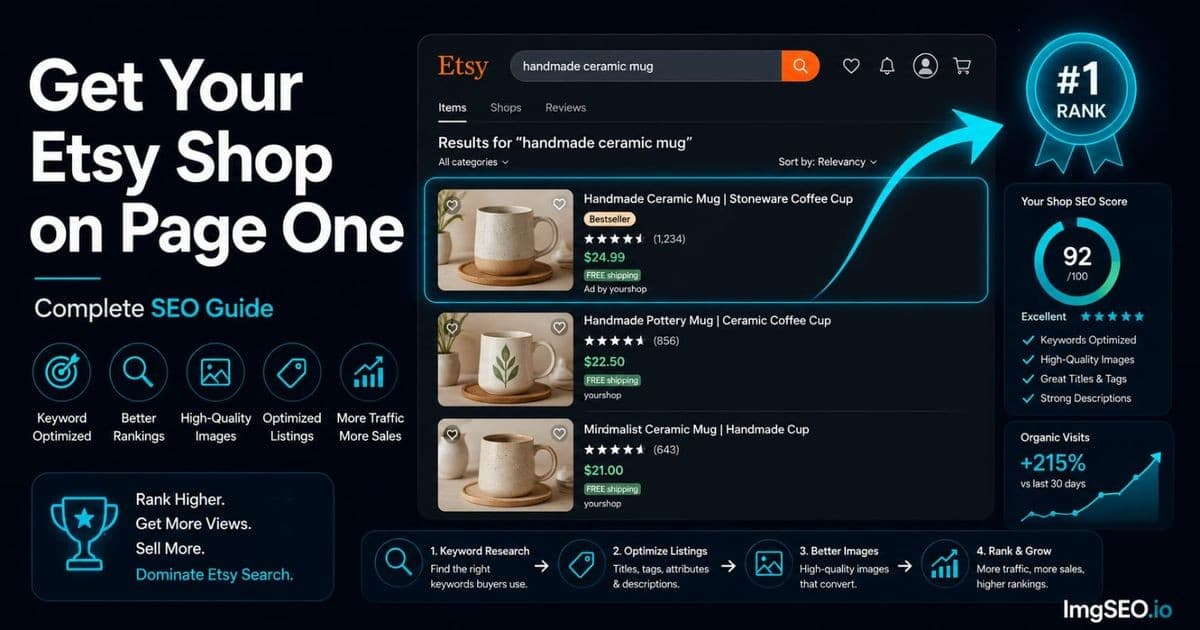
Page one of Etsy search captures roughly 80 percent of all clicks. Page two gets most of what remains. Page three and beyond receive traffic so thin it barely registers. The sellers earning a living on Etsy are almost exclusively on page one for at least a handful of keywords — and the sellers who struggle are almost always ranking on pages three through ten, wondering why nobody finds their shop.
The uncomfortable truth is that most shops stay off page one not because their products are inferior. Their products are often better than what ranks above them. They stay buried because their SEO is incomplete: wrong keywords in the title, tags filled with single words, images with no alt text, listings published at 70 percent done. Every one of those gaps is a fixable problem.
The Etsy algorithm is not a black box. Etsy has published documentation explaining what it rewards, and the behavior of the algorithm — what it responds to, what it ignores — is observable through testing. Understanding the five factors Etsy confirms as ranking signals, combined with the unconfirmed signals that clearly influence results, gives you a system you can work through methodically.
This guide covers every ranking factor, the image SEO signals most sellers overlook, tactics calibrated to your shop's current stage, and a 90-day plan for moving from buried to page one.
How the Etsy Algorithm Ranks Listings
The 5 Ranking Factors Etsy Confirms
Etsy has publicly documented the primary factors its search algorithm considers. Working through these in order is the most direct path to page one.
1. Relevancy — how closely your listing matches the buyer's search query. Etsy compares the buyer's search terms against your title, tags, categories, and attributes. If your title does not contain the words a buyer typed, you cannot rank for that search — no amount of other optimization compensates for a keyword gap.
2. Listing quality score — a composite signal derived from click-through rate, conversion rate, and favorites. When buyers click your listing after seeing it in search results and then purchase, Etsy interprets this as evidence your listing satisfies that query. High satisfaction scores push listings up. Low scores push them down.
3. Customer and market experience score — a shop-level signal that includes your review rating, Star Seller status, dispute and case rate, and shop completeness. A shop with consistent five-star reviews and completed policies ranks better than an identical listing from a shop with complaints and empty sections.
4. Shipping price — Etsy explicitly rewards free or competitive shipping. Free shipping listings receive a ranking boost, and Etsy surfaces free-shipping results more aggressively to buyers who filter by it.
5. Recency — newly created and recently renewed listings receive a temporary visibility boost. Etsy gives new content an initial window of higher exposure to gather performance data. How the listing performs during that window then determines its ongoing rank.
What Etsy Does Not Confirm but Clearly Matters
Several signals are not documented by Etsy but show consistent correlation with ranking outcomes across the seller community:
Sales volume — listings and shops with more sales rank higher for competitive keywords. Etsy makes money when sellers make money; its algorithm naturally favors proven revenue generators.
Revenue generated — a shop generating substantial gross merchandise sales appears to receive organic ranking benefits beyond what individual listing quality scores explain.
Ad spend history — sellers who run Etsy Ads consistently report positive organic ranking effects on the listings they advertise. The causal mechanism is unclear, but the correlation is widely observed.
Shop age and reputation — established shops with long positive histories rank faster for new listings than brand-new shops with identical content. Trust accumulates over time.
The Feedback Loop
Understanding the algorithm is useful. Understanding the feedback loop it creates is what actually changes your trajectory.
A well-optimized listing appears in search results for the right queries. Buyers see it and click — the thumbnail and title are compelling. Clicks drive CTR data. High CTR tells Etsy the listing is relevant and attractive. Etsy shows it to more people. More impressions generate more clicks and eventually purchases. Purchases boost the listing quality score. The quality score improvement pushes the listing higher. Higher position generates even more impressions and clicks.
Your job at every stage is to start and sustain this loop. The first click is the hardest to earn; each subsequent click costs less effort to generate than the one before it.
Factor 1: Keyword Relevancy — Titles and Tags
Why Relevancy is the Foundation
Keyword relevancy is not one signal among equals — it is the gate every other signal passes through. A listing with outstanding photos, hundreds of reviews, and free shipping still cannot rank for a query if its title and tags do not contain the relevant keywords. Etsy's algorithm performs keyword matching before it evaluates quality signals. Relevancy filters first; quality ranks what passes the filter.
This means poor keyword choices cannot be rescued by good conversion rates. The fix must happen at the keyword layer.
Title Optimization for Page One
Your primary keyword — the exact phrase buyers type — belongs in the first 40 characters of your title. Etsy displays roughly the first 40 characters in most mobile search views and weights the beginning of the title more heavily in relevancy scoring.
The phrase must be an exact or near-exact match to real buyer search behavior, not a creative description of your product. "Handcrafted artisanal botanically-inspired wearable jewelry" does not match the way buyers search. "Sterling silver botanical ring women minimalist" does.
For the full title optimization framework including character limits and keyword placement strategy, see How to Write Etsy Titles That Rank on Google in 2026.
Tag Optimization for Page One
Etsy provides thirteen tag slots. Use all thirteen. Every empty tag slot is a keyword opportunity permanently surrendered. Every tag filled with a single word ("ring", "jewelry", "silver") is a wasted opportunity — single-word tags are so competitive they contribute almost nothing to ranking.
Tags should be multi-word phrases that expand keyword coverage beyond what fits in the title. Do not repeat exact phrases that already appear in your title — use variations, synonyms, long-tail combinations, and occasion or recipient terms. The title and tags together build your listing's complete keyword footprint.
For the thirteen-tag strategy and how to choose which keyword variations to target, see How to Use Etsy Tags for Maximum SEO in 2026.
Factor 2: Listing Quality Score
What Drives Listing Quality Score
The listing quality score is Etsy's measure of how satisfying your listing is to buyers who encounter it. It is built from three observable behaviors:
Click-through rate — what percentage of buyers who see your listing in search results click on it. A listing that appears 1,000 times and gets 100 clicks has a 10 percent CTR. One that appears 1,000 times and gets 20 clicks has a 2 percent CTR. The first listing is telling Etsy it is appealing; the second is signaling the opposite.
Conversion rate — what percentage of buyers who visit your listing page make a purchase. A listing that converts one in ten visitors outperforms one that converts one in fifty, even with identical impressions.
Favorites rate — how often buyers save your listing without purchasing immediately. Favorites signal strong interest and often precede eventual purchases. High favorites rates are a positive quality indicator.
Improving CTR for Page One
CTR is primarily a thumbnail problem. In a grid of search results, buyers make click decisions based on a 150-pixel thumbnail image and a title snippet in under a second. Your main image determines whether you earn that click.
The practical test: open Etsy on your phone and search your primary keyword. Look at your listing in context with the listings around it. Does your thumbnail stop the scroll or blend in? Does it communicate product quality faster than competitors? If you have to think about whether it stands out, it does not.
A competitive price displayed in the search preview also influences CTR. Buyers scanning results use price as a quick filter.
Improving Conversion Rate
Conversion rate is a listing completeness and trust problem. Buyers who visit a listing and leave without purchasing are sending a signal that something failed — the price, the images, the information, or the credibility.
The highest-leverage conversion fixes:
- Use all ten image slots with a mix of product detail, lifestyle, and context shots
- Include at least one image showing scale — buyers need to understand size
- Show the item in use or worn, not only isolated
- Make pricing, shipping cost, and processing time visible above the fold
- Respond to every review to demonstrate active shop management
For a detailed guide on the images that move conversion rate most, see How to Increase Your Etsy Conversion Rate with Better Images in 2026.
Factor 3: Image SEO for Page One Rankings
Why Images Drive Page One Rankings
Image SEO connects to page one rankings through a mechanism most sellers have not mapped: the main image drives CTR, CTR drives listing quality score, and listing quality score is one of the five confirmed ranking factors. A better main image thumbnail is not just a visual improvement — it is a ranking improvement through the quality score pathway.
The second pathway is external: optimized image alt text and metadata bring Google Images traffic to your Etsy listings. Google Images traffic arrives as external referrals. Etsy tracks external traffic to listings and factors it into the shop's market experience score. More external traffic — from Google Images, Pinterest, and other sources — strengthens Etsy's assessment of your listing's value.
The Thumbnail Formula for Page One
The main image that earns the highest CTR in Etsy search consistently shares these characteristics:
- Clean background — white, light gray, or minimalist lifestyle context — so the product is the subject
- Product fills at least 80 percent of the frame with no awkward cropping
- High contrast and brightness: Etsy thumbnails are displayed small and compete for attention against dozens of others
- Instant readability at 150 pixels — the product category should be identifiable in under one second at thumbnail size
- Professional lighting that communicates product quality before the buyer reads a word
Test your thumbnail by opening Etsy search on a mobile device. Your listing competes on a screen smaller than your hand. What matters in that context is different from what looks good in a full browser view.
Alt Text and Metadata for Etsy + Google
Alt text — the text description attached to each image in your listing — is read by Google's crawlers when indexing your listings for Google Images. Buyers searching Google Images for products like yours can land directly on your Etsy listing. This external traffic from Google benefits your listing's standing with Etsy's algorithm.
Image metadata — EXIF and XMP data embedded in the image file itself — provides an additional keyword layer that Google reads when crawling. Most Etsy sellers never update image metadata; their files carry default camera data with no product-relevant keywords. Adding keyword-rich metadata to every listing image adds a persistent SEO signal that travels with the file regardless of where it is displayed.
ImgSEO embeds your keyword set directly into image metadata before upload, so every image you add to Etsy carries complete keyword data automatically. For the full image SEO strategy including alt text best practices, see How to Get More Etsy Sales with Image SEO in 2026.
Factor 4: Customer and Market Experience Score
What This Score Includes
The customer and market experience score is a shop-level signal, not a listing-level signal. It evaluates:
- Star Seller badge status — Etsy's verified indicator that your shop meets thresholds for response rate, on-time shipping, and five-star reviews
- Review count and average rating — more reviews and higher average ratings improve your score
- Dispute and case rate — open cases and unresolved disputes actively damage your score
- Shop completeness — an About section, completed policies, a full FAQ, and filled profile information all contribute positively
A strong experience score lifts all listings in your shop. Improving it is not a per-listing task — it is a shop infrastructure investment that pays dividends across your entire catalog.
Getting Reviews Faster
Reviews are the compound interest of Etsy ranking. Each review builds on the previous ones, and the effect accelerates as count increases. The fastest legitimate methods for accumulating reviews:
Automated follow-up message — Etsy's messaging system allows you to send an automatic message after estimated delivery. A simple, genuine note thanking the buyer and mentioning that reviews help your small shop is sufficient. Do not directly ask for a five-star review — ask for an honest one.
Physical thank-you card — a small card included with every order that thanks the buyer personally and mentions where to leave a review. Buyers who feel a personal connection leave reviews at higher rates.
Review responses — respond to every review, positive or negative. This signals active shop management to both buyers and Etsy's algorithm. A negative review with a professional, solutions-focused response is less damaging than a negative review with no response at all.
Issue resolution — resolve problems before they become cases. A buyer who messages about a shipping delay or product defect and receives a fast, generous resolution rarely leaves a negative review. The same buyer ignored often does.
Shop Completeness Impact
Etsy has confirmed that shops with complete profiles — About section, shop policies, FAQ, and an accurate location and contact method — rank better than incomplete shops with otherwise similar listings. This is a one-time investment that permanently improves your baseline ranking position.
For optimizing your shop's visual profile including banner, logo, and profile image, see Etsy Shop Banner and Profile Image Optimization in 2026.
Factor 5: Recency and Renewal Strategy
How Recency Works
Etsy gives newly published listings a temporary visibility boost — an initial window of higher exposure designed to gather performance data. This window lasts anywhere from a few hours to a few days depending on the keyword's competitiveness. How the listing performs during this window substantially influences its baseline position afterward.
Renewed listings — listings whose 4-month active period you manually or automatically renew — receive a smaller but real recency boost. This is the mechanism behind renewal strategies that Etsy sellers have used for years.
The Renewal Schedule
The mistake most sellers make with renewals is renewing everything at once. Renewing all listings on the same day produces a brief spike followed by the baseline — no sustained benefit. Staggering renewals across days produces consistent, ongoing recency signals.
Renew two to three listings per day rather than all at once. Focus renewals on your highest-potential listings — those with strong keywords and good images that need additional exposure to accumulate their initial performance data. Let low-potential listings auto-renew on their natural schedule.
New Listings Strategy
New listings receive a larger recency boost than renewals. A consistent cadence of new listings gives your shop a sustained stream of high-exposure windows. Adding two to five new listings per week does three things simultaneously: captures additional keyword territory, generates fresh recency boosts, and builds listing count (which correlates with shop authority over time).
Each new listing should be fully optimized before publishing — complete title, all thirteen tags, all ten images, alt text, description. A new listing that performs poorly during its initial exposure window gets assigned a low quality baseline that is slow to recover from.
The Long-Tail Keyword Strategy for Page One
Why Long-Tail is Faster to Page One
"Ring" returns millions of listings on Etsy. The first page is occupied by shops with thousands of sales, years of reviews, and established ranking authority. Competing for that page one position as a new or growing shop is a multi-year project.
"Sterling silver hammered ring minimalist women size 7" returns hundreds of listings. The first page contains shops with modest sales counts and recent reviews. Page one is achievable in four to eight weeks with optimized titles, tags, and images.
Long-tail keyword page one is not a consolation prize — it is the entry point for building the sales history and review count that eventually allows you to compete for shorter, broader terms. The path to ranking for "silver ring" runs through ranking for "sterling silver hammered ring minimalist women" first.
Finding Page-One-Ready Long-Tail Keywords
Search your target keyword on Etsy and look at the result count displayed at the top of the page. This count is your competition indicator:
- Under 1,000 results — very achievable, even for new listings
- 1,000–5,000 results — achievable with strong optimization
- 5,000–50,000 results — competitive; requires established shop or exceptional optimization
- Over 50,000 results — highly competitive; approach only after building authority on lower-competition terms
Find long-tail keywords with under 5,000 results that still have real buyer search volume. These are your page-one opportunities.
Building to Head Terms Over Time
The compounding effect of the long-tail strategy: ranking for lower-competition keywords earns early sales, early sales generate reviews, reviews improve your customer experience score, improved experience score lifts all listings, and the accumulated shop authority makes shorter head terms increasingly accessible.
Sellers who try to skip this progression — targeting "silver ring" from day one of a new shop — stay frustrated on page eight indefinitely. Sellers who build through the long-tail sequence are targeting "silver ring" six months later with the ranking signals to compete for it.
The 90-Day Page One Plan
Days 1–30: Foundation
The first month is entirely infrastructure. No strategy works without the foundation.
Keyword research — complete keyword research for every listing using eRank's free tier or Etsy autocomplete. Identify your primary keyword and twelve to thirteen tag variations per listing. Validate that search volume exists for each target.
Title optimization — update all listing titles to lead with the primary keyword in the first 40 characters. Remove creative but non-searchable language.
Tag completion — fill all thirteen tags on every listing with multi-word phrases. No single words. No repetition of exact title phrases.
Image completion — every listing should have at least seven images, ideally ten. Main image optimized for thumbnail CTR. Alt text added to every image.
Shop completion — About section written, policies complete, FAQ answered, profile image and banner set.
Metadata update — add keyword-embedded metadata to your top 20 listing images using ImgSEO. This is a one-time setup that persists through every subsequent upload.
Days 31–60: Growth
The second month is diagnosis and momentum building.
Weekly Etsy Stats review — track impressions, views, and conversion rate for each listing. The data tells you exactly what to fix:
- High impressions, low views — buyers see the listing but do not click. Fix: main image thumbnail, title clarity, or price competitiveness.
- High views, low conversions — buyers click but do not buy. Fix: secondary images, description, pricing, or shipping clarity.
- Low impressions — the listing is not appearing in searches. Fix: keyword relevancy in title and tags.
New listings cadence — add two to three new fully optimized listings per week. Each one expands your keyword coverage and earns a new-listing recency boost.
First reviews — your first ten reviews are the most important ones. Buyers who receive genuinely great products and a thank-you card leave reviews. Follow up with every early order.
Pinterest distribution — pin every listing to Pinterest with keyword-rich descriptions. Pinterest is a meaningful Etsy traffic source and each pin is an additional backlink to your listing.
Days 61–90: Optimization
The third month is doubling down on what works.
Identify your best performers — look at your three to five listings generating the most views and conversions. These are your page-one candidates. Invest additional effort here: better lifestyle images, more comprehensive descriptions, additional secondary images covering different use cases and angles.
Title testing — for listings that get impressions but poor CTR, test a title variation. Change the keyword order, lead with a different phrase, adjust the first 40 characters. Run the new version for two weeks and compare CTR.
Google Search Console — connect your Etsy shop to Google Search Console to see which queries trigger your listings in Google search and what your average image position is. This data reveals keyword opportunities you cannot see from inside Etsy.
Expand to broader keywords — listings that have accumulated sales and reviews during the first 60 days now have the quality signal foundation to target slightly broader, more competitive keywords. Update titles carefully — do not abandon what is working, adjust around it.
Platform-Specific Page One Tactics
New Shop Tactics (0–20 Sales)
Your limiting factor as a new shop is the absence of a quality signal track record. Etsy has no data confirming your listings satisfy buyers. The algorithm responds to this uncertainty by ranking you conservatively.
Target exclusively long-tail keywords with under 1,000 search results. At this result count, even a shop with zero sales can reach page one with optimized titles and tags. Price competitively to win those first sales quickly — the quality signal from early sales is more valuable than the margin difference. Run Etsy Ads at one to three dollars per day on your best listing to seed initial click data while organic signals build.
Growing Shop Tactics (20–200 Sales)
With twenty or more sales and several reviews, you have a quality signal baseline. Begin targeting keywords with five to ten thousand results. These are still achievable but represent a step up in competition that your accumulated shop history can now support.
Use your review count as social proof language in listing descriptions — "loved by over 50 customers" converts hesitant buyers. Focus conversion optimization effort on your proven top listings first; they have the most to gain from improvement. Increase Etsy Ads to five to ten dollars per day concentrated on your two or three strongest listings.
Established Shop Tactics (200+ Sales)
Established shops with Star Seller status and strong review histories can compete for head terms that were inaccessible at earlier stages. Use your shop authority to target competitive two to three word keywords that would have been unreachable when you started.
Brand recognition becomes a ranking signal at this stage — repeat customers, direct traffic, and shop favorites all contribute to the market experience score that Etsy factors into search position. Invest in making your shop visually distinctive and memorable.
Common Reasons Shops Stay Off Page One
Reason 1: Wrong Keywords
The most common root cause. Sellers optimize for how they describe their products rather than how buyers search for them. "Artisanal hand-poured fragrance vessel" is not how buyers search. "Soy candle gift women home decor" is. Validate every keyword with eRank or Etsy autocomplete before committing to it.
Reason 2: Poor Thumbnail CTR
The second most common cause. A listing with excellent keywords that buyers never click accumulates negative CTR data and ranks lower over time. A professionally photographed, well-cropped main image that communicates quality instantly is not optional for page one rankings.
Reason 3: No Reviews
New shops rank lower for competitive terms because Etsy has no quality signal to rely on. The solution is not to wait — it is to target lower-competition keywords, generate those first sales, collect reviews, and use that foundation to expand.
Reason 4: Incomplete Listings
Missing images, empty tag slots, no description, no policies. Etsy treats listing completeness as a relevance and quality signal. A listing with three of ten images and eight of thirteen tags filled is competing against fully complete listings at a structural disadvantage.
Reason 5: No Image SEO
Empty alt text, default camera EXIF metadata, files named IMG_4521.jpg. These gaps forfeit Google Images traffic that could otherwise arrive as external referrals. For a full image SEO audit framework, see The Complete Image SEO Audit Guide for 2026 and the Image SEO Checklist for 2026.
Measuring Page One Progress
Etsy Stats to Track
Monitor these three numbers weekly, not monthly. Weekly tracking catches problems before they compound.
Search impressions — how many times Etsy showed your listing in search results. Increasing impressions means keywords are gaining relevancy score. Flat or declining impressions means keyword issues or algorithm penalty.
Views — how many buyers clicked through to your listing page. Views divided by impressions is your CTR. Benchmark against 5 to 15 percent for well-optimized listings in most categories.
Conversion rate — views divided by orders. A conversion rate below 1 percent on a listing with significant traffic indicates a listing page problem worth diagnosing.
Google Search Console
Connect your Etsy shop URL to Google Search Console to track your listings' Google performance independently of Etsy's internal stats. The "Search results" and "Image results" tabs show which Google queries surface your listings, the number of impressions and clicks from Google, and your average position in Google search. This data is not available anywhere inside Etsy.
eRank Rank Tracking
eRank's rank tracking feature monitors specific keyword positions over time. Set up tracking for your five to ten primary target keywords and check positions weekly. Movement toward page one confirms your optimization is working; stagnant positions identify where additional effort is needed.
For a structured approach to auditing your shop's full SEO performance, see The Complete Image SEO Audit Guide for 2026.
FAQ
How long does it take to get on page one of Etsy? For long-tail keywords with under 1,000 results, well-optimized new listings can reach page one in two to six weeks. For medium-competition keywords with 5,000 to 20,000 results, expect four to twelve weeks with consistent sales and review accumulation. Competitive head terms with 50,000-plus results can take six months to over a year for shops without established history.
Does Etsy Ads help organic ranking? Etsy does not officially confirm that ad spend improves organic ranking. However, Etsy Ads generate clicks and potentially purchases on listings — those performance signals feed the listing quality score, which does affect organic ranking. The indirect effect is widely observed: listings that run ads and convert tend to rank better organically over time.
How many sales do I need to rank on page one of Etsy? There is no fixed number. For long-tail keywords with low competition, zero sales can be sufficient with strong keyword optimization. For competitive medium-tail keywords, 20 to 50 sales on the listing typically provides enough quality signal to rank in the top 20. For head terms, 100-plus sales on the listing plus strong shop-level authority becomes relevant.
Does having more listings help Etsy ranking? Yes, indirectly. More listings cover more keyword territory, which means more search queries where your shop has a relevant result. More listings also mean more chances for sales that feed your shop-level quality signals. There is no direct benefit from listing count alone — a shop with 500 poorly optimized listings does not outrank a shop with 50 well-optimized ones.
What is the biggest factor for Etsy page one ranking? Keyword relevancy is the gate everything else passes through — if your title and tags do not match buyer search queries, nothing else matters. After relevancy, listing quality score (driven by CTR and conversion rate) is the primary differentiator between listings that pass the relevancy filter and those that rank on page one versus page five.
Does free shipping help Etsy ranking? Yes. Etsy explicitly confirms free shipping as a positive ranking factor. It also makes your listing eligible for buyer shipping filters and Etsy's free shipping promotional surfaces. If your margins support it, building shipping cost into the product price and offering free shipping improves both ranking and conversion rate.
How do I rank faster as a new Etsy seller? Target long-tail keywords with under 1,000 results exclusively. Optimize every listing completely before publishing. Photograph products at a professional quality level your price point can support. Run Etsy Ads at a small daily budget to seed initial click data. Ask every early buyer for a review through a follow-up message and a thank-you card. Prioritize your first ten reviews above everything else.
Can image SEO help me rank on page one of Etsy? Yes, through two pathways. Better main images improve CTR, which improves listing quality score, which improves ranking position. Keyword-optimized alt text and image metadata attract Google Images traffic, which arrives as external referrals that strengthen your market experience score. Both pathways contribute to ranking improvement, and both are underused by the average Etsy seller.
Conclusion
Page one on Etsy is not a lottery. It is the predictable outcome of executing the five ranking factors — relevancy, quality score, experience score, shipping, and recency — systematically and completely. Shops that stay on page eight are missing at least one of these factors in a material way, and most are missing several.
The path is clear: start with long-tail keywords your shop can actually rank for today, build the first sales and reviews that create quality signals, then use that foundation to target broader terms. Images drive the CTR and conversion signals that Etsy uses to rank your listings — investing in photography and image SEO is not aesthetic spending, it is ranking infrastructure.
The 90-day plan works because it addresses the most common causes of ranking failure in sequence: keyword foundation in month one, data-driven growth in month two, compounding optimization in month three. Most shops that follow this sequence see meaningful movement by week six and page-one positions on their target long-tail keywords within 90 days.
ImgSEO handles the image SEO side of this plan automatically — metadata embedding, keyword optimization, and alt text workflow built into a single upload process. Start with 30 free image optimizations and build the image SEO foundation your 90-day plan needs from day one.
For new sellers looking for the foundational overview before diving into the ranking system, Etsy SEO Tips for New Sellers in 2026 covers the essential starting points in detail.
