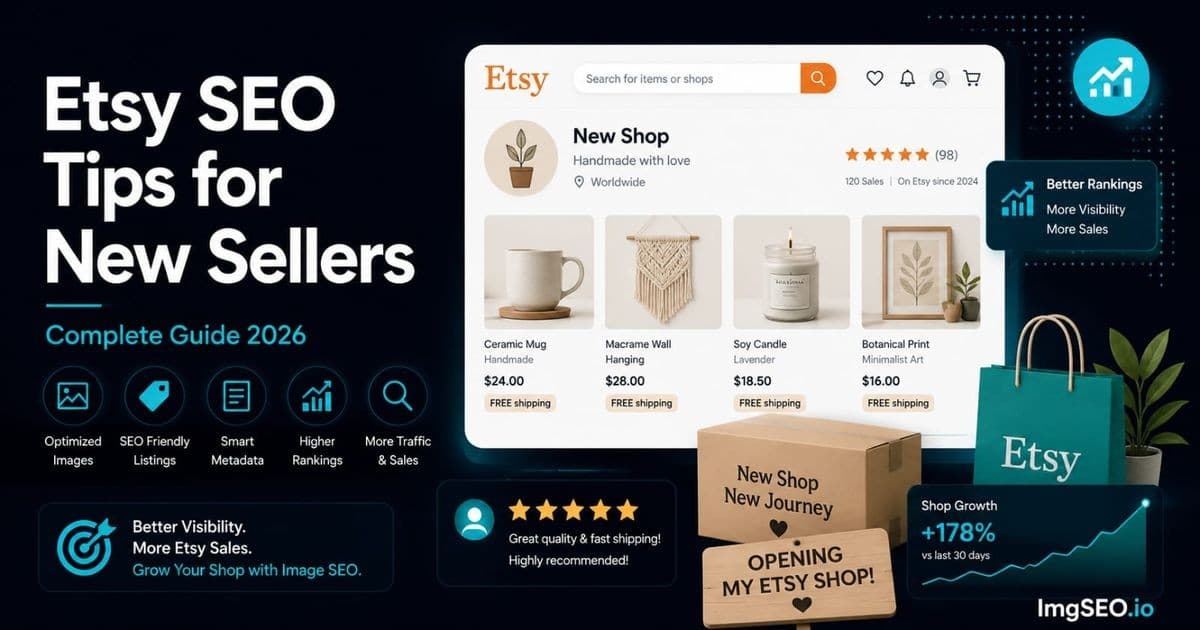
Opening an Etsy shop takes about twenty minutes. Getting found in Etsy search takes longer — but for new sellers who optimize correctly from the start, significantly less time than for sellers who wing it and wonder why their listings sit at zero views for months.
The challenge every new Etsy seller faces is the same: no reviews, no sales history, no established ranking signals. Etsy's algorithm uses all three as trust indicators. A new shop starts from zero on all of them. But it is not a closed door — it is a sequencing problem. Etsy gives new listings a temporary visibility boost in the first weeks after publication specifically to gather the initial signals the algorithm needs. That window is short. Sellers who optimize immediately capture it; sellers who plan to "fix it later" miss it entirely.
This guide covers nine actionable SEO tips for new Etsy sellers, including the two that most sellers overlook entirely: image alt text and pre-upload metadata. You will also get a week-by-week 30-day action plan to put all of it into practice immediately.
Key Takeaways
- Etsy displays roughly the first 40 characters of your title on mobile search, so the primary keyword must appear there — not just somewhere within the full 140-character limit.
- Every listing gets 13 tag slots (up to 20 characters each); leaving any empty forfeits a free keyword-match opportunity.
- A small Etsy Ads budget ($1–5/day) on your 2–3 best listings during the first 30 days, combined with Pinterest pinning and a personal-network launch discount, produces first sales faster than organic ranking alone.
How Etsy SEO Works for New Sellers
The Etsy Algorithm Basics
Etsy's search algorithm ranks listings using four primary factors:
- Relevance — how closely your title, tags, and description match what the buyer searched
- Listing quality score — a composite of click-through rate, conversion rate, and listing completeness
- Customer experience score — reviews, on-time shipping, and adherence to policies
- Recency — new and recently renewed listings get a temporary ranking boost
New sellers can act on relevance and listing completeness immediately. Customer experience score builds over time as sales and reviews accumulate. Recency is the one automatic advantage new sellers have — use it.
The New Seller Advantage
The new listing boost is real and it is temporary. Etsy surfaces new listings to gather initial click and conversion data. Listings that collect strong signals during this window — clicks, favorites, and sales — carry those signals forward into longer-term ranking. Listings that launch under-optimized miss the boost window and start from a weaker position than they would have if optimized from day one.
Treat your shop launch as a high-priority optimization period. Prepare accurate titles, relevant tags and attributes, clear images, and useful alt text before publishing, then use Etsy Stats to evaluate performance.
Two Search Channels to Optimize
Most new Etsy sellers think about Etsy search exclusively. Etsy search is important — it is where the majority of Etsy-native traffic originates. But Google search is a second channel that new sellers routinely ignore, and it is often more reachable.
Etsy listings can appear in Google's regular search results and in Google Images, but timing and visibility vary. Give external search engines useful context with descriptive listing-image alt text and a clear listing description, then monitor results rather than assuming traffic will arrive on a fixed schedule.
Tip 1: Optimize Your Etsy Title
Title Structure for New Sellers
Etsy displays approximately the first 40 characters of your listing title in search results on mobile — that is the only text a buyer sees before deciding whether to click your thumbnail. Your primary keyword must appear in those first 40 characters. Not near the end. Not in the middle. First.
The full title can be up to 140 characters. Use all of it. Every additional keyword phrase in your title is an additional relevance signal. But the first 40 characters win or lose the click.
Avoid including your shop name in the title — it wastes keyword space. Avoid filler phrases like "beautiful," "amazing," "perfect for" — they occupy characters without adding search relevance. Every word in the title should either be a keyword buyers search or a modifier that sharpens the keyword (material, size, color, style).
Title Formula
[Primary keyword] + [material] + [style descriptor] + [occasion/buyer]
Title Examples
❌ Bad: Beautiful Handmade Ring by MyShop - Great Gift
✅ Good: Sterling Silver Minimalist Ring Women Adjustable Boho Jewelry Gift for Her
❌ Bad: Cozy Blanket - Perfect for Winter
✅ Good: Chunky Knit Throw Blanket Cream Wool Handmade Sofa Bedroom Decor Gift
❌ Bad: Custom Dog Bandana
✅ Good: Personalized Dog Bandana Organic Cotton Small Dogs Custom Name Embroidered
The good versions lead with the primary keyword, include material and style, and end with an occasion or recipient keyword that captures gift-shopping searches.
Keyword Research for Titles
Before writing any title, find out what buyers actually type. Three free methods:
Etsy autocomplete — type your product into the Etsy search bar and read the dropdown suggestions. These are real buyer searches, ranked by volume. The top suggestions belong in your title.
Competitor research — find the top 10 listings for your product type. Read their titles. Identify the keyword phrases that appear repeatedly across multiple well-ranked listings — those are the terms buyers use and the algorithm rewards.
eRank free tier — eRank's free plan provides keyword search volume data for Etsy specifically. Use it to compare two or three keyword options before committing to a title structure.
Tip 2: Use All 13 Etsy Tags Strategically
The 13 Tag Rule
Etsy gives every listing 13 tag slots, each accepting a phrase up to 20 characters. Using fewer than 13 tags is leaving ranking opportunities unused. Every empty tag slot is a keyword phrase that could have matched a buyer's search and did not.
Tags must match your title and description keywords — consistency across all three fields reinforces the relevance signal. Etsy's algorithm looks for coherence: a listing where titles, tags, and description all point to the same product concept ranks higher than one where the tags seem unrelated to the title.
Tag Strategy for New Sellers
Mix broad and specific. Include some high-volume broad terms ("sterling silver ring") and some lower-volume specific terms ("adjustable boho ring women"). Broad terms get more impressions. Specific terms convert at higher rates because the buyer searching the specific term has already narrowed their intent.
Do not repeat your title verbatim. Tags and title complement each other. If your title already contains "sterling silver ring women," your tags should cover adjacent phrases: "boho jewelry gift," "minimalist ring silver," "gift for girlfriend." Each tag is a new search phrase, not a repetition.
Include: material, style, color, size, occasion, recipient. These six dimensions map to how buyers filter their searches. A tag for each dimension gives you coverage across the different ways buyers approach the same product.
Tag Examples for Common Products
Handmade Jewelry
sterling silver ring, minimalist jewelry, boho ring, gift for her, adjustable ring, women jewelry, handmade ring, silver jewelry, ring gift, everyday ring, dainty ring, boho jewelry, gift for girlfriend
Home Decor
macrame wall hanging, boho wall decor, bedroom wall art, large wall hanging, boho home decor, woven wall art, natural cotton decor, housewarming gift, boho bedroom, handmade wall art, wall hanging decor, bohemian decor, nursery wall art
Pet Accessories
dog bandana custom, personalized dog gift, organic cotton dog, small dog bandana, pet gift for dog, dog lover gift, puppy bandana, dog birthday gift, cute dog bandana, dog scarf cotton, custom pet gift, dog accessories, handmade dog gift
Tip 3: Optimize Images from Day One
Why Images Are Critical for New Sellers
A new seller with zero reviews has nothing to compensate for a weak thumbnail. Reviews build trust — but only for buyers who click first. The thumbnail is the trust signal that exists before the click. A buyer who does not click never sees the reviews, the listing description, the process photos, or any of the other things that would have converted them.
Beyond the Etsy-internal CTR effect, images are the primary driver of Google Images traffic. Describing each listing image with useful alt text improves accessibility and gives external search engines text context for the different views. It does not guarantee that every image will be indexed or ranked.
The New Seller Image Checklist
- 10 images per listing — use every slot Etsy provides
- Main image: clean or white background, product fills 80%+ of the frame, bright and sharp
- Lifestyle images: product in use, in context, or in a setting that matches your buyer's life
- Detail shots: material texture, construction quality, any safety or care features
- Scale reference: product next to a familiar object or shown in use to communicate size
- Alt text on every image: found in the listing editor under each image as "Describe this photo"
New sellers sometimes skip lifestyle images because they feel they need a professional photographer. You do not. Natural window light, a clean surface, and your actual product produce perfectly effective lifestyle images. Buyers on Etsy expect handmade-brand authenticity — an iPhone photo in natural light often performs better than an overly produced studio shot.
Image Alt Text for New Sellers
Etsy's listing-image alt text field accepts up to 250 characters. Etsy says it might add AI-generated alt text to some US sellers' listing images when the field is empty; seller-written alt text can be edited at any time.
Write useful alt text for every image. Describe what the item looks like, its texture, scale, and details a buyer would miss if the image did not load. Keep it natural, concise, and within Etsy's 250-character limit.
For complete alt text examples and formulas by product type, see our guides on how to get more Etsy sales with image SEO and Etsy image SEO.
Tip 4: Write Descriptions That Rank on Google
Etsy Description SEO
Google displays approximately the first 160 characters of your Etsy listing description as the search snippet — the text that appears under your listing title in Google results. The first sentence of your description is, in effect, your Google meta description. It should lead with your primary keyword and communicate the product clearly and specifically.
After the first paragraph, write for buyers rather than algorithms. Include materials, dimensions, available colors or sizes, and care instructions. Use the language buyers use — "sterling silver" not "precious metal alloy," "hand-dyed" not "artisan colorway process." Keyword-rich descriptions help listings rank on Google search and reinforce the keyword signals in your image alt text.
Description Structure
A well-structured Etsy listing description follows this order:
- First paragraph: primary keyword + key product features + what makes it special
- Second paragraph: materials, dimensions, colors, variants available
- Third paragraph: care instructions, usage notes, what comes with the order
- Fourth paragraph: processing time, shipping method, estimated delivery
- Final paragraph: return policy, custom order availability, shop policies
This structure serves both SEO (keyword-rich opening that Google indexes immediately) and conversion (all buyer questions answered before they have to ask).
The Google SEO Connection
Google indexes Etsy listing descriptions and uses them as relevance signals for ranking. A description that includes "sterling silver ring adjustable size women handmade minimalist" reinforces the same keywords in your title, tags, and image alt text. Consistent keyword signals across all listing fields produce stronger rankings than optimized titles with generic descriptions.
Tip 5: Complete Your Shop for Higher Rankings
Shop Completeness Affects Rankings
Etsy explicitly factors listing and shop completeness into its ranking signals. An incomplete shop — missing About section, no policies, placeholder banner — signals low listing quality and ranks accordingly. A fully complete shop ranks higher than an identical product listing in an incomplete shop.
Complete these immediately when you open your shop:
- Shop banner: 3360×840px, professional representation of your brand and product style
- Shop icon: 500×500px, clear logo or your best product photo
- About section: minimum 100 words describing your story, process, and what makes your products unique — this is also indexed by Google
- Shop policies: shipping timelines, return policy, exchange conditions — buyers read these before purchasing
- Shop announcement: current promotions, lead times, or a welcoming message
- All 10 listing images with alt text: listing completeness score matters
Profile and Banner Image Quality
Shop icon and banner images are not just branding — they are the first visual impression for buyers who arrive on your shop homepage. A blurry, pixelated banner signals an amateur shop regardless of how good your product photos are. Use the correct dimensions, export at appropriate quality, and make sure the visual quality matches the care you put into your product photography.
For Etsy-specific image dimension and format guidance, see our Etsy image SEO guide.
Tip 6: Add Metadata Before Every Upload
Why New Sellers Should Add Metadata
ImgSEO can store descriptive and rights-related information inside exported image files using XMP, with EXIF additionally included for JPEG. Etsy may process uploaded images, so do not assume that embedded metadata remains intact or is used by Etsy or Google as a ranking signal.
For actionable Etsy optimization, focus on the fields sellers control: clear listing titles, relevant tags and attributes, useful descriptions, high-quality images, and concise listing-image alt text. Search visibility and timing vary, so monitor performance instead of relying on a special crawl-timing theory.
How to Add Metadata Quickly
ImgSEO generates alt text, filenames, titles, descriptions, and tag suggestions, and embeds XMP in JPEG, WebP, and AVIF exports, with EXIF additionally included for JPEG. For Etsy, choose a currently supported upload format such as JPEG and add the generated alt text in the listing editor.
For a manual field-by-field walkthrough using free tools, see our guide on how to add metadata to product images.
Tip 7: Price and Position Strategically
Pricing Affects SEO Indirectly
Pricing does not directly change your keyword relevance on Etsy. But it directly affects your conversion rate — and conversion rate directly affects your listing quality score, which directly affects your ranking. The relationship is: competitive pricing → higher conversion → better listing quality score → higher Etsy ranking.
A listing priced so high it never converts accumulates low conversion data that depresses its ranking over time. A listing priced so low it converts frequently but unsustainably trains Etsy's algorithm to surface it — but cannot sustain the shop that makes it.
New Seller Pricing Strategy
Research the top 20 Etsy listings for your product type. Note the price range: the cheapest, the most expensive, and the cluster where most successful listings sit. Price yourself in the middle tier to start — not the lowest (which signals low quality and attracts bargain hunters who leave no reviews), not the highest (where your zero reviews make conversion difficult).
As reviews accumulate and your listing quality score improves, raise prices incrementally. Review accumulation is the main mechanism that lets new sellers move from middle-tier pricing into premium positioning.
Tip 8: Get Your First Sales Quickly
Why First Sales Matter for SEO
First sales do three things for your Etsy SEO simultaneously. They generate a listing quality score improvement through the conversion data they provide. They create the opportunity for a first review, which begins building your customer experience score. And they signal to Etsy's algorithm that your listing converts real buyers — the most direct ranking signal available.
The faster you get first sales, the faster all three signals begin compounding.
Getting First Sales Strategies
Pinterest — pin every listing immediately after publishing. Etsy's Pinterest integration makes this one click per listing. Pinterest referral traffic can produce sales within days of opening, before your Etsy search ranking has established. See our Pinterest image SEO guide for optimization tips.
Relevant Facebook groups — handmade marketplace groups, local small business groups, and niche product groups accept new shop announcements. Share your launch, link your listings, and respond to every question immediately.
Friends and family launch — offer a 10–15% launch discount to your personal network. First sales from people who know you still produce real reviews and real conversion data that Etsy's algorithm counts.
Etsy Ads at $1–5/day — Etsy Ads give new listings paid visibility while organic ranking builds. Even a small daily budget on your two or three best listings can produce first sales during the critical first weeks when organic visibility is lowest.
Tip 9: Monitor and Iterate
Etsy Stats for New Sellers
Etsy Stats is available from the first day your shop opens and is the primary feedback mechanism for your SEO work. Three metrics matter most in the first 30 days:
Views — is your listing being seen? Views come from Etsy search impressions and external traffic. Increasing views after changing a title or tags confirms the keyword change improved relevance matching.
Visits — are buyers clicking through to your listing? A listing with high views and low visits has a thumbnail problem. A listing with low views has a title or tag problem.
Orders — are visitors buying? High visits with low orders indicates a product page problem: images that do not build enough trust, a description that does not answer buyer questions, or pricing that does not match buyer expectations.
What to Track Weekly
Check Etsy Stats every week in the first 90 days. For each of your top five listings, note the views, visits, and orders for the week. Look for changes — both improvements and declines — that correlate with changes you made to titles, tags, images, or alt text.
Also track traffic sources. Etsy Stats shows how much traffic comes from Etsy search, from Google and other search engines, from social media, and from direct visits. Use changes in "Google and other search engines" traffic as one performance indicator, while remembering that attribution may reflect multiple listing and site factors rather than embedded metadata alone.
When to Update Listings
- Low views: the title and tags are not matching buyer searches — research and revise
- Views but low visits: the thumbnail is not winning clicks — re-crop, re-edit, or re-shoot the main image
- Visits but low orders: the product page is not converting — add images, improve the description, or review pricing
The New Seller 30-Day SEO Action Plan
Week 1: Foundation
This week is about getting the basics correct before a single buyer sees your listings.
- Upload all product images with descriptive SEO filenames before uploading to Etsy
- Use ImgSEO to embed EXIF/XMP metadata into every image
- Write concise, descriptive alt text for every listing image (up to 250 characters)
- Optimize every title: primary keyword first, material + style + occasion to follow
- Fill all 13 tags with mixed broad and specific phrases
- Use all 10 image slots per listing
Week 2: Content and External Traffic
- Write or complete the shop About section (minimum 100 words, include keywords naturally)
- Add or review shop policies: returns, exchanges, processing time, shipping
- Write keyword-rich descriptions for every listing — first sentence leads with primary keyword
- Pin every listing to Pinterest immediately after publishing
- Share your shop launch in 2–3 relevant Facebook groups
Week 3: Optimization Based on Data
- Open Etsy Stats and identify your three highest-view listings
- Run the scroll-stop test on each main thumbnail — can you identify the product at thumbnail size in under half a second?
- Re-shoot or re-crop any main image that fails the test
- Add lifestyle images to your top three listings if any slots are empty
- Update titles on any listing that has been live for two weeks with fewer than 20 views
Week 4: Growth and Measurement
- Request a review from every buyer who has received an order (Etsy allows one follow-up message)
- Add five or more new listings — fresh listings get the recency boost
- Set up Google Search Console and verify your Etsy shop URL
- Check the Image search tab for impressions on your listings
- Continue filling empty image slots and adding alt text across remaining listings
- See our image SEO audit guide for a full measurement framework
Common New Seller SEO Mistakes
Using shop name in the title instead of keywords. Your shop name is not what buyers search. The first 40 characters of your title are premium keyword real estate — use them for what buyers actually type.
Not using all 13 tags. Every unused tag is an unused search match opportunity. There is no penalty for using all 13, and there is a definite cost to leaving any empty.
Only one or two images per listing. Each empty image slot is a missed Google Images ranking opportunity and a missed conversion moment for buyers who want more visual confirmation before purchasing.
No alt text on images. Etsy fills empty alt text fields with AI-generated generic text that is not optimized for your keywords. Writing your own alt text is one of the highest-leverage, lowest-effort SEO actions available to new sellers.
Copying competitor titles verbatim. Etsy's algorithm can detect and deprioritize duplicate content. Use competitor titles as keyword research, not as templates to copy directly.
Generic titles with no specifics. "Beautiful Ring" does not match any buyer's search. "Sterling Silver Hammered Ring Women Adjustable Boho Jewelry Gift" matches dozens of specific searches simultaneously.
Not completing the shop profile. An incomplete shop ranks lower and converts worse. Buyers check the About section and policies before purchasing from a seller they have not bought from before.
Skipping source-file organization. Keep descriptive filenames and portable metadata in your source files when useful, but prioritize Etsy's seller-controlled listing fields because Etsy may process uploaded images.
Not using Pinterest for traffic. Pinterest referral traffic is free, it is accessible from day one before Etsy search ranking builds, and it compounds indefinitely from a single pin. There is no reason to skip it.
Giving up before 90 days. Etsy SEO signals accumulate over time. A shop that has been open for three months with consistent optimization effort will significantly outrank a shop that was optimized for two weeks and then left static. Patience is part of the strategy.
Frequently Asked Questions
How long does Etsy SEO take to work for new sellers?
Etsy may give new listings a temporary recency boost, but search performance varies with relevance, competition, engagement, crawl and indexing behavior, and shop quality. Track Etsy Stats and external search performance rather than relying on fixed milestones.
What is the most important SEO factor for new Etsy sellers?
Title optimization and image alt text are the two highest-leverage actions because they are immediately implementable, cost nothing, and directly affect the two channels new sellers need most: Etsy search relevance and Google Images visibility.
How do I get my first Etsy sale?
Combine Etsy Ads at a small daily budget on your best listing ($1–5/day) with Pinterest pinning of every listing and a personal-network launch offer. These three combined produce first sales faster than relying on organic Etsy ranking alone, which takes time to build for a new shop.
Should new Etsy sellers use Etsy Ads?
Yes — briefly and strategically. A small Etsy Ads budget on your two or three best listings during the first 30 days produces sales and review opportunities that would otherwise require months of organic ranking development. Once reviews accumulate and organic ranking improves, you can reduce or eliminate ad spend.
How many listings should a new Etsy shop have?
Open with at least 10–15 fully optimized listings. More listings mean more keyword coverage, more search match opportunities, and a more established-looking shop. Each listing is a separate entry point for buyers — a shop with three listings has three chances to be found; a shop with fifteen has fifteen.
Does Etsy punish new shops in search results?
Not with a penalty — but they start without ranking history. The new listing boost partially compensates by giving fresh listings temporary elevated visibility. The practical effect is that new shops start lower in established competitive searches but can appear prominently in niche or specific searches where their keyword optimization is strong.
How do I find the right keywords for my Etsy listings?
Etsy autocomplete is the fastest starting point — type your product into the search bar and read the dropdown suggestions. eRank's free tier provides search volume data. Competitor title research identifies the phrases that appear consistently in well-ranked listings. Use all three before finalizing any title or tag set.
What is the biggest mistake new Etsy sellers make with SEO?
Publishing listing images without useful alt text and never reviewing them. Descriptive alt text improves accessibility, and Etsy says external search engines may read it, but indexing, visibility, and rankings are not guaranteed. You can add or edit alt text later.
Conclusion
Etsy says new listings receive a small, temporary recency boost that may last from a few hours to a few days depending on search activity. Search performance also depends on multiple documented factors, including relevance, listing quality, engagement, customer service quality, and shopper behavior. Prepare accurate listing fields before publishing, then monitor Etsy Stats and refine them over time.
Images and alt text deserve attention from new Etsy sellers. Use alt text primarily to describe each listing image for accessibility; external search engines may read it, but rankings and indexing are not guaranteed. Strong thumbnails and useful lifestyle images can support buyer understanding and engagement, with results varying by listing and audience.
ImgSEO generates alt text and embeds XMP in JPEG, WebP, and AVIF exports, with EXIF additionally included for JPEG. Choose an Etsy-supported export format, upload it, and add the generated alt text in Etsy's listing editor. Try free — 30 images, the perfect size for a new shop launch.
For a complete Etsy image optimization reference to build on these fundamentals, see our Etsy image SEO guide.