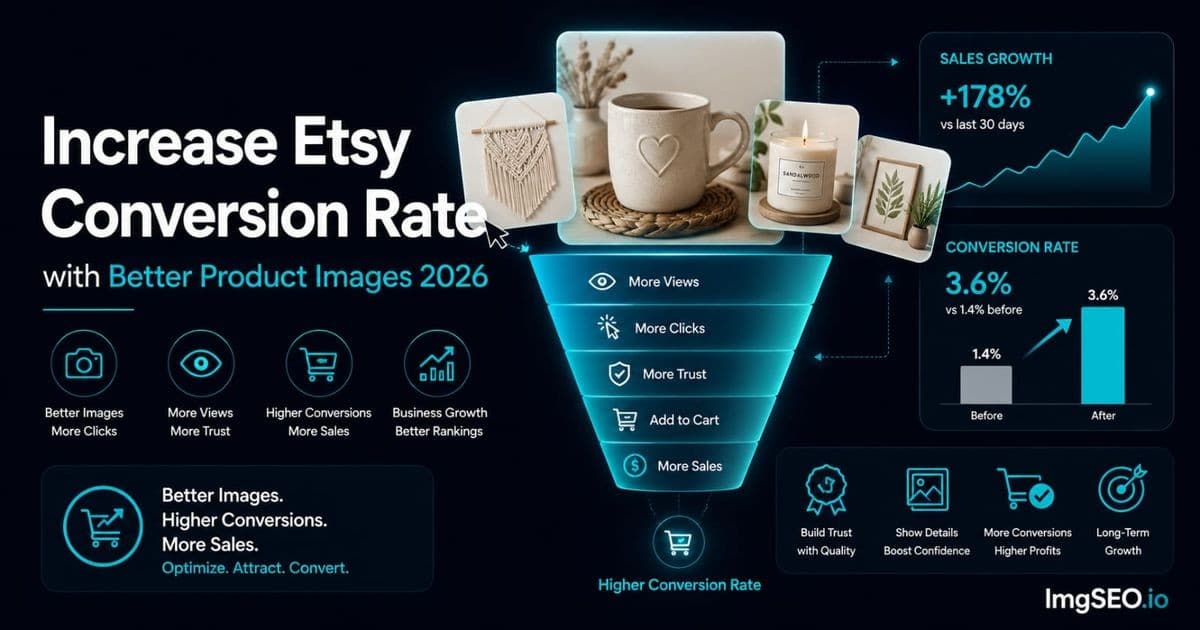
Getting clicks from Etsy search is only half the battle. A buyer who clicks your listing has already indicated interest — they saw your thumbnail and decided to look closer. What happens in the next thirty seconds, as they scroll through your images, determines whether that interest becomes a purchase. Most sellers spend their optimization energy on getting clicks and almost none on converting them.
Conversion rates vary widely by category, price, traffic source, shop maturity, and measurement period. Better images can answer buyer questions and reduce uncertainty, but they should not be credited with a fixed conversion or revenue increase by themselves.
This guide covers the psychology of why buyers purchase on Etsy, the five images that drive the most conversions, how to compose and style photos that convert, and how to measure the impact of every image change you make.
Key Takeaways
- The average Etsy conversion rate is 1–3%; moving from 1% to 5% means five times more revenue from the same traffic, with no added ad spend or SEO work.
- Five images do the heaviest conversion lifting: hero shot, lifestyle image, detail/close-up, scale reference, and social proof or packaging shot — each resolves a specific buyer doubt.
- Over 70% of Etsy buyers shop on mobile, so every image must read clearly at 150–400px; test each new photo on an actual phone before publishing.
How Images Drive Etsy Conversion Rate
The Psychology of Online Buying
When a buyer walks into a physical store, they pick things up. They feel the weight, test the texture, hold a ring up to see how it looks on their hand, sit in the chair to judge the comfort. They gather sensory information that either confirms or eliminates the purchase doubt that precedes every buying decision.
On Etsy, none of that is available. The buyer makes the same decision — spend money on something — with only visual information. Every physical question they would have answered by touching the product must be answered by your images instead. What does the material feel like? How big is it really? What does it look like in a real room? What will arrive in the box? Images that answer these questions convert. Images that raise additional questions do not.
The Trust Equation
Professional, high-quality images do not just show the product — they signal seller reliability. A buyer looking at a blurry, poorly lit product photo has no way to distinguish whether the blur is a photography failure or a product quality failure. They assume the worst and click away.
Every image quality signal — sharpness, accurate color, clean background, natural-looking lifestyle context — is simultaneously a signal about product quality and seller professionalism. Buyers on Etsy are trained to associate image quality with product quality because, over millions of purchases, that association has proven directionally correct. A seller who cares enough to photograph their products well cares enough to make them well.
More images also directly increase conversion rate independent of image quality. Buyers who view more images before purchasing are more confident in their decision and less likely to have unmet expectations that generate returns or negative reviews. Every empty image slot is an unanswered buyer question — and unanswered questions are where sales go to die.
Conversion vs SEO: Two Different Goals
SEO and conversion serve different moments in the buyer journey. SEO gets your listing in front of buyers — your thumbnail's job is to win the click from a page of competing results. Conversion turns that click into a purchase — your full image gallery's job is to eliminate every reason not to buy.
Your main image must do both: perform as an SEO thumbnail and serve as the first conversion image. The other nine slots are purely conversion real estate. This guide focuses on conversion — for the SEO side, see the Etsy image SEO guide for 2026 or our guide on how to get more Etsy sales with image SEO.
The 5 Images That Drive the Most Conversions on Etsy
Image 1: The Hero Shot
The hero shot is your main listing image — the one that appears in search results as a thumbnail and the first image buyers see when they open your listing. It carries dual responsibility: it must win the click from search and then immediately confirm to the buyer that clicking was the right decision.
Clean background — white, off-white, or a simple neutral — with the product filling 85–90% of the frame. No props competing for attention, no busy background distracting from the product, nothing in the frame that is not the product. High contrast, bright, and sharp enough to communicate product quality at thumbnail scale (around 200×200px on mobile) and at full listing image size simultaneously.
This is not the image that tells the buyer's lifestyle story. That is image two's job. The hero shot's one job is: product clarity and click-worthy quality.
Image 2: The Lifestyle Image
The lifestyle image is the single highest-impact conversion image for most Etsy products. It shows the product in real-world context — in a room, being worn, used in a daily routine — and answers the buyer's most fundamental purchase question: "Can I see this in my life?"
Buyers on Etsy are not just purchasing objects. They are purchasing a version of their home, wardrobe, or gifting identity. A macrame wall hanging photographed alone on a white wall is an object. The same piece photographed above a linen sofa with a potted plant beside it is a vision of the home the buyer wants to live in. That vision is what converts.
Etsy's own data consistently shows that listings with lifestyle images convert at meaningfully higher rates than those without. The exact figure varies by category, but the direction is consistent and significant across product types.
Image 3: The Detail or Close-up Shot
The detail shot shows the buyer what their hands would tell them in a physical store: the texture of the fabric, the weight implied by the metal thickness, the precision of the stitching, the smoothness of a ceramic glaze, the clarity of a gemstone. It answers the question "Is this actually good quality?" that a buyer cannot answer from the hero shot alone.
For handmade products, the detail shot is especially important because it shows the maker's skill in a way no description can. A close-up of hand-stitched seams, hand-stamped metal, or hand-thrown ceramic walls demonstrates craft. Buyers who choose handmade over mass-produced are specifically looking for evidence of that craft. Show it to them.
Image 4: The Scale Reference
Missing scale reference is the most common cause of Etsy returns. A buyer who orders a ring expecting it to be a full ring and receives a midi ring — or orders a wall hanging expecting it to be large and receives something that looks doll-sized — is going to leave a negative review and request a return. The purchase information was technically in the listing. The image did not make it real.
A hand holding the product, a coin placed next to it, a familiar object for comparison, or the product being worn by a person with their height and size noted — any of these makes size concrete in a way that "5 inches diameter" in a description does not. Buyers process visual scale information differently from text-based measurement information. Show the size, do not just state it.
Image 5: The Social Proof or Packaging Image
The fifth conversion-critical image is a trust closer — either a customer photo using or wearing the product (user-generated content) or a packaging shot showing exactly what will arrive.
A customer photo is the most powerful trust signal in e-commerce because it shows a real person who already bought and valued the product enough to photograph it. It answers "will I get what I see?" with evidence rather than assurance. A packaging shot answers the same question from a different angle — here is exactly what will arrive in your mailbox. The box, the tissue paper, the card. No surprises. For gift purchases, which represent a significant fraction of Etsy sales, the packaging shot directly closes the sale: "yes, this will look beautiful as a gift."
The Complete 10-Image Conversion Strategy
Every image slot on an Etsy listing is a buyer doubt resolved. Here is the full conversion map:
| Slot | Image | Conversion Goal | |------|-------|----------------| | 1 | Hero shot, clean background | Win the click; confirm product identity | | 2 | Lifestyle in context | "I can see this in my life" | | 3 | Detail or close-up | Trust in quality and craftsmanship | | 4 | Scale reference | Accurate size expectation, prevent returns | | 5 | Alternate angle | Complete product view, no surprises | | 6 | In use — worn or being used | Aspirational lifestyle connection | | 7 | Packaging or gift presentation | Gift buyer conversion, unboxing anticipation | | 8 | Process or handmade story | Etsy authenticity trust signal | | 9 | Size or variant comparison | Help buyer choose the right option | | 10 | Additional lifestyle or customer photo | Final conversion push, social proof |
A buyer who views all ten images has had ten of their purchase doubts addressed. A buyer who views two images has had two. The correlation between images viewed and conversion rate is one of the most consistent patterns in Etsy seller data.
Image Composition for Higher Conversion
The Rule of Product Dominance
In your hero image and most product shots, the product should fill 80–90% of the frame. This is counterintuitive to sellers who have seen editorial and lifestyle photography where products appear small in large environments — that style communicates aspiration, not product clarity.
On Etsy, where buyers are making purchase decisions from small thumbnails before they open a listing, a small product in a large frame is a product that buyers scroll past. Fill the frame. Leave enough breathing room to prevent a cramped feeling, but not so much empty space that the product looks small or incidental.
Color Psychology in Product Photography
Background color communicates brand positioning before the buyer processes any other information:
White and off-white communicate cleanliness, professionalism, and clinical precision. They work well for skincare, ceramics, minimalist jewelry, and any product where purity and exactness are core values. They are also the standard for marketplaces — buyers expect white backgrounds for main product images.
Natural and warm backgrounds — linen, wood grain, warm stone, natural cotton — communicate quality, warmth, and artisanal character. They work well for handmade goods, natural products, home textiles, and any brand positioned around craft and natural materials.
Dark backgrounds create drama and luxury positioning. They work well for jewelry, candles, and any product that benefits from a premium, editorial aesthetic. Dark backgrounds require careful lighting to avoid muddiness, but when done well they communicate high-end quality signals.
Match your background palette to your buyer's expectations. A boho home decor buyer expects warm, earthy, natural-material backgrounds. A buyer seeking precision-crafted technical jewelry expects clean white. Mismatch between background style and buyer expectation creates subtle cognitive friction that reduces conversion.
The Negative Space Strategy
Intentional empty space around a product — particularly in hero images — focuses visual attention by removing competition for the eye. Luxury brands and premium tech companies (Apple being the canonical example) use this technique consistently because it communicates confidence: the product does not need visual props or a busy context to earn attention.
This is different from the problem of a small product in a large frame. Negative space is deliberate and proportional — the product still dominates, but the surrounding emptiness is purposeful rather than accidental.
Consistency Across Listings
Buyers who click from a listing to your shop page see your full listing grid. A grid of thumbnails with wildly inconsistent backgrounds, lighting temperatures, and photography styles looks like a collection of random items gathered from different sellers, not a curated shop with a coherent identity.
Visual consistency across your listing grid is a trust signal at the shop level that compounds the conversion trust signals in individual listings. A buyer who arrives at a shop that looks designed and intentional is more likely to add to cart and browse additional listings than one who arrives at a shop that looks like a thrift store.
Lifestyle Photography That Converts
The Aspirational Image Formula
The lifestyle image is not a photo of your product in context. It is a photo of the life your buyer wants to live, with your product in it. That distinction determines whether a lifestyle image converts or merely decorates.
A scented candle on a generic shelf is context. The same candle on a marble shelf next to a linen hand towel, a small potted plant, and a cup of tea, photographed in warm afternoon light — that is aspiration. The buyer is not looking at the candle. They are looking at a bathroom that feels peaceful and intentional, imagining themselves in it, and purchasing the candle as a step toward that vision.
Identify what life your target buyer is trying to build or improve and style your lifestyle images around that life. The product is always in the frame. The emotional aspiration is what converts.
Styling for Your Target Buyer
The props, settings, and styling choices in your lifestyle images communicate who this product is for as powerfully as the product itself. A macrame wall hanging photographed in a room styled with vintage furniture, dried botanicals, and rattan baskets speaks directly to the boho buyer. The same piece in a spare, light-filled room with white walls and concrete floors speaks to the minimalist buyer. They are photographing the same product for two different buyers.
Know your buyer's aesthetic before you style a shoot. Their Pinterest boards, Instagram following, and the Etsy listings they favorite give you direct evidence of the visual language they respond to. Style to them, not to your personal preference.
Models for Clothing and Jewelry
For wearable products, a model eliminates the single most significant source of pre-purchase doubt: "Will this look good on me?" A model wearing the product makes size, proportion, and wearability concrete. No model means the buyer has to imagine all three, and imagination in the direction of doubt is where sales are lost.
Including size information with model photos — "Model is 5'7" and wearing size M" — further reduces return risk by giving buyers a concrete reference point. Diverse model representation increases conversion across buyer segments by ensuring more buyers can see themselves in the product.
Props That Help and Hurt Conversion
Props that add context: a coffee mug next to a morning journal, a hand holding a piece of jewelry, flowers next to a skincare product — these props add lifestyle meaning without competing with the product.
Props that show scale: a hand next to a small product, a coin next to a ring, a person standing next to a large wall hanging — these make size concrete in ways no measurement text achieves.
Props that compete: too many objects in the frame split the buyer's visual attention. Every element in the frame that is not the product is visual noise that the buyer's eye must filter. Reduce props to the minimum needed to achieve the lifestyle or scale goal.
Props that confuse: an object in the frame that has no relationship to the product or the lifestyle raises questions instead of answering them. If a buyer has to wonder why something is in the photo, the photo is not doing its conversion job.
The Trust Signals in Product Images
Packaging Shot: Purchase Anxiety Eliminated
The packaging shot shows the buyer exactly what will arrive in their mailbox — the box, the wrapping, the tissue paper, the card. It answers the question that underlies every online purchase: "Will I get what I see?"
For gift purchases, the packaging shot closes the sale at the point of the purchase decision. A buyer looking for a birthday gift for their best friend does not just want a beautiful product — they want to know the product will look beautiful when it is unwrapped. A packaging shot of tissue paper, ribbon, and a handwritten card tells that buyer: yes, your friend will be delighted. That confirmation is the final element they needed to click add to cart.
Process and Maker Images
The process image — your hands at work, your tools, your materials, your studio — is unique to Etsy as a conversion element. Buyers on Etsy choose the platform specifically because they want handmade, which means they want the story of how and by whom a product was made. A process image delivers that story visually and instantly.
A ceramicist's hands shaping clay on a wheel. A jeweler soldering a silver ring under magnification. A weaver threading a loom. These images communicate: this was made by a skilled person who cares about their craft. That communication creates an emotional connection that mass-produced product photos cannot replicate — and that emotional connection converts.
Customer Photos as Social Proof
User-generated content — photos from real customers using or wearing the product — is the most powerful trust signal available for Etsy conversion because it provides third-party evidence that the product delivers on its promise. A professional product photo shows what the product looks like. A customer photo shows what it looks like on a real person in a real life.
Build a systematic UGC collection process: include a card in every order asking buyers to share photos, follow up in your Etsy thank-you message with a photo request and a small incentive (discount on next order, a featured spot in your listings), and share all received photos with permission. Every customer photo you add to a listing is a conversion asset that compounds indefinitely.
Mobile Optimization for Etsy Conversion
70%+ of Etsy Buyers Shop on Mobile
The majority of Etsy traffic is mobile. That means your conversion image strategy must work on a screen roughly 6 inches wide, with images that render at 300–400px across for in-listing view and 150–200px for thumbnails. Everything must be legible and compelling at those sizes.
Test every new image on your actual phone before publishing. Browse to your listing as a buyer would and scroll through all images. At mobile view:
- Is the product instantly identifiable in the main image?
- Are text overlays in secondary images readable without pinching to zoom?
- Does the lifestyle image convey its aspirational context at mobile scale, or does it become too small to read?
- Does the detail shot retain enough resolution to communicate quality, or does it become a blur?
If any image fails these questions on mobile, it is failing the majority of your buyers.
The Mobile Scroll Test
Open your Etsy shop on your phone and browse your listings as a buyer would. Scroll your listing grid at a normal pace. Which thumbnails stop your scroll? Which do you scroll past without registering? Scroll speed is a proxy for buyer attention — the images that stop your scroll in your own shop are the ones that will stop buyers' scrolls too.
For listings whose main images do not stop the scroll, the problem is usually one of: product too small in frame, insufficient contrast with background, or insufficient brightness. Adjust before the listing costs you more impressions.
Image Quality and Conversion Rate
Resolution Requirements
Etsy's zoom feature lets buyers click on any listing image and inspect it at full resolution. A buyer considering a handmade ring who zooms in to check the setting quality and sees a pixelated blur will not purchase. A buyer who zooms in and sees crisp, clear metalwork and smooth solder lines will.
Upload images at a minimum of 2000px on the longest side. This gives the zoom feature sufficient resolution to display detail without pixelation. For highly detailed products — fine jewelry, intricate embroidery, small ceramics — 2500–3000px preserves the detail that justifies the price. For a deeper guide to optimizing product images for search engines, see Image SEO for Product Photography 2026.
Lighting and Color Accuracy
Color accuracy is a conversion factor that operates after the purchase as well as before it. A buyer who receives a product that is significantly darker, lighter, or different in hue from the listing photos feels deceived — even when the listing description stated the accurate color. The visual impression from the image overrides the text description in buyer memory.
Natural light is the most accurate for most products because it approximates the light buyers will see the product in. Artificial light — especially warm incandescent or cool fluorescent — shifts color in ways that are difficult to fully correct in post-processing. Where artificial light is necessary, calibrate your white balance carefully and check the final images against the actual product in natural light before publishing.
A/B Testing Your Etsy Images
What to Test
Main image: white background vs lifestyle. Each can communicate different information. Follow current marketplace rules, choose the version that identifies the product clearly, and test with your own audience instead of assuming a click-through or conversion advantage.
Main image: product only vs product with hand or model. Adding a hand holding jewelry, or a model wearing a garment, changes both the scale reference and the aspiration signal. For some products this increases conversion significantly. For others, the clean product shot converts better.
Listing image order. Which image performs better as the first image after the main shot? Lifestyle or detail? Some products convert better when the second image is a detail shot (quality-first buyers); others convert better when the second image is a lifestyle shot (aspiration-first buyers).
How to Test on Etsy
Duplicate the listing, change only the main image (or image order), keep all titles, tags, prices, and descriptions identical. Run both for 30 days. Compare views, favorites, and conversion rate in Etsy Stats. The listing with higher conversion rate wins — close the other.
This is a manual process, but the data it produces is specific to your product and your buyers, which no general advice can replicate.
Measuring Conversion Rate Improvement
Where to Find Your Conversion Rate
Etsy Stats → Listings shows per-listing performance data. Your conversion rate is orders ÷ visits × 100. Etsy does not display this calculation directly — divide your order count by your visit count to get the percentage.
Track this per-listing, not just shop-wide. A shop with a 3% average conversion rate may have individual listings at 8% and others at 0.5%. The high-converting listings tell you what is working; the low-converting listings tell you where the revenue opportunity is.
Baseline Metrics to Track
For each listing, track weekly: views (search impressions), visits (clicks through to the listing), and orders (purchases). Calculate conversion rate as orders ÷ visits. A views increase without a visits increase means your thumbnail is not winning clicks. A visits increase without an orders increase means your images are not converting. A views decrease means your SEO has weakened.
What Good Looks Like
| Conversion Rate | Benchmark | |----------------|-----------| | Under 1% | Needs significant image and listing improvement | | 1–3% | Etsy average | | 3–5% | Good | | 5–8% | Excellent | | Over 8% | Top performer |
Benchmarks vary meaningfully by product category. Handmade jewelry, printable digital products, and pet accessories tend to convert higher than average. Highly competitive categories like candles or generic apparel tend to convert lower. Use these benchmarks as directional guides, not absolute targets.
Common Conversion-Killing Image Mistakes
Only one or two images. Buyers who cannot answer their visual questions from your image gallery go answer them from a competitor's. More images equal more answered questions equal higher conversion.
No scale reference. The single most common cause of Etsy returns and "not as described" reviews. A buyer who expected a large wall hanging and received a small one is a buyer who leaves a negative review. Show the size.
No lifestyle image. Buyers cannot visualize the product in their own life from a white-background product shot alone. A lifestyle image does that visualization for them. Without it, the burden falls on the buyer's imagination — and imagination in the presence of doubt trends negative.
Blurry or dark main image. Immediate trust destruction. A buyer who sees a blurry main image assumes either the seller could not be bothered to photograph properly or the product itself is not worth photographing properly. Both interpretations lead to a click away.
Inconsistent photography style across listing images. Different backgrounds, lighting temperatures, and styling choices within the same listing create visual incoherence that undermines quality perception. Every image in a listing should look like it belongs to the same shoot.
No packaging shot for gift products. Gift buyers are purchasing on behalf of someone else — the uncertainty of how the product will arrive is heightened because the stakes of the unboxing experience are higher. A packaging shot eliminates that uncertainty.
No model or person for wearable products. Without a model, the buyer must mentally calculate how the product will look on their body from a flat or mannequin shot. That calculation introduces doubt. A real person wearing the product in a real body removes it.
Watermarks on listing images. Watermarks communicate defensiveness — a seller who does not trust buyers — and add visual clutter that competes with the product. They also create a slight but real reduction in trust. Remove them.
Fake-looking stock backgrounds. Composite images with clearly digital backgrounds (the product appears to float on a texture that has no physical relationship to it) read as low-effort and reduce perceived product quality. Use real surfaces and real environments.
Images that show flaws without context. A visible seam, a variation in natural material, or a slight asymmetry in a handmade piece should be addressed directly — either in the image (a detail shot that contextualizes it as a feature of handmade character) or in the description. An unexplained flaw visible in a listing image creates purchase doubt that an explanation would resolve.
Frequently Asked Questions
What is a good Etsy conversion rate?
The Etsy average is 1–3%. A rate of 3–5% is good; 5–8% is excellent; above 8% is top-performer territory. Rates vary by category — digital products and niche handmade goods often convert higher than competitive commodity categories.
How many images do I need per Etsy listing?
All 10. Every image slot is a buyer doubt resolved. A listing with 10 well-chosen images answers more questions, builds more trust, and converts at a higher rate than the same listing with 3 images.
Does lifestyle photography increase Etsy sales?
Yes — consistently and significantly. Lifestyle images answer the buyer's core question ("Can I see this in my life?") in a way that no product-only shot can. Listings with lifestyle images convert meaningfully higher than those with only white-background product shots across virtually every Etsy product category.
Should I use a model for clothing on Etsy?
Yes. A model wearing the garment answers scale, proportion, fit, and style questions simultaneously. Including model height and size information ("Model is 5'7" wearing size M") further reduces return risk and increases buyer confidence.
What is the most important Etsy listing image?
The main image (slot 1) has dual importance: it wins clicks from search results and serves as the first conversion image. But the full gallery matters equally for conversion — a strong main image that brings buyers in, followed by a weak gallery, produces clicks but not sales.
How do I get customer photos for my Etsy listings?
Include a card in every order asking buyers to share a photo. Follow up in your Etsy thank-you message with a photo request. Offer a small incentive — a 10% discount on the next order, a feature in your listings. Make it easy: specify that they can share via Etsy messages or email. Buyers who love a product are often happy to share; they just need to be asked.
Does packaging photography help Etsy conversion?
Yes — particularly for gift purchases, which represent a large share of Etsy's transaction volume. A packaging shot answers "will this look good as a gift?" with visual evidence. It also reduces purchase anxiety for all buyers by showing exactly what will arrive.
How do I test which images convert better on Etsy?
Duplicate the listing with only the test variable changed (main image, image order), run both for 30 days, and compare conversion rates in Etsy Stats. The higher-converting version wins. This is manual but produces data specific to your product and buyer, which no general benchmark can provide.
Conclusion
At the same traffic volume and order value, a higher conversion rate produces more revenue. Images are one influence among price, offer, reviews, delivery terms, product-market fit, and traffic quality, so isolate changes and measure results rather than attributing nearly all variation to photography.
The five essential images that drive conversion — hero shot, lifestyle, detail, scale reference, and social proof or packaging — each address a specific buyer doubt. Use all 10 slots to answer all 10 doubts. Test what works for your specific product and buyer. Measure the results. Iterate. If you're also working on your Etsy search visibility, Etsy SEO tips for new sellers is a strong starting point.
Great images and great SEO are not separate strategies — they are the same strategy at different stages of the buyer journey. SEO brings buyers to the click. Images convert the click into the sale. ImgSEO handles the SEO side — alt text, metadata, and compression for every listing image — so your images work as hard for search ranking as they do for conversion. Try free — 30 images.
For a complete guide to the image SEO side of the equation, see our guide on how to get more Etsy sales with image SEO.