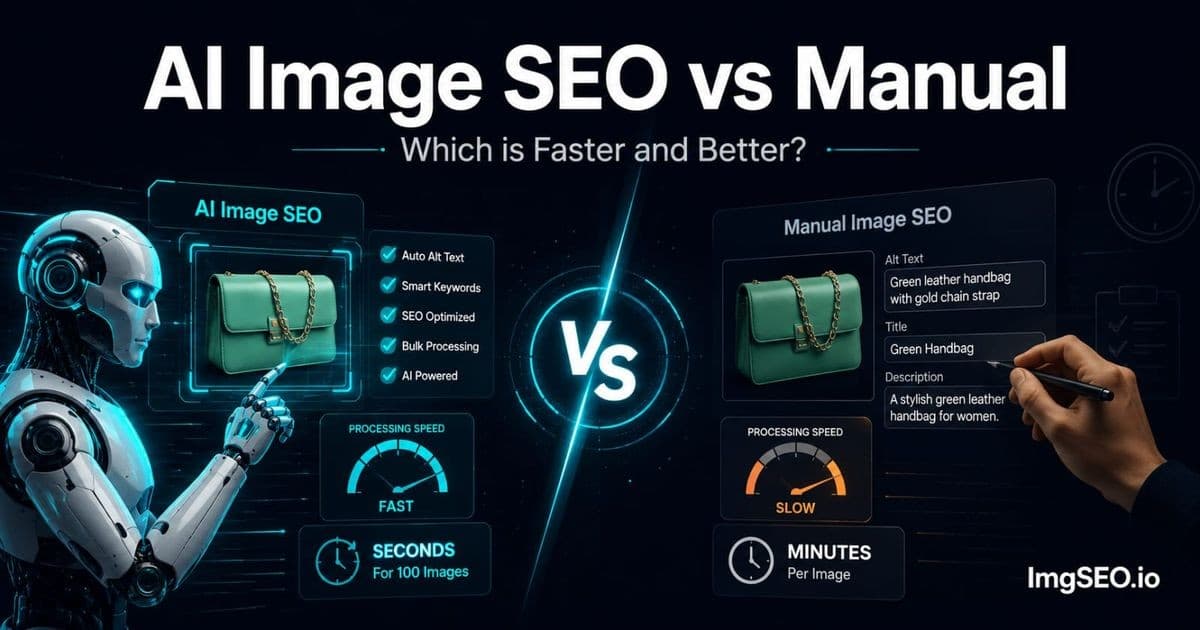
You have 200 product images that need alt text, metadata, and optimized filenames. You can spend two to three weeks on it manually, or you can spend a few hours with AI. That is the core equation — but the honest answer about which approach is right for your shop is more nuanced than "AI always wins."
Most sellers end up in one of two places: they optimize everything manually (slow, inconsistent) or they optimize nothing at all (costly in missed traffic). AI changes what is possible in the middle — but it does not eliminate the need for judgment. This comparison covers the real numbers on both sides.
Key Takeaways
- Full manual optimization (alt text + metadata + filenames) runs 10–15 hours per 100 images; the AI-plus-review hybrid runs about 1 hour for the same batch.
- AI wins on speed, consistency, and scale for catalogs of 20+ products; manual still wins on custom or highly specialized product details AI cannot see in a photo.
- The hybrid approach — AI generates, a human reviews for 30 seconds per image — closes almost all of the accuracy gap while keeping most of the time savings.
The Manual Approach: What It Actually Takes
Time Per Image (Manual)
Manual image SEO involves multiple separate steps, each taking longer than sellers expect:
- Writing alt text: 2–3 minutes per image when done properly — researching keywords, writing the description, checking it against your other listings for consistency
- Adding EXIF/XMP metadata: 3–5 minutes per image using tools like Lightroom or dedicated metadata editors — opening the tool, filling in title, description, and keyword fields, saving
- Renaming files: 1 minute per image — coming up with a descriptive filename that includes relevant keywords without being unwieldy
Total per image done properly: 6–9 minutes. Most sellers who say they do it manually are doing a shortened version — alt text only, no metadata — which still takes 2–3 minutes per image.
Time for 100 Images (Manual)
| Scope | Time estimate | |---|---| | Alt text only (100 images) | 3–5 hours | | Full optimization: alt text + metadata + filenames | 10–15 hours | | New Etsy seller: 50 listings × 5 images each | 25–40 hours |
That 25–40 hour figure is the actual time investment for a reasonably sized new shop, before a single sale. Most sellers either skip the optimization entirely or do a rushed version that produces inconsistent results.
The Manual Quality Problem
Even sellers who invest the time hit a quality ceiling: writing effective alt text requires knowing which keywords buyers use for your product category. Most sellers write what they would call their product, not what buyers search for.
Manual alt text also degrades with volume. The first ten listings get thoughtful descriptions. By listing fifty, shortcuts appear. By listing one hundred, some images get "silver ring" instead of "sterling silver adjustable band ring minimalist women everyday jewelry." The inconsistency across the catalog creates a noisy SEO signal — Google sees different levels of keyword optimization pointing in different directions.
The AI Approach: What It Actually Takes
Time Per Image (AI)
The AI workflow has three stages:
- Upload and process: 5–10 seconds per image — the AI runs computer vision analysis and generates alt text, metadata, and SEO title
- Review output: 30 seconds per image — checking that the product type, material, and color are correct
- Apply to platform: 1–2 minutes per image — pasting the alt text into Etsy's image description field or Shopify's alt text field
Total per image: 2–3 minutes — roughly the same as manual alt text alone, but producing alt text, metadata, and filenames simultaneously.
Time for 100 Images (AI)
| Scope | Time estimate | |---|---| | AI processing (100 images) | 10–15 minutes | | Review all output | 30–45 minutes | | Apply to platform | 1.5–2 hours | | Total | ~2.5–3 hours |
That is a 70–80% reduction compared to full manual optimization. The time per image drops further as your workflow becomes practiced — the review step gets faster once you know what to look for.
The AI Quality Advantage
AI brings two quality improvements that manual approaches rarely achieve at scale:
Consistent keyword structure: Every image gets the same quality of keyword research behind its description. Image 1 and image 1,000 receive the same effort.
Buyer vocabulary alignment: AI trained on e-commerce search data knows that buyers search for "sterling silver adjustable ring" not "silver ring that fits multiple sizes" — the exact phrases that appear in search queries rather than the natural language sellers use to describe their own products.
For a detailed explanation of how computer vision and keyword mapping work together, see how AI generates alt text for product images.
Head-to-Head Comparison
Speed
| Task | Manual | AI | |---|---|---| | Alt text per image | 2–3 min | ~10 sec | | Metadata per image | 3–5 min | ~10 sec | | Filename per image | 1 min | ~10 sec | | 100 images total | 10–15 hrs | ~2.5–3 hrs | | Winner | | ✅ AI |
Consistency
| Factor | Manual | AI | |---|---|---| | Same keyword structure across catalog | ❌ Varies with effort | ✅ Consistent | | Same quality at image 100 vs image 1 | ❌ Fatigue degrades output | ✅ Identical | | Platform-optimized keywords | ❌ Guesswork | ✅ Trained on search data | | No keyword fatigue | ❌ Repetition dulls output | ✅ Not a factor | | Winner | | ✅ AI |
Accuracy for Unique Products
| Factor | Manual | AI | |---|---|---| | Custom product names and variants | ✅ You know your product | ❌ Cannot know from image | | Niche specialist terminology | ✅ You have the vocabulary | ⚠️ Varies by category | | Exact color matching in unusual lighting | ✅ You see the real product | ⚠️ Usually accurate | | Branded details and unique features | ✅ Complete knowledge | ❌ Misses what is not visible | | Winner | ✅ Manual | |
Cost
| Approach | Real cost | |---|---| | Manual (your time) | $15–50/hr opportunity cost × 10–15 hrs per 100 images | | AI tool (ImgSEO) | Fixed monthly cost, covers hundreds of images | | Winner at scale | ✅ AI |
The manual cost calculation depends on how you value your time. At $25/hr, optimizing 100 images manually costs $250–375 in opportunity cost — time you could spend on product development, photography, or customer service. AI subscriptions cost a fraction of that per month for equivalent or larger volume.
When Manual Wins
Manual optimization is the right choice in specific situations — not because it produces better SEO results, but because the trade-offs make sense.
Small Catalogs Under 20 Products
For a shop with 10–20 listings and no immediate plans to scale, the time investment is manageable. Five to eight hours of focused work can fully optimize a small catalog. The opportunity cost is real but not prohibitive.
More importantly, doing it manually at small scale teaches you what effective alt text looks like for your specific product category — knowledge that makes you a better reviewer of AI output later.
Highly Specialized or Custom Products
Products with unusual materials, specialized terminology, or significant variation between pieces can trip up AI in ways that matter for SEO. A ceramics artist who works with specific clay bodies and glaze chemistry will write better descriptions than AI for those technical distinctions.
For products where the exact description is the SEO differentiator — where "celadon glaze" performs differently from "blue-green glaze" in your niche — manual control makes sense.
As a Learning Exercise
Writing alt text manually for your first batch of products is worth doing once. It forces you to research which keywords buyers use, examine your products from a buyer's perspective, and understand the vocabulary patterns that perform well in your category. That knowledge carries forward into better AI review and more targeted edits.
When AI Wins
Growing Catalogs of 20+ Products
Once a catalog grows past twenty products, the manual approach starts to create a backlog. New products listed without optimization are leaving traffic on the table while you work through the queue. AI eliminates the queue — every new listing can be optimized before it goes live.
The consistency benefit also compounds: AI-optimized catalogs give Google a coherent, keyword-rich image catalog to index. Manual catalogs with varying quality across listings give mixed signals.
Seasonal Restocks and Product Refreshes
A product that sells out and gets restocked is a new listing — and in manual workflow, that means repeating optimization work you already did. AI reprocesses in seconds. For sellers who refresh seasonal products regularly, the time saving from AI compounds across every restock cycle.
Selling on Multiple Platforms
Etsy, Shopify, and WooCommerce have different buyer vocabularies and different alt text conventions. Manually writing optimized alt text three times for the same product is impractical. AI handles platform-specific keyword optimization as part of the generation step — the same image produces Etsy-appropriate output and Shopify-appropriate output from a single process.
The Hybrid Approach: Best of Both
For most sellers, the right answer is neither pure AI nor pure manual — it is AI-generated output plus targeted human review.
How to Combine AI and Manual
- AI generates alt text, metadata, and filenames for every image in the batch
- Human reviews each output at 30 seconds per image — scanning for obvious errors
- Human adds specific details the AI could not know: custom product names, exact sizing, branded details, specialist terminology
- Human adjusts any descriptions where the AI's keyword choices do not match how buyers in your specific niche search
The Review Checklist
Run through these five checks for each AI-generated description:
- [ ] Product type correctly identified (ring, not bracelet; mug, not bowl)?
- [ ] Material description accurate (sterling silver, not silver-plated; genuine leather, not faux)?
- [ ] Color description matches actual product — not just photo lighting?
- [ ] Any custom or branded details worth adding?
- [ ] Platform-appropriate keywords present?
Most images pass all five checks without edits. A well-priced ten minutes per batch catches the exceptions.
Time for the Hybrid Approach (100 Images)
| Step | Time | |---|---| | AI processing | 10–15 min | | Human review (30 sec × 100) | ~50 min | | Total | ~1 hour |
One hour versus ten to fifteen hours manual. The quality gap between hybrid and pure manual is small for most product categories — and in the seller's favor, because AI brings keyword consistency that manual rarely achieves.
The Scale Problem: Why AI Wins Long Term
The Catalog Growth Reality
The math on manual optimization works against sellers as their catalog grows:
- Year 1, 50 products: Manual optimization takes 25–40 hours — painful but achievable
- Year 2, 200 products: Adding 150 products at 6–9 minutes each is another 15–22 hours — on top of the work already done
- Year 3, 500 products: Full catalog optimization is a part-time job in its own right
This is before accounting for seasonal updates, platform migrations, or re-optimization as keyword patterns shift. Manual optimization does not scale — and the sellers who defer it accumulate a growing backlog of unoptimized listings. For the bigger picture on how AI is transforming e-commerce SEO beyond individual catalogs, that guide covers the structural shift in how online stores compete.
The Speed-to-Market Advantage
Beyond scale, AI changes the relationship between listing and optimization. With manual workflow, optimization happens after listing — often days or weeks later, or never. With AI, optimization can happen before listing. New products go live already indexed with keyword-rich metadata.
Google starts crawling and indexing image metadata from the first visit to a listing. Early optimization means earlier indexing, which means earlier rankings. The compounding effect of six months of early indexing versus six months of post-listing optimization is measurable. For the full picture on how Google Images rankings build over time, see how to rank on Google Images.
Conclusion
The honest answer: for sellers with 20+ products, AI wins on speed, consistency, and scale — not because manual produces worse SEO per image when done carefully, but because manual cannot maintain quality across a growing catalog at the pace most active sellers need.
For sellers with under 20 products, manual is viable. It is also worth doing once as a learning exercise before switching to AI, so you understand what good alt text looks like for your category.
The practical recommendation for most sellers is the hybrid approach: AI handles the keyword research and generation at scale, human review catches the product-specific inaccuracies that AI cannot know from visual analysis alone. The total time investment is roughly one hour per 100 images — and the output quality is higher than most sellers achieve manually because AI brings consistency the manual process rarely sustains.
ImgSEO generates alt text, metadata, SEO titles, and optimized filenames in one step — try it free with your first 30 images to see the AI output for your own products before committing to anything.
For a broader comparison of the tools available for image SEO, see the best AI tools for image SEO.