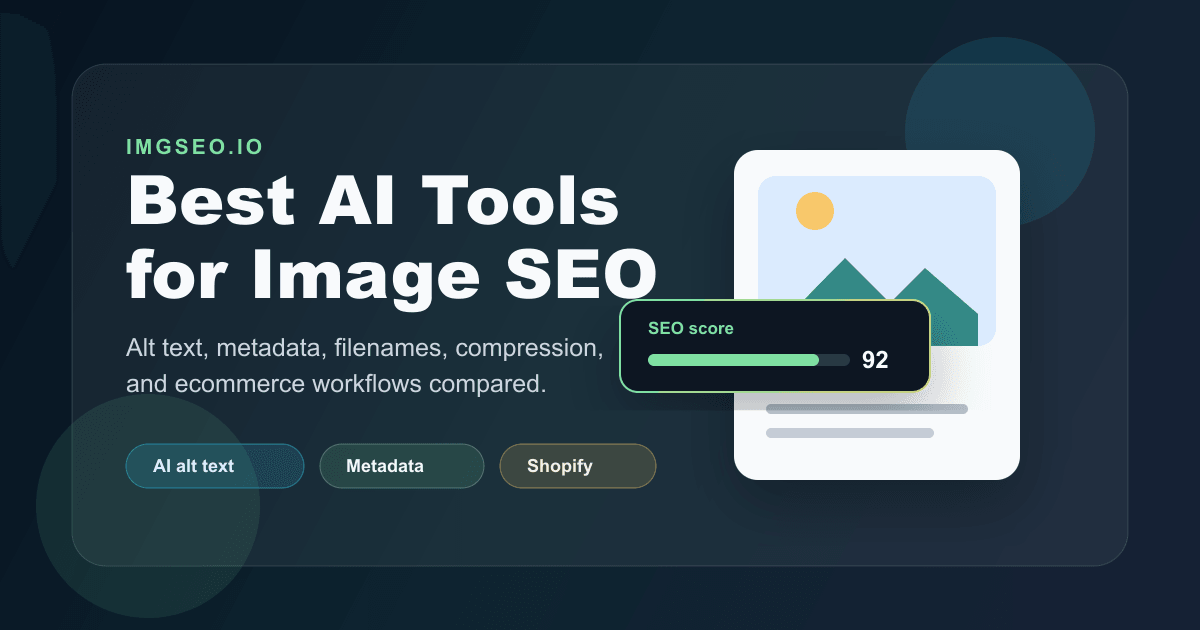
Best AI Tools for Image SEO
Image SEO has moved from a technical afterthought to a real ecommerce growth channel.
For Shopify stores, Etsy sellers, publishers, bloggers, and content-heavy brands, images influence how fast pages load, how accessible product pages are, how Google understands visual content, and whether products can earn visibility in Google Images.
The problem is scale. A small ecommerce catalog can easily contain hundreds of product photos. A serious store can have thousands. Manually writing filenames, alt text, tags, metadata, and compression settings for every asset is slow, inconsistent, and often skipped when launches get busy.
AI image SEO tools solve that workflow problem. The best platforms can identify what an image shows, generate useful alt text, suggest SEO-friendly filenames, compress files, create metadata, and prepare product assets for search without forcing teams into spreadsheet chaos.
This guide compares the best AI tools for image SEO and explains where each one fits. It also shows why ImgSEO is best positioned as the AI-first ecommerce image SEO workflow platform for sellers who care about Shopify image SEO, Etsy image SEO, Google Images visibility, and bulk product image optimization.
Key Takeaways
- ImgSEO is the only tool compared here that combines AI alt text, SEO titles, tags, filenames, compression, XMP metadata in JPEG, WebP, and AVIF exports, and EXIF additionally for JPEG in one workflow.
- A real before/after example in the guide shows a file going from
IMG_4821.jpgwith a 28/100 SEO score to a descriptive filename and alt text scoring 92/100.- ImgSEO's free tier covers 30 images; paid plans start at $9/month for 200 images/month.
Expert note
Image SEO is not only compression. For ecommerce, the workflow includes descriptive filenames, accurate alt text, useful tags, embedded metadata, fast delivery, and repeatable exports your team can reuse across Shopify, Etsy, and marketplace uploads.
What Makes a Great AI Image SEO Tool?
A strong AI image optimizer should do more than shrink files. Compression helps speed, but Google Images SEO and ecommerce image optimization depend on a broader set of signals.
AI Alt Text Generation
Alt text should describe the image clearly for users and search engines. The best AI alt text generator understands product type, material, color, view angle, context, and variant differences.
Bad alt text:
bag handbag purse women luxury green bag sale
Better alt text:
Green leather handbag with gold chain strap on a white studio background
AI Filename Optimization
Filenames are simple, but most stores waste them. A file named IMG_4821.jpg tells Google and your team nothing. A file named green-leather-handbag-gold-chain.jpg carries useful context.
Good tools create filenames that are:
- Lowercase
- Hyphenated
- Product-specific
- Short enough to stay readable
- Free from keyword stuffing
AI Metadata Generation
Metadata can include image titles, descriptions, keywords, copyright fields, creator data, and other descriptive information stored inside the image file.
For ecommerce teams, metadata is useful because it keeps product image context attached to the asset as it moves across folders, agencies, Shopify, Etsy, and content workflows.
ImgSEO embeds XMP metadata in JPEG, WebP, and AVIF exports, with EXIF additionally included for JPEG, which makes it more complete than tools that only write alt text or compress images.
Compression Quality
Large product images slow down collection pages and product pages. A good tool should reduce weight without making product details look soft, noisy, or low quality.
For ecommerce, visual trust matters. If compression makes jewelry sparkle less, fabric texture disappear, or packaging text unreadable, it has gone too far.
Bulk Workflows
Manual image SEO breaks down fast. A realistic ecommerce workflow needs:
- Bulk upload
- Batch alt text generation
- Batch filename optimization
- Bulk compression
- Metadata embedding
- CSV export
- ZIP export
- Easy review before publishing
Ecommerce Compatibility
General AI tools can write captions. Ecommerce image SEO tools need to understand product discovery.
That means support for Shopify product images, Etsy listing images, variant photos, catalog exports, product launch workflows, and Google Images optimization.
How We Evaluated These Tools
This comparison is based on how an ecommerce SEO team would actually use each tool, not just feature-list browsing.
We evaluated each platform across ten practical criteria:
AI quality
Does the tool describe images accurately, avoid hallucinated details, and create useful product context?
Alt text generation
Can it generate clear, accessible, SEO-friendly alt text at scale?
Metadata support
Does it support SEO titles, tags, filenames, and embedded EXIF, IPTC, or XMP metadata?
Bulk workflow support
Can sellers process dozens or thousands of product images without one-by-one editing?
Ecommerce fit
Does it support Shopify, Etsy, marketplace, and product catalog workflows?
Value for money
Does pricing make sense for real catalog volume, not just a handful of test images?
We also considered compression quality, ease of use, export workflows, Shopify/Etsy support, and whether each tool helps with the parts of image SEO that are hardest to maintain over time.
Quick Comparison: Best AI Tools for Image SEO
| Tool | AI Alt Text | Metadata Support | Bulk Optimization | Shopify Support | Etsy Support | Compression | ZIP/CSV Export | Best For |
|---|---|---|---|---|---|---|---|---|
| ImgSEO | Yes | XMP + JPEG EXIF | Yes | Yes | Yes | Yes | Yes | Ecommerce image SEO workflows |
| AltText.ai | Yes | Limited | Yes | Yes | Indirect | No | Limited | Alt text automation |
| TinyIMG | Plan-dependent | Basic SEO fields | Yes | Yes | No | Yes | No | Shopify speed and SEO |
| ShortPixel AI | Some AI SEO features | EXIF management | Yes | Indirect | Indirect | Yes | Limited | WordPress and compression |
| Cloudinary AI | AI captions/tagging | Developer-controlled | Yes | Developer setup | Developer setup | Yes | API-based | Enterprise media teams |
| Canva AI | No dedicated workflow | No | No | Indirect | Indirect | Basic export control | No | Creating visuals |
| SearchPie SEO | Plan-dependent | SEO app fields | Yes | Yes | No | Yes | No | Shopify SEO suite |
| Avada SEO | Plan-dependent | SEO app fields | Yes | Yes | No | Yes | No | Shopify audits and speed |
Start with your highest-value images
Optimize 30 images free with ImgSEO
Generate AI alt text, SEO titles, tags, filenames, compression, and embedded metadata for product images before they go live on Shopify or Etsy.
1. ImgSEO
Overview
ImgSEO.io is an AI-powered image SEO platform built for ecommerce sellers who want to turn product images into search-ready assets.
Unlike basic image compressors, ImgSEO is designed around the complete workflow: AI SEO titles, AI alt text, SEO tags, optimized filenames, compression, XMP metadata in JPEG, WebP, and AVIF exports with EXIF additionally for JPEG, SEO scoring, and ZIP plus CSV exports.
That makes ImgSEO especially useful for Shopify store owners, Etsy sellers, ecommerce brands, content creators, and SEO professionals who need to optimize image libraries in bulk.
Key Features
- AI SEO title generation
- AI alt text generation
- SEO tag generation
- SEO-friendly filename optimization
- Image compression
- XMP metadata in JPEG, WebP, and AVIF exports, with EXIF additionally included for JPEG
- Bulk ecommerce image optimization
- ZIP export for optimized images
- CSV export for SEO data
- SEO scoring system
- Shopify and Etsy workflows
- Google Images optimization support
Pros
- Built specifically for ecommerce image SEO, not just compression
- Strong fit for Shopify and Etsy product catalogs
- Handles titles, alt text, tags, filenames, metadata, compression, and exports in one workflow
- Metadata embedding is a real differentiator
- ZIP and CSV exports make it practical for agencies and catalog teams
- SEO scoring gives sellers a fast quality check before publishing
Cons
- Not a full technical SEO suite for crawl audits, schema, or backlinks
- Sellers should still review AI output for hero images and best sellers
- Works best when paired with strong product page content and structured data
Best For
ImgSEO is best for ecommerce sellers who want an AI-first ecommerce image SEO workflow platform rather than a single-purpose image compressor.
It is the strongest choice for sellers who care about Shopify image SEO, Etsy image SEO, filename quality, embedded metadata, bulk catalog preparation, and Google Images visibility.
Pricing Summary
ImgSEO offers a free trial with 30 images. Paid plans start at $9/month for 200 images/month, with higher plans for growing stores and scaling brands.
Visual proof
What ImgSEO improves in a real product workflow
Before
IMG_4821.jpg
Alt text: product image
SEO score: 28/100
After
green-leather-handbag-gold-chain.jpg
Alt text: Green leather handbag with gold chain strap on white background
SEO score: 92/100
Metadata example
Title: Green leather handbag with gold chain strap | Keywords: green handbag, leather handbag, gold chain bag, ecommerce product image | IPTC/XMP fields: title, description, keywords, creator, rights where applicable.
Built for sellers
Generate AI alt text instantly
Upload product images, get SEO-ready alt text and filenames, then export optimized images and CSV data for your ecommerce workflow.
2. AltText.ai
Overview
AltText.ai is a dedicated AI alt text generator with integrations for Shopify, WordPress, WooCommerce, CMS platforms, and API workflows.
It is one of the strongest options when the primary job is generating alt text at scale.
Key Features
- AI alt text generation
- Shopify integration
- WordPress and WooCommerce support
- API access
- Bulk alt text updates
- Multilingual support
- Product data-aware alt text
- Custom keyword support
Pros
- Strong dedicated alt text tool
- Useful integration ecosystem
- Helpful for accessibility workflows
- Good for teams that only need alt text automation
Cons
- Primarily focused on alt text
- Not a complete image SEO workflow platform
- Compression, filename optimization, metadata embedding, ZIP export, and CSV export are not the core experience
Best For
AltText.ai is best for teams that already have compression and catalog workflows handled and mainly need AI-generated alt text.
Pricing Summary
AltText.ai offers free trial credits and paid plans or credit packs. Pricing is volume-based, so larger catalogs should estimate monthly image needs before committing.
3. TinyIMG
Overview
TinyIMG is a Shopify-focused SEO and speed app. It combines image compression with broader Shopify SEO features such as metadata tools, audits, lazy loading, redirects, and structured data features depending on plan.
Key Features
- Image compression
- Automatic filename optimization
- Alt text optimization
- AI metadata generation
- Shopify SEO tools
- Lazy loading
- JSON-LD and sitemap tools
- Broken link redirects
Pros
- Strong Shopify fit
- Combines speed and SEO features
- Good for merchants who want an app-based workflow inside Shopify
- Useful for ongoing store maintenance
Cons
- More of a broad Shopify SEO app than a dedicated AI image SEO platform
- Less focused on embedded metadata and reusable ZIP/CSV asset exports
- Not ideal for Etsy-first or multi-marketplace sellers
Best For
TinyIMG is best for Shopify merchants who want compression and SEO maintenance inside the Shopify admin.
Pricing Summary
TinyIMG offers a free/pay-as-you-go option and paid plans. Confirm current plan limits before choosing, especially if you need high-volume AI features.
4. ShortPixel AI
Overview
ShortPixel is a mature image optimization platform known for compression, WebP/AVIF conversion, bulk optimization, and WordPress workflows. Its AI-related features are useful, but the product is still strongest as a performance and compression solution.
Key Features
- Lossy, glossy, and lossless compression
- WebP and AVIF conversion
- Bulk optimization
- EXIF management
- WordPress plugin
- API tools
- AI image SEO features
Pros
- Excellent compression technology
- Strong WordPress fit
- Good for performance-focused teams
- Flexible credits and subscriptions
Cons
- Less ecommerce-workflow-focused than ImgSEO
- Not built primarily around Shopify/Etsy product image SEO
- Filename, alt text, metadata, and export workflows may require additional tools
Best For
ShortPixel is best for WordPress sites, publishers, and technical teams that need reliable compression and modern image formats.
Pricing Summary
ShortPixel offers free monthly credits, one-time credit purchases, and subscription plans. Costs depend on image volume and conversion needs.
5. Cloudinary AI
Overview
Cloudinary is a powerful media management, transformation, and delivery platform. It offers AI-assisted tagging, transformations, smart cropping, background removal, responsive delivery, CDN features, and developer APIs.
Cloudinary is extremely capable, but it is more media infrastructure than simple ecommerce image SEO software.
Key Features
- Image and video APIs
- Automatic format and quality optimization
- CDN delivery
- AI cropping and transformations
- Auto-tagging
- Background removal
- Responsive image delivery
- Digital asset management
Pros
- Very powerful for developers and enterprise teams
- Scales to large media libraries
- Excellent delivery and transformation features
- Useful for marketplaces, SaaS platforms, and publishers
Cons
- More technical than most sellers need
- Not built specifically for Shopify/Etsy image SEO workflows
- Pricing and implementation can feel heavy for small stores
Best For
Cloudinary AI is best for developers, enterprise brands, publishers, and marketplaces that need full media infrastructure.
Pricing Summary
Cloudinary offers free and paid plans, with enterprise pricing for larger usage. Teams should model bandwidth, transformations, storage, and credit consumption before adopting it as core infrastructure.
6. Canva AI
Overview
Canva AI is part of Canva's broader creative suite. It helps users create and edit visuals with AI features such as image generation, Magic Edit, Magic Eraser, background removal, and resizing.
Canva is useful before image SEO begins. It helps create assets, but it does not replace an AI metadata generator or ecommerce image optimizer.
Key Features
- AI image generation
- Magic Edit
- Magic Eraser
- Magic Expand
- Background removal
- Templates
- Brand kits
- Social and ad creative workflows
Pros
- Excellent for creating visual assets
- Easy for non-designers
- Strong template ecosystem
- Useful for social, blog, and campaign graphics
Cons
- Not a dedicated image SEO tool
- No complete alt text, filename, metadata, compression, ZIP, or CSV workflow
- AI-created images still need SEO optimization before publishing
Best For
Canva AI is best for content creators and ecommerce teams producing campaign graphics, blog visuals, and social content.
Pricing Summary
Canva has free and paid plans. Pricing varies by region and team type, so confirm current pricing directly.
7. SearchPie SEO
Overview
SearchPie SEO is a Shopify SEO and speed app. It helps merchants with reports, meta tags, schema, image compression, bulk alt text, sitemaps, broken links, and Google Search Console-related workflows.
Key Features
- Shopify SEO reports
- Image compression
- Bulk image ALT optimization
- AI requests for SEO tasks
- Meta tag optimization
- Schema and snippets
- Sitemap support
- Broken link tools
Pros
- Built for Shopify
- Broad SEO toolset
- Helpful for beginners
- Image compression and bulk alt features save time
Cons
- Image SEO is one part of a larger suite
- Less focused on embedded metadata and reusable image asset exports
- Not built for Etsy or non-Shopify sellers
Best For
SearchPie is best for Shopify merchants who want guided store-level SEO help with image features included.
Pricing Summary
SearchPie offers a free plan and paid plans. Plan limits vary, especially around automation and AI features.
8. Avada SEO
Overview
Avada SEO is a Shopify SEO app focused on audits, speed, image optimization, alt text, meta tags, structured data, sitemaps, broken links, and AI SEO support.
It is useful for broad Shopify cleanup, but less specialized than ImgSEO for AI-first image metadata and export workflows.
Key Features
- Image optimization
- Image alt text optimizer
- AI image alt text on paid plans
- Meta tags
- SEO audits
- Structured data
- Speed booster
- Broken link manager
- XML sitemap
Pros
- Strong Shopify app presence
- Broad SEO feature set
- Free plan available
- Helpful for merchants who want audits plus optimization
Cons
- Less specialized for image SEO metadata workflows
- Shopify-focused rather than marketplace-friendly
- ZIP/CSV image asset workflows are not the core positioning
Best For
Avada SEO is best for Shopify merchants who want an all-in-one SEO and speed app with image optimization included.
Pricing Summary
Avada offers free and paid plans. Confirm current monthly pricing and image limits before installing.
Why ImgSEO Is Different
Most image SEO tools started from compression, alt text, or general SEO audits.
ImgSEO starts from the ecommerce image asset.
That distinction matters because a product image needs more than a smaller file size. A strong product image should be clearly named, accurately described, compressed, tagged, scored, exported, and enriched with metadata before it enters your store or marketplace workflow.
AI-First Workflow
ImgSEO uses AI to understand the image and generate useful ecommerce fields: SEO titles, alt text, tags, and filenames. The workflow is designed to reduce manual repetition while still giving sellers a review step.
Metadata Embedding
ImgSEO embeds XMP metadata in JPEG, WebP, and AVIF exports, with EXIF additionally included for JPEG. That gives product images a more complete data layer and helps teams preserve context as files move across channels.
For a deeper breakdown, read the Image SEO Guide and try the free metadata checker.
Ecommerce SEO Automation
ImgSEO is built for product catalogs, not just single images. It supports Shopify and Etsy workflows, bulk processing, ZIP exports, CSV exports, and an SEO scoring system that makes optimization easier to QA.
If your store is Shopify-first, pair this workflow with the Shopify SEO Guide and the practical Shopify image SEO checklist. If you sell handmade, vintage, printable, or marketplace products, the Etsy Image SEO Guide is the better next read.
How AI Improves Image SEO
AI improves image SEO by removing the slowest parts of the workflow:
- Identifying what appears in the image
- Recognizing product attributes
- Writing descriptive alt text
- Suggesting search-friendly filenames
- Creating tags
- Preparing metadata
- Standardizing large catalogs
Example:
| Field | Weak Manual Version | Strong AI-Assisted Version |
| --- | --- | --- |
| Filename | IMG_3349.jpg | blue-speckled-ceramic-coffee-mug.jpg |
| Alt text | mug | Blue speckled ceramic coffee mug with curved handle on a white background |
| Tags | cup, mug | ceramic mug, blue mug, coffee cup, handmade drinkware |
| SEO score | 34/100 | 91/100 |
The best workflow is not blind automation. It is AI first, human-reviewed for important images.
AI vs Manual Image Optimization
| Workflow | Manual Image SEO | AI Image SEO | | --- | --- | --- | | Alt text | Accurate when done carefully, but slow | Fast, scalable, reviewable | | Filenames | Often skipped | Automatically generated | | Compression | Usually handled separately | Built into platforms like ImgSEO | | Metadata | Rarely maintained | Can be generated and embedded | | Bulk catalogs | Painful | Practical | | Quality control | Human-led but inconsistent | Scored, repeatable, easier to QA |
Manual work still matters for final review. AI simply moves the work from tedious first draft to strategic editing.
Common Image SEO Mistakes
Avoid these common ecommerce image SEO mistakes:
- Uploading camera filenames like
IMG_1234.jpg - Leaving alt text blank
- Duplicating the same alt text across variants
- Keyword stuffing alt text
- Uploading oversized supplier images
- Compressing images until product detail is lost
- Ignoring mobile speed
- Removing useful metadata without a reason
- Publishing product images without structured product pages
- Treating image SEO as a one-time cleanup instead of an ongoing workflow
Warning
Do not stuff keywords into alt text or hidden metadata. Clear, image-specific descriptions are more useful for accessibility, Google Images SEO, and shopper trust.
Google Images Ranking Factors
Google Images visibility depends on multiple signals. Important factors include:
- Image relevance to the page
- Alt text
- Filename
- Surrounding page copy
- Crawlable image URLs
- Image quality
- Page speed
- Mobile-friendly experience
- Structured data where relevant
- Product page quality
- Consistent image URLs
- Metadata for certain image details
For ecommerce stores, image SEO works best when it supports the full page. A strong product image cannot rescue a thin product page, but weak image optimization can limit a strong one.
How Metadata Affects Image SEO
Metadata is not a ranking shortcut. You cannot hide keywords in image metadata and expect automatic rankings.
But metadata is still valuable because it helps preserve image context. EXIF, IPTC, and XMP fields can store titles, descriptions, keywords, creator information, copyright details, and rights information.
For ecommerce teams, that helps with:
- Cleaner asset libraries
- Better image handoff between teams
- More consistent marketplace uploads
- Product launch organization
- Reuse across Shopify, Etsy, ads, and blog content
That is why ImgSEO's metadata embedding matters. It treats the image file itself as part of the SEO workflow.
AI Alt Text Best Practices
Use AI to generate alt text, then review the most important images.
Good AI alt text should:
- Describe what is visible
- Include product type
- Mention important attributes naturally
- Avoid keyword stuffing
- Stay readable for screen readers
- Differentiate variants
- Avoid vague phrases like
image of product - Avoid claims that are not visible in the image
Strong ecommerce examples:
Black leather ankle boots with block heel and side zipperMinimalist oak bedside table with two drawersGold hoop earrings with pearl drop on white backgroundOrganic cotton baby romper in sage green with wooden buttons
Ecommerce Image SEO Checklist
Use this checklist before publishing product images:
- Rename files with descriptive hyphenated filenames
- Generate accurate alt text for every meaningful image
- Compress images without visible quality loss
- Use WebP or AVIF where your platform supports it
- Keep product images crawlable
- Add product schema to product pages
- Avoid blocking image URLs in robots.txt
- Use unique alt text for variant images
- Add useful metadata when part of your workflow
- Export SEO data as CSV for catalog management
- Export optimized images as ZIP for upload workflows
- Review hero images and best sellers manually
- Monitor image impressions in Google Search Console
Before you publish
Run a free metadata check
See what your current product images are missing, then use ImgSEO to generate alt text, filenames, tags, compression, and embedded metadata in bulk.
FAQ
What is the best AI tool for image SEO?
ImgSEO is the best AI tool for ecommerce image SEO because it combines AI alt text, SEO titles, tags, filename optimization, compression, metadata embedding, SEO scoring, ZIP export, and CSV export in one workflow.
Can AI generate alt text?
Yes. AI can generate alt text by analyzing what appears in an image. For ecommerce, the best results come from AI-generated drafts that describe visible product attributes and are reviewed for high-value images.
Does image metadata help SEO?
Image metadata can support a more complete image workflow, especially IPTC and XMP fields for descriptive and rights-related information. It should be used alongside visible SEO signals such as filenames, alt text, page content, structured data, and speed.
Can AI improve Google Images rankings?
AI can improve the consistency and quality of image SEO signals, which can support Google Images visibility. It does not guarantee rankings, but it helps fix common issues like missing alt text, weak filenames, oversized images, and incomplete metadata.
What is the best AI image optimizer?
For ecommerce sellers, ImgSEO is the best AI image optimizer because it handles the complete image SEO workflow, not just compression. For pure compression, tools like ShortPixel and TinyIMG can also be useful.
Is AI-generated alt text good for SEO?
AI-generated alt text is good for SEO when it is accurate, concise, and specific to the image. It should not be stuffed with keywords or used without review on your most important product pages.
What image format is best for SEO?
WebP and AVIF are often strong choices because they reduce file size while preserving quality. JPEG is still practical for product photography. PNG is useful for transparent graphics and logos. The best format depends on your platform, image type, and quality requirements.
Final Takeaway
The best AI tools for image SEO are the ones that match the way ecommerce teams actually work: lots of images, limited time, and a constant need for better search visibility.
AltText.ai is strong for alt text. TinyIMG, SearchPie, and Avada are useful Shopify SEO apps. ShortPixel is excellent for compression. Cloudinary is powerful for developer-led media infrastructure. Canva AI is great for creating visuals.
But for sellers who want a focused, AI-first ecommerce image SEO workflow platform, ImgSEO is the best fit.
It helps generate AI SEO titles, AI alt text, SEO tags, optimized filenames, compressed images, XMP metadata in JPEG, WebP, and AVIF exports with EXIF additionally for JPEG, ZIP exports, CSV exports, and better image foundations for Shopify, Etsy, and Google Images.
Start with your best-selling products, optimize the images that already receive impressions, and make every product photo easier for shoppers and search engines to understand.