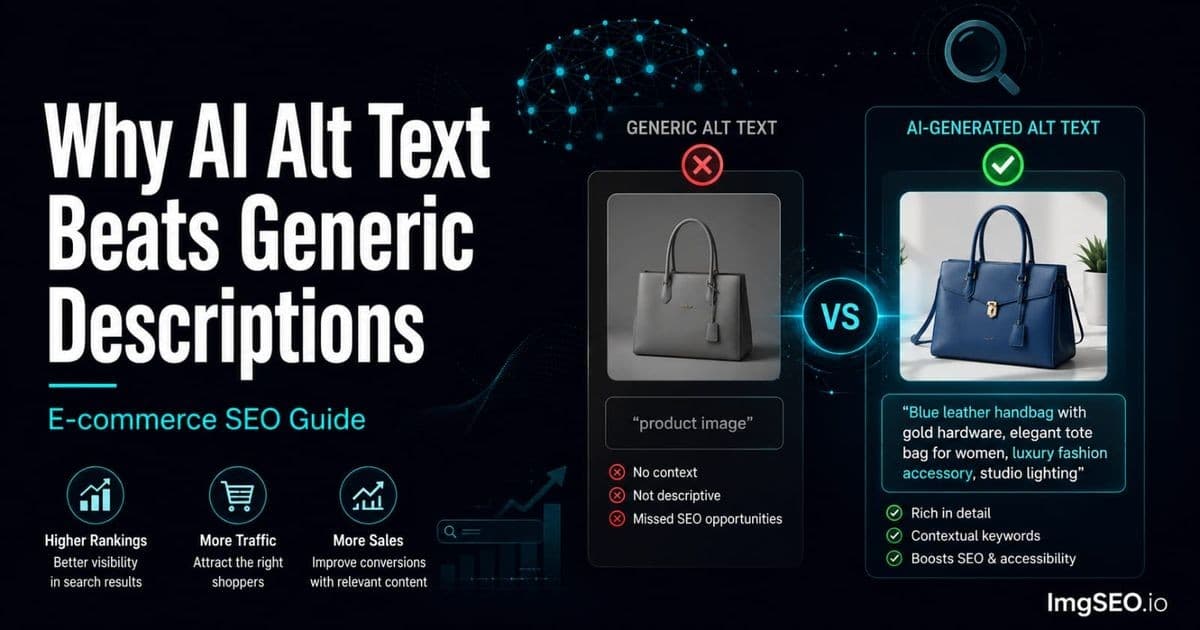
"Product image" is the most common alt text on Etsy. Across millions of listings, in every category from jewelry to ceramics to printable art, the default is a two-word placeholder that tells Google precisely nothing about what the image contains.
Alt text is the single most important factor Google uses to rank product images in Google Images search. And the majority of sellers are wasting it on descriptions that rank for nothing competitive.
AI changes the output. In seconds, it generates specific, buyer-vocabulary alt text that covers material, style, finish, occasion, and use case — the same terms buyers type when they are ready to purchase. This article shows the difference with real examples across four product categories, and explains why the gap between generic and AI-generated alt text is large enough to matter to your traffic.
Key Takeaways
- Alt text is the single highest-weight signal Google uses to rank images in Google Images — human-provided alt text overrides Google's own automatic visual interpretation when the two diverge.
- The practical target is 12–18 words covering material, product type, style, color, and occasion; under 8 words reads as too generic, over 22 starts to look like keyword stuffing.
- The most common mistake is writing from the seller's perspective ("handmade ring I hammered and polished") instead of the buyer's ("sterling silver hammered ring minimalist women gift").
The Generic Alt Text Problem
What Most Sellers Write
Walk through any Etsy category and right-click inspect the images. You will find the same short list of generic descriptions appearing across thousands of listings:
- "product image"
- "ring"
- "handmade candle"
- "blue dress"
- "coffee mug"
- "necklace silver"
These descriptions are not wrong — the image probably is a ring, a candle, a blue dress. But they are the equivalent of labeling every book in a library "book." Technically accurate, completely useless for finding anything specific.
Why Generic Alt Text Fails
Google Images ranks images for specific buyer search queries. A buyer searching Google Images for "sterling silver hammered ring minimalist women" is looking for something specific. They have purchase intent. They are going to click on the image that most closely matches their search query.
An image with alt text "ring" does not match that query. It matches "ring" — a term with enormous competition and buyers at every stage of awareness, most of them not ready to purchase. An image with alt text "sterling silver hammered ring minimalist women" matches the exact query, signals the exact product, and earns the click.
Generic alt text fails on three axes:
No material specificity. "Ring" competes with millions of results. "Sterling silver hammered ring" competes with thousands — and the buyers using that query already know what they want.
No context. "Candle" describes an object category. "Soy lavender candle 8oz gift" describes a purchasing decision. The second description matches the buyer who is one search away from an order.
No buyer intent. Generic descriptions are written from the seller's perspective — what the object is. Buyer-intent descriptions are written from the buyer's perspective — what they would search for to find it. SEO rewards buyer vocabulary, not seller vocabulary.
The opportunity this creates is significant. Google Images drives millions of product-related searches daily, and most sellers competing in any given product category are using generic alt text. Specific, keyword-rich alt text does not just rank better — it often ranks at all, where generic alt text ranks for nothing. For the full picture of what alt text does and how Google weighs it, see what is alt text: the complete guide.
Real Comparison: Generic vs AI Alt Text
Example 1: Jewelry
Generic (what most sellers write): "Silver ring women gift"
AI-generated: "Sterling silver hammered band ring minimalist adjustable size 6-8 women everyday jewelry gift"
Why the AI version wins:
"Sterling silver" instead of "silver" targets buyers who are searching with material precision — these buyers know exactly what they want and are far more likely to purchase than someone browsing for "silver." "Hammered band ring" is a specific search query with low competition and clear buyer intent. "Adjustable size 6-8" directly answers the sizing question buyers type before purchasing. "Everyday jewelry" captures use-case searches that convert at high rates. The generic version has four words. The AI version has fourteen, covering five different buyer entry points.
Example 2: Home Decor
Generic: "Candle home decor"
AI-generated: "Soy wax lavender candle 8oz clear glass jar wooden wick handmade natural aromatherapy gift women"
Why the AI version wins:
"Soy wax lavender candle" is approximately forty times more specific a search query than "candle." The buyers typing that phrase are not browsing — they know they want soy, they know they want lavender, and they are comparing specific options. "Wooden wick" has its own buyer segment: people who specifically want the crackling sound and visual of a wooden wick are loyal to that feature and search for it by name. "Aromatherapy gift women" captures the gift buyer specifically, who often has the highest purchase urgency of any buyer segment. Material plus size plus distinctive feature plus gift intent — that is four separate buyer paths in one alt text.
Example 3: Clothing
Generic: "Blue dress summer"
AI-generated: "Women's linen midi dress dusty blue minimalist casual summer sleeveless adjustable strap vacation"
Why the AI version wins:
"Linen midi dress" is how buyers search for this product type. The fabric matters — buyers searching for linen specifically are filtering out polyester and cotton options. "Dusty blue" is the specific color name buyers use, not just "blue" — color searches at this specificity level have less competition and more committed buyers. "Adjustable strap vacation" captures a distinct buyer segment: travelers who need a versatile dress and search by packing functionality. The generic version has three words and two ranking opportunities. The AI version has eleven words and at least seven distinct buyer search paths.
Example 4: Ceramics
Generic: "Handmade mug coffee"
AI-generated: "Wheel thrown stoneware mug speckled glaze 12oz handmade artisan coffee morning gift pottery"
Why the AI version wins:
"Wheel thrown stoneware" is exactly how buyers who care about craft technique search — these buyers are specifically seeking handmade ceramics and filter out mass-produced options. "Speckled glaze 12oz" is a product detail combination that matches buyers who have a specific visual in mind. "Artisan coffee morning gift pottery" stacks buyer occasions (morning routine, gifting) with category terms (artisan, pottery) that buyers use when browsing for quality handmade goods. The AI identified "speckled glaze" from texture analysis — something a seller writing generic alt text would not think to include. For more on how AI extracts these visual details, see how AI generates alt text for product images.
The Keyword Count Difference
The gap between generic and AI alt text is measurable across four dimensions:
| Metric | Generic | AI-generated | |--------|---------|--------------| | Average word count | 3–5 words | 12–18 words | | Unique rankable keywords | 2–3 | 8–12 | | Specific modifiers (material, style, finish) | 0–1 | 4–6 | | Buyer intent matches | 1–2 | 6–8 | | Google Images ranking potential | Low | High |
Each additional specific keyword in an alt text is a separate ranking opportunity. "Sterling silver hammered ring minimalist adjustable women everyday gift" gives Google eight distinct keyword combinations to rank the image for. Some of those combinations may have only a few hundred monthly searches — but a buyer typing that specific query is almost certainly ready to purchase, and the competition for that query is a fraction of broader terms.
Long-tail keywords win e-commerce image SEO not because they have high volume but because they have high intent and low competition. AI alt text generates them systematically. Generic alt text generates none.
Why Consistency Matters as Much as Quality
The Inconsistency Problem with Manual Alt Text
Manual alt text has a quality cliff. A seller who commits to writing specific alt text typically produces strong output for the first ten to twenty listings — and then fatigue, time pressure, and repetition flatten the quality:
- Product 1: "Sterling silver minimalist ring adjustable women everyday jewelry"
- Product 50: "ring silver handmade"
- Product 100: "nice ring gift"
This is not a hypothetical — it is the pattern that appears in almost every manually optimized catalog of meaningful size. The first few listings get full attention. By the time the seller reaches the back half of their catalog, they are copying their own generic descriptions.
The SEO consequence is a catalog-wide signal that is strong in some places and weak in others. Google's understanding of your shop is shaped by the aggregate of your images, not just your best-optimized ones.
AI Consistency Across a Catalog
AI applies the same analytical process to image 1 and image 500. There is no fatigue, no repetition, no gradual shortening of output as the task becomes tedious. A 500-image catalog optimized by AI has consistent keyword depth and structure throughout.
The compound effect is significant. Each additional image with specific, buyer-intent alt text is another entry point from Google Images into your shop. The more of these entry points you have — and the more consistent their keyword quality — the more paths exist for buyers to find you. A catalog of 500 consistently optimized images has 500 potential Google Images ranking opportunities. A catalog of 500 generic-alt-text images has close to zero. For a direct comparison of AI versus manual at scale, see AI image SEO versus manual optimization.
The Three Reasons AI Alt Text Outperforms Generic
Reason 1: E-commerce Training Data
General-purpose AI describes what it sees. E-commerce AI describes what buyers search for — because it was trained on buyer search queries and product listing data, not just image labels.
This is why AI writes "sterling silver" instead of "silver," "soy wax" instead of "wax," "wheel thrown stoneware" instead of "ceramic." These are the buyer-vocabulary terms that appear in actual purchase searches. The model learned them from the same data Google's algorithm learned from: what people type when they are looking for a product.
Platform context is also built in. Etsy buyers search with different vocabulary than Shopify buyers — more gift-occasion language, more handmade signals, more artisan terminology. AI applies platform-appropriate weighting automatically when you select your target marketplace.
Reason 2: Visual Analysis Depth
A seller writing manual alt text for their fiftieth product of the day sees a ring and types "silver ring." AI sees the same ring and detects: metallic sheen with cool color temperature indicating silver tone, surface texture pattern indicating hammered finish, profile indicating band style rather than prong or bezel set, thinness of band indicating stackable/minimalist style category.
"Speckled glaze" on a ceramic mug requires actually seeing the texture. A seller writing generic alt text is not going to include it. AI detects the pixel pattern of small color variations across the glaze surface, maps it to the "speckled" descriptor, and includes it — because buyers search for "speckled glaze mug" and that search has buyers behind it.
Visual details that seem minor to a seller writing quickly are often the specific differentiators that drive a buyer's decision. AI catches them systematically.
Reason 3: Keyword Intent Mapping
Generic alt text describes what the seller sees. AI alt text describes what buyers search for. These are different things, and the difference is the entire game in SEO.
A seller sees "a blue linen dress." A buyer types "linen midi dress dusty blue casual summer." The seller's description is accurate. The buyer's search is what Google's ranking algorithm rewards.
AI is trained to map visual observations to buyer vocabulary, not object labels. When it identifies "blue linen mid-length dress," it outputs "linen midi dress dusty blue" — the search term, not the label. That mapping is what separates useful SEO alt text from technically accurate but useless descriptions.
How to Replace Generic Alt Text Today
Option 1: Manual Improvement
If you want to improve your alt text without AI, use this formula consistently:
[Material] + [product type] + [style detail] + [color or finish] + [occasion or use]
Applied to the jewelry example: sterling silver + hammered band ring + minimalist + adjustable + women everyday gift
This produces specific, buyer-intent alt text without any tools. The limitation is consistency — applying this formula to every image in a catalog of hundreds requires sustained effort that most sellers cannot maintain. For templates covering every major product type, see how to write alt text for every product type.
Option 2: AI Generation
Upload your product image to ImgSEO. The AI analyzes the image visually, identifies material, style, color, product type, and buyer context, and generates alt text in the buyer-vocabulary format described throughout this article. The process takes seconds per image.
Copy the output into your platform's alt text field — Etsy's "Describe this photo for buyers who are visually impaired" field, or Shopify's image alt text input. For a full batch of images, the entire workflow from upload to deployed alt text takes about two minutes per listing.
The sellers winning on Google Images are not doing anything complicated. They have specific, keyword-rich alt text on their product images — and their competitors have "product image" or nothing at all.
AI generates that specificity in seconds, consistently, across an entire catalog. Generic alt text is a default that persists because fixing it manually does not scale. AI makes it scale.
For the complete picture of what image optimization covers beyond alt text — metadata, compression, filenames — see AI-powered image optimization: the complete guide.