Every Printful seller using the default front flat t-shirt mockup is competing against thousands of other listings that show the exact same photograph with a different graphic on it. Google knows. Its image recognition systems identify duplicate or near-duplicate images and reduce the ranking potential of each copy proportionally. When your mockup is shared by ten thousand other Etsy sellers, Google has very little reason to surface your version over anyone else's.
This is the defining challenge of print on demand image SEO — and it is solvable. Not by changing what the mockup looks like (you cannot), but by changing everything Google reads alongside it: the filename, the alt text, and the embedded metadata. Those three layers are completely under your control regardless of which mockup generator you use. Most POD sellers never touch any of them. That gap is your competitive opening.
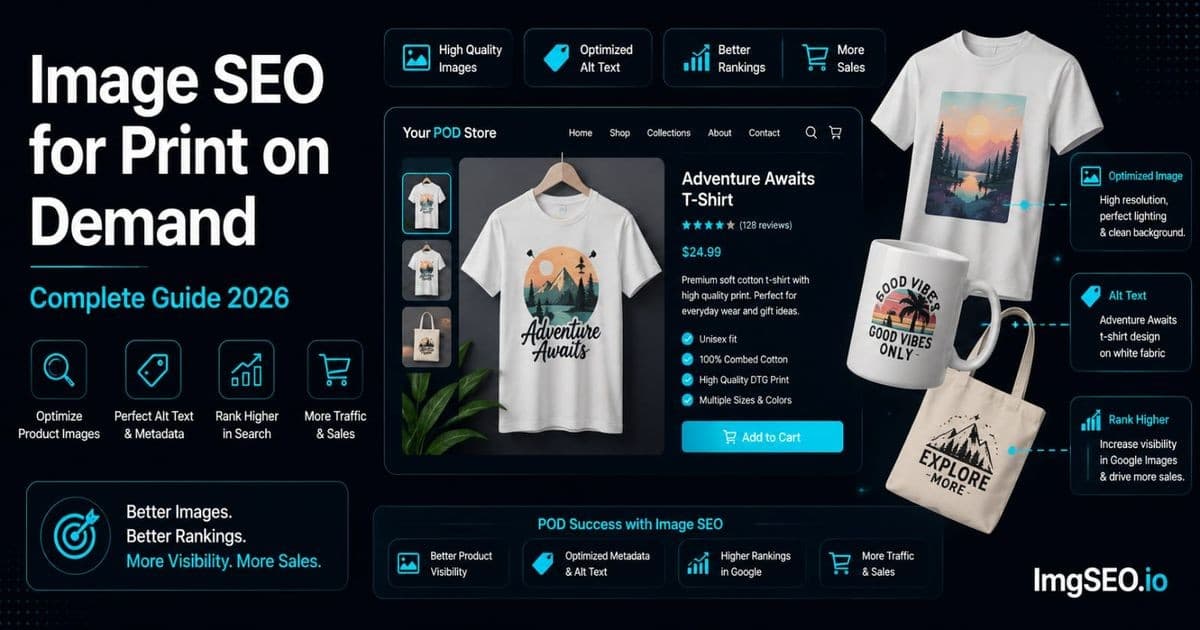
What you will learn: why POD images are a structural SEO problem, how to select and create mockups that give you a ranking advantage, how to write filenames and alt text that differentiate your listings even when the mockup is shared, how to handle niche and occasion keywords that drive high-intent traffic, and platform-specific implementation for Etsy, Shopify, and Redbubble.
The Print on Demand Image Challenge
Why POD Images Are an SEO Problem
Printful's front flat t-shirt mockup — the gray background, male model, standard studio lighting — is used by an estimated millions of active Etsy and Shopify listings. The image is not identical across every listing (the graphic changes), but the base photograph is the same. Google's image analysis treats this as near-duplicate content: the structural visual fingerprint of the image is shared, which dilutes the ranking weight each individual listing receives.
This is not Google penalizing you for using a popular mockup. It is Google distributing limited ranking authority across many similar images and favoring originality where it can detect it. The practical result is that two POD listings with identical mockups, identical products, and identical designs will rank primarily on the strength of their text signals — title, description, alt text — because their image signals are indistinguishable.
Most POD sellers respond to this by doing nothing and wondering why their listings do not rank. The correct response is to optimize everything you can control and, where possible, create images that are genuinely unique.
What You Can Control
Even with a shared mockup, you have meaningful control over four elements:
- Filename: Google reads the filename before it processes the image.
mockup-front.png(Printful's default export) is shared by millions.vintage-sunset-mountains-tshirt-navy-unisex.jpgis yours alone. - Alt text: completely unique to your listing. Google reads it independent of the image content. A detailed, niche-specific alt text on a shared mockup still differentiates your listing in Google's text-based image ranking signals.
- Metadata (EXIF/XMP): embeddable before upload, readable by Google when it crawls fresh listings. Most POD platforms strip metadata after upload, but Google crawls listings quickly enough that metadata embedded pre-upload can influence initial indexing.
- Mockup selection: the default mockup is the most duplicated. Less common mockups from the same platform — lifestyle mockups, flat lays with props, model shots in different environments — are used by far fewer sellers.
The Opportunity
The overwhelming majority of POD sellers on Etsy and Shopify have never touched their image filenames, never written a single alt text field, and are using the first mockup in Printful's default set. The optimization floor is extremely low, which means even moderate effort produces above-average results. On Etsy, where hundreds of competing listings for "cat mom mug" share the same mockup and the same blank alt text, any seller who writes keyword-specific alt text for every image is already in the top 5% of the search.
Step 1: Choose Less Common Mockups
The Mockup Duplication Problem
The most popular mockups on Printful and Printify are popular for a reason — they look professional and photograph the product clearly. But their popularity is precisely the problem. Printful's front flat t-shirt mockup variant #1 is used in a number that makes meaningful image differentiation impossible.
The rule of thumb: the more prominent and default a mockup is, the more duplicated it is, and the weaker the image ranking signal it carries. Moving one step away from the default — choosing a different model angle, a different background, a lifestyle setting instead of a studio — dramatically reduces the duplication density you are competing against.
Mockup Selection Strategy
- Lifestyle mockups over flat product shots: a t-shirt shown on a model at a coffee shop is used by far fewer sellers than the same shirt on a white background. The lifestyle context also adds room keywords and occasion context to the image that Google can read.
- Mix mockup styles across listings: if you have 50 mug designs, using five different mockup styles across those listings (not the same base mockup 50 times) reduces the duplication problem across your catalog and creates a more varied image asset set for Google to index.
- Third-party mockup generators: Placeit, Smartmockups, and Creative Fabrica offer thousands of lifestyle mockup options that are used by a much smaller seller population than Printful's built-in mockups. A Placeit lifestyle mockup of a t-shirt being worn at a farmers market is exponentially less duplicated than the Printful default.
- Physical samples: ordering printed samples from your POD supplier and photographing them yourself creates genuinely unique images. This is the highest-effort option and the strongest possible image SEO outcome.
Custom Mockup Tools
| Tool | Best for | Cost | |---|---|---| | Placeit | Lifestyle mockups for apparel, mugs, totes | Monthly subscription | | Smartmockups | Clean product mockups, flat lays | Free tier available | | Creative Fabrica | Design-focused mockup packs | Subscription or per-pack | | Your own photography | Maximum uniqueness, any product | Cost of samples |
Physical sample photography deserves special mention. A $15–30 sample order from Printful, photographed with a smartphone against a simple backdrop or worn by a friend, produces a completely unique image that no other seller in the world has. For your top-selling designs, this investment has a clear ROI: unique images rank better, and a top-selling design ranking higher converts more sales.
Step 2: Create SEO-Friendly Filenames for POD
The POD Filename Problem
Printful and Printify export mockup files with generic names: mockup-front.png, lifestyle-1.jpg, flat-lay.png. These names are shared across every seller who downloads the same mockup. When you upload mockup-front.png to Etsy, you are uploading a filename that thousands of other Etsy listings also have. Google sees this in the image URL and it contributes nothing to your keyword relevance.
The fix is simple and takes thirty seconds per image: rename the file before you upload it.
The POD Filename Formula
[product-type]-[design-description]-[color]-[style].jpg
The design description is the most important element. It converts a generic filename into a keyword-specific one that Google can match against search queries. Describe the design visually — what the graphic shows, what aesthetic it belongs to, what emotion or niche it targets — not what you internally call it.
Examples by POD Product Type
T-Shirts
vintage-sunset-mountains-tshirt-navy-unisex.jpgfunny-cat-mom-tshirt-white-women.jpgminimalist-line-art-tshirt-black-oversized.jpgplant-lover-botanical-graphic-tee-sage-green.jpgteacher-appreciation-pencil-tshirt-heather-gray.jpg
Mugs
wildflower-botanical-coffee-mug-11oz-white.jpgfunny-monday-morning-mug-ceramic-15oz.jpgdog-mom-paw-print-mug-white-11oz-gift.jpgmountain-hiking-adventure-mug-black-ceramic.jpg
Tote Bags
floral-canvas-tote-bag-natural-cotton-reusable.jpginspirational-quote-tote-bag-black-handles.jpgwildflower-market-tote-natural-canvas-everyday.jpg
Wall Art Prints
boho-abstract-art-print-bedroom-sage-green-8x10.jpgminimalist-mountain-landscape-print-nordic-12x16.jpgvintage-botanical-illustration-print-kitchen-green-5x7.jpg
Design Description in Filenames
The design description slot is where most POD sellers default to "design-1" or leave the Printful export name unchanged. Both waste the keyword opportunity. Describe what the design actually shows:
- Vintage western sunset →
vintage-sunset-mountains - Cartoon cat with coffee →
funny-cat-coffee - Single-line minimalist wave →
minimalist-line-wave - Wildflower bouquet in botanical style →
wildflower-botanical-illustration
Include the aesthetic style when it is a searchable keyword: vintage, minimalist, boho, funny, inspirational, cottagecore. These appear in buyer search queries and belong in filenames.
For guidance on bulk-renaming an existing catalog, see the guide on how to fix bad image filenames for SEO.
Step 3: Write POD-Specific Alt Text
The Alt Text Advantage for POD
Alt text is your primary competitive weapon as a POD seller. It is 100% unique to your listing regardless of how many other sellers use the same mockup. Google reads and weights it as a text signal independent of the image content — which means a well-written, keyword-specific alt text on a shared mockup still gives you a ranking advantage over a competitor with the same mockup and a blank alt text field.
This is the single most impactful optimization available to POD sellers who are not creating custom mockups. If you do nothing else from this guide, write unique, specific alt text for every image in every listing.
The POD Alt Text Formula
[Design style] + [design description] + [product type] + [color] + [buyer or occasion]
The design style and description come first because they are the primary differentiators. The product type and color specify the object. The buyer or occasion keyword captures high-intent gift and niche searches.
Examples by POD Product Type
T-Shirts
- Main (front mockup): "Vintage sunset mountains graphic t-shirt navy blue unisex casual"
- Worn/lifestyle: "Model wearing vintage sunset mountains navy graphic tee outdoors hiking"
- Detail (design close-up): "Vintage sunset mountains print close-up graphic on navy t-shirt"
- Back mockup: "Back view vintage sunset mountains graphic t-shirt navy unisex"
Mugs
- Main: "Wildflower botanical coffee mug 11oz white ceramic hand-illustrated floral"
- Styled (desk scene): "Wildflower botanical mug with morning coffee on wooden desk home office"
- Gift context: "Wildflower botanical mug in gift box plant lover birthday gift"
Tote Bags
- Main: "Floral canvas tote bag natural cotton reusable shopping everyday market"
- In-use lifestyle: "Woman carrying floral canvas tote bag at farmers market weekend"
- Flat lay: "Floral canvas tote bag flat lay natural cotton with sunflowers"
Wall Art Prints
- Main: "Boho abstract art print sage green bedroom wall decor 8x10 inch"
- Styled (framed): "Boho abstract print framed above bed gallery wall boho bedroom"
- Flat lay: "Boho abstract art print 8x10 flat lay sage green white mat"
Niche and Occasion Keywords
Niche keywords are among the highest-converting search terms in the POD market. A buyer typing "cat mom gift mug" has intent that is specific to the point of being nearly pre-qualified. They know what they want, they know who it is for, and they are ready to purchase. Capturing this buyer in Google Images requires that your alt text contains those exact words.
The niche keyword categories most worth targeting:
- Identity niches: cat mom, dog dad, plant parent, book lover, coffee addict, hiking enthusiast, teacher
- Occasion niches: birthday gift, Mother's Day gift, graduation gift, Christmas gift, teacher appreciation
- Interest niches: mountain life, ocean lover, cabin in the woods, wildflower garden, cottagecore
Include niche keywords in alt text for every applicable design. A mug with a paw print design is not just a "white ceramic mug" — it is a "dog mom paw print mug birthday gift for dog lover." Those extra words are the difference between ranking on page 10 and ranking on page 1 for a search with real buyer intent.
For a complete guide to alt text strategy, see what is alt text: the complete guide.
Step 4: Add Metadata to POD Images Before Upload
Why Pre-Upload Metadata Matters
Most POD platforms — Printful, Printify, Etsy's own image processor — strip EXIF and XMP metadata from uploaded images as part of their processing pipeline. By the time your mockup is live on your Etsy listing, the metadata embedded in the original file is typically gone.
However: Google crawls new Etsy listings quickly, often within hours. The sequence matters — if Google indexes your listing image before Etsy's CDN has fully processed and re-served the file, it reads the original metadata. This is an edge-case benefit, not a guaranteed ranking factor. The more reliable reason to add metadata before upload is for platforms that do preserve it (Shopify's own CDN, WooCommerce) and for the benefit of any future Google crawl that reaches the source file.
The practical rule: add metadata anyway. It takes seconds with the right tool, costs nothing, and has upside without downside.
POD Metadata Keyword Strategy
Structure your metadata keywords around the same dimensions as your alt text, but include the full extended set that would make alt text too long:
- Design keywords: vintage, minimalist, boho, funny, inspirational, cottagecore, hand-illustrated, retro
- Niche keywords: dog mom, cat mom, plant parent, hiking lover, coffee addict, teacher, book lover, nurse
- Occasion keywords: birthday gift, Christmas gift, Mother's Day, graduation, teacher appreciation, Valentine's Day
- Product keywords: t-shirt, mug, tote bag, art print, hoodie, sweatshirt, phone case, pillow
- Style keywords: graphic tee, funny gift, cute gift, unique gift, personalized gift
The EXIF/XMP fields for POD images:
- Title: design name + product type. Example: "Vintage Sunset Mountains Graphic T-Shirt Navy"
- Description: match your alt text. Example: "Vintage sunset mountains graphic t-shirt in navy blue, unisex fit, casual outdoor style."
- Keywords: full comma-separated niche and occasion array. Example:
vintage mountains, hiking gift, outdoor t-shirt, camping gift, mountain lover, nature gift, men's graphic tee, women's graphic tee, unisex tshirt
Using ImgSEO for POD
ImgSEO handles the metadata embedding step automatically. Upload your mockup file and provide the design name and product type. The AI generates niche-aware alt text suggestions and embeds EXIF/XMP metadata matched to the product — producing a renamed, metadata-optimized file ready for upload to any platform.
For full implementation details on metadata tools and field formats, see the guide on how to add metadata to product images.
Platform-Specific POD Image SEO
Etsy POD
Etsy is the largest POD marketplace in the world and the platform where image SEO has the most direct impact on organic traffic. Etsy listings rank in Google search natively — a well-optimized Etsy listing for "funny cat mom mug" can appear in both Etsy search and Google Images simultaneously.
Key Etsy-specific considerations:
- Alt text field (describe this photo): Etsy provides 500 characters per image. Use them. The formula — design style + design description + product + niche + occasion — typically fills 80–120 characters for a focused alt text. The remaining characters can carry additional niche terms, materials, and gift keywords. Example: "Funny cat mom coffee mug 11oz white ceramic, crazy cat lady gift, cat lover birthday gift, coffee lover mug, cat mom present, gift for her."
- Tags: all 13 tags, full phrases. Tags are a separate keyword signal from alt text and should cover different variations: the niche (cat mom), the occasion (birthday gift for cat lover), the product (ceramic coffee mug funny), the aesthetic (cute cat mug). Do not duplicate your title keywords in tags — cover additional keyword variations.
- Main image: a clean, legible mockup that shows the design and product clearly should lead as the main listing image. Lifestyle mockups go in secondary slots. Buyers searching on Etsy need to see the design immediately in the search thumbnail; a lifestyle shot cropped to a thumbnail can be ambiguous.
- All image slots: use all available Etsy image slots (up to 10). Each additional image is another indexed asset, another alt text, another opportunity to rank for a variant of your target keyword.
For a complete Etsy image optimization guide, see Etsy image SEO.
Shopify POD
Shopify POD stores connected to Printful or Printify through the official integrations face a specific filename challenge: the integration often overwrites your pre-optimized filename during the product sync. The mockup URL in your Shopify store is controlled by Printful's CDN, not Shopify's — which means the filename you set in Shopify may not be the filename Google sees in the image URL.
The workaround: add alt text through Shopify's product editor after sync, not before. The integration does not overwrite alt text. Every product image that syncs from Printful to Shopify should have its alt text set manually in the Shopify product editor before the listing goes live.
For stores with large catalogs, Shopify supports bulk editing of product alt text through the Bulk Editor (Products → Bulk Edit → Add Fields → Image Alt Text). This makes catalog-scale alt text updates manageable.
For full Shopify image optimization, see the Shopify image SEO guide.
Redbubble and Society6
Redbubble and Society6 operate a fundamentally different model: they control the product pages, the image rendering, and most of the SEO settings. Your leverage as a seller is limited to:
- Product title: the primary keyword field. Front-load your design description and niche keyword.
- Tags: the tag field is effectively the keyword field on Redbubble. Research tags carefully — use the full range allowed (up to 15 on Redbubble) with a mix of design keywords, niche keywords, and product type keywords.
- Description: less influential on Redbubble's own search, but indexed by Google for the product page. Include your primary keywords naturally in the first sentence.
Image SEO in the traditional sense (alt text control, filename control, metadata embedding) is not available on these platforms. If image SEO is a priority for your POD business, Etsy and Shopify offer significantly more control and should be your primary platforms.
Google Images Strategy for POD
Niche-Specific Search Queries
POD buyers searching on Google Images use predictable query patterns that your optimization strategy should address explicitly:
| Query pattern | Example | |---|---| | [niche] + gift + [product] | "cat mom gift mug" | | [design style] + [product] | "vintage mountains t-shirt" | | [occasion] + [product] | "funny birthday mug" | | [niche] + [product] + [color/style] | "plant mom tote bag natural" | | [design description] + [product type] | "wildflower art print bedroom" | | [aesthetic] + [product] + gift | "cottagecore mug gift her" |
Work through your top designs and verify that each listing has alt text targeting at least two of these patterns — the primary design description pattern and at least one niche or occasion pattern.
Long-Tail POD Keywords
Long-tail keywords are the correct strategy for POD image SEO. "Cat mug" is dominated by major retailers and high-volume Etsy sellers with thousands of reviews. "Funny cat mom coffee mug 11oz gift for cat lover" is achievable for a new seller because fewer sellers are competing for that exact combination.
The specificity that makes a keyword long-tail is usually a combination of:
- Design description: "vintage mountains," "wildflower botanical," "funny cat"
- Product specifics: "11oz," "canvas tote," "8x10 print"
- Niche: "cat mom," "plant parent," "hiking lover"
- Occasion: "birthday gift," "Christmas gift," "teacher appreciation"
Combining two or three of these dimensions creates a keyword phrase that is specific enough to be achievable and still gets meaningful search volume from buyers who have high purchase intent.
Trending Design Keywords
POD search behavior is heavily seasonal and trend-driven. Monitoring Google Trends for your design categories allows you to update alt text and metadata before a search trend peaks rather than after:
- Teacher appreciation week: peaks in late April and early May every year. Update teacher-niche listings with "teacher appreciation gift" and "teacher appreciation week" keywords in early April.
- Mother's Day: peaks four weeks before the second Sunday in May. "Gift for mom" and "Mother's Day mug" keywords should be in your metadata by mid-April.
- Holiday season: "Christmas gift for [niche]" searches start building in November. "Christmas gift for cat lover," "Christmas mug," "holiday gift for dog mom" should be in your metadata by October 31.
- Valentine's Day: "Valentine's Day gift" searches begin in January. Update relevant designs in early January.
These updates require no new photography — just alt text and metadata keyword additions on your existing mockup images.
Creating Custom Mockups for SEO Advantage
Why Custom Mockups Win
A genuinely unique image — one that no other seller in the world has — carries full image ranking weight. Google has no duplication to distribute it across. It indexes your unique mockup and assigns it the full ranking signal from its alt text, filename, metadata, and page context. This is the maximum possible image SEO outcome for a POD product.
Custom mockups also typically produce better click-through rates in Google Images results because they look different from the sea of identical Printful-style shots. A product that visually stands out in a results grid captures more clicks even at the same ranking position.
Low-Budget Custom Mockup Options
Custom mockups do not require a photography studio or a professional model. Practical options by budget:
Minimal investment:
- Order a $15–30 printed sample from Printful → photograph with a smartphone in natural light against a clean background. A single unique lifestyle photo of your product is worth more SEO-wise than ten copies of the default mockup.
- Flat lay photography of printed products with simple props (books, plants, coffee mugs, marble tile backgrounds) produces clean, professional results with equipment most people already own.
Low investment:
- Placeit lifestyle mockups — thousands of options, each used by far fewer sellers than Printful defaults. A Placeit lifestyle t-shirt mockup showing the shirt in an outdoor setting is in use by hundreds of sellers, not millions.
- Request UGC (user-generated content) from buyers: offer a discount code or free shipping in exchange for a lifestyle photo wearing or using their purchase. Even five UGC photos per top design create genuinely unique assets.
Moderate investment:
- Commission a micro-influencer or UGC creator for styled product photos. Rates for a set of lifestyle mockup photos start at $50–150. For a design generating $500/month in sales, the ROI is clear.
Custom Mockup ROI
The math for a top-selling design with custom photography:
- 5 unique lifestyle photos per design
- Each photo indexed independently in Google Images
- Each photo targeting a different alt text keyword variation (outdoor, desk, gift box, flat lay, worn)
- One Google Images click that converts at your average order value ($25 mug, $30 t-shirt) pays for the sample cost in 1–2 sales
- Sustained organic ranking from unique images generates traffic indefinitely
For your top five to ten designs by revenue, custom mockup photography is the highest-ROI image SEO investment available.
POD Image SEO Checklist
Use this before every new POD listing goes live:
- ✅ Mockup selected from less common alternatives (not the default front flat)
- ✅ Custom lifestyle mockup created or sourced for top-selling designs
- ✅ Filename describes design + product + color (not
mockup-front.png) - ✅ Alt text describes design style + product + niche + occasion
- ✅ Unique alt text written for each mockup angle in the listing
- ✅ EXIF/XMP metadata keywords include niche, occasion, and design terms
- ✅ All available image slots used on every platform
- ✅ Seasonal designs updated with seasonal keywords before peak search periods
- ✅ Main image is clean design-forward mockup; lifestyle shots in secondary slots
- ✅ Google Search Console monitored for image impressions per listing
FAQ
Can POD sellers rank on Google Images? Yes. Alt text, filename, and metadata are strong enough signals to differentiate your listing in Google Images even when the underlying mockup image is shared. Custom mockups provide an additional ranking advantage by eliminating image duplication. Etsy listings in particular rank well in Google Images because Etsy has strong domain authority.
Does alt text help if I use the same mockup as other sellers? Yes. Alt text is a text signal that Google reads independently of the image content. Two listings with identical mockups but different alt text are treated as different listings in Google's text-based ranking signals. The image signal is diluted across all duplicates; the alt text signal is 100% unique to your listing.
How do I make my POD images unique for SEO? Three levels of uniqueness: (1) choose less common mockups from the same platform, (2) use third-party mockup generators like Placeit that are used by fewer sellers, (3) photograph physical samples yourself for complete uniqueness. Even level one provides meaningful differentiation over sellers using the default mockups.
What keywords work best for POD image SEO? Combine design description keywords (vintage mountains, wildflower botanical, funny cat) with niche keywords (cat mom, plant parent, hiking lover) and occasion keywords (birthday gift, Christmas gift, teacher appreciation). Long-tail combinations of two or three of these dimensions outperform broad single keywords for POD because they match specific buyer intent.
Should I order samples for custom photography? For your top five to ten designs by revenue, yes. A $15–30 sample order that produces genuinely unique images pays for itself quickly when those unique images rank better in Google Images and generate sustained organic traffic. For new designs or low-volume listings, use third-party mockup generators as an intermediate step.
How do I write alt text for t-shirt designs? Use the formula: design style + design description + product type + color + buyer or occasion. Example: "Vintage sunset mountains graphic t-shirt navy blue unisex outdoor hiking gift." Each mockup angle gets unique alt text — front view, back view, worn lifestyle, design detail close-up all describe different visual content and should be treated as separate keyword opportunities.
What POD platform is best for image SEO? Etsy offers the most image SEO leverage for POD sellers: full alt text control (500 characters), direct Google indexing of listings, and strong organic search performance. Shopify with a Printful integration gives you full control but requires manual alt text management after each product sync. Redbubble and Society6 offer the least control and should be secondary platforms if image SEO is a priority.
How do I optimize Printful mockups for Etsy SEO? Before uploading to Etsy: rename the file with your design description and product type. After uploading: fill the "describe this photo" alt text field with the full POD formula — design style, design description, product, niche, occasion. Use all 13 tags with full phrases. Use all 10 image slots. This process takes five minutes per listing and puts you ahead of the majority of Etsy POD sellers who do none of it.
Conclusion
POD image SEO has a harder ceiling than standard e-commerce because you cannot always control the image itself. But it has a much lower floor — most POD sellers do absolutely nothing to optimize their image metadata, which means the optimization gap between you and your average competitor is enormous.
The priority order: write specific alt text for every image on every listing first. That alone puts you ahead of most of the market. Then rename files before upload. Then add metadata with ImgSEO before upload. Then, for your top designs, invest in custom mockups — either through less common mockup generators or physical sample photography.
Seasonal updates are non-negotiable for gift-niche designs. "Cat mom mug birthday gift" searches year-round; "Mother's Day gift for cat mom" searches for six weeks in April and May. Being in the metadata before the search spike matters more than being there after it.
ImgSEO generates niche-aware alt text and embeds metadata automatically for POD images. Upload your mockup, describe the design and niche, and it produces a renamed, optimized file ready for any platform. Try it free — 30 images, no card required.
For a parallel guide to SEO image challenges in another non-traditional e-commerce model, see the image SEO for dropshipping guide.