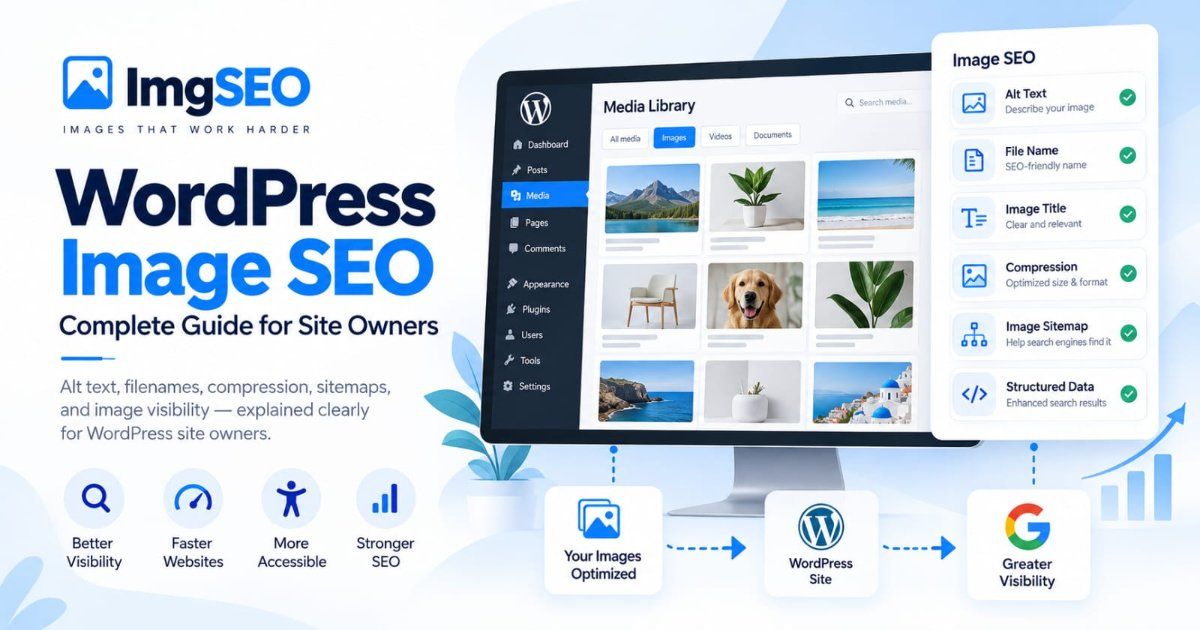

When you upload a product photo to ImgSEO, something happens in about two seconds that would take a human copywriter two to three minutes. The AI analyzes the image, identifies what is in it, maps those visual elements to the keywords buyers use when searching, and generates a complete, keyword-optimized alt text description ready for Google and Etsy.
Most sellers treat alt text as a chore — a box to fill in before they can move on. AI makes it automatic. But understanding how the technology actually works helps you use it more effectively: you will know when to trust the output, when to edit it, and why the results are better than what most sellers write by hand.
Here is what is happening inside the AI when your product photo gets processed.
Key Takeaways
- AI alt text generation runs in three layers: visual recognition (what's in the photo), SEO context (mapping that to buyer search vocabulary), and language generation (assembling it into a natural sentence).
- Manual alt text averages 3–5 keywords per image and degrades in quality as sellers work through a large catalog; AI produces 8–12 keyword-rich phrases at consistent quality regardless of catalog size.
- AI still misses custom product names, brand-specific terms, and specialist vocabulary it cannot see in the photo — a short human review closes that gap.
What AI Actually Sees When You Upload a Photo
Computer Vision in Plain English
AI does not see images the way humans do. It does not look at your photo and think "that looks like a ring." Instead, it analyzes millions of individual pixel values — tiny numeric measurements of color, brightness, and contrast — and compares those patterns against patterns it has learned from hundreds of millions of labeled images.
During training, the AI is shown an image of a ring alongside the label "ring" thousands of times, in every imaginable variation — different angles, materials, sizes, backgrounds, and lighting conditions. Over time, it builds an internal model of what "ring-shaped" patterns look like in pixel data. By the time it sees your product photo, it can recognize the product type with high confidence even in conditions it has never seen before.
This is called computer vision — teaching machines to extract meaning from images by learning patterns from large datasets.
What the AI Detects in a Product Image
Modern e-commerce AI does not just identify the product type. It reads multiple layers of visual information simultaneously:
- Object recognition: "This is a ring" — identifying the product category
- Material detection: "Silver-colored metal with a hammered texture" — reading surface properties from light reflection patterns
- Color analysis: "Silver with grey undertones" — precise color vocabulary rather than just "shiny"
- Style classification: "Minimalist, handmade aesthetic" — matching visual style cues to learned style categories
- Context inference: "Jewelry, women's accessory, wearable item" — broader category placement
Each of these layers contributes keywords to the final alt text description.
Why This Matters for SEO
The reason this matters is that Google Images ranks photos based on the words associated with them — alt text, filenames, surrounding page text, and embedded metadata. When AI converts your product's visual information into text, it is creating the vocabulary Google needs to understand what your image shows and which searches it should appear in.
A human writer staring at a photo makes the same translation manually. AI does it in two seconds, at consistent quality, and with keyword awareness that most sellers do not have.
The Three Layers of AI Alt Text Generation
Alt text generation is not a single step — it happens in three distinct stages, each adding a different kind of value.
Layer 1: Visual Recognition
The first layer is pure computer vision. The AI reads the image and extracts factual visual information:
- Product type and category identification
- Material and texture analysis (is the surface smooth, rough, matte, glossy, woven, hammered?)
- Color and finish detection (not just "blue" but "dusty sage" or "midnight navy")
- Scale and composition reading (is the product the main subject or one of several objects?)
This layer produces a visual inventory of what is in the image. It is accurate and objective — it describes what is there, not what the seller wants it to say.
Layer 2: SEO Context
The second layer is where e-commerce AI diverges from generic image description AI. The visual inventory from Layer 1 gets mapped against buyer search behavior:
- E-commerce keyword mapping: "hammered metal band" → "hammered band ring" (the search phrase buyers use)
- Platform-specific optimization: Etsy buyers use different vocabulary than Shopify buyers — "handmade gift" versus "product SKU"
- Search intent matching: Identifying whether the buyer is searching to browse, compare, or buy — and structuring keywords accordingly
- Buyer vocabulary alignment: Using the words buyers type, not the words manufacturers use
This layer is why e-commerce AI produces better SEO results than generic caption tools. The same computer vision input produces different output because the SEO layer is trained specifically on purchase-intent search behavior.
Layer 3: Language Generation
The third layer takes the keyword-rich output from Layers 1 and 2 and assembles it into natural language:
- Structuring keywords in the order Google weights most heavily (most specific to least specific)
- Avoiding keyword stuffing — using phrases that read like a description, not a keyword dump
- Generating text that passes readability checks and works for screen readers as well as search engines
- Keeping descriptions concise enough to be useful, complete enough to be keyword-rich
The result is alt text that does three things simultaneously: describes the image accurately, uses buyer-vocabulary keywords, and reads like a natural sentence.
Why AI Alt Text Beats Manual for Most Sellers
The Consistency Problem with Manual Alt Text
When sellers write alt text manually, quality follows their energy level. The first five listings get thoughtful descriptions. By listing fifty, they are writing "silver ring women." By listing two hundred, some images have no alt text at all.
Manual alt text also suffers from a keyword knowledge gap. Most sellers write what they would call the product, not what buyers search for. "My handmade ring" versus "adjustable sterling silver band ring women minimalist jewelry." Both describe the same product. Only one matches how buyers search.
One hundred product listings means one hundred separate decisions about what keywords to use, how long the description should be, and what details to include. Human inconsistency is the norm, not the exception.
AI Consistency at Scale
AI produces the same quality of output for product one thousand as it does for product one. There is no fatigue, no guessing, no variation in effort level. The keyword structure applied to your first listing is the same structure applied to your last.
This consistency matters for SEO in a compound way: a uniform, well-structured catalog gives Google a clear signal about what your shop sells. Random, inconsistent alt text creates a noisy signal that is harder to rank.
The Keyword Knowledge Gap
AI models trained on e-commerce data have been exposed to the actual search queries buyers use. They know:
- "Sterling silver" outperforms "silver" in search volume for jewelry
- "Adjustable ring" is a high-intent phrase buyers use when they are ready to buy
- "Handmade ceramic" performs differently from "artisan pottery" depending on the platform
- Occasion keywords ("Mother's Day gift," "wedding jewelry") expand which searches a listing appears in
This is knowledge most individual sellers do not have unless they have done extensive keyword research. For the complete approach to building keyword knowledge for your shop, see the Etsy keyword research guide.
How ImgSEO's AI Generates Alt Text
The Process Step by Step
Here is what happens between the moment you upload a product photo and the moment alt text appears:
- Image uploaded → visual analysis begins immediately
- Computer vision layer identifies product elements: type, material, color, texture, style, context
- E-commerce context applied — platform selection (Etsy or Shopify) and product category shape the keyword mapping
- Keyword mapping matches visual elements against buyer search vocabulary
- Natural language generation assembles the keywords into structured, readable alt text
- SEO structure applied — material + product + style + occasion, weighted for Google's reading order
- Alt text delivered in seconds, displayed for review and editing
The entire process runs in the cloud, processes the visual data, and returns structured text — no waiting, no manual steps between upload and output.
What Makes E-commerce AI Different
The gap between generic image AI and e-commerce AI is easiest to see with a direct comparison.
Generic image AI output: "a silver ring on a white background"
E-commerce AI output: "sterling silver hammered band ring adjustable minimalist women everyday jewelry"
Both descriptions come from analyzing the same image. The generic description is visually accurate. The e-commerce description is SEO-optimized. The difference is not the computer vision — both AIs see the same pixel patterns. The difference is in what happens with that visual data: e-commerce AI maps it to buyer search vocabulary, generic AI maps it to visual vocabulary.
Platform Optimization
The platform you are selling on affects which keywords matter. ImgSEO adjusts alt text generation based on platform:
- Etsy alt text: includes handmade indicators, gift-occasion keywords, and craft vocabulary that Etsy buyers use ("artisan," "small batch," "handmade with love")
- Shopify alt text: emphasizes product specifications, variants, and the more specification-driven vocabulary of direct-to-consumer buyers
For a complete breakdown of image SEO differences between platforms, see the Etsy image SEO guide.
AI Metadata Generation: Beyond Alt Text
Alt text is one piece of image SEO. The same AI process generates a complete metadata package:
What Else AI Generates
- SEO title: An optimized product title built for search, distinct from your listing title but keyword-aligned with it
- Tags: Keyword phrases formatted for Etsy tags and other platform tag systems — multi-word phrases, buyer intent terms, occasion and recipient tags
- EXIF/XMP metadata: Keyword data embedded directly inside the image file itself
The Metadata Advantage
The EXIF/XMP metadata embedded inside the image file is what Google reads on its very first crawl of that image — before it reads the surrounding page text, before it processes the alt text in the HTML. Sellers who add metadata to their image files before uploading to Etsy or Shopify give Google a keyword-rich signal at the earliest possible crawl point.
Most sellers never add image file metadata manually because it requires technical tools and knowledge most people do not have. AI generates it automatically in the same step as alt text — no extra effort required.
For a complete walkthrough of adding metadata to product images, see how to add metadata to product images.
The Limitations of AI Alt Text
AI alt text is not perfect, and knowing where it falls short helps you use it correctly.
When AI Gets It Wrong
- Niche or specialist products: AI has less training data for specialized industrial products, unusual craft materials, or professional equipment with technical names
- Abstract or artistic products: Art prints, sculptures, and abstract ceramics are harder to describe accurately because there is no single "correct" visual interpretation
- Specialized terminology: A product that is technically a "chasing hammer" but visually looks like a generic hammer may get the generic description
- Complex multi-product scenes: When multiple products appear in one image, AI may focus on the most visually prominent element rather than all of them
How to Review AI Output
Before downloading and uploading AI-generated alt text, check four things:
- Product type: Is the product correctly identified? "Ring" versus "bracelet" matters for SEO.
- Material accuracy: Is the material description right? "Gold-plated" and "solid gold" look similar in photos but are very different products.
- Color accuracy: Does the color description match the actual product? Photo lighting can shift perceived color.
- Missing specifics: Did the AI miss a custom detail, unusual size, or product-specific term that matters for how buyers search?
Most edits take under thirty seconds — a targeted correction rather than a rewrite.
The Human + AI Combination
The most effective approach is not AI alone or manual alone — it is AI as a first draft, human as a final review. AI handles the keyword knowledge and scale problem. Human review handles the product-specific accuracy problem. The result is faster than writing from scratch and more accurate than accepting AI output without review.
AI vs Manual Alt Text: A Real Comparison
The gap between what average sellers write and what AI generates is consistent across product categories.
Handmade Ceramic Mug
Manual (average seller): "Ceramic mug handmade"
AI-generated: "Wheel thrown stoneware mug speckled glaze 12oz handmade artisan coffee mug"
Sterling Silver Ring
Manual (average seller): "Silver ring women gift"
AI-generated: "Sterling silver hammered band ring adjustable minimalist women everyday jewelry gift"
Soy Candle
Manual (average seller): "Lavender candle soy"
AI-generated: "Soy wax lavender candle 8oz glass jar wooden wick handmade natural aromatherapy gift"
The Keyword Count Difference
Across these examples, manual alt text averages 3–4 keywords. AI-generated alt text averages 8–12. Each keyword phrase is a potential search query you can rank for. More relevant phrases mean more search entry points into your product listing.
A listing with 10 images, each with 10 keyword phrases in its alt text, has 100 separate keyword signals feeding into Google Images. A listing where all 10 images say "ceramic mug handmade" has effectively one signal, repeated.
For a complete guide to what alt text should contain and how it works, see the complete alt text guide.
The Future of AI Image SEO
Where This Technology Is Going
The AI behind image analysis is moving quickly in directions that matter directly for e-commerce sellers:
Multimodal AI — models that understand image, text, and context together — are already changing how search engines interpret product pages. Google does not just read alt text in isolation; it reads the image, the surrounding text, and the metadata as a combined signal. AI that generates all three consistently will outperform AI that generates only alt text.
Visual search via Google Lens and Pinterest Lens is growing as a product discovery channel. When a buyer photographs a product they like and searches visually for similar items, the images that appear are the ones with the richest metadata and most accurate descriptions. Early investment in AI image SEO builds the metadata layer that visual search relies on.
Trend-aware optimization — alt text that updates as buyer vocabulary shifts with seasons and trends — is the next frontier. Static alt text written once gets stale as search patterns evolve. Dynamic AI-maintained metadata stays current.
Why Getting AI Image SEO Right Now Matters
The sellers who invest in AI image SEO now are building a compounding advantage. Google Images rankings accumulate over time — a listing with optimized metadata that has been indexed for eighteen months will outrank a newly optimized listing for months. Starting earlier means the compound effect starts working sooner.
Most sellers in most niches have not yet optimized their image metadata. The competitive window for early advantage is open now, and will close as AI image SEO becomes the default rather than the exception.
Conclusion
AI generates alt text by running product images through computer vision to extract visual information, then mapping that information to buyer search vocabulary, then assembling the result into keyword-structured natural language. The whole process takes seconds.
The quality advantage over manual alt text comes from two places: consistency at scale (AI produces the same quality for every image in your catalog) and keyword awareness (AI knows what buyers search for, not just what sellers call their products).
The right workflow is AI-generated first draft plus targeted human review — not fully automated and not fully manual. That combination is faster than pure manual, more accurate than pure automation, and produces better SEO results than either approach alone.
See what AI-generated alt text looks like for your own products — try ImgSEO free, with the first 30 images included at no cost.
For the foundational understanding of why image SEO matters in the first place, start with the image SEO beginner's guide.