You paid for studio photography — clean white background, perfect lighting, color-corrected to match your brand palette. Then some creator filmed your product on their kitchen counter with a phone, and their content outsold yours. Welcome to TikTok Shop, where polish is a handicap and "real person, real lighting" is the best-performing aesthetic in commerce.
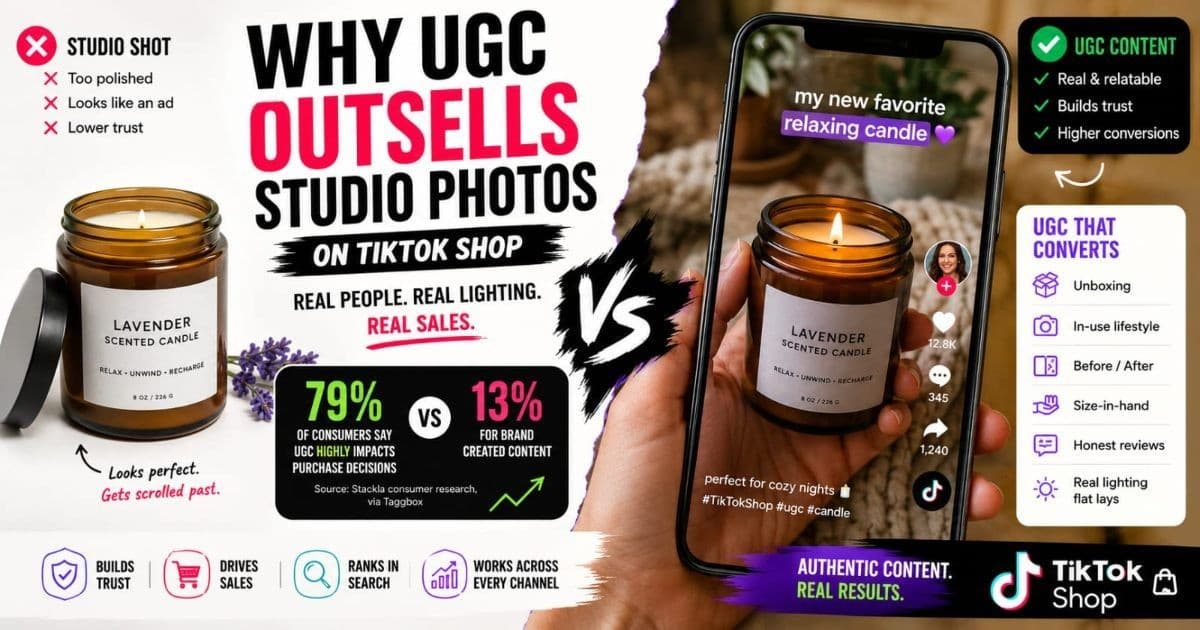
This isn't a fluke of one platform's culture — it's measured buyer psychology. In one widely cited consumer survey, 79% of people said user-generated content highly impacts their purchasing decisions, versus just 13% for brand-created content (Stackla consumer research, via Taggbox). Buyers trust evidence over advertising, and UGC is evidence.
But most sellers handle UGC badly: they repost without permission, over-edit until the authenticity dies, and never optimize the images for search on any platform. This guide covers the full pipeline — why UGC wins, how to source it legally, and how to make creator content rank and convert on TikTok Shop, your own site, and Google.
Key Takeaways
- 79% of consumers say UGC highly impacts purchase decisions, versus 13% for brand content (Stackla, via Taggbox) — authenticity is the conversion lever, not polish.
- You need written rights for every UGC asset you republish: a customer tag is not permission, and TikTok Shop's affiliate program is the scalable legal route.
- UGC alt text should describe person, context, and use case — "woman applying the balm before a workout" outperforms "balm on white background" for AI search and accessibility.
- Keep UGC phone-real but technically clean: sufficient resolution for Shop image slots, no heavy filters, no watermarked overlays.
Why UGC Outsells Studio Photos on TikTok Shop
TikTok Shop lives inside a feed built on native-feeling content, and its buyers scroll with finely tuned ad detectors. A studio-perfect image pattern-matches to "advertisement" and gets scrolled past; a phone-shot photo of your candle burning on someone's actual nightstand pattern-matches to "a person like me showing me something" — and earns the pause that everything else depends on.
Three forces stack here. The algorithmic one: TikTok's surfaces reward content that behaves like content, not like ads — engagement decides distribution, and native-feeling material earns more of it. The psychological one: shoppers trust peers over brands, which is what that 79%-vs-13% gap measures (Stackla, via Taggbox). And the practical one: UGC answers the questions studio photos structurally can't — what it looks like in bad lighting, how big it really is, what actually shows up in the box.
None of this means firing your photographer. Your white-background shot still owns the main image slot (TikTok Shop requires a clean background there, as our TikTok Shop image SEO guide covers). UGC wins the supporting slots — and the feed.
The UGC Image Types That Convert
Not all customer content pulls equally. Six formats do most of the converting:
- Unboxing stills. The moment of opening — packaging, first look, contents laid out. Answers "what actually arrives" and de-risks the purchase.
- In-use lifestyle shots. The product doing its job in a real home, on a real desk, in a real gym bag. This is where buyers picture ownership.
- Before/after. The most persuasive format wherever it applies — skincare, cleaning products, organization, craft supplies. One image carries the whole value proposition.
- Size-in-hand reference. A product held in a human hand kills the #1 cause of returns and negative reviews: "smaller than expected." Boring, and worth more than any glamour shot.
- "Here's what I actually got" honest reviews. Slightly imperfect, clearly unsponsored-feeling content — the imperfection is the credibility.
- Real-lighting flat lays. A customer's arrangement on their own table, in daylight, no lightbox. The aesthetic gap from your studio version is the trust signal.
Brief your affiliate creators toward these formats rather than "make content" — you'll get assets that slot directly into your image strategy instead of vibes.
Sourcing UGC Legally
Here's the rule that saves you from the most common UGC mistake: appearing in your mentions is not a license. A customer photo tagged with your brand is that customer's copyrighted work. Screenshotting it into your Shop gallery, product page, or ads without permission is copyright infringement — and scraping tagged posts at scale is how brands end up with takedowns, creator callouts, and occasionally lawsuits.
The legitimate channels:
- Ask, then keep the receipt. For organic customer posts, a comment or DM — "We love this! May we feature it on our product page and social?" — plus their written yes is a usable, documented license. Save the screenshot.
- TikTok Creator Marketplace and creator programs. Formal collaborations where deliverables and usage are agreed upfront.
- Rights language in every contract. Specify where (TikTok, your site, ads, marketplaces), how long (12 months? perpetual?), and what modifications are allowed. "You can use it" without scope is a future dispute.
- Licensed asset, not screenshot. Get the original file from the creator, not a compressed screenshot of a post — better resolution for reuse, and cleaner provenance.
The Creator Affiliate Route
TikTok Shop's affiliate program is the scale answer: you list products with a commission rate, creators opt in, order samples, and produce shoppable videos on their own initiative. Each video is UGC you didn't brief, shot in a real home, tagged to your product — and because affiliate content carries product tags, it's searchable, shoppable inventory inside TikTok, not just a nice mention.
Two practices separate sellers who get usable assets from those who just get sales spikes. First, set commission where creators actually pick you up — too low and nobody samples your product; benchmark your category. Second, negotiate content reuse into your affiliate relationships: the affiliate video belongs to the creator, so ask top performers for extended usage rights (often for a bonus or flat fee) so their best frames can become your product page and ad assets. The video already proved it converts — that's exactly the content worth licensing.
Every affiliate video also compounds your search presence: tagged videos rank in TikTok search for the queries their captions and audio target, as covered in our TikTok SEO guide.
Optimizing UGC for TikTok Shop Search
A creator's authentic content still needs a searchable text shell — authenticity wins the click, keywords win the impression. When you post or commission UGC for Shop:
- Product tags on everything. The tag is what turns a video into a Shop asset that surfaces in shopping search and converts in-app.
- Caption keywords, front-loaded. The real query — "linen tote bag everyday carry" — belongs in the caption's first line, in natural phrasing.
- On-screen text with brand + product type. An early overlay like "my [Brand] ceramic mug" gives TikTok's OCR the brand-product pairing to index, without breaking the native feel.
- Sound that survives. Original audio (the creator talking) keeps shoppable content evergreen and adds a transcription signal; trending sounds date the video to the month the trend died.
The full mechanics of caption, overlay, and spoken-word optimization are in the TikTok SEO guide — everything there applies doubly to content you're paying commissions on.
UGC Alt Text Is Different
Alt text for a studio shot describes the product; alt text for UGC should describe the scene — person, context, and use case. "Woman applying the lavender sleep balm before a workout" gives search engines and AI assistants the who-where-why that makes the image match real queries ("balm for gym," "pre-workout skincare"), while "sleep balm on white background" matches almost nothing a human types.
This context-first pattern matters more every month, because AI search systems parse images and their alt text to answer conversational shopping questions — "what do people use X for" is answered by exactly the metadata UGC carries. Our guide to image SEO for AI search covers that shift in depth, and the alt text writing guide has formulas for every product type.
The formula for UGC alt text: [person/setting] + [action] + [product with key attribute]. Real examples beat abstractions:
- Weak: "candle photo from customer"
- Strong: "customer's amber jar candle burning on a wooden nightstand next to a book"
One Asset, Six Surfaces: Repurposing UGC
A single licensed UGC asset can work across your whole footprint — if your rights and metadata travel with it:
| Surface | What to check | |---------|--------------| | TikTok video | Original post — creator's own; your rights start at reuse | | TikTok Shop gallery | Rights to use in listings; meets slot resolution; no watermarks | | Your product page | Rights scope includes "own site"; context-first alt text; lazy loaded below fold | | Instagram / Pinterest | Rights scope includes "other social"; re-crop to each platform's ratio | | Google Shopping feed | Rights for marketplace/ads use; clean image per feed rules | | Paid ads | The scope most creators price separately — confirm explicitly |
Two rules make the table work. On rights: your usage agreement must name the surfaces, because "you can post it" does not imply ad usage — that's the scope creators most often object to discovering. On metadata: every surface re-reads the image fresh, so each export needs its filename, alt text, and embedded metadata set before upload — a batch pass through ImgSEO handles all three so the same still is search-ready on every surface it lands.
UGC on Your Own Product Page
Bringing UGC onto your product pages pays twice — conversion and SEO. The conversion side is the trust gap closing at the decision moment: shoppers scrolling a gallery that moves from clean product shots into real customer photos get their "what's it really like" question answered without leaving the page.
The SEO side has three components. Fresh content: a UGC block that updates as new customer photos arrive signals an actively maintained page. Engagement: real photos hold attention longer, and dwell time on product pages correlates with everything good. And schema: when a UGC image pairs with the customer's actual testimonial, that's a Review — mark it up, because review-bearing product schema qualifies for rating rich results, as covered in our product image schema guide.
Technical setup matters because UGC blocks are heavy: a dozen customer photos can wreck your load time. Keep the UGC gallery below the fold and lazy load it — the pattern (and the one image you must never lazy load) is in our lazy loading guide. Compress UGC exactly as aggressively as brand images; authenticity is an aesthetic, not a file size.
Quality Standards: Phone-Shot, Not Sloppy
"Authentic" is a look, not an excuse. UGC that works commercially still clears technical bars:
- Resolution. Shop image slots need real pixels — 1000px+ on the long edge keeps thumbnails sharp (TikTok Shop technically accepts less, but soft thumbnails lose the click). Always source the original file from the creator; a screenshot of a story is pre-ruined.
- No heavy filters. A vintage filter that shifts your product's color is manufacturing returns. Natural light, true color, real setting — the filter-free look is the genre.
- No watermarked overlays. TikTok Shop rejects main images with promotional text and branded overlays, same as Amazon — and a creator's watermark on a licensed asset just confuses provenance. Get clean files.
- Sharp where it counts. The product itself should be in focus even when the scene is casual. Blurry background: charming. Blurry product: useless.
Pulling Stills From UGC Video
Your best UGC images are often hiding inside UGC videos — the affiliate video that converted has three or four frames worth using as product images. The workflow: get the original video file from the creator (platform downloads are compressed and watermarked), scrub for frames where the product is sharp and well-lit, and export at the video's native resolution.
Two technical cautions. Motion blur ruins most candidate frames — look for the moments the creator holds still, often at the "reveal" beat or while talking over a static shot. And resolution math matters: a 1080p video yields stills around 1920×1080, which survives light cropping but not aggressive zooms; 4K source video gives you real cropping freedom. After extraction, treat the still like any product image: name it, compress it, write its context-first alt text, and it's ready for any surface in the repurposing table.
Legal and Disclosure Rules
The disclosure layer is separate from the rights layer, and both bind you:
- FTC endorsement rules (US). If a creator received payment, free product, or commission, their content is a sponsored endorsement and must be disclosed — #ad or equivalent, clearly visible. When you repost their content, the material connection still exists, so the disclosure travels with it (FTC Endorsement Guides).
- Model releases. Copyright permission covers the image; it doesn't cover a person's likeness in commercial use. When the creator is the person pictured, fold likeness consent into one agreement. When customers' photos include friends or children, get explicit confirmation before commercial reuse.
- International variants. The UK's ASA and EU consumer rules run stricter on disclosure prominence than the FTC — "Ad" upfront rather than buried hashtags. If you sell into those markets, apply the strictest standard everywhere; it's simpler than per-market compliance and reads more honest anyway.
None of this is exotic: one decent rights-and-disclosure template, used consistently, covers a small shop's entire UGC program.
Why AI Search Prefers Real Photos
A structural shift is quietly favoring UGC: AI shopping assistants and Google's AI Overviews increasingly answer product questions with real-context evidence, and authentic photos carry information that stock and studio images don't — how products look in actual lighting, at actual scale, in actual use. An AI answering "does this run small" has more to work with from thirty customer photos than from six studio angles.
For sellers, that makes a well-labeled UGC library an AI-search asset: context-rich images, context-first alt text, and schema-connected reviews are exactly the machine-readable evidence these systems cite. The mechanics of being legible to AI search — from alt text to structured data — are in our image SEO for AI search guide, and the wider foundation lives in the complete image SEO guide.
Common UGC Mistakes
- Over-editing until it's studio. Retouching UGC into polish deletes the only thing it had that your brand photos didn't. Crop and correct exposure; stop there.
- Using content without written permission. The screenshot habit feels harmless until the creator notices. Every asset, a documented yes.
- Not tracking which creator's content converts. UGC isn't interchangeable — one creator's frames may outconvert another's 3-to-1. If you don't attribute, you can't double down.
- Ignoring negative UGC. A critical video gets more credible when you respond well publicly — and the criticism often names the exact objection your next product image should answer. Silence looks like guilt; deletion requests look worse.
Measurement: Which UGC Actually Sells
Treat UGC assets like a portfolio, not decoration. Three measurement layers:
In TikTok Shop, attribute at the creator and video level: Shop analytics shows GMV per affiliate video, which tells you whose content converts — the input for both commission decisions and usage-rights offers.
On your site, A/B test the gallery: same product page with and without the UGC block, or studio-only versus studio-plus-UGC ordering. Watch conversion rate and add-to-cart, not just time on page. UGC usually wins, but which UGC wins varies by category — size-in-hand may outperform lifestyle for one product and reverse for the next.
Across search, watch which UGC-derived images earn impressions in Google Images and which tagged videos hold TikTok search positions. The compounding assets — content that keeps producing months later — are what you brief future creators to replicate.
FAQ
Can I use tagged customer photos without asking?
No. A tag grants zero usage rights — the photo remains the customer's copyrighted work, and reposting it to your Shop, site, or ads without permission is infringement. Ask in a comment or DM, get a written yes, and save the screenshot. Most happy customers agree within the hour, which makes skipping the ask doubly pointless.
Does UGC hurt my brand's premium positioning?
Not when you pair instead of replace. Keep polished photography for hero images and campaigns; use UGC as proof — real customers in real settings. Luxury brands do exactly this. What actually erodes premium positioning is a product page with no evidence that real people buy and love the product.
Do I need a model release for UGC images?
For identifiable people, yes. Rights-to-use covers the copyright; a release covers the person's likeness in commercial use. When the creator is the person pictured, one signed agreement handles both. For customer photos featuring friends or children, get explicit confirmation everyone pictured consents before commercial reuse.
How many UGC images should a product page have?
Two to four per product: enough for real context, size reference, and honest condition without burying spec-accurate brand images. Place them after the primary gallery and lazy load below-the-fold blocks so authenticity doesn't cost page speed.
Can I edit or crop UGC before using it?
Light edits are expected — crop, straighten, fix exposure. Don't retouch toward studio perfection: smoothing, background swaps, and product color-grading change what the customer actually showed, killing the signal and risking misrepresentation. If it stops looking phone-shot, you've gone too far.
Conclusion
The lesson of TikTok Shop is that buyers stopped believing perfect pictures — they believe other buyers. That makes UGC a supply chain, not a lucky screenshot: source it through affiliates and permissioned customer content, hold it to real technical standards, keep the rights and disclosures clean, and give every asset the metadata that makes it findable on each surface it touches.
The sellers winning this game run it as a loop: brief creators toward the six converting formats, license the frames that prove themselves, measure per-asset, and feed the winners back into the brief. Authenticity scales fine — it's sloppiness that doesn't.
And whether an image came from a studio or a kitchen counter, it ranks on its metadata. ImgSEO batch-processes your UGC stills alongside your brand photos — keyword-rich filenames, context-aware AI alt text, compression, and embedded metadata in one pass — so every licensed asset is search-ready for your Shop, your site, and Google. Try it free, no credit card required.