
You post a product video, it gets a burst of views, then the graph flatlines and you start over. That treadmill is what chasing the For You feed looks like — and most sellers assume it's the only game on TikTok. It isn't. While you've been chasing viral reach, TikTok has quietly become a search engine, and search is a different game with a much better prize: traffic that doesn't stop when the trend does.
The scale of the shift is documented. Back in 2022, a Google senior vice president revealed internal research showing that almost 40% of young people (US users 18–24) turn to TikTok or Instagram rather than Google Search or Maps for discovery queries like finding a place for lunch (TechCrunch, 2022). Later analysis put numbers on the split: among 18–24-year-olds, 21% now start their searches on TikTok (Econsultancy, citing Bernstein research). And "TikTok made me buy it" is an entire documented purchase behavior with its own hashtag ecosystem.
For an e-commerce seller, this changes what a product video is for. This guide covers how TikTok's search ranking actually works, what it reads from your videos, and how to build videos that keep selling months after the For You feed forgets them.
Key Takeaways
- TikTok is a search destination now: Google's own research found ~40% of young users turning to TikTok/Instagram over Google for discovery searches (TechCrunch).
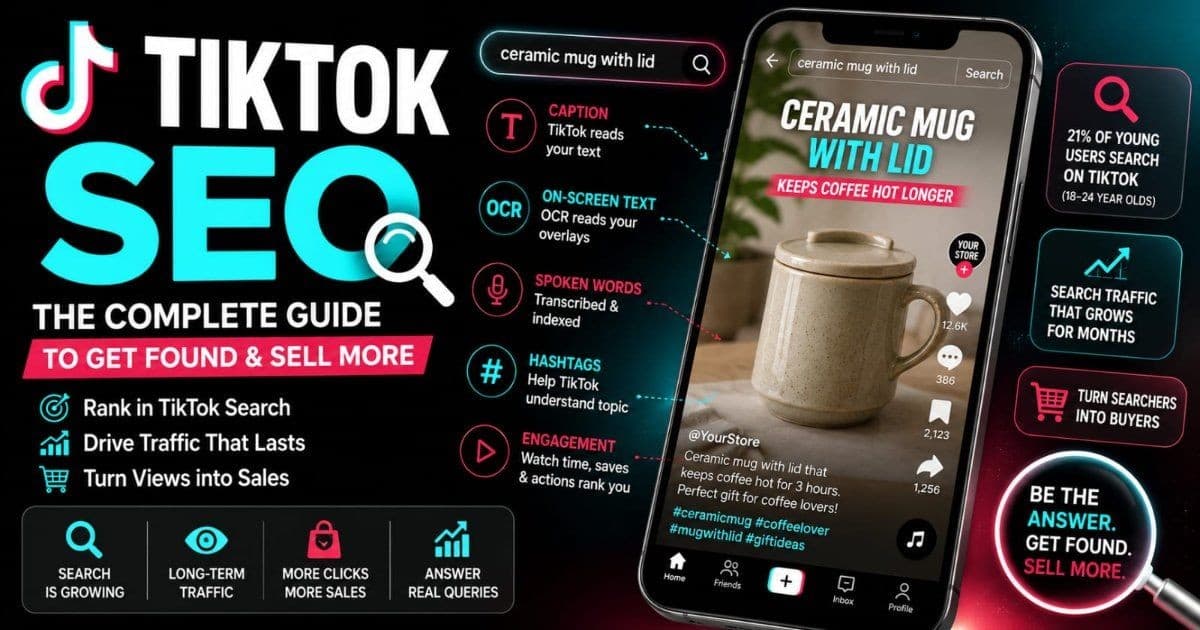
- TikTok search reads your caption, your on-screen text (via OCR), and your spoken words (via transcription) — so the keyword needs to be typed, shown, and said.
- Search-ranked videos have a shelf life of months, unlike For You spikes that die in days — answer-shaped product videos become long-term traffic assets.
- Google indexes TikTok videos too, so one well-optimized video can rank inside TikTok and in Google's video results simultaneously.
TikTok Is a Search Engine Now
The search bar at the top of TikTok gets used like Google — especially by shoppers under 30. People type "best budget espresso machine," "linen dress try on," and "gifts for plant lovers," then scroll video results the way they'd scroll blue links. Google noticed years ago: its own internal study found nearly 40% of 18–24-year-olds reaching for TikTok or Instagram first for discovery-type searches (TechCrunch, 2022).
The honest nuance: Google hasn't been dethroned — 46% of that same age group still starts on Google, versus 21% starting on TikTok (Econsultancy). But for product discovery — "does this actually work," "what does it look like on a real person" — video answers beat text pages, and TikTok owns that format.
Why should a seller care more about search than virality? Shelf life. A For You spike is a lottery ticket that expires in 48 hours. A video ranking for "ceramic mug with lid" earns views every day someone types that phrase — the same compounding logic that makes Pinterest valuable, as we covered in our Pinterest SEO guide. Search traffic is smaller per day and vastly larger per video lifetime.
FYP Reach vs Search Rank: Two Different Games
The For You algorithm and the search algorithm optimize for different outcomes, and content built for one often fails at the other.
The For You feed predicts what a passive scroller will watch next. It rewards immediate retention: shock hooks, trends, entertainment. Your video is competing against everything for a bored viewer's next three seconds.
Search ranks answers to an active question. The searcher typed a query and wants it resolved — so the ranking signals shift toward searcher satisfaction: did people who searched this phrase watch your video fully, save it, visit your profile, or buy? A video can bomb on For You and still dominate a search query for a year, because the audiences want different things.
The practical takeaway: stop grading every video on first-week views. A product video's real report card includes what it ranks for — and that grade takes weeks to come in.
What TikTok Search Actually Reads
TikTok extracts text relevance from more layers of your video than most sellers realize:
| Signal | How TikTok reads it | Your move | |--------|--------------------|-----------| | Caption | Direct text indexing | Front-load the exact search phrase | | On-screen text | OCR reads your overlays | Put the keyword in the first overlay | | Spoken words | Automatic transcription | Say the keyword out loud, early | | Hashtags | Topic categorization | 3–5 specific tags | | Sound title | Text attached to the audio | Name original sounds descriptively | | Searcher engagement | Watch time, saves, and actions from search viewers | Fully answer the query |
The layered reading is why TikTok SEO differs from every text platform: the keyword has to exist in three modalities. A video where the caption says "hand-poured soy candle," the first overlay shows "Hand-Poured Soy Candles," and your voice says it in the opening seconds gives TikTok three agreeing signals about what the video answers. Most sellers provide one at best.
The Three Surfaces Where Search Shows Your Video
One optimized video can surface in three different places:
- TikTok search results — the main results grid for a typed query. Your cover frame, overlay text, and caption snippet are what searchers see and choose between.
- The "Others searched for" carousel — related-query suggestions TikTok injects into results and under videos. Ranking for one phrase gets you impressions on its neighbors, which is why keyword clusters beat single keywords.
- Google's video results — Google crawls and indexes TikTok videos and surfaces them in video packs and even main results for many product queries. A well-optimized TikTok can outrank slow-moving product pages for "how to" and "review" phrasings — which means TikTok SEO is partly Google SEO in disguise. More on this below.
TikTok Keyword Research
Three free instruments, all fed by real search behavior:
The search bar autocomplete. Type your product's base term and read the dropdown — those are real queries, roughly ordered by volume. "Ceramic mug" might suggest "ceramic mug painting," "ceramic mug with lid," "aesthetic ceramic mugs." Same alphabet-trick method that works on every platform: base term plus each letter, ten minutes, full keyword map.
"Others searched for." Run a search, scroll the results, and note the related-query chips TikTok offers. These are the queries TikTok itself considers adjacent — a ready-made content calendar. Each chip is a video brief.
Creative Center Keyword Insights. TikTok's free Creative Center (no ad spend required) includes a Keyword Insights tool showing which words and phrases appear in top-performing ads, filterable by region, industry, and timeframe (TikTok Creative Center). It's ad data rather than organic search volume, but it reveals the exact consumer phrasing that makes people click in your category — the words to put in your overlays and scripts. Most sellers have never opened it.
Caption Optimization
Captions are indexed directly, so write them like a search result, not a diary entry. The rules:
- Front-load the phrase. The exact query you're targeting goes in the first line: "Hand-poured soy candles that actually smell like fall" beats "Y'all are not ready for this 😭."
- Natural language, not a keyword pile. TikTok's indexing handles conversational phrasing well, and searchers see your caption — stuffing reads as spam to both.
- Use the space when it earns its place. Longer captions give TikTok more text to index; add context, materials, and use cases in sentences. But a focused two-line caption that nails the query beats three paragraphs of filler.
- Keywords first, hashtags last. The searchable phrase belongs in the caption body; hashtags are a supplement at the end, not a replacement.
One rule above all: never paste the same caption across videos. Every video is a chance to own a different query — identical captions compete with yourself and read as low-effort.
On-Screen Text: The Biggest Lever
TikTok runs OCR on your video frames — it literally reads your text overlays, and practitioners consistently find overlay text among the strongest relevance signals. The overlay also does double duty: it's the first thing a searcher sees when scanning results, since your cover frame with its text is your search listing.
The pattern that works is hook + keyword in one line on the opening frame: "The ceramic mug that keeps coffee hot for 3 hours" — keyword for the OCR, promise for the human. Keep overlays high-contrast, large enough to read at thumbnail size, and out of the UI zones where buttons overlap. Every subsequent frame's overlay is another indexable line, so caption your video's beats ("wheel-thrown," "dishwasher safe," "12 oz") instead of leaving frames bare.
If you've read our Pinterest image SEO guide, this should feel familiar — it's the same cover-frame logic, applied to video.
Say the Keyword: Spoken Word Optimization
TikTok transcribes your audio automatically and indexes the transcription — your voice is metadata. The move is simple: say the target phrase naturally within the first few seconds. "These are my hand-poured soy candles, and this is how I get the crackle wick right" puts the keyword in the transcript, the viewer's ear, and (if you add auto-captions, which you should) the on-screen text simultaneously.
Silent videos with music-only audio surrender this entire signal layer. If you can't or won't talk on camera, a brief voiceover works — even a few sentences of narration gives the transcription engine something to index. Turn on auto-captions either way: accessibility for viewers, and one more text surface for the algorithm.
Hashtags for Search, Not Virality
Hashtags on TikTok are topic labels, not magic reach dust. For search purposes:
- 3–5 specific tags that describe the product and query: #ceramicmug #handmadepottery #coffeelovergift. A tag that could label ten thousand unrelated videos (#fyp, #viral) adds zero search relevance — it's a wasted slot.
- Match tags to the query family you're targeting, not to whatever's trending. The tag set is context that helps TikTok place you in the right results.
- Skip sketchy tags entirely. Tags associated with spammy or policy-adjacent content drag your distribution the way bad neighborhoods drag any signal. If a tag's feed is full of engagement bait, don't stand next to it.
Sounds: Original Audio for Evergreen Content
Sound choice splits by goal. Trending sounds are For You fuel — they ride a wave, and then they date your video precisely to the month the trend died. For content you want ranking in search for a year, a trending sound is a countdown timer stamped on otherwise evergreen material.
Original sound (your voice, your ambient audio) does two things trending audio can't: it keeps the video timeless, and it gives you a named asset — title your original sounds descriptively ("Sage Green Ceramic Mug Review") and the sound title becomes one more indexed text field. Save trending sounds for genuinely trend-shaped content, and let your product answers speak in your own audio.
Video Length: Long Enough to Answer
Search queries deserve complete answers, and completeness takes longer than entertainment. A 15-second clip can't fully answer "which ceramic mug should I buy" — a 60-to-90-second comparison can, and the search algorithm can see the difference in how searchers behave: full watches, saves, and profile visits versus a swipe-away.
This doesn't mean padding. It means matching length to query: a quick "how big is it" answer can be 20 seconds; a "worth it?" review earns a minute-plus. The metric that matters is whether the searcher's question is resolved — resolved questions produce the engagement patterns that rank. Save-worthy completeness beats clip-brevity in search, even though the For You feed often prefers the opposite.
E-commerce Video Formats That Rank
Four formats map directly onto how shoppers actually search:
- Product demos — "how to use," "does it work." Show the product doing its job, narrated, with overlay captions on each step.
- Comparison videos — "X vs Y," "best [product] for [use]." Comparisons collect searches from both products' queries and position you as the guide.
- "Which one should you buy" — decision content for your own product line ("which of my three mug sizes fits a latte"). It ranks for buying-intent phrases and pre-sells the answer.
- Unboxings that answer a real query — not hype, but "here's what actually arrives, the size in hand, the packaging." This is the search-shaped version of social proof, and it doubles as UGC-style authenticity even when you shoot it yourself.
Each format is a repeatable series: one per product, one per product pair, refreshed as your catalog grows. That's a search-indexed content library, not a content treadmill.
TikTok SEO and TikTok Shop
If you run a TikTok Shop, search optimization and Shop discovery feed each other. Product tags on your videos make them shoppable — and tagged videos surface in Shop's own search and recommendation surfaces, where the buying intent is even more concentrated. The video's keywords help it rank; the tag turns the ranking into an in-app checkout path.
Structure shoppable videos so the search-satisfying content comes first and the tag does the selling quietly: answer the query, show the product honestly, and let the tag sit there for the convinced. Videos that are pure pitch underperform in search because searchers came for an answer, not an ad.
Your Shop listing itself has its own optimization layer — product titles, image slots, and the specs TikTok's internal search reads — which we cover in the TikTok Shop image SEO guide.
When TikToks Rank on Google
Google indexes TikTok videos and shows them in video packs, and for many "how to," "review," and "vs" product queries, a TikTok video now outranks traditional product pages. What Google reads is the text shell around your video: the caption (which becomes the page title/description context), hashtags, and the transcript. The same three-modality optimization that ranks you inside TikTok is exactly what Google needs.
This is part of a bigger shift — search results across Google and AI assistants increasingly favor authentic visual content, a trend we unpack in how AI is transforming e-commerce SEO and our guide to image SEO for AI search. The strategic point for sellers: your TikTok presence is now part of your Google footprint. A video answering "are linen dresses see-through" can capture a Google searcher who would never have found your product page.
Common TikTok SEO Mistakes
- The same caption on every video. You're competing with yourself for one query and forfeiting every other one.
- Bare frames. No overlay text means no OCR signal and a cover frame that says nothing in search results.
- Trending sounds on evergreen product content. The video dates itself; use original audio for anything meant to rank.
- Deleting "failed" videos. A video that flopped on For You may already rank for a long-tail search. Deleting old videos erases indexed assets — leave them unless they're wrong or off-brand.
- Grading videos at day three. Search performance shows up over weeks. The verdict on a keyword-targeted video isn't in until you've checked where its traffic comes from.
Measurement: Find Your Search Assets
TikTok's per-video analytics break down traffic sources — including how many views arrived from Search. That single split changes how you read your library: sort your videos by search traffic share, and you'll find your quiet compounders — videos with modest totals but steady, search-driven daily views.
The monthly routine: identify which videos earn search traffic and for roughly which phrases (the video's target keyword plus autocomplete around it), then make more content in exactly that shape — same format, neighboring keywords. Watch saves and profile visits from search viewers as your quality signal, and outbound results (Shop taps, link clicks, branded searches on your store) as the money signal. For You spikes are nice; the search line is the business.
FAQ
Does TikTok SEO work for older audiences?
Yes, increasingly. Search-first behavior is strongest under 25 — Google's research pegged ~40% of 18–24s turning to TikTok/Instagram for discovery searches (TechCrunch) — but the search bar sits in front of every user, and how-to and product queries grow across age groups. Where older buyers stay on Google, your optimized TikToks rank in Google's video results anyway.
How long does it take to rank on TikTok search?
Faster than Google. A well-optimized video can appear in results within days, then moves with engagement — videos that searchers watch fully and save climb over weeks. Expect meaningful search traffic to build over one to three months of consistent keyword-targeted posting, not from any single upload.
What does TikTok search actually rank?
TikTok reads caption text, on-screen text overlays (via OCR), spoken words (via automatic transcription), hashtags, and sound titles — then orders results by how searchers engage. That's why the keyword should be typed, shown, and said: three agreeing signals beat one.
Do hashtags still matter for TikTok SEO?
They help, but less than captions, overlays, and audio. Use 3–5 specific tags that describe the product and topic; generic reach tags like #fyp add no search relevance. Treat hashtags as category labels, not a growth mechanic.
Should I delete old videos that got few views?
No. Videos accumulate search position over time, and a For You flop can become a steady search asset months later. Deleting old content erases indexed videos that may already rank for long-tail queries. Leave them up unless they're inaccurate or off-brand.
Conclusion
The sellers burning out on TikTok are playing the wrong game — feeding a feed that forgets every video in 48 hours. The search game rewards the opposite instincts: pick a real query, answer it completely, put the keyword in your caption, your overlays, and your mouth, and let the video compound. Ten answer-shaped videos beat a hundred trend-chases, because the ten are still working next year.
Start this week: pull your keyword list from autocomplete and Keyword Insights, script one video per query, use original audio, and check the search traffic split monthly to find what's compounding.
And remember the other half of your TikTok commerce footprint: your Shop listings and product pages, whose images Google and TikTok both read. ImgSEO optimizes those product photos in one pass — keyword-rich filenames, AI alt text, and embedded metadata — so the image layer of your store works as hard as your videos. Try it free, no credit card required. For the full foundation, see our complete image SEO guide.


