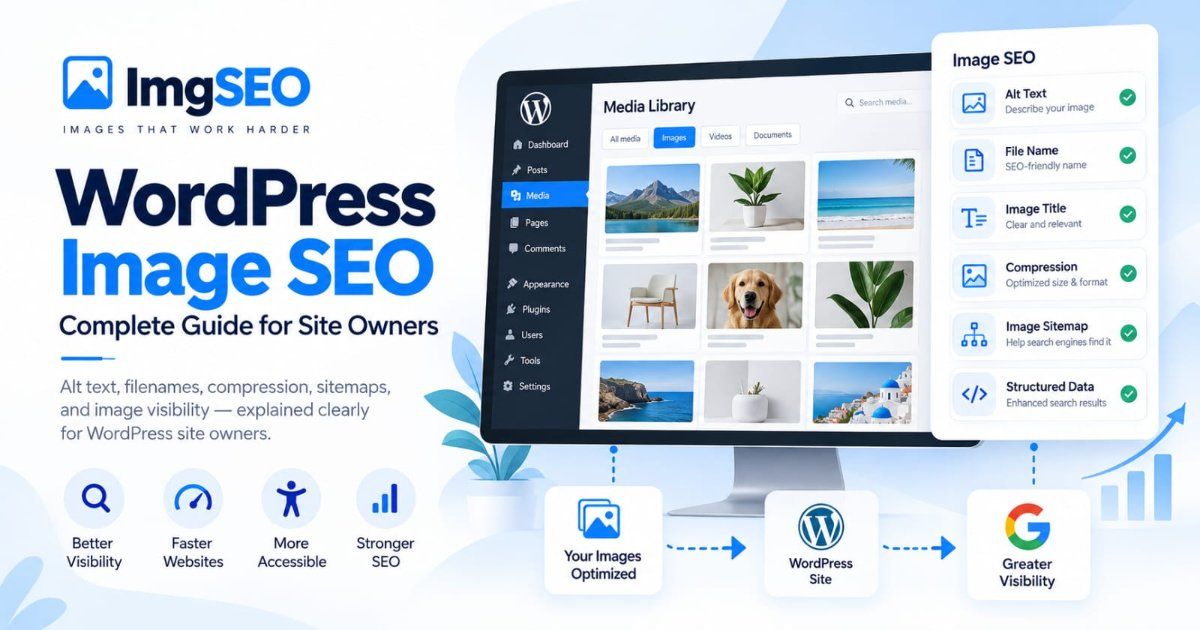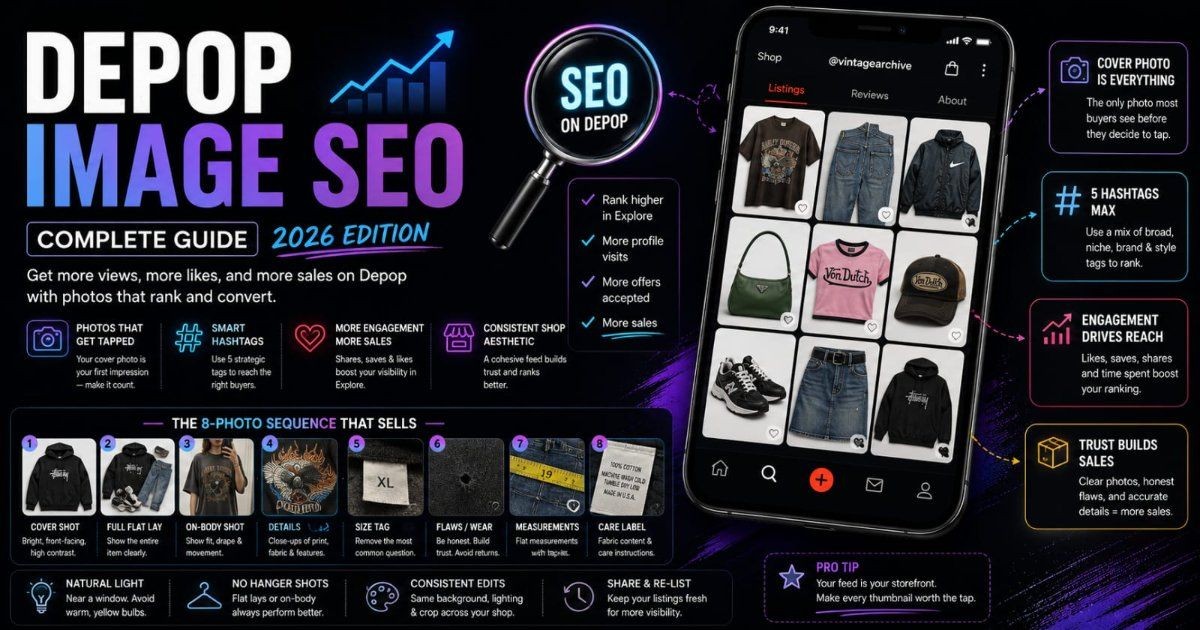

Your product photos are doing two jobs simultaneously — selling to buyers who land on your listing, and ranking in search results that bring those buyers there in the first place. Most sellers optimize obsessively for one and completely ignore the other.
Product image SEO is how your product photos appear in Google Images, Google Shopping, and platform search results. It is a separate optimization track from your product title and description SEO — with different signals, different timelines, and a different competitive landscape.
The good news: the competitive landscape for product image SEO is nearly empty. The majority of Etsy sellers have zero Google Images optimization on any of their listings. The seller who adds specific alt text and descriptive filenames to a full catalog has a meaningful advantage over everyone who does not.
This guide covers all seven components of product image SEO — alt text, metadata, filenames, compression, photography, structured data, and platform-specific implementation — with concrete examples and a checklist at the end.
Key Takeaways
- Over 90% of Etsy listings have zero Google Images optimization — no alt text, no metadata, generic filenames — making this one of the emptiest competitive channels available to sellers.
- For Google image SEO, prioritize useful alt text, descriptive filenames, relevant page context, crawlability, appropriate performance, structured data, and overall site quality. XMP metadata can separately carry file-level information.
- Expect a 4–8 week timeline for Google Images impact: recrawl in weeks 1–2, images appearing in results by weeks 3–4, and clicks compounding from month 2 onward.
What Is Product Image SEO
Definition
Product image SEO is the practice of optimizing product photos to rank in image search results and platform search. It encompasses every signal that search engines use to understand, categorize, and rank an image:
- Alt text — the primary text description of the image
- XMP metadata — title, description, and keywords embedded in the image file
- Filename — the name of the image file before upload
- Image quality — resolution appropriate for the platform
- File size and compression — affects page load speed
- Structured data — Product schema markup that contextualizes images for Google
Google Images processes billions of product searches every month. Buyers searching for "sterling silver minimalist ring women" or "handmade soy candle gift" are actively looking for products to purchase — not information. These are high-intent searches that convert.
The Two Search Engines You Are Optimizing For
Most sellers think about one search engine: the platform they sell on. Etsy search, Shopify site search, Amazon search. These use title, tags, and description as primary signals.
Google Images operates on entirely different signals:
| Signal | Platform Search | Google Images | |---|---|---| | Primary | Title + tags | Alt text | | Secondary | Description | Metadata + filename | | Supporting | Category | Page context + schema | | Speed factor | No | Yes — page load speed |
Both need optimization. A seller who writes perfect Etsy titles but has no alt text is invisible on Google Images. A seller with excellent alt text but generic titles underperforms on Etsy search. Product image SEO requires working both tracks.
The Opportunity
Over 90% of Etsy listings have no Google Images optimization — no alt text, no metadata, generic filenames. This is not because it does not work. It is because most sellers do not know it exists, and the platforms do not make it obvious.
Every image you optimize with specific alt text and a descriptive filename is an image that competes for Google Images rankings that your competitors are not even entering.
For a full breakdown of how Google Images ranking works, see how to rank on Google Images.
Part 1: Alt Text for Product Images
What Is Alt Text
Alt text is an HTML attribute on image elements that describes the image content to search engines. When Google crawls a page with a product image, it reads the alt text to understand what the image shows. This is the primary signal Google uses to rank images in Google Images.
Alt text also serves as the fallback text displayed when an image fails to load, and is read by screen readers for visually impaired users — making it both an SEO and an accessibility element.
The Product Alt Text Formula
Well-optimized product alt text follows a consistent structure:
[Material] + [Product type] + [Style/aesthetic] + [Color] + [Size/quantity] + [Occasion/use]
Not every element applies to every product. Use the ones that are accurate and relevant to buyer searches. The goal is specificity — the more accurately your alt text describes what a buyer would search for, the more searches your image ranks for.
Platform-Specific Alt Text
Etsy Alt Text
In Etsy's listing editor, click on any product image to open the image editor. The field labeled "Describe this photo for buyers who are visually impaired" is the alt text field. Etsy provides up to 500 characters — use 100–200 for SEO.
Etsy buyer vocabulary includes:
- Handmade signals: "handmade," "hand-poured," "wheel thrown," "hand-stamped"
- Gift intent: "gift for her," "birthday gift," "unique gift," "personalized"
- Craft terminology: "artisan," "small batch," "studio made"
Shopify Alt Text
In Shopify admin, go to Products → open the product → click on any image in the Media section. The alt text field appears. Shopify has no character limit — keep descriptions to 125–200 characters for optimal readability and keyword density.
Shopify buyer vocabulary tends toward:
- Specifications: dimensions, weight, capacity, material grade
- Variant terms: color names, size options, style variants
- Technical keywords matching product catalog terms
Alt Text Examples by Product Type
Jewelry:
Sterling silver hammered band ring minimalist adjustable women everyday jewelry gift
Candle:
Soy wax lavender candle 8oz clear glass jar wooden wick handmade aromatherapy relaxation gift
Clothing:
Women's linen midi dress dusty blue minimalist casual summer sleeveless adjustable strap
Ceramics:
Wheel thrown stoneware mug speckled glaze 12oz handmade artisan coffee morning gift pottery
Stationery:
Pressed flower bookmark dried wildflower laminated bookmark gift reader book lover set of 3
For alt text templates covering 40+ product categories, see how to write alt text for every product type.
Part 2: Image Metadata for Products
What Is Image Metadata
Every image file contains embedded metadata — structured data stored inside the file itself, not visible in the image but readable by software.
There are two relevant metadata standards for product image SEO:
EXIF — originally designed to store camera settings (aperture, shutter speed, GPS). Google does not use EXIF fields for ranking purposes.
XMP — extended metadata format designed for descriptive and rights information. Relevant fields include XMP Title, XMP Description, and XMP Keywords (also called Subject). Search engines and destination platforms determine whether this metadata is preserved or used.
Embedded Metadata and Platform Processing
Etsy and Shopify process images when they are uploaded — resizing, converting, and re-serving them from their own CDN. This processing strips most metadata from the file.
Embedded metadata remains inside the exported source file, but search engines and destination platforms determine whether that metadata is preserved or used. For image SEO, prioritize descriptive alt text, filenames, relevant page context, crawlability, and appropriate image performance.
What to Include in Product Metadata
XMP Title — keyword-rich product name in title case:
Handmade Sterling Silver Minimalist Hammered Ring Women Adjustable
XMP Description — natural language description covering material, style, size, and occasion:
Handmade sterling silver adjustable band ring with hammered texture. Minimalist design suitable for everyday wear. Perfect gift for women who prefer simple, elegant jewelry.
XMP Keywords / Subject — 10–15 keyword phrases covering the buyer search vocabulary for this product:
sterling silver ring, minimalist ring, adjustable ring, hammered ring, women jewelry, everyday ring, gift for her, silver band ring, handmade ring, dainty ring
How to Add Metadata
Manual tools: Adobe Lightroom (XMP panel), ExifTool (command-line), Photoshop File Info. Accurate but time-consuming at scale — practical for photographers processing small batches.
AI tools: ImgSEO analyzes the product image visually and generates XMP title, description, and keywords automatically, then embeds them in the file before download. Practical for catalogs of any size.
For a step-by-step guide to metadata embedding, see how to add metadata to product images.
Part 3: Product Image Filenames
Why Filenames Matter for SEO
A descriptive filename can give Google a light clue about the image subject when that filename remains visible in the image URL.
For example:
https://cdn.shopify.com/s/files/sterling-silver-ring-minimalist-women.jpg— Google immediately has keyword contexthttps://cdn.shopify.com/s/files/IMG_4521.jpg— Google has no context
The filename is the only pre-upload optimization signal for Google Images, and it is the one most sellers skip entirely.
The Product Filename Formula
[material]-[product-type]-[style]-[color]-[occasion].jpg
Use hyphens between words (not underscores — Google treats underscores as word joiners, not separators). Lowercase. No spaces. 3–6 descriptive words.
Filename Examples
| Original | Optimized | |---|---| | IMG_4521.jpg | sterling-silver-ring-minimalist-women-gift.jpg | | DSC_0034.jpg | soy-lavender-candle-8oz-glass-jar-handmade.jpg | | photo.jpg | wheel-thrown-stoneware-mug-speckled-glaze.jpg | | image001.jpg | linen-midi-dress-dusty-blue-women-summer.jpg | | scan.jpg | pressed-flower-bookmark-dried-wildflower-laminated.jpg |
Platform Behavior
| Platform | Filename handling | SEO impact | |---|---|---| | Etsy | Renames on upload | Google reads before Etsy renames — window exists | | Shopify | Preserves original in CDN URL | Filename stays in URL permanently | | WooCommerce | Preserves original in URL | Filename stays in URL permanently | | Amazon | Renames on upload | Limited window — still worth doing |
Shopify and WooCommerce sellers get permanent SEO value from descriptive filenames because the original name persists in the CDN URL. For Etsy, the window is shorter but still worth optimizing.
For a full guide to fixing bad filenames across an existing catalog, see how to fix bad image filenames for SEO.
Part 4: Product Image Quality and Compression
Image Quality Requirements by Platform
| Platform | Minimum | Recommended | Maximum | |---|---|---|---| | Etsy | 800px | 2000×2000px | 3000px | | Shopify | 800px | 2048×2048px | 5000px | | WooCommerce | 800px | 1200px | No limit | | Amazon | 1000px (main) | 2000px | No limit |
Etsy penalizes listings with low-resolution main images in search ranking. High-resolution images that can be zoomed also increase conversion rates — buyers examine product details before purchasing.
Why Compression Matters for SEO
Page load speed is a confirmed Google ranking factor. An uncompressed 8MB product photo on a Shopify product page significantly increases load time, which can lower both Google search ranking and Google Shopping placement.
Google PageSpeed Insights specifically flags "Properly size images" and "Serve images in next-gen formats" as optimization recommendations. Failing these checks on product pages has measurable ranking impact.
Compression Best Practices
JPEG — the standard for product photos. Quality setting 80–85 preserves visual quality for product images while reducing file size by 50–70% versus maximum quality. Most buyers cannot distinguish quality-80 from quality-95 at product-page viewing sizes.
WebP — 25–35% smaller than JPEG at equivalent visual quality. Supported by all modern browsers. Ideal for Shopify and WooCommerce product images.
AVIF — 40–50% smaller than JPEG. Best compression available. Browser support is broad but not universal. Use for modern storefronts with technically sophisticated buyers.
Target file sizes:
- Thumbnail / listing grid image: under 100KB
- Main product image: under 300KB
- High-resolution detail shot: under 500KB
For a complete guide to image compression formats and tools, see image compression guide for e-commerce.
Part 5: Product Photography for SEO
The 5 Essential Product Shots
Every listing should include these five types of images — each targets a different keyword cluster and a different buyer intent:
1. Clean background hero shot — This is your main image: product on white or neutral background, filling 80%+ of the frame. This is the thumbnail that appears in Google Images search results and Etsy listing grids. It determines click-through rate.
2. Lifestyle in-use shot — Product shown in realistic context (worn, displayed, in use). Targets use-case keywords: "minimalist ring worn hand," "candle living room decor."
3. Detail / close-up shot — Extreme close-up showing material, texture, craftsmanship. Targets material and quality keywords: "hammered texture sterling silver," "speckled glaze stoneware."
4. Scale reference shot — Product shown next to a hand, ruler, or common object. Targets "size" queries and reduces return rates from buyers who misjudged dimensions.
5. Gift / packaging shot — Product in gift-ready presentation: tissue paper, box, ribbon. Targets: "gift for her," "birthday gift," "ready to gift," "gift packaging."
Main Image Optimization
The main image is the most important SEO asset in your listing. It is:
- The thumbnail displayed in Etsy search results
- The image that appears in Google Images for the listing
- The first image Google crawls when indexing the page
Optimization rules for main images:
- White or very light neutral background (best contrast for thumbnails)
- Product fills 80%+ of the frame (no large margins)
- No text overlays, watermarks, or lifestyle elements on main image
- Bright, well-lit, sharp focus throughout the product
Shot-Specific Alt Text Strategy
Each image in a listing should target a different keyword cluster — not repeat the same alt text:
| Shot type | Alt text focus | |---|---| | Hero | Material + product type + style + primary keywords | | Lifestyle | Use case + occasion + context keywords | | Detail | Material + texture + craft quality + technique | | Scale | Size + dimensions + comparison reference | | Gift | Occasion + recipient + gift-intent keywords |
Part 6: Structured Data for Product Images
Product Schema Markup
Structured data is code added to product pages that tells Google explicitly: "this page is selling a product, here are its details." Google uses this to display rich results in search — including price, availability, star ratings, and the product image.
The image field in Product schema designates the primary product image that Google uses for rich results and Google Shopping listings. Without Product schema, Google may choose any image on the page.
{
  "@type": "Product",
  "name": "Sterling Silver Minimalist Ring",
  "image": "https://yourstore.com/images/sterling-silver-ring.jpg",
  "offers": {
    "@type": "Offer",
    "price": "45.00",
    "priceCurrency": "USD"
  }
}
How to Implement
Shopify — Product schema is built in to all Shopify themes. Verify it is working with Google's Rich Results Test (search.google.com/test/rich-results). The image field is automatically populated from your main product image.
Etsy — Etsy generates Product schema for all listings automatically. You control the image that populates the schema's image field by ensuring your main listing image is high-quality and has correct alt text.
WooCommerce — Install Yoast SEO or RankMath, both of which add Product schema with image data automatically from your product featured image.
Google Rich Results
Product pages with valid schema markup are eligible for rich results in Google search — showing price, availability, and star rating directly in search snippets. These rich results have significantly higher click-through rates than standard blue-link results and give your product image premium placement in Google Shopping.
Part 7: Platform-Specific Product Image SEO
Etsy Product Image SEO
Etsy provides 10 image slots per listing. Most sellers upload 3–5 images and write alt text on none of them.
Priority actions:
- Fill all 10 image slots — each is a separate Google Images entry point
- Write alt text on every image, targeting different keyword clusters
- Main image: clean background, product-fills-frame, no text
- Image 2–5: lifestyle, detail, scale, packaging shots
- Images 6–10: variants, styled shots, process/story images (for handmade credibility)
The Etsy listing main image appears as the Google Images thumbnail when buyers find your listing through Google — it must work as a standalone product advertisement with no surrounding context.
For Etsy-specific image SEO strategy, see Etsy image SEO guide.
Shopify Product Image SEO
Shopify has the most favorable image SEO environment of any platform:
- Original filenames are preserved in CDN URLs (permanent SEO value)
- Product schema is automatic and complete
- WebP conversion available in Shopify admin
- Alt text editable per-image in product media
Priority actions:
- Rename all product images before uploading (filenames persist in URL)
- Add alt text to every image in product media
- Use WebP format for all new product uploads
- Verify Product schema with Rich Results Test
For a comprehensive Shopify image SEO workflow, see the Shopify SEO guide.
WooCommerce Product Image SEO
WooCommerce product images are stored in WordPress media library. Filenames persist in URL paths — making pre-upload filename optimization permanently valuable.
Priority actions:
- Rename files before uploading to WordPress
- Set alt text in media library (not just product settings)
- Install Yoast SEO or RankMath for Product schema
- Use WebP with a plugin like ShortPixel or Imagify for compression
For WooCommerce-specific image SEO, see WooCommerce image SEO guide.
Amazon Product Image SEO
Amazon's image requirements are strict: main image must have a pure white background, product must fill 85%+ of the frame, no text or watermarks. This is non-negotiable.
Amazon SEO for images works differently — Amazon does not surface images in Google Images prominently because Amazon controls indexing. The product image SEO on Amazon operates through:
- Main image quality → higher click-through rate → higher Amazon search ranking
- Backend search terms (not image alt text — Amazon has its own backend keyword system)
- 7 image slots — use all 7, each image increases buyer confidence and conversion
For Amazon-specific image strategy, see Amazon product image SEO guide.
The Product Image SEO Checklist
Before Upload
- [ ] Descriptive filename using formula:
material-product-type-style-color.jpg - [ ] XMP metadata embedded: title, description, keywords
- [ ] Image compressed to target size (under 300KB for main product image)
- [ ] Correct format: WebP for Shopify/WooCommerce, JPEG for Etsy
- [ ] Resolution meets platform minimum: 2000px recommended for Etsy and Shopify
After Upload
- [ ] Alt text on every image slot — not just the main image
- [ ] Main image: clean background, product fills 80%+ of frame
- [ ] All available image slots used (10 for Etsy, 7+ for Amazon)
- [ ] Lifestyle shot included targeting use-case keywords
- [ ] Detail shot included targeting material/quality keywords
- [ ] Gift/packaging shot included targeting occasion keywords
Platform and Technical SEO
- [ ] Product schema implemented and verified (Shopify/WooCommerce)
- [ ] Product title includes primary keyword (not just for SEO — for Google Shopping)
- [ ] Page load speed checked — no images over 500KB on product page
- [ ] Rich Results Test passing for product pages (Shopify/WooCommerce)
Frequently Asked Questions
What is product image SEO? Product image SEO is the optimization of product photos to rank in Google Images, Google Shopping, and platform search results — using alt text, metadata, filenames, compression, and structured data to make images findable by search engines.
Does alt text help product images rank on Google? Yes. Alt text is the primary signal Google uses to understand and rank product images. Without alt text, a product image competes for no specific searches. With specific, material-and-use-case alt text, the same image can rank for dozens of buyer queries.
How do I optimize product images for Google Images? Write specific alt text (material + product type + style + occasion), use descriptive filenames before uploading, embed XMP metadata, compress images for fast load speed, and implement Product schema markup on your product pages.
What is the best image format for product SEO? WebP for Shopify and WooCommerce — 25–35% smaller than JPEG at equivalent quality. JPEG for Etsy — most consistent compatibility with Etsy's image processing. AVIF for cutting-edge implementations where compression is the priority.
How many product images should I have per listing? Use every available image slot. Etsy: all 10. Amazon: all 7. Shopify: 5–8 per product minimum. Each slot is an independent Google Images ranking opportunity targeting different keyword clusters.
Does image file size affect product SEO? Yes. Large images slow page load speed, which is a Google ranking factor. Target under 300KB for main product images and under 100KB for thumbnails. Use WebP or AVIF format for the best compression without quality loss.
What metadata should product images have? XMP Title (keyword-rich product name), XMP Description (natural language covering material, style, size, and occasion), and XMP Keywords (10–15 buyer search phrases). These fields keep descriptive information inside the exported source file.
How long does product image SEO take to work? Search performance varies by query demand, relevance, competition, crawl and indexing behavior, and site authority. Measure impressions and clicks in Search Console rather than relying on a fixed timeline.
Conclusion
Product image SEO operates on five core signals: alt text, metadata, filenames, compression, and photography. Most sellers optimize none of them. Any optimization you implement puts distance between your listings and the competition.
The highest-leverage starting point is alt text and filenames — they require no tools, only time, and they produce permanent ranking improvements. Adding specific, material-and-use-case alt text to every image in a catalog of 250 images is a weekend project that compounds for years.
Metadata and compression require tooling but contribute different benefits: metadata carries descriptive and rights-related information inside the exported file, while compression supports faster product pages. Search engines and destination platforms determine whether embedded metadata is preserved or used.
Google Images is a traffic source that most e-commerce sellers have not activated. The sellers who have activated it are seeing meaningful, growing organic traffic from buyers who were searching for exactly what they sell.
ImgSEO automates alt text generation, XMP metadata embedding, and image compression in a single upload — generating platform-specific output for Etsy, Shopify, and WooCommerce. Free for 30 product images, no credit card required.
For a guide to the full AI-powered image optimization workflow, see AI-powered image optimization guide.