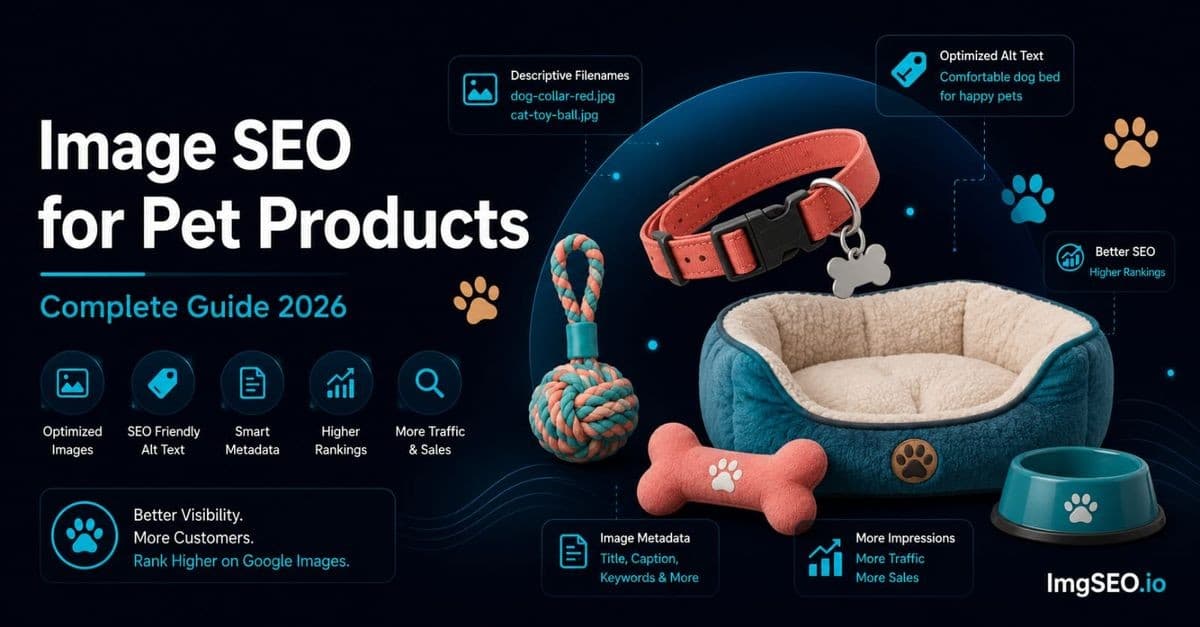
Pet owners spend more than $150 billion annually on their animals — and they search Google Images before nearly every purchase. A shopper looking for a harness for their French Bulldog is not typing "dog harness." They are typing "harness for French Bulldog" or "French Bulldog no-pull step-in harness" because they know their dog's breed has a specific chest shape that most harnesses do not fit. If your product image is named photo_001.jpg with alt text that says "dog harness," you are invisible to that buyer.
Pet product image SEO rewards specificity in three dimensions: animal species, size or breed, and material safety. These are the terms buyers use to filter out products that will not work for their specific pet. This guide covers the complete workflow — photography shot types, the pet product filename formula with breed examples, safety-compliant alt text patterns, metadata strategy, platform-specific tips for Etsy, Shopify, and Amazon, and a seasonal keyword approach for holiday pet traffic.
Key Takeaways
- Pet owners spend more than $150 billion annually and search by breed because breed determines fit — "harness for French Bulldog" targets a pre-qualified, ready-to-buy searcher that "dog harness" does not.
- Each size or breed variant needs unique alt text (e.g., "orthopedic dog bed small breeds" vs. "large breeds") — shared alt text across variants means ranking for none of them.
- Fur-detail lifestyle shots need higher JPEG quality (85–88%) than clean product-only shots (82–85%) to avoid smearing artifacts in fine fur texture.
Why Pet Product Image SEO Is Different
Breed and Size Specificity
Pet owners search by breed because breed determines fit. A harness sized for a French Bulldog has a wider chest and shorter back than one sized for a Whippet of the same weight. A collar for a Greyhound needs a wider band to prevent slipping. Buyers know this, and their searches reflect it. "Harness for French Bulldog," "Greyhound collar martingale," "Maine Coon cat tree wide platforms" — these are real search queries from buyers who have already decided on the product type and are now filtering by compatibility.
Include the target breed in alt text and metadata whenever your product is genuinely designed or sized for specific breeds. Generic breed mentions added purely for keyword volume — when the product does not actually fit or suit that breed — damage trust and drive returns.
Size is equally important when breed is not specific. "Small dog collar," "large dog bed," "extra-large cat tree" — buyers use these terms to filter before clicking. A product page that ranks for "dog bed" but does not communicate size in the image alt text loses the buyer the moment they realize they cannot tell if it fits their dog.
Safety and Material Searches
Pet owners research materials with the same intensity as parents shopping for children's products. "Non-toxic," "BPA-free," "organic cotton," and "natural dye" are not marketing adjectives in pet product searches — they are filters that a significant portion of buyers apply before purchasing. A search for "organic cotton dog bandana non-toxic dye" is a buyer who has already decided they will not purchase anything without that safety profile.
Safety keywords drive the highest-intent searches in the pet category because the buyer has made a decision before they search. They are not comparing safety levels — they are looking for products that meet a standard they have already set. Include safety and material terms in every relevant filename, alt text, and metadata field.
The Emotional Connection
Pet owners purchase for their animals the way parents purchase for children. The emotional stakes are high, the research is thorough, and lifestyle imagery that shows a happy pet genuinely using the product converts at a significantly higher rate than clean product-only shots. "Cute" and "adorable" are not frivolous modifiers in pet product alt text — they appear in real buyer searches, particularly on Etsy and Pinterest, and they belong in your keyword vocabulary alongside the technical terms.
Pet Product Photography Best Practices
Shot Types for Pet Products
A complete pet product image set covers six shot types, each targeting different search intent and serving a different page position:
Clean product shot — white background, full product visible, technically sharp. This is the required main image on most marketplaces and the image that appears most in Google Images results. It must communicate product type, color, and approximate size clearly.
Product on or with pet — a dog wearing the harness, a cat using the scratching post, or a rabbit in the hideout. This view can answer a buyer's fit and use questions in ways a product-only shot cannot.
Size reference — product shown on or next to the target breed or size pet, with a size indicator visible. Buyers cannot tell if a bed is large or small from a photo alone. A size reference shot eliminates that uncertainty and reduces returns.
Detail shot — material close-up, stitching, safety buckle, non-toxic finish, or construction quality. This targets material and safety searches and builds trust with buyers who research before purchasing.
Multiple sizes — all size variants shown together. This single image communicates the size range at a glance and can rank for multiple size-specific searches.
Packaging or gift shot — product in gift box or with seasonal packaging. Essential for holiday pet gift traffic in Q4.
Working with Live Animal Props
Using a real pet can demonstrate scale and fit. Diffused window light, outdoor shade, or a controlled studio setup can preserve fur detail when used well. Keep sessions short, prioritize animal welfare, and choose the lighting method that represents coat and product color accurately.
Action shots — a dog running with a toy, a cat mid-leap to a cat tree platform — show the product in genuine use and capture a different set of search terms than static images. They also tend to stand out in Google Images results against the majority of static product shots from competitors.
Size Reference Strategy
Size ambiguity is one of the top reasons pet product buyers abandon a product page or return a purchase. Solve it in the image itself. Show the product on the target breed or size animal. Include a size graphic or measurement overlay in a secondary image. Write "fits dogs 10–25 lbs" in the alt text and, where platform rules allow, in an image graphic.
A dog bed photographed alone looks the same at 24 inches and 42 inches. A dog bed with a Labrador Retriever sleeping in it communicates large-dog scale instantly.
Pet Product Filenames for SEO
The Pet Product Filename Formula
[product type]-[animal]-[size/breed]-[material]-[feature].jpg
Every element in the filename is a keyword signal. Hyphens between words, lowercase throughout, three to six terms for readability. The animal comes before the breed or size because buyers search "dog harness" before "French Bulldog harness" — lead with the broader term, narrow with the modifier.
Examples by Pet Product Type
Dog Products
adjustable-dog-harness-french-bulldog-mesh-breathable.jpgpersonalized-dog-collar-leather-medium-engraved.jpgorganic-cotton-dog-bandana-non-toxic-small-dogs.jpgorthopedic-dog-bed-large-breeds-memory-foam.jpg
Cat Products
cat-tree-large-cats-sisal-scratching-post-72-inch.jpgbreakaway-cat-collar-reflective-safety-adjustable.jpginteractive-cat-toy-feather-wand-indoor-cats.jpg
Small Animals
hamster-hideout-wooden-non-toxic-small-animal.jpgguinea-pig-fleece-cage-liner-2x4-c-and-c-cage.jpg
Breed-Specific Filenames
When a product is designed or sized for specific breeds, the breed name belongs in the filename:
french-bulldog-harness-no-pull-step-in.jpggolden-retriever-bandana-personalized-cotton.jpggreyhound-martingale-collar-wide-band-leather.jpg
If your existing product images have generic names like product-1.jpg or camera-generated names, see our guide on how to fix bad image filenames for SEO for a systematic renaming workflow without breaking existing URLs.
Alt Text for Pet Products
Pet Product Alt Text Formula
[Product type] + [animal/breed] + [size] + [material/feature] + [safety/benefit]
This formula targets product type searches, breed and size searches, and material or safety searches simultaneously. Each element adds specificity that moves from a crowded broad term into a targeted, conversion-ready niche.
Examples by Product Type
Dog Harnesses and Collars
- Main:
Adjustable mesh dog harness for French Bulldog breathable no-pull small - On dog:
French Bulldog wearing adjustable mesh harness on outdoor walk - Detail:
Adjustable buckle and padded chest plate detail on mesh dog harness
Cat Products
- Main:
Large cat tree 72 inch sisal scratching post multi-level indoor cats - In use:
Cat using sisal scratching post on large multi-level cat tree - Detail:
Sisal rope wrapped scratching post on cat tree close-up texture
Dog Beds
- Main:
Orthopedic dog bed large breeds memory foam washable cover gray - In use:
Large golden retriever sleeping on orthopedic memory foam dog bed - Detail:
Memory foam layer cross-section visible in orthopedic dog bed
Pet Accessories
- Main:
Organic cotton dog bandana non-toxic dye small dogs adjustable tie - On dog:
Small terrier wearing organic cotton bandana lifestyle photo outdoor
Safety and Material Keywords
Safety terms are not optional in pet product alt text — they are the highest-intent modifiers in the category. Include whichever of these apply to your product:
Safety: non-toxic, BPA-free, safety-certified, vet-recommended, chew-resistant, breakaway (for cat collars)
Material: organic cotton, natural wood, stainless steel, recycled fabric, natural rubber
Care: washable, machine washable, waterproof, easy-clean
Size: XS, small, medium, large, extra-large, giant breed
Fit: adjustable, universal fit, breed-specific (French Bulldog, Greyhound, Maine Coon)
For the foundational principles behind effective alt text, see our complete guide to alt text.
Metadata for Pet Products
Pet Product Keyword Strategy
EXIF and XMP can carry descriptive or rights-related information in a source asset, but they are not documented standalone ranking signals and may be removed after upload. Put buyer-facing descriptions in the platform's actual alt-text and product fields.
Animal: dog, cat, puppy, kitten, rabbit, guinea pig, hamster, bird, fish
Breed: French Bulldog, Golden Retriever, Labrador, Maine Coon, Persian, Chihuahua
Size: XS, small, medium, large, XL, giant breed
Material: organic cotton, non-toxic, BPA-free, natural wood, stainless steel
Feature: washable, adjustable, personalized, orthopedic, reflective, breakaway
Safety: non-toxic, vet-recommended, safety-certified, chew-resistant
EXIF and XMP Fields
For an adjustable mesh dog harness:
- Title:
Adjustable Mesh Dog Harness French Bulldog No-Pull Small - Description:
Step-in mesh harness designed for French Bulldogs and short-muzzled breeds. Adjustable chest and belly straps, breathable mesh, padded chest plate. No-pull design with front and back leash attachment points. Small fits chest 14–18 inches. - Keywords:
dog harness, French Bulldog, mesh harness, no-pull, step-in harness, small dog, adjustable, breathable, brachycephalic
See our guide on how to add metadata to product images for field-by-field instructions across JPEG, WebP, and AVIF formats.
Platform-Specific Pet Product Image SEO
Etsy Pet Products
Etsy is the dominant marketplace for handmade and personalized pet products — custom name bandanas, hand-stamped ID tags, sewn pet beds, and knitted toys. Buyers arrive on Etsy specifically looking for products that feel personal rather than mass-produced, and lifestyle photography with actual pets performing reinforces that expectation immediately.
Personalized products present a specific image SEO opportunity: show the customization clearly. A dog bandana with a pet's name embroidered on it — photographed with the name legible — captures the emotional appeal and the "personalized dog bandana" search simultaneously. Customer photos of their specific pet wearing the product, shared with permission, are uniquely valuable here because they are 100% original images that Google has never indexed before.
See our Etsy image SEO guide for Etsy-specific listing image requirements and alt text character limits.
Shopify Pet Stores
Size variants are the primary image SEO challenge for Shopify pet stores. A dog bed available in small, medium, and large needs unique images for each size — ideally lifestyle shots with appropriately sized dogs — and unique alt text per variant. "Orthopedic dog bed small breeds memory foam" and "orthopedic dog bed large breeds memory foam" are different searches with different buyer intent. Sharing alt text across sizes means ranking for none of them specifically.
Breed-specific collection pages — "For French Bulldogs," "For Large Dogs," "For Senior Dogs" — create additional indexable surfaces that capture breed and size searches upstream of the product page, before the buyer has decided on a specific product. See our Shopify image SEO guide for collection page and variant implementation details.
Amazon Pet Products
Safety certifications and material transparency are the highest-leverage elements in Amazon pet product image SEO. Buyers on Amazon filter by material and certification more readily than on any other platform — the faceted search system makes it easy, and buyers have learned to use it. Make certifications visible in the images themselves: a graphic in image slot two or three that clearly lists "non-toxic," "BPA-free," "ASTM safety certified" removes doubt at the point where doubt causes the buyer to click a competitor.
Use all nine image slots. Main image: white background, product clearly visible. Slots two through nine: lifestyle with pet, size comparison, safety certifications graphic, material detail, multi-size range, A+ content infographic, and a customer UGC-style lifestyle shot. See our Amazon product image SEO guide for A+ content best practices specific to pet products.
Google Images Strategy for Pet Products
High-Volume Pet Search Queries
The dominant search patterns in pet product image search:
- Breed + product: "French Bulldog harness," "Maine Coon cat tree," "Greyhound collar"
- Size + animal + product: "small dog bed," "large cat tree," "giant breed orthopedic mattress"
- Material + product: "organic cotton dog toys," "natural wood hamster hideout," "BPA-free dog bowl"
- Feature + product: "orthopedic dog bed large," "reflective dog collar night walking," "waterproof dog mat"
Build alt text and filename strategy to cover all four patterns across your product catalog. A single product image — the main shot — cannot capture all four simultaneously. Distribute the keyword coverage across your full image set: main shot for product + animal + size, lifestyle shot for breed specifics, detail shot for material and safety.
The Breed Keyword Strategy
Breed-specific wording can narrow the audience and communicate fit when the product is genuinely designed for that breed. Search volume, competition, and purchase readiness vary, so validate terms with current data rather than assuming a conversion advantage.
If your product suits three to five target breeds, list all of them in the metadata Keywords field. In alt text, lead with the primary target breed. In the filename, include the breed most strongly associated with the product. The metadata Keywords field exists precisely for this kind of multi-breed coverage — use it.
Seasonal Pet Product Searches
Pet product search volume shifts significantly with the seasons:
October: pet Halloween costumes peak sharply. Update alt text to include "Halloween dog costume" or "cat Halloween outfit" for relevant products from late September.
November–December: pet gift sets, Christmas pet stockings, holiday bandanas. Add seasonal modifiers and consider dedicated holiday collection images.
Summer: cooling mats, portable water bowls, travel accessories, outdoor dog gear. Update metadata for summer intent terms in May–June.
Spring: flea and tick prevention accessories, outdoor collars, garden-safe pet toys.
Seasonal changes should be made only where the product and visible image genuinely support them. Update the page's buyer-facing text when useful; do not rely on EXIF or XMP keywords to capture traffic.
Pet Lifestyle Photography Tips
Getting Great Pet Lifestyle Shots
Natural light outdoors produces the most authentic pet lifestyle images. Overcast daylight is the ideal — soft, directionless light that shows fur texture without harsh shadows or blown-out highlights. Direct midday sun creates strong shadows and causes pets to squint, which reads as discomfort to buyers.
Capture action: a dog running with a toy, a cat mid-leap to a cat tree platform, a rabbit exploring a new hideout. Action shots show the product in genuine use and stand out in Google Images results against the majority of static competitor product shots. They also support a different set of alt text keywords — "golden retriever running with rope toy outdoor" versus "rope dog toy product shot."
Show the product clearly while the pet uses it. A harness half-hidden by a dog's fur, or a bed edge-cropped out of frame, fails to communicate the product even though the lifestyle appeal is there. Adjust framing so both the pet and the product are clearly visible.
Working with Customer Photos
User-generated content is uniquely valuable in pet product image SEO because every customer photo is an original image that Google has never indexed. A product with 50 UGC lifestyle photos from real customers has 50 images that are inherently unique — something no competitor's catalog shoot can replicate.
Build a systematic UGC collection program: ask customers to share photos at the time of delivery confirmation, offer a small discount on the next order in exchange for a photo submission, and feature submitted photos in a gallery on the product page. Tag shared photos with the customer's permission before using them commercially. The SEO benefit of genuinely unique lifestyle imagery compounds over time as Google's image index grows to include a diverse range of real-use shots from your products.
Image Compression for Pet Products
Pet Photography Compression Settings
Fur texture is detail-rich and compresses poorly at low quality settings — compression artifacts appear as smearing in fine fur patterns that makes the image look low-quality to buyers. Pet product images require slightly higher JPEG quality than smooth-surface products like ceramics or packaged goods.
Recommended settings for pet products:
- Lifestyle shots with fur detail: test several export settings and inspect fine detail at the final display size
- Clean product shots: choose the smallest file that preserves necessary edges and product detail
- WebP: compare it with other destination-supported formats because results vary by image and encoder
- Compare lifestyle exports carefully around fur, grass, and detailed backgrounds
- Check product-only exports for clean edges, label text, and accurate color
WebP is the preferred format for pet lifestyle photography when you have format control — it consistently preserves fur texture at smaller file sizes than JPEG at equivalent quality. For a complete compression reference, see our image compression guide for e-commerce.
Pet Product Image SEO Checklist
Before publishing any pet product image set, verify:
- ✅ Clean white or neutral background main image — product fully visible and sharp
- ✅ Lifestyle shot with actual pet using or wearing the product
- ✅ Size reference image — product on appropriately sized pet or with measurement graphic
- ✅ Filename includes animal, size or breed, and material (
organic-cotton-dog-bandana-non-toxic-small-dogs.jpg) - ✅ Alt text includes safety and material keywords — non-toxic, BPA-free, organic where applicable
- ✅ Breed-specific keywords included when product targets specific breeds
- ✅ Metadata Keywords field lists all target breeds, sizes, and safety certifications
- ✅ Seasonal keywords updated for upcoming holidays — Halloween, Christmas, summer
- ✅ JPEG quality 85–88% for lifestyle shots containing fur detail
- ✅ Customer UGC photos collected, tagged, and added to product gallery
Frequently Asked Questions
What is the best alt text for dog products?
Lead with the product type and target animal, follow with breed or size, then include material and safety terms. "Adjustable mesh dog harness French Bulldog breathable no-pull small" targets product, breed, material, and feature searches simultaneously without being keyword-stuffed.
Should I include breed names in pet product alt text?
Yes — when the product is genuinely designed or sized for that breed. Generic breed mentions on products that do not specifically fit or suit the breed create buyer disappointment and drive returns. Targeted breed mentions on appropriately designed products are one of the highest-value keyword opportunities in the pet category.
What keywords work best for pet product image SEO?
Combine breed, product type, material, and safety attributes only where accurate. Specific descriptions can help qualified buyers understand the item, but performance should be measured rather than assumed.
How do I optimize for breed-specific pet searches?
Include the breed in the filename, alt text, and metadata Keywords field. Build breed-specific collection pages on Shopify — "For French Bulldogs," "For Giant Breeds" — to create additional indexable surfaces for breed searches before the buyer reaches the product page.
Should pet main images show product alone or with a pet?
Check each marketplace's current main-image requirements. Product-only and lifestyle images serve different buyer questions; test their order rather than promising a universal click-through or conversion result.
How do I handle size variants in alt text?
Give each size variant its own alt text. "Orthopedic dog bed small breeds memory foam" and "orthopedic dog bed large breeds memory foam" are different searches. Shared alt text across sizes means ranking for none of them specifically. Each size is a separate SEO and revenue opportunity.
What safety keywords should I include for pet products?
Include every safety attribute your product carries: non-toxic, BPA-free, safety-certified, ASTM certified, vet-recommended, chew-resistant, breakaway (for cat collars), lead-free, food-grade (for bowls and feeders). These terms appear in high-intent searches from buyers who have made safety a purchase filter.
How do I get lifestyle photos of my pet products?
Use your own pet, hire a local pet model through pet photography networks, or build a UGC collection program asking customers for photos in exchange for a discount on their next order. Customer photos are uniquely valuable for image SEO because they are genuinely original images that no competitor has.
Conclusion
Pet product image SEO rewards the same specificity that pet owners apply to their searches. Breed names, size specifications, safety certifications, and material transparency — these are the terms that separate a product photo visible to a ready buyer from one buried under millions of generic results.
Lifestyle photography with an appropriately sized pet can demonstrate fit and use in a way a product-only image cannot. That can improve clarity for buyers, but it is not a documented Google relevance signal or guaranteed highest-converting format.
Seasonal keyword updates — Halloween costumes in October, holiday gift sets in November, cooling products in June — cost minutes to implement and capture traffic peaks that static year-round metadata misses entirely. Every seasonal update is a compounding advantage over competitors whose images have not been touched since the original product upload.
ImgSEO generates pet-product-aware alt text and metadata automatically, applying breed, size, and safety terminology from your product context and embedding it across JPEG, WebP, and AVIF formats in a single workflow. Try free — 30 images.
For a broader introduction to image SEO fundamentals, see our image SEO guide for beginners.