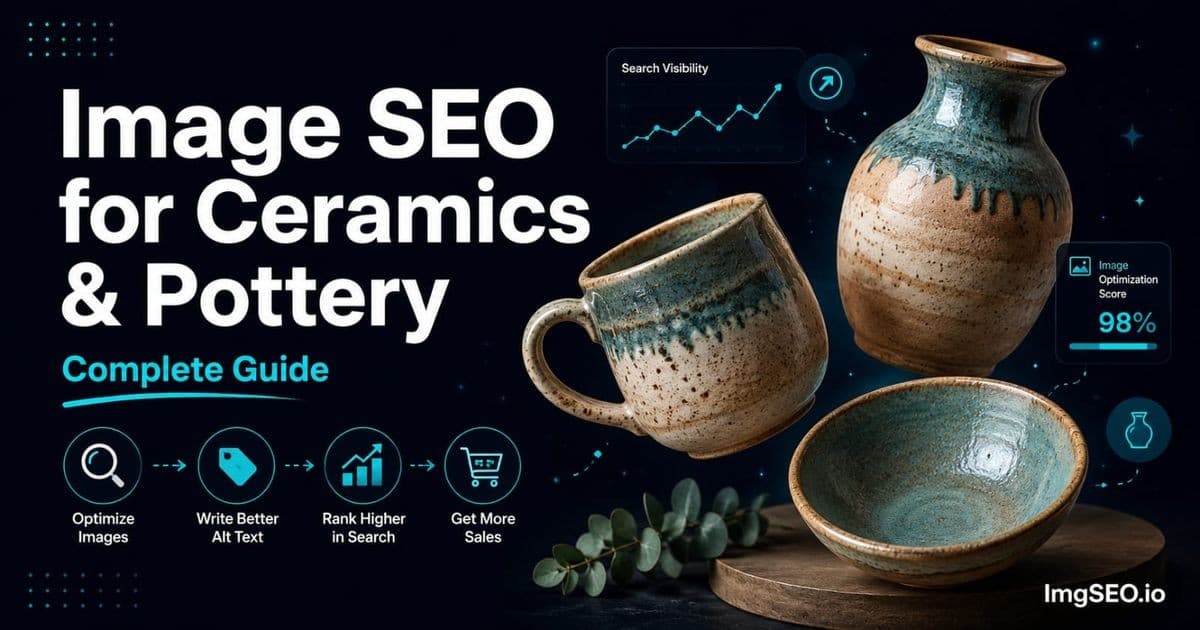
When a buyer looks at a ceramic mug on Etsy, they are not just deciding whether they want a mug. They are deciding whether they want this mug — this particular glaze, this specific form, the marks of this maker's hands. Ceramics buyers are buying the maker as much as the object, and your images must communicate both.
That is what makes ceramics image SEO different from nearly every other product category. The glaze variation that makes each piece unique is not a complication — it is your most powerful visual selling point and your clearest competitive advantage over mass-produced alternatives. The challenge is making sure Google can find those images and understand what they show.
This guide covers everything specific to ceramics and pottery: which technique and glaze keywords drive traffic, how to shoot the glaze macro that every ceramics buyer wants to see, how to write alt text for one-of-a-kind pieces, and how to structure filenames and metadata that tell Google exactly what your work is.
Key Takeaways
- Technique-specific keywords (wheel thrown, hand built, slab built) convert at higher rates and command premium prices versus generic terms like "pottery" or "mug."
- Glaze macro shots work best photographed 5–10cm from the surface with side (raking) window light to reveal texture and depth that front lighting flattens.
- Because every handmade piece is unique, its images are genuinely original rather than near-duplicates — a signal Google's image search treats as a ranking advantage over mass-produced competitors.
Why Ceramics Image SEO Is Unique
The Craft Technique Search Behavior
Ceramics buyers search by technique in a way that buyers of almost no other product category do. A buyer searching for a mug on most platforms types "coffee mug." A buyer searching for handmade pottery types "wheel thrown mug" or "hand built stoneware mug" — they know the vocabulary, they value the process, and they are specifically filtering for it.
This is an enormous advantage for studio potters. It means your most valuable buyers are already telling you exactly what keywords they use. Build your titles, tags, and alt text around technique terms and you will reach exactly the audience willing to pay what your work is worth.
The core technique vocabulary that drives ceramics search:
- Making method: wheel thrown, hand built, slab built, pinch pot, coiled, slip cast
- Glaze description: speckled glaze, reactive glaze, matte black, celadon, shino, wood fired, glossy, satin
- Clay body: stoneware, porcelain, earthenware, terracotta, white clay, black clay
- Firing method: kiln fired, wood fired, raku, reduction fired, salt glazed, pit fired
The Texture and Glaze Story
Every handmade ceramic piece has a unique surface. The speckled cream glaze on your mug is not identical to any other mug you have made — the way the iron spots bloomed in this firing, the way the glaze broke over the rim, the precise color that emerged from this particular clay body. That is not a manufacturing inconsistency. It is the most compelling story your images can tell.
Macro glaze shots serve two functions simultaneously: they show buyers the tactile quality that no mass-produced piece can replicate, and they create genuinely unique images that Google has never indexed before. Original images get stronger signals from Google's image search than duplicated or near-duplicate content.
The Functional vs Decorative Split
Functional ceramics — mugs, bowls, plates, serving dishes — and decorative ceramics — vases, sculptures, wall pieces — require different keyword strategies because buyers have fundamentally different search intent.
Functional piece buyers need to know whether a piece is food safe, dishwasher safe, and microwave safe. These are not bonus details — they are go/no-go criteria, and buyers actively filter by them. "Food safe ceramic mug" and "dishwasher safe stoneware bowl" are high-conversion search queries.
Decorative piece buyers are filtering by aesthetic: how the piece looks in a space, what design style it fits, what mood it creates. Aesthetic keywords — "wabi sabi vase," "minimalist ceramic sculpture," "japandi pottery" — perform strongly for decorative work in a way they rarely do for functional pieces.
Know which category your work falls into and build your keyword strategy accordingly.
Ceramics Photography Best Practices
Shot Types for Ceramics
A complete ceramics listing covers six distinct shot types, each earning its place:
Clean neutral background (main image): White, off-white, or light grey background with the piece centered and clearly lit. This is your thumbnail — the image that must read instantly at small size in a grid of competing listings. The silhouette and glaze color must be immediately identifiable.
Glaze and texture macro close-up: Your camera as close to the surface as it can focus, showing the full depth and variation of the glaze. This is the shot most ceramics buyers scroll to first after the main image.
In-use shot: Mug with coffee, bowl with food styled on a table, vase with flowers on a shelf. Shows scale naturally and lets buyers picture the piece in their own space.
Maker's hands holding the piece: One of the highest-converting shots for handmade ceramics. It shows scale accurately, connects the object to a human maker, and signals craftsmanship in a way that no other shot does.
Multiple angles: Side profile, three-quarter view, bottom showing the foot ring and your signature or stamp. Buyers need to understand the full three-dimensional form.
Group or collection shot: Multiple pieces together showing your range, or a set if you sell sets. Buyers who discover one piece often want more.
Lighting for Ceramics
Natural diffused light is the most reliable light source for ceramics and almost universally superior to artificial alternatives for this product category.
Position your piece near a large window on an overcast day, or diffuse direct sunlight with a white curtain. The key variable is the angle: side lighting — window positioned 90 degrees to the side of the piece — creates raking light that travels across the glaze surface and reveals texture, depth, and dimension. Front lighting flattens all of this.
Matte glazes photograph well in softer, more diffused light. Shiny and reactive glazes need more controlled light to avoid harsh specular highlights that turn portions of the glaze into white or blown-out patches. For glossy surfaces, experiment with a reflector card (a piece of white card stock) on the opposite side of the piece from the window to fill shadows without creating additional highlights.
Avoid flash and overhead artificial lighting for main product shots. Both flatten the glaze and create shadows and reflections that distort color accuracy.
The Glaze Macro Shot
The glaze macro is the most important secondary image for almost every ceramics listing. Buyers who are choosing between your piece and a competitor's are not making that decision on the main thumbnail alone — they are clicking through to see the surface detail, and the quality of your macro shot often determines whether they add to cart.
Shoot as close as your lens will allow while staying in sharp focus — for most phone cameras this is 5–10 cm. Use the same side window lighting that reveals depth and surface movement. The shot should fill the entire frame with glaze: no background, no context, just the surface itself.
What a good glaze macro communicates: the depth of the glaze layer, color variation and complexity, surface texture (smooth, dimpled, crawled, crystalline), and the uniqueness that no factory can replicate. That last point is worth making explicit to buyers in your alt text: "Blue-green reactive glaze with natural copper highlights — no two pieces identical."
Ceramics Filenames for SEO
The Ceramics Filename Formula
Structure every ceramics image filename around the most specific and searchable description of what is in the image:
[clay type]-[technique]-[item type]-[glaze/finish]-[size or color].jpg
This formula front-loads the terms buyers actually search and gives Google the keyword context it needs when it first discovers and indexes the image file.
Examples by Ceramic Type
Mugs
wheel-thrown-stoneware-mug-speckled-glaze-12oz-handmade.jpghand-built-porcelain-espresso-cup-matte-white-minimal.jpgterracotta-mug-reactive-glaze-teal-blue-artisan.jpgstoneware-coffee-mug-speckled-cream-glaze-food-safe.jpg
Vases
wheel-thrown-stoneware-vase-matte-black-tall-minimalist.jpghand-built-ceramic-vase-textured-white-sculptural.jpgporcelain-bud-vase-celadon-glaze-small-flower.jpgterracotta-vase-reactive-glaze-amber-wabi-sabi.jpg
Bowls and Plates
stoneware-serving-bowl-speckled-cream-large-food-safe.jpghand-built-ceramic-plate-wabi-sabi-organic-edge.jpgwheel-thrown-porcelain-bowl-celadon-glaze-soup.jpg
Decorative Ceramics
ceramic-sculpture-abstract-white-stoneware-handmade.jpghand-pinched-ceramic-ring-dish-speckled-glaze.jpgstoneware-wall-vase-matte-terracotta-japandi-decor.jpg
For more on filename strategy across product categories, see our guide on how to fix bad image filenames for SEO.
Alt Text for Ceramics
Ceramics Alt Text Formula
Alt text for ceramics works best when it combines technique, material, and glaze in a natural sentence structure:
[Technique] + [clay type] + [item] + [glaze/finish] + [size] + [use or occasion]
Write a sentence, not a keyword list. Google reads alt text as language, and natural phrasing outperforms strings of disconnected terms.
Examples by Ceramic Type
Mugs
- Main image: "Wheel thrown stoneware mug with speckled cream glaze, 12oz, handmade artisan coffee mug"
- Glaze macro: "Close-up of speckled cream and brown reactive glaze on handmade stoneware mug — natural color variation"
- In-use shot: "Handmade stoneware mug with morning coffee on a wooden table, food safe and dishwasher safe"
- Maker's hands: "Potter holding wheel thrown stoneware mug showing scale and speckled glaze detail, 12oz handmade"
Vases
- Main image: "Wheel thrown stoneware vase matte black glaze tall minimalist home decor, 10 inches"
- Glaze detail: "Matte black glaze texture close-up on wheel thrown stoneware vase — smooth satin finish"
- Styled: "Matte black ceramic vase with dried pampas grass on shelf, minimalist japandi home decor"
Bowls
- Main image: "Hand built stoneware serving bowl speckled cream glaze, large, food safe and dishwasher safe"
- Interior shot: "Inside of handmade stoneware serving bowl showing speckled glaze and organic texture, food safe"
- In use: "Handmade ceramic bowl with fresh salad on wooden table — food safe stoneware, large serving size"
Food Safe and Functional Keywords
For any functional piece — mugs, bowls, plates, pitchers, serving dishes — include food safety terms in your alt text wherever they fit naturally. "Food safe," "dishwasher safe," and "microwave safe" are not just accurate descriptions; they are the exact search modifiers that high-intent buyers use to filter their results.
A buyer searching "food safe stoneware mug" is not browsing — they are ready to buy and need one specific assurance before they do. Your alt text is one of the places Google finds that signal.
For a full breakdown of alt text strategy across product types, see our complete guide to alt text for product images.
Metadata for Ceramics Images
Image metadata — the information embedded inside your image file itself — is read by Google when it first discovers and indexes your image. Most ceramics sellers have never added metadata to their product images, which means every seller who does has an immediate competitive advantage.
Ceramics-Specific Keyword Strategy
Your metadata keyword set should cover five dimensions of your ceramic piece:
- Technique: wheel thrown, hand built, slab built, pinch pot, coiled
- Clay body: stoneware, porcelain, earthenware, terracotta, white clay
- Glaze: matte, glossy, speckled, reactive glaze, celadon, shino, crawl glaze, crystalline
- Firing method: kiln fired, wood fired, raku, reduction fired, salt glazed
- Function and safety: food safe, lead free, dishwasher safe, microwave safe (for functional pieces only)
EXIF and XMP Fields to Fill
For each ceramics product image, populate these metadata fields:
Title: The most search-optimized name for the piece. "Wheel Thrown Stoneware Mug Speckled Glaze 12oz Handmade" — specific, keyword-rich, readable.
Description: A full sentence combining technique, clay body, glaze, size, and intended use. "Handmade wheel thrown stoneware mug with speckled cream and brown reactive glaze, 12oz, food safe and dishwasher safe, made from high-fire stoneware clay."
Keywords: A comma-separated list covering all keyword dimensions: "stoneware mug, wheel thrown, speckled glaze, reactive glaze, handmade mug, food safe ceramic, artisan pottery, 12oz mug, handmade coffee mug."
For a complete walkthrough of adding metadata to product images, see our guide on how to add metadata to product images.
Platform-Specific Ceramics Image SEO
Etsy Ceramics Sellers
Etsy is the primary marketplace for studio pottery and the platform where technique-specific keywords have the clearest commercial impact. Buyers shopping for handmade ceramics on Etsy skew toward buyers who understand and actively seek the making process — they know the difference between wheel thrown and hand built, and they pay more for the technique they prefer.
Optimize your Etsy listings with technique terms in the first 40 characters of your title, use all 13 tags covering technique, clay body, glaze, and aesthetic, and prioritize the maker's hands shot in your image sequence. That image — more than any other — communicates the handmade authenticity that Etsy buyers are paying a premium for.
For a complete Etsy image SEO strategy, see our Etsy SEO guide.
Shopify Ceramics Stores
For ceramics shops running on Shopify, organize your product collections around the terms buyers browse by rather than your internal studio organization.
Strong collection structures for ceramics:
- By form: "Mugs and Cups," "Bowls," "Vases," "Plates and Platters," "Decorative Ceramics"
- By glaze: "Speckled Glaze Collection," "Matte Black Ceramics," "Celadon Collection"
- By aesthetic: "Wabi Sabi Pottery," "Minimalist Ceramics," "Japandi Collection"
Each collection page is an independent SEO asset with its own URL, title tag, and description. A well-optimized "Wheel Thrown Stoneware Mugs" collection page can rank on Google independently of any individual product listing.
For platform-specific image SEO strategy, see our Shopify image SEO guide.
Google Images Strategy for Ceramics
High-Volume Ceramics Search Queries
Google Images is a significant and underused traffic source for ceramics sellers. Buyers who find a ceramic piece through Google Images often arrive with strong purchase intent — they were searching for a specific look and your image matched it.
The search patterns that generate the most ceramics traffic on Google Images:
- Technique + item: "wheel thrown mug," "hand built vase," "slab built bowl," "pinch pot planter"
- Glaze + ceramic + item: "speckled glaze mug," "matte black vase ceramic," "celadon bowl"
- Clay + item: "stoneware mug," "porcelain vase," "terracotta planter"
- Aesthetic + ceramic: "wabi sabi ceramics," "japandi pottery," "minimalist ceramic mug"
- Functional modifier + item: "food safe ceramic mug," "dishwasher safe stoneware bowl"
Target these queries by matching your alt text and filenames to the exact phrasing buyers use — not a paraphrase, not a synonym, but the actual string.
The Aesthetic Keyword Opportunity
Ceramics buyers are among the most aesthetically intentional shoppers in any handmade category. They are often decorating with a specific design philosophy in mind, and they use the vocabulary of that philosophy when they search.
The highest-volume current aesthetic terms for ceramics:
- Wabi sabi ceramics: Japanese aesthetic of natural imperfection — organic edges, earthy glazes, irregular forms
- Japandi pottery: Japanese-Scandinavian fusion — minimal, functional, neutral palette
- Cottagecore ceramics: Soft, rustic, nature-inspired — botanical patterns, earthy tones, vintage feel
- Minimalist ceramic: Clean forms, neutral colors, no decoration
- Farmhouse pottery: Warm neutrals, functional forms, slightly rustic
Monitor Pinterest's trending boards in the home decor and ceramics categories to identify emerging aesthetic terms before they peak in Google search volume. Sellers who adopt emerging aesthetic keywords early capture traffic with lower competition.
Pinterest Strategy for Ceramics
Ceramics consistently outperform most other handmade categories on Pinterest. Glaze detail shots, maker's hands images, and styled lifestyle photos are among the most-saved content types on the platform — particularly by the interior design and home decor audience that represents ceramics' highest-value buyers.
Create boards organized around your key aesthetics and techniques. Pin your glaze macro shots alongside main product images — on Pinterest, the detail shot that a buyer wants to zoom into often outperforms the clean white-background main image. Every Pinterest pin pointing back to your Etsy or Shopify listing is an external link that contributes to your domain's search authority.
For a complete guide on using Pinterest to drive traffic to your shop, see our Pinterest traffic guide for Etsy sellers.
The Unique Piece Strategy
Every Ceramic Is One of a Kind
Studio pottery has an SEO advantage that mass-produced competitors can never replicate: every piece is genuinely unique. The glaze variation that bloomed differently in this firing, the slight asymmetry from the wheel, the mark from the kiln shelf — these are not flaws. They are the literal proof of handmaking, and they result in images that are completely original.
Google's image search algorithm treats original images differently from near-duplicates. A factory that produces ten thousand identical mugs will eventually have near-duplicate images competing with each other across thousands of seller accounts. Your mug, photographed at the same angle, will have different glaze markings from every other image of your work. That originality is an indexing advantage.
Each unique piece justifies its own listing — and its own listing means its own set of SEO assets: title, tags, alt text, description, and images. A studio potter with 50 one-of-a-kind mugs listed individually has 50 independent opportunities to rank, each with genuinely unique images, rather than one listing that has to do all the work.
Alt Text for Unique Pieces
When each piece is one of a kind, your alt text should reflect what makes this specific piece distinct. Generic category alt text wastes the opportunity.
Instead of: "Handmade stoneware mug"
Write: "Wheel thrown stoneware mug with blue-green reactive glaze — natural copper highlights on rim, each piece unique, one of a kind"
Instead of: "Wood fired ceramic vase"
Write: "Wood fired stoneware vase with natural ash deposit on shoulder and flame markings — unique markings from single firing, one of a kind"
These descriptions are not just more accurate — they are more compelling to buyers and more informative to Google's image index.
Ceramics Image SEO Checklist
Work through this checklist for every ceramics listing you publish or update:
- ✅ Clean neutral background main image — product fills frame, glaze color reads accurately
- ✅ Glaze macro close-up as second or third image — full frame, side lighting, shows surface depth
- ✅ In-use shot — mug with drink, bowl with food, vase with flowers, styled in context
- ✅ Maker's hands holding the piece — shows scale, signals handmade craftsmanship
- ✅ Filename includes technique, clay type, and glaze description
- ✅ Alt text on every image includes technique and glaze type in natural language
- ✅ Food safe and dishwasher safe keywords in alt text and description (functional pieces only)
- ✅ Aesthetic keywords included where accurate (wabi sabi, japandi, minimalist, cottagecore)
- ✅ Image metadata populated — title, description, and keyword fields filled before upload
- ✅ Multiple angles showing full three-dimensional form — at least 5 images per listing
FAQ
What keywords work best for pottery on Etsy?
Technique-specific phrases consistently outperform generic product terms. "Wheel thrown mug," "hand built vase," and "slab built bowl" attract buyers who understand and value the making process — and those buyers convert at higher rates and accept premium prices. Pair technique with clay body and glaze description for maximum specificity. Add "food safe" and "dishwasher safe" for mugs and bowls, where buyers actively filter by those terms.
Should ceramics main images show product alone or in use?
Your main listing image should show the product alone on a clean neutral background — this is what reads best as a thumbnail in search results. Save in-use shots for secondary images at positions 2 or 3. The in-use shot is important for conversion, but it belongs after the clean product shot, not before it.
How do I photograph glaze texture for ceramics?
Shoot as close as your lens will allow while staying in focus. Use natural window light positioned to the side of the piece to create raking light that reveals surface depth and texture. For shiny or reactive glazes, diffuse the window light with a white curtain to prevent blown-out highlights. The goal is to fill the frame entirely with glaze surface — no background, just the material itself.
What technique keywords should I use for pottery SEO?
Use the technique that accurately describes how the piece was made: wheel thrown, hand built, slab built, pinch pot, coiled, or slip cast. These terms attract buyers who specifically value that making method and are willing to pay more for it. Using the correct technique keyword also reduces buyer misunderstanding and the returns that result from it.
Does the food safe keyword help ceramic mug SEO?
Yes, significantly. "Food safe mug," "food safe ceramic," and "dishwasher safe mug" are high-intent search modifiers used by buyers filtering specifically for functional pieces. Include these terms in alt text, description, and tags for any functional piece. If your pieces are genuinely food safe — fired to appropriate temperature with food-safe glazes — this keyword is both accurate and commercially important.
How do I optimize for ceramic aesthetic searches?
Identify which interior design aesthetic your work aligns with and use those terms consistently. The highest-volume aesthetic searches for ceramics include "wabi sabi ceramics," "japandi pottery," "minimalist ceramic," and "cottagecore pottery." These terms attract buyers who are decorating with intention and willing to pay premium prices for pieces that fit their specific vision. Monitor Pinterest home decor trends to catch emerging aesthetic keywords early.
What is the best lighting for photographing ceramics?
Natural diffused window light on an overcast day, with the light source positioned to the side of the piece rather than in front of it. Side lighting creates raking light that reveals glaze texture and surface dimension. On sunny days, diffuse the window with a white curtain. Avoid flash and overhead artificial light — both flatten the glaze and distort color accuracy.
How do I handle alt text for one-of-a-kind ceramic pieces?
Describe what makes this specific piece unique rather than writing generic category descriptions. Instead of "handmade stoneware mug," write "wheel thrown stoneware mug with blue-green reactive glaze and natural copper highlights on rim — one of a kind." The uniqueness of each piece is a genuine SEO advantage: your images are original and not duplicated anywhere else on the web, which Google's image search treats as a positive ranking signal.
Conclusion
Ceramics image SEO rewards the things that make studio pottery valuable in the first place: technique specificity, glaze uniqueness, and the unmistakable mark of a maker's hands. The keyword combination that drives the most qualified traffic — wheel thrown or hand built, clay body, glaze finish — is also the most honest description of what you make and why it is worth more than a factory alternative.
Your glaze macro shots are your single strongest competitive advantage over mass-produced competitors. No factory can photograph glaze variation that does not exist. No algorithm can fake the surface depth that emerges from a real reduction firing. Those images are unique, original, and — when properly named, alt-texted, and tagged — visible to exactly the buyers who are searching for them.
Add food safe keywords for functional pieces. Add aesthetic terms for decorative work. Fill every alt text field with specific, technique-rich language. Add metadata to your image files before you upload them.
ImgSEO generates ceramics-aware alt text and metadata automatically — upload your product image, get the metadata embedded, download and upload to your listing. It takes two minutes per image and handles the metadata step that most sellers never get around to. You get 30 images free to start.
For more on building your Etsy image SEO strategy as a handmade seller, see our guide on image SEO for handmade Etsy sellers.