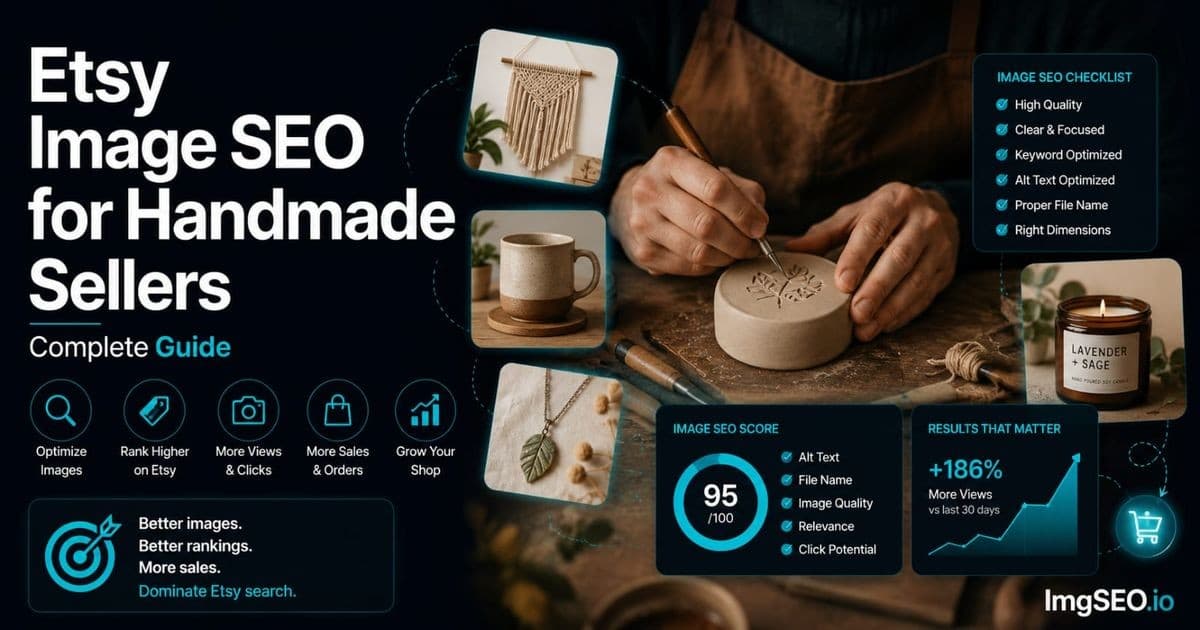
Every handmade product on Etsy has a story: the hours of skilled labor, the carefully chosen materials, the maker behind it. Most buyers on Etsy are there precisely because they want that story. The problem is that your images have about two seconds to tell it before a buyer scrolls past.
Handmade product imagery often needs to communicate craft, texture, scale, and process as well as identify the item clearly. Atmospheric photos can still benefit from useful alt text, descriptive filenames, relevant page context, and accessible delivery; none of those elements guarantees Google visibility.
This guide covers how to do both: photograph handmade products in a way that converts buyers and rank those images in Etsy search and Google Images. You will learn the exact filenames, alt text formulas, metadata strategy, and image sequencing that separates top-performing handmade shops from everyone else.
Key Takeaways
- The handmade filename formula is
[handmade]-[technique]-[material]-[product]-[style].jpg— e.g.handmade-wheel-thrown-ceramic-mug-speckled-glaze.jpg.- Etsy allows 10 images per listing; top-performing handmade shops use all 10, each assigned a specific job — hero, hands, process, materials, macro detail, lifestyle, scale, variation, packaging, maker's mark.
- Describe the visible craft technique, material, product, finish, and distinctive feature where relevant; keep the wording concise and natural rather than following a fixed performance formula.
Why Handmade Image SEO Is Unique
The Handmade Premium
Handmade buyers are not looking for the cheapest option. They are looking for the best version of something, made by a person, from materials that matter. That is why a hand-thrown ceramic mug sells for $65 on Etsy while a factory equivalent sells for $8 on Amazon.
The price difference is only sustainable if your images make the case for it. A buyer who lands on your listing and cannot immediately see why your mug costs $65 will leave. Your images must answer the question before it is asked: "What makes this worth the price?"
Image SEO reinforces this because the keywords that describe craftsmanship — "wheel-thrown," "hand-forged," "hand-dyed" — are also the keywords that attract buyers who are willing to pay for it. Optimizing your images for handmade technique terms simultaneously justifies your price and attracts the right customer.
The Craft Story
Three categories of images do the heavy lifting for handmade pricing justification:
Process images show why it costs more. A photo of hands shaping clay on a wheel, a metalsmith hammering a ring blank, a weaver working at a loom — these images communicate hours of skilled labor in a single frame.
Materials images show what makes it special. Raw sterling silver before it becomes a ring, a skein of hand-dyed wool before it becomes a blanket, locally sourced oak before it becomes a cutting board — buyers can see the quality of inputs before the finished product ever appears.
Maker images show who made it. The personal connection is the reason handmade exists as a category. A photo of your hands, your workspace, or your face builds the trust that makes a buyer choose your $85 ring over a cheaper alternative.
The Etsy Handmade Advantage
The keyword "handmade" is not just a category tag on Etsy — it is an active search term with buying intent behind it. Searches like "handmade ceramic mug," "handmade silver ring," and "handmade wool blanket" represent buyers who have already decided they want something made by a person. Your images, filenames, and alt text need to match this language explicitly.
Google Images applies the same logic. Authentic handmade content — process shots, maker images, textured detail photography — is unique in a way that mass-produced product photography never is. Google has never seen your specific hands throwing your specific clay on your specific wheel. That uniqueness is an SEO advantage: no duplicate content, no competing versions of the same image, no risk of being filtered out of search results.
Pinterest users are another significant traffic source for handmade sellers. They actively seek handmade items, save process images, and follow makers whose aesthetic resonates with them. Images optimized with handmade technique keywords perform well in Pinterest search and drive long-term referral traffic back to your Etsy shop.
Photography for Handmade Products
Showing Craftsmanship Through Photography
The images that perform best for handmade SEO are also the images that convert best — because they prove the value that justifies the price.
Macro shots of craft detail are non-negotiable. The hand-stitched seam on a leather bag, the slight texture variation on a hand-thrown pot, the hammered finish on a forged ring — these details are invisible at standard product scale but decisive for buyers making a purchase decision. Get close. Fill the frame with the detail that separates your work from factory production.
Process shots showing hands at work are the most powerful single image type in handmade selling. A photo of your hands mid-task communicates skill, labor, and authenticity simultaneously. It also produces unique SEO content: images of your specific hands in your specific workspace that no competitor can replicate.
Material-to-finished-product progressions — raw wool beside a finished blanket, raw silver beside a finished ring, raw wood beside a finished bowl — show the full transformation. These work particularly well as the second or third image in a listing sequence and as standalone content on Pinterest and Instagram.
Natural Light for Handmade Aesthetics
Natural light is almost always the right choice for handmade product photography. It renders materials authentically — the slight variation in a hand-dyed fabric, the organic surface of stoneware, the grain of solid wood — in ways that artificial studio lighting tends to flatten or distort.
A simple window-light setup produces professional results without expensive equipment. Position your product at a 45-degree angle to a large north-facing window (indirect daylight, no harsh shadows), add a white foam board reflector on the opposite side to fill shadows, and shoot in the hours around midday when light is brightest but not direct.
The secondary benefit of natural light is that it looks handmade. Artificial three-point studio lighting makes your product look like it was shot in a commercial photo studio — which is the opposite of the signal you want to send on Etsy.
Imperfection as a Feature
Handmade products have variations. Slight differences in glaze color between two mugs, irregular texture on hand-stamped leather, natural grain variation in wooden pieces — these are not flaws. They are proof of authenticity.
Your photography and your alt text should frame variations as features, not apologies. Show the variation deliberately: photograph two mugs together and note in the alt text that each piece is unique. Write alt text like "slight natural variation in hand-dyed indigo color — each piece unique" rather than treating color variation as something to hide. Buyers who understand handmade see this as a selling point. Buyers who expect mass-market consistency will return the item regardless of how you photograph it.
The Maker's Hands
Hands can demonstrate scale and the making process for handmade products. Whether that presentation improves conversion depends on the item and audience, so test it rather than treating it as a universal top-performing element.
The reasons are practical: hands show scale more naturally than a ruler, hands show how an item is held or worn, and hands show that a person made the thing you are about to buy. For jewelry, a hand-wearing shot replaces a model shoot for most sellers. For ceramics, hands cradling a mug communicate warmth and size. For textiles, hands running across a knit fabric communicate texture in a way no flat-lay can.
Include at least one hand image in every listing. It does not need to be your face — just your hands, at work or holding the finished piece.
Handmade-Specific Filenames
The Handmade Filename Formula
[handmade]-[technique]-[material]-[product]-[style].jpg
Every part of this formula carries SEO weight. "Handmade" signals the category. The technique keyword ("wheel-thrown," "hand-forged," "hand-dyed") targets the specific buyer vocabulary. The material and product terms match standard search queries. The style descriptor narrows to the specific aesthetic.
For ImgSEO, renaming files is the step most sellers skip because it is tedious at scale. A shop with 50 listings and 10 images each means 500 files to rename — which is why most shops still have IMG_4521.jpg everywhere.
Examples by Craft
Ceramics and Pottery
handmade-wheel-thrown-ceramic-mug-speckled-glaze.jpghand-painted-porcelain-vase-blue-botanical.jpghandbuilt-ceramic-plant-pot-terracotta-textured.jpgwheel-thrown-stoneware-bowl-matte-white-minimalist.jpg
Textiles and Fiber Arts
hand-knitted-wool-blanket-chunky-cream-natural.jpghandwoven-cotton-table-runner-natural-stripe.jpghand-embroidered-linen-tote-bag-floral-botanical.jpghand-dyed-indigo-linen-cushion-cover-natural.jpg
Jewelry
hand-forged-sterling-silver-ring-hammered-texture.jpghandmade-copper-wire-wrapped-pendant-labradorite.jpghand-stamped-gold-fill-bracelet-personalized-name.jpg
Woodworking
hand-carved-wooden-spoon-walnut-kitchen.jpghandmade-oak-cutting-board-end-grain-personalized.jpghand-turned-maple-bowl-natural-edge-wood.jpg
Craft Technique Keywords That Buyers Search
The technique keywords in your filenames are not just descriptors — they are the vocabulary of buyers who know what they want and are willing to pay for it. Someone searching "hand-forged ring" is a more qualified buyer than someone searching "silver ring." The first person has already self-selected for handmade, has likely bought handmade before, and understands why it costs more.
High-value technique keywords by category:
- Metalsmithing: hand-forged, hand-fabricated, hand-stamped, hand-hammered
- Ceramics: wheel-thrown, hand-built, hand-painted, soda-fired, wood-fired
- Textiles: hand-knitted, hand-woven, hand-embroidered, hand-dyed, hand-sewn
- Leatherwork: hand-stitched, hand-tooled, hand-burnished, hand-cut
- Woodworking: hand-carved, hand-turned, hand-planed, hand-finished
Use these terms consistently across filenames, alt text, and metadata — the repetition builds relevance for technique-specific searches.
Alt Text for Handmade Products
The Handmade Alt Text Formula
[Craft technique] + [material] + [product] + [style/finish] + [unique feature]
Alt text for handmade products must do two things simultaneously: describe what the image shows accurately (for Google's image understanding algorithm) and include the technique keyword that matches buyer search intent. For a full breakdown of alt text fundamentals, see what is alt text: complete guide 2026.
Examples by Craft Type
Ceramics
- Main product shot: "Wheel-thrown ceramic mug speckled glaze handmade stoneware 12oz"
- Detail/macro shot: "Speckled glaze texture close-up on handmade ceramic mug"
- Process shot: "Potter throwing ceramic mug on wheel in studio"
- Hands/lifestyle: "Handmade ceramic mug held in hands showing size and speckled glaze"
- Materials: "Raw stoneware clay and wheel tools before ceramic mug making"
Jewelry
- Main product shot: "Hand-forged sterling silver hammered ring adjustable size women"
- Detail/macro shot: "Hammered texture detail on hand-forged sterling silver ring"
- Making/process shot: "Jeweler hammering sterling silver ring on anvil in workshop"
- Worn/lifestyle: "Hand-forged sterling silver ring worn on finger side view"
Textiles
- Main product shot: "Hand-knitted chunky wool throw blanket cream natural fiber sofa"
- Detail/macro shot: "Chunky knit stitch pattern close-up on hand-knitted wool blanket"
- Lifestyle: "Hand-knitted cream wool blanket draped over armchair cozy home"
- Process: "Knitter working on chunky wool blanket with natural fiber yarn"
Technique Keywords in Alt Text
The most important principle for handmade alt text: always include the craft method. "Wheel-thrown pottery mug" and "ceramic mug" describe the same object but target entirely different buyers. The first targets someone with specific intent — they searched for "wheel-thrown" because they understand what it means and why it matters. The second targets a generic query that competes with every mass-produced mug in existence.
For alt text character limits: aim for 100–125 characters. Long enough to include technique, material, product, and one descriptive detail; short enough that screen readers deliver it naturally.
Metadata for Handmade Products
EXIF and XMP metadata can carry descriptive and rights-related information inside source files. Search engines and destination platforms determine whether that metadata is preserved or used, so it should not be treated as a direct ranking signal. For a full guide on embedding metadata, see how to add metadata to product images 2026.
Handmade-Specific Metadata Fields
Title field (EXIF ImageDescription / XMP dc:title): Follow the same formula as your filename. "Hand-forged Sterling Silver Hammered Ring Minimalist" is both a valid title and a search-ready phrase.
Description field (XMP dc:description): Combine technique + material + process + unique feature in 2–3 sentences. Example: "Wheel-thrown stoneware mug with speckled ash glaze, fired at cone 6 in an electric kiln. Each piece is unique — slight glaze variation is natural and expected. Made in my studio in Portland, Oregon."
Keywords field (IPTC Keywords / XMP dc:subject): Layer three tiers of keywords:
- Technique terms: wheel-thrown, hand-forged, hand-dyed, hand-knitted
- Material terms: stoneware, sterling silver, natural wool, solid oak
- Values/process terms: small batch, one of a kind, made to order, sustainable, slow fashion
A ceramicist's keyword field might look like: wheel-thrown, handmade, stoneware, ceramic mug, speckled glaze, small batch, studio pottery, made in USA.
Why Metadata Matters for Handmade Specifically
Embedding accurate technique details can make your exported source files more informative and easier to manage. Etsy may process uploaded images, so do not assume that embedded metadata remains intact or improves Etsy or Google rankings.
ImgSEO generates descriptive filenames and separate alt text, embeds XMP in JPEG, WebP, and AVIF exports, and adds EXIF additionally for JPEG. For Etsy, choose a supported export format and add the generated alt text in the listing editor.
The 10-Image Strategy for Handmade Listings
Etsy allows 10 images per listing. Most handmade sellers use 4–6 and leave slots empty. Top-performing handmade shops use all 10 deliberately, with each image serving a specific conversion and SEO function.
| Slot | Image Type | Purpose | |------|-----------|---------| | 1 | Hero product on clean or minimal background | Search CTR — this is your thumbnail | | 2 | Maker's hands with product | Authenticity + trust signal | | 3 | Process/making shot | Justifies premium price | | 4 | Materials flat lay | Shows quality inputs | | 5 | Macro detail of craft | Shows skill and precision | | 6 | Lifestyle in context | Aspiration + conversion | | 7 | Scale reference (with hand or familiar object) | Sets accurate expectations | | 8 | Variation or range | Shows other options available | | 9 | Packaging | Gift buyer conversion | | 10 | Close-up of maker's mark or signature | Brand and authenticity |
Image 1 is your search thumbnail — it needs to be clean, well-lit, and immediately readable at small size. Images 2–5 do the price justification work. Images 6–9 handle conversion and gifting scenarios. Image 10 is a trust signal that mass-produced products can never replicate.
Each of the 10 images needs its own alt text. That is 10 opportunities to include technique keywords, material terms, and craft-specific phrases — a significant SEO advantage that most sellers leave unused.
Process Photography for SEO
Why Process Images Rank Well
Process images are the most SEO-resilient content a handmade seller can produce. Every other product photo on Etsy shows a finished object on a surface or in a lifestyle setting — process images show something unique: your specific work, at your specific stage, in your specific studio.
Process images can demonstrate how an item is made and help buyers understand the craft behind it. They may also support pages that answer “how it is made” questions, but Google does not publish an originality score that guarantees those images rank above product-only photography.
What Process Images to Take
For a complete process image library, document these four stages:
- Raw materials: Yarn before knitting, silver sheet before forging, clay before throwing. A flat lay of your inputs shows quality before the making begins.
- Early stage: The blank being shaped, the piece in progress, the material mid-transformation.
- Hands and tools in action: The image of you working. This is your most powerful handmade content.
- Finishing stage: Sanding, glazing, blocking, polishing — the steps that most buyers never think about but that explain the labor component of your price.
You do not need to document every step of every product. Three or four well-chosen process images cover most handmade listings.
Alt Text for Process Images
Process image alt text should name the action, the material, and the context:
- "Jeweler soldering sterling silver ring components in workshop"
- "Raw clay being shaped into bowl on pottery wheel"
- "Natural indigo dye bath with linen fabric hand-dyeing process"
- "Woodworker hand-carving walnut spoon with gouges and mallet"
- "Hand-knitting chunky wool yarn on wooden needles close-up"
The combination of action verb + material + technique is the search pattern that buyers use when looking for process content — and it is also the pattern that Google Images uses to categorize your images.
Handmade Pricing and Image Confidence
How Images Justify Handmade Prices
The gap between a $85 handmade ring and a $15 mass-produced one is not obvious to a buyer who has only seen the finished product. Your images are what close that gap.
Your process image shows 4 hours of skilled labor — the hammering, filing, soldering, and finishing that produced that ring. Your materials image shows solid sterling silver — not plated base metal. Your detail image shows the hand-finished edges that a machine cannot replicate. Collectively, these images tell a buyer: "You are paying $85 because that is what honest labor, real materials, and genuine skill cost."
Buyers who understand this will convert. Buyers who do not understand this are probably not your buyer. Optimizing your images for the craft story self-selects for your best customers.
The Value Stack Image Strategy
The most effective handmade listing images build a value stack — each image adds a reason to justify the price:
- Materials image: "The inputs are high quality — this started with the best materials"
- Process image: "A skilled person spent real time making this"
- Detail/macro image: "Look at the quality and precision of the finished work"
- Lifestyle image: "This is what you get to own and live with"
- Packaging image: "This is how it arrives — gift-ready, handled with care"
When a buyer has seen all five, the price feels like information, not a shock. The conversion happens because the images did the selling.
Google Images and Handmade
Handmade Keywords in Google Search
Google searches for handmade products have distinct patterns worth optimizing for:
- "Handmade [product]" queries ("handmade ceramic mug," "handmade silver bracelet") have strong buying intent — the searcher has already decided they want something made by hand.
- "Artisan [product] [location]" searches ("artisan pottery Portland," "handmade jewelry Brooklyn") target makers in specific places. Include location details in seller-controlled listing fields when they are accurate and relevant.
- Technique-specific searches ("wheel-thrown pottery," "hand-forged ring," "cold-process soap") come from the most educated buyers — they know exactly what technique they want because they have researched or bought handmade before.
For a complete breakdown of ranking in Google Images, see how to rank on Google Images 2026.
Building Google Images Authority Over Time
Process shots, maker images, material photos, and finished-product views can give shoppers useful context that generic catalog imagery lacks. Google does not document a guaranteed originality reward, so focus on accuracy, accessibility, relevant page context, and measurable buyer value.
A consistent archive of useful handmade content can improve navigation and give crawlers more relevant pages to discover. New listings still have no guaranteed ranking advantage or fixed indexing speed.
Common Handmade Image Mistakes on Etsy
1. White background only, nothing else. A clean white-background shot is necessary for your first image, but a listing with nothing but product-on-white looks mass-produced. It removes the handmade context completely.
2. No hands in any photo. Hands are your most powerful differentiator from factory goods. A listing with no hand images is leaving the strongest handmade signal unused.
3. Over-produced studio look. Hard light, commercial backdrops, and clinical styling communicate "this was shot in a photography studio," not "this was made by a person." Natural light and authentic settings work better for handmade.
4. No detail shots. If a buyer cannot zoom in and see the craftsmanship — the stitching, the glaze, the wood grain — they cannot make the case to themselves for the price. Macro detail shots are not optional.
5. No scale reference. Handmade items vary in size in ways that mass-produced items do not. A hand-thrown mug that holds 8oz and one that holds 14oz look identical in a product shot without context. Include a hand or a familiar object for scale.
6. Stock-looking or artificial backgrounds. Handmade products photographed on generic grey seamless paper look like stock photography. Backgrounds that suggest a workspace, home, or natural setting reinforce the handmade narrative.
7. No alt text describing the technique. "Ceramic mug" and "wheel-thrown stoneware mug" are different search targets. Most Etsy sellers write the former, leaving the latter — the higher-intent, higher-converting keyword — unclaimed.
8. Generic filenames. IMG_4521.jpg tells Google nothing. wheel-thrown-ceramic-mug-speckled-glaze-handmade.jpg tells Google everything. File renaming at scale is tedious, which is why tools like ImgSEO handle it as part of the optimization pipeline.
Handmade Image SEO Checklist
Work through this checklist for every new listing and retroactively for your top-selling products:
- ✅ Hero product shot on clean or minimal background
- ✅ Maker's hands included in at least one image
- ✅ Process or making shot showing craft in progress
- ✅ Materials flat lay showing quality inputs
- ✅ Macro detail shot of craftsmanship
- ✅ Craft technique in filename (hand-forged, wheel-thrown, hand-dyed)
- ✅ Craft technique in alt text for every image
- ✅ Metadata includes technique, material, and process keywords
- ✅ Lifestyle image showing product in use or context
- ✅ Packaging shot for gift buyer conversion
For shops with large catalogs, prioritize your top 20% of listings by revenue first — those are the products that will benefit most quickly from improved image SEO.
Frequently Asked Questions
What images work best for handmade products on Etsy? A useful set may include a clean hero shot, hands for scale, a process view, a macro detail, and a lifestyle image. Use only the slots needed to communicate the product clearly.
Should I show my face in Etsy product photos? You do not need to. Hands are sufficient to create the human connection that handmade buying relies on. If you are comfortable showing your face, it adds another dimension of trust — but many successful Etsy sellers never appear in their listings beyond their hands.
How do I photograph handmade jewelry for Etsy? Use a combination of: a clean flat lay on a neutral surface for the hero shot, a worn-on-hand lifestyle shot for scale and context, a macro detail shot for the technique and finish, and a process shot showing the making. Natural window light renders metal authentically and avoids the harshness of direct flash.
Do process images help Etsy SEO? Yes, in two ways. On Google Images, process images produce unique content that drives "how it's made" searches. Within Etsy, listings with more images tend to perform better in search because complete listings signal quality to Etsy's algorithm.
What alt text should I use for handmade products? Use the formula: [craft technique] + [material] + [product] + [style/finish] + [unique feature]. "Wheel-thrown ceramic mug speckled glaze handmade stoneware 12oz" is better than "ceramic mug" because it targets the specific buyer who searched for that technique.
How do handmade images differ from mass-produced product photos? Handmade images should include the maker, the process, and the materials — elements that mass-produced photography cannot include authentically. A factory does not photograph the hands that assembled your product. That authenticity is your competitive advantage.
Should I show my workspace in Etsy photos? Yes, selectively. A workspace background that shows tools, materials, or your creative environment reinforces the handmade narrative. A cluttered or generic workspace does not. A well-lit corner of a real studio tells a more authentic story than any artificial set.
How do I justify handmade prices through photography? Use the value stack: materials image (quality inputs) + process image (skilled labor) + detail image (quality output) + lifestyle image (the experience of owning it) + packaging image (the care in delivery). When buyers have seen all five, the price reflects what they have already concluded about the product's value.
Conclusion
Handmade image SEO is fundamentally a storytelling problem. Google and Etsy buyers both respond to the same signals: authentic craft, visible skill, real materials, a human maker. The difference is in the execution — filenames that include technique keywords, alt text that names the craft method, metadata that layers technique and material terms, and an image sequence that walks a buyer from curiosity to confidence.
Your authentic handmade content is something no mass-market competitor can replicate. A factory cannot publish a genuine photo of hands throwing your specific clay on your specific wheel. A drop-shipper cannot embed "hand-forged" in their EXIF data and have it mean anything. Craft technique keywords — wheel-thrown, hand-forged, hand-dyed, hand-embroidered — are both truthful descriptions and competitive moats.
ImgSEO handles the mechanical side of this: renaming files with your craft technique keywords, writing alt text to the handmade formula, and embedding XMP metadata across every image in a batch. It is the part of image SEO that stalls most sellers because it is tedious to do file by file. Start with your 10 best-selling listings, get the image SEO right on those, and scale from there.
For a broader look at driving Etsy sales through image optimization, see how to get more Etsy sales with image SEO 2026.