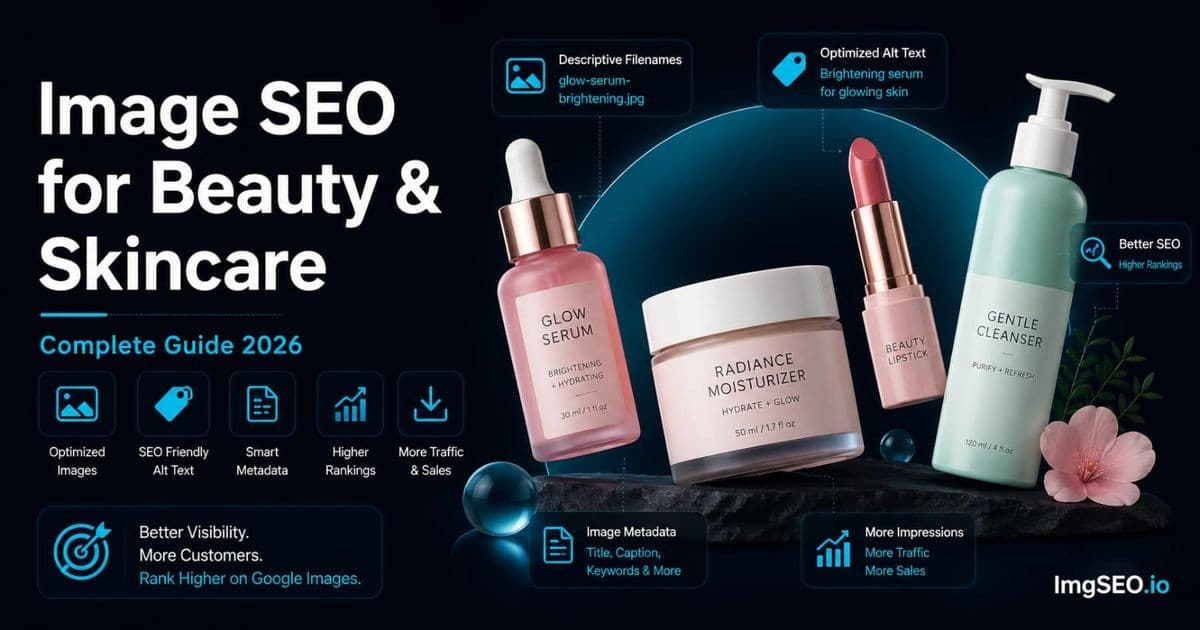
Beauty and skincare is the fastest-growing e-commerce category — and the most visually driven. A shopper searching "niacinamide serum combination skin" on Google Images is not browsing. They know exactly what ingredient they want, they know their skin type, and they are ready to buy. If your product images are named IMG_7843.jpg with blank alt text, you are invisible to that shopper. A competitor with properly named files, ingredient-specific alt text, and complete metadata is not.
What makes beauty image SEO different from other product categories is specificity. Generic alt text like "face serum" competes with millions of results and ranks for nothing. "Niacinamide 10% pore-minimizing serum combination skin 30ml" targets a buyer who has already done their ingredient research and is one click from checkout. This guide covers everything: photography shot types, the beauty filename formula, alt text that passes regulatory scrutiny, platform-specific strategies for Shopify, Etsy, and Amazon, and a complete optimization checklist.
Key Takeaways
- Ingredient + skin type alt text and filenames (e.g., "niacinamide serum combination skin") outrank generic terms like "face serum" because they match higher-intent buyer searches.
- Before-and-after images carry FTC/ASA regulatory risk unless results are substantiated — use texture, formula, and application shots with compliant language ("formulated for," "targets") instead of "treats" or "cures."
- Metallic and glass packaging needs higher JPEG quality (88%) than matte packaging (82–85%) to avoid compression artifacts, and each shade variant (e.g., 30 foundation shades) is a separate ranking opportunity when given unique alt text.
Why Beauty and Skincare Image SEO Is Different
The Trust and Ingredient Factor
Skincare buyers research before they purchase. They read ingredient lists, watch ingredient explainers, and search for specific compounds before they ever visit a product page. That research journey passes directly through Google Images. A shopper who searches "vitamin C serum oily skin" and finds your product photo — properly named and tagged — has already self-qualified. They want this ingredient. They have this skin type. The image was the first impression that pulled them in.
This changes how you write alt text and metadata. Including only the product type ("serum") is wasted opportunity. Every image needs the key ingredient, the skin type or concern it addresses, and the benefit. "Vitamin C brightening serum oily skin dark spot corrector 30ml" targets the exact search language buyers use. "Face serum" does not.
The Before/After and Results Challenge
Before-and-after images are powerful for beauty brands, but they carry regulatory risk. The FTC in the US and ASA in the UK require that any implied or explicit result shown in an image is substantiated by evidence. An unqualified "before/after" image that implies clinical results without that evidence is a compliance problem — regardless of how well it ranks.
The practical solution: shift visual storytelling away from claimed results and toward texture, formula, and application. A close-up of serum texture on a fingertip tells the buyer more about the product than a disputed before/after, and it carries zero regulatory risk. The same applies to alt text. Language like "treats acne" or "eliminates dark spots" is both a legal liability and a trust problem. Use "formulated for acne-prone skin", "targets dark spots", or "helps address hyperpigmentation" instead.
High Competition Category
Beauty is one of the most saturated categories on Google Images. Broad terms like "face moisturizer" or "eye cream" are dominated by major brands with decades of authority. The opportunity for mid-size and independent brands is in long-tail ingredient and skin type combinations. "Niacinamide serum combination skin" is a more winnable search than "face serum." "Fragrance-free moisturizer sensitive skin dermatologist tested" reaches a specific buyer that a generic term never could.
Ingredient specificity is the single most effective lever in beauty image SEO. Every filename, every alt text, every metadata field should include the hero ingredient.
Beauty Photography Best Practices
Shot Types for Beauty Products
A complete beauty product image set covers six shot types, each serving a different search intent and page position:
Clean product shot — white or neutral background, full product visible. This is the main listing image and the one that appears most in Google Images results. It must be technically perfect: sharp, color-accurate, properly exposed.
Texture/formula shot — product on fingertip, swatch on skin, or dropper releasing formula. This answers the buyer's most common question: what does this actually look and feel like? It is also the most shareable format for social.
Ingredients flat lay — hero ingredients (whole vitamin C, fresh hyaluronic acid sources, niacinamide powder) arranged around the product. This reinforces the ingredient story and ranks for ingredient image searches.
Application shot — product being applied to skin by a model. Demonstrates usage context, builds trust, and captures lifestyle search terms.
Packaging detail — pump mechanism, dropper, lid, or label close-up. Buyers want to know what they are buying. A clear packaging shot reduces post-purchase disappointment and returns.
Shade range lineup — for color cosmetics: all shades arranged together. This single image can rank for every shade in the lineup simultaneously.
Lighting for Beauty Photography
Soft, diffused lighting is the standard for beauty product photography because it preserves color accuracy and eliminates harsh reflections on glass and metallic packaging. A lightbox or softbox setup on a white or light grey background works for the clinical, clean aesthetic that skincare brands require.
For natural and organic brands, a warmer lifestyle background — natural wood, linen, botanical elements — matches the brand language buyers expect. The key is consistency: all images in a collection should share the same lighting temperature so the product catalog reads as coherent rather than assembled from different shoots.
Color Accuracy
Foundation shades, lipsticks, and eyeshadows must be color-accurate. A foundation that photographs two shades darker than the actual product drives returns and negative reviews. Calibrate your monitor, photograph against a neutral grey card, and check the final images on multiple screens and devices before publishing.
Color inaccuracy in makeup images is a trust problem that cascades beyond the image itself. Buyers who feel deceived by product photos leave negative reviews that damage the product's ranking across every channel.
Beauty Product Filenames for SEO
The Beauty Filename Formula
[product type]-[key ingredient]-[skin type/concern]-[brand style].jpg
Every word in the filename is a keyword signal. Separate words with hyphens — never underscores or spaces. Use lowercase throughout. Keep filenames descriptive but scannable: three to six terms is the practical limit before the filename becomes unwieldy.
Examples by Product Category
Skincare
vitamin-c-brightening-serum-oily-skin-30ml.jpghyaluronic-acid-moisturizer-dry-skin-fragrance-free.jpgniacinamide-pore-minimizing-toner-combination-skin.jpgretinol-anti-aging-night-cream-sensitive-skin.jpg
Cleansers
gentle-foaming-cleanser-sensitive-skin-sulfate-free.jpgsalicylic-acid-face-wash-acne-prone-skin.jpg
Makeup
matte-lipstick-nude-pink-long-wearing-vegan.jpgfull-coverage-foundation-shade-n20-all-skin-types.jpgvolumizing-mascara-black-vegan-cruelty-free.jpg
Body Care
shea-butter-body-lotion-dry-skin-unscented.jpgcoffee-body-scrub-exfoliating-vegan-8oz.jpg
Skin Type and Concern Keywords
Build your filename vocabulary from these validated search terms:
Skin types: oily, dry, combination, sensitive, normal, mature
Concerns: acne, hyperpigmentation, anti-aging, brightening, hydrating, pore-minimizing, redness
Certifications: vegan, cruelty-free, organic, fragrance-free, dermatologist-tested, hypoallergenic
If your existing product images have generic names like product-1.jpg or DSC_0048.jpg, see our guide on how to fix bad image filenames for SEO for a systematic renaming workflow.
Alt Text for Beauty Products
Beauty Alt Text Formula
[Key ingredient] + [product type] + [skin type/concern] + [size] + [key claim/benefit]
This formula produces alt text that targets ingredient searches, skin type searches, and benefit searches simultaneously. Each element adds a layer of specificity that moves you from a crowded broad term into a targeted, winnable niche.
Examples by Product Category
Serums
- Main:
Vitamin C brightening serum 30ml for oily skin dark spot corrector - Texture:
Vitamin C serum lightweight gel texture close-up on fingertip - Ingredients:
Fresh vitamin C oranges and serum bottle flat lay ingredients
Moisturizers
- Main:
Hyaluronic acid moisturizer 50ml dry skin fragrance free dermatologist tested - Application:
Hyaluronic acid moisturizer being applied to face close-up
Cleansers
- Main:
Gentle foaming cleanser sensitive skin 150ml sulfate free pH balanced - Texture:
Gentle foaming cleanser foam texture on hand application
Makeup
- Main:
Matte lipstick nude pink shade long wearing vegan cruelty free - Shade lineup:
Five matte lipstick shades ranging nude pink to deep berry - Application:
Matte nude pink lipstick applied on model close-up lips
Regulatory Compliance in Alt Text
This is the area where beauty sellers most commonly make mistakes. Alt text is public-facing metadata. The same FTC/ASA standards that apply to marketing copy apply here.
Safe to include: ingredients, skin type, texture, color, size, certifications (vegan, cruelty-free, fragrance-free)
Safe phrasing for benefits: "formulated for", "targets", "addresses", "helps with", "suitable for"
Avoid: "cures", "treats", "eliminates", "removes" when referring to a skin condition
Avoid: Any language that implies clinical results without substantiation
"Retinol anti-aging night cream mature skin" — safe. "Retinol cream that reverses wrinkles" — not safe. The distinction is between describing what a product is formulated for versus claiming a verified clinical outcome.
For a full reference on alt text best practices, see our complete guide to alt text.
Metadata for Beauty Products
Beauty-Specific Keyword Strategy
EXIF and XMP metadata fields give you three additional places — Title, Description, and Keywords — to signal relevance to Google's image indexing systems. Beauty metadata should layer the same ingredient, skin type, and concern terms used in filenames and alt text, without repeating strings verbatim.
Ingredient keywords: vitamin C, hyaluronic acid, retinol, niacinamide, peptides, AHA, BHA, glycolic acid, salicylic acid, ceramides, squalane
Skin type: oily, dry, combination, sensitive, mature
Concerns: acne-prone, anti-aging, brightening, hydrating, pore-minimizing, redness, hyperpigmentation
Certifications: vegan, cruelty-free, organic, dermatologist-tested, fragrance-free, hypoallergenic
Format: serum, moisturizer, cleanser, toner, SPF, mask, eye cream, exfoliant
EXIF and XMP Fields
For a vitamin C serum:
- Title:
Vitamin C Brightening Serum Oily Skin 30ml - Description:
Lightweight vitamin C serum formulated for oily and combination skin. Targets dark spots, uneven tone, and dullness. 15% ascorbic acid, fragrance-free, vegan. - Keywords:
vitamin C, serum, brightening, oily skin, dark spots, antioxidant, ascorbic acid, fragrance-free, vegan
See our complete guide on how to add metadata to product images for field-by-field instructions across JPEG, WebP, and AVIF formats.
Platform-Specific Beauty Image SEO
Shopify Beauty Stores
Shopify's variant system creates a specific challenge for color cosmetics: 30 foundation shades or 20 lipstick colors all technically share the same product page. Each shade must have a unique image with unique alt text. "Matte lipstick nude pink shade N01 long wearing vegan" and "Matte lipstick dusty rose shade N02 long wearing vegan" are two different ranking opportunities. Treat them that way.
Organize collections around skin type and ingredient, not just product category: "For Oily Skin", "Vitamin C Products", "Vegan Beauty" — these collection pages create additional indexable surfaces that capture ingredient and skin type searches upstream of the product page. See our Shopify image SEO guide for implementation details.
Etsy Beauty Sellers
Etsy is a strong channel for handmade, natural, artisan, and small-batch beauty. The buyer intent is different: Etsy shoppers expect handcrafted, small-production products and respond to lifestyle imagery that reflects that. A natural beeswax lip balm photographed against linen and dried botanicals performs better than a clinical white background on Etsy — the aesthetic matches buyer expectations for the platform.
Alt text on Etsy follows the same ingredient + skin type formula, but "handmade", "small batch", and "natural ingredients" are high-value modifiers to include. See our Etsy image SEO guide for platform-specific best practices.
Amazon Beauty
Amazon Beauty has strict main image requirements: white background, product clearly visible, no props or text overlays. These rules are non-negotiable for the primary listing image. Secondary images in the A+ content gallery have more flexibility — use them for ingredient callouts, texture shots, before-and-after style application photography (with compliant language), and infographic-style benefit breakdowns.
Title optimization on Amazon should include the key ingredient and skin type in the first 80 characters, since that is what appears in search results. See our Amazon product image SEO guide for A+ content best practices.
Google Images Strategy for Beauty
High-Volume Beauty Search Queries
Understanding how buyers actually search determines which keyword combinations to prioritize. The dominant patterns in beauty image search:
- Ingredient + product: "vitamin C serum", "retinol eye cream", "niacinamide toner"
- Concern + product: "anti-aging moisturizer", "acne spot treatment", "brightening mask"
- Skin type + product: "oily skin cleanser", "dry skin moisturizer", "sensitive skin SPF"
- Certification + product: "vegan cruelty free mascara", "organic face oil", "fragrance free moisturizer"
Each pattern maps to a different buyer stage. Ingredient searches indicate a buyer who knows what they want. Concern searches indicate a buyer still comparing solutions. Skin type searches indicate a buyer filtering for compatibility. Build your alt text and filename strategy to capture all four.
The Ingredient SEO Opportunity
Ingredient-specific searches have among the highest buyer intent in all of e-commerce. A shopper searching "niacinamide serum" has already decided on the ingredient — they are now choosing a brand and product. That search has a direct path to purchase, and it is the kind of search where well-optimized product images beat brand authority.
Include the hero ingredient in the filename, alt text, and metadata for every product image. For products with multiple active ingredients, lead with the primary or most-searched one. A product with both niacinamide and tranexamic acid leads with niacinamide in image SEO — it has significantly higher search volume.
Trend Keywords
Beauty ingredient trends move faster than almost any other category, driven primarily by TikTok. "Slugging skincare", "skin cycling", "glass skin", "barrier repair" — these trend terms spike in search volume rapidly and represent a window to rank before competition catches up. Monitor trending ingredients in your category and update image metadata when a relevant trend emerges. A product already containing an ingredient that suddenly trends can capture that traffic immediately if the metadata includes the trend keyword.
Shade and Variant Strategy
Color Cosmetics Challenge
Foundation with 30 shades and lipstick with 20 colors present the same core problem: each variant is a unique SEO opportunity that generic shared alt text fails to capture. The correct approach is a base template with a shade-specific modifier.
Variant Alt Text Pattern
Base template: Matte lipstick long wearing vegan cruelty free
- Shade N01:
Matte lipstick nude pink shade N01 long wearing vegan cruelty free - Shade N02:
Matte lipstick dusty rose shade N02 long wearing vegan cruelty free - Shade N03:
Matte lipstick berry red shade N03 long wearing vegan cruelty free
Each shade now ranks for its specific color keyword — "nude pink lipstick", "dusty rose lipstick", "berry red matte lipstick" — while maintaining the shared product attributes. Scaled across 20 shades, this is 20 additional ranking opportunities from a single product.
Image Compression for Beauty Products
Beauty-Specific Compression Settings
Metallic packaging and glossy finishes require slightly higher JPEG quality to preserve detail in reflective surfaces. Standard compression settings that work well for apparel or home goods can introduce compression artifacts on glass bottles and metallic caps that make the product look lower quality than it is.
Recommended settings for beauty:
- Metallic and glass packaging: 88% JPEG quality
- Matte packaging and flat lay: 82–85% JPEG quality
- WebP (all beauty): 80–83% — WebP handles reflective surfaces particularly well
- Target file size: under 250KB for main product shots
- Texture close-ups: under 200KB at 85% quality
For a complete compression reference including format comparisons and e-commerce benchmarks, see our image compression guide for e-commerce.
Beauty Image SEO Checklist
Before publishing any beauty product image set, verify:
- ✅ Clean white or neutral background main image — no distracting props
- ✅ Texture or formula close-up shot included
- ✅ Ingredients flat lay for hero ingredient products
- ✅ Filename includes key ingredient and skin type (
niacinamide-toner-combination-skin.jpg) - ✅ Alt text includes ingredient, skin type, and concern — no medical claims
- ✅ Language is compliant: "formulated for", "targets", not "treats" or "cures"
- ✅ Unique alt text per shade variant for color cosmetics
- ✅ Certifications present in metadata: vegan, cruelty-free, fragrance-free, organic
- ✅ JPEG quality 85–88% for metallic and glass packaging
- ✅ Metadata Keywords field includes ingredient, skin type, concern, and certifications
Frequently Asked Questions
What is the best alt text for skincare products?
Lead with the hero ingredient, follow with product type, skin type, and a key benefit. Example: "Hyaluronic acid serum dry skin intense hydration fragrance free 30ml". This targets ingredient searches, skin type searches, and benefit searches simultaneously.
Can I include ingredient benefits in alt text?
Yes — with careful phrasing. "Formulated for", "targets", and "addresses" are safe. Avoid "treats", "cures", or "eliminates" in relation to skin conditions, which imply clinical claims the image cannot substantiate.
What keywords work best for beauty image SEO?
Ingredient + skin type combinations consistently outperform generic category terms. "Niacinamide serum combination skin" ranks better and converts better than "face serum" — the buyer who uses the specific term is further along in the purchase journey.
How do I write alt text for foundation shade variants?
Use a base template for shared attributes, then add the shade name and number as a modifier. "Full coverage foundation shade W30 warm undertone 30ml all skin types" — the shade identifier is the differentiating keyword.
Should beauty main images show the product or a model using it?
The main listing image should show the product clearly — most marketplaces require this. Models and application shots belong in secondary images. On your own Shopify store, lifestyle imagery can lead if it clearly shows the product.
What certifications should I include in beauty metadata?
Include every certification your product carries: vegan, cruelty-free, leaping bunny, organic, ECOCERT, fragrance-free, hypoallergenic, dermatologist-tested. These are high-value search modifiers and trust signals.
How do I optimize for ingredient-based searches?
Include the INCI name or common name of the ingredient in the filename, alt text, and metadata Keywords field. For a niacinamide product, include both "niacinamide" and "vitamin B3" — buyers use both terms.
What are the FTC rules for beauty product image claims?
Any result implied by an image must be substantiated by evidence. Before-and-after images require a disclaimer if they show results not typical for users. When in doubt, consult FTC guidance on cosmetic claims or work with a regulatory consultant.
Conclusion
Beauty and skincare image SEO rewards specificity above everything else. The brands winning Google Images in this category are not the ones with the biggest budgets — they are the ones whose images are named correctly, described with ingredient precision, and tagged with the skin type and concern language their buyers actually use to search.
The regulatory dimension makes beauty image SEO slightly more demanding than other categories, but the compliance floor is clear: describe what the product is formulated for, not what it promises to achieve. That discipline produces alt text that is both safer and more credible than marketing language.
Each shade variant is a separate ranking opportunity. Each hero ingredient is a separate keyword cluster. A foundation with 30 shades and three shot types per shade is 90 images — and 90 opportunities to appear in front of buyers with high purchase intent. That opportunity compounds when every image in the set is properly named, described, and tagged.
ImgSEO generates beauty-aware alt text and metadata automatically, applying ingredient and skin type terminology from your product context. It handles variant-specific alt text, regulatory-safe phrasing, and EXIF/XMP embedding across JPEG, WebP, and AVIF in a single workflow. Try free — 30 images.
For a broader e-commerce image SEO strategy, see our complete e-commerce image SEO guide.