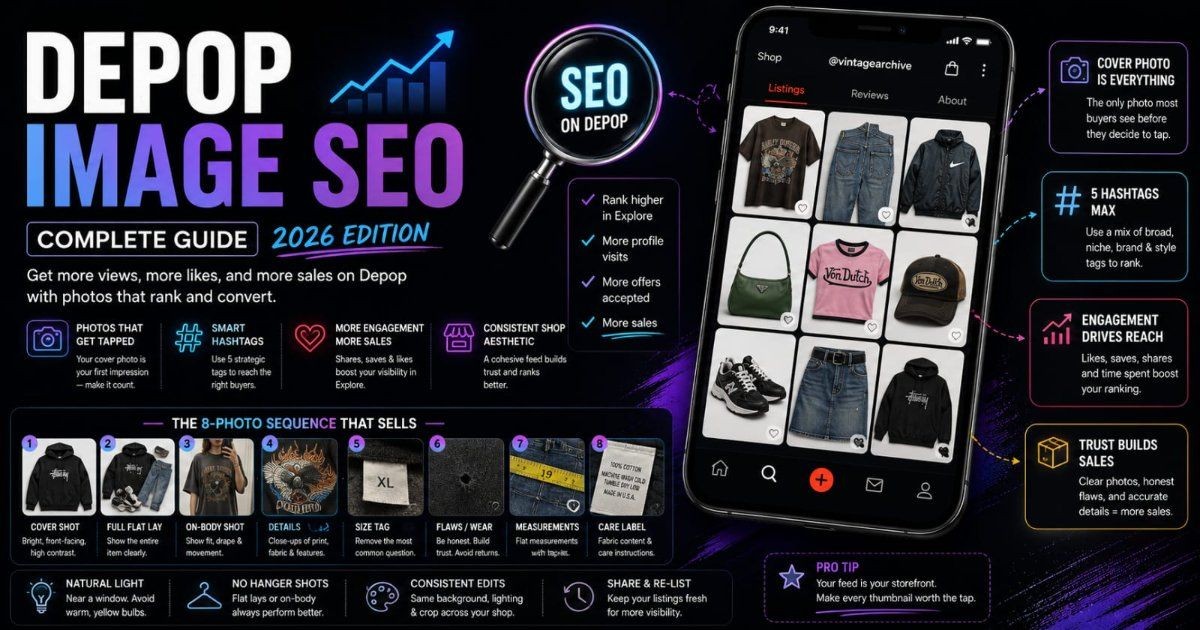

Vintage and secondhand selling is growing faster than almost any other segment of e-commerce — but most vintage sellers have no image SEO strategy. They upload items with camera-generated filenames, leave alt text blank, and write descriptions that say "beautiful vintage piece" without telling Google — or the buyer — anything useful. Meanwhile, buyers are typing highly specific queries into Google Images: "1970s boho maxi dress floral cotton" or "art deco rhinestone brooch silver 1930s." Those searches either find your listing or find a competitor's.
The challenge with vintage image SEO is that every item is unique. You cannot optimize once and replicate across inventory the way a new-product seller can. But this challenge flips into a significant advantage: unique items produce unique images with no duplicate content problem, and buyers searching for vintage items use precise, high-converting queries that have very little competition in Google's index. The seller who understands how to capture those queries wins traffic most new-product categories cannot touch.
Key Takeaways
- Era and decade keywords ("1970s," "Y2K," "mid century modern") consistently outperform generic descriptors and map directly to how vintage buyers search.
- Photograph and describe flaws clearly — transparent condition photography reduces disputes and actually increases conversion by removing buyer anxiety, not the reverse.
- Every vintage item is one-of-a-kind, so there's no duplicate-content penalty; the trade-off is that each piece needs its own filename, alt text, and description written from scratch.
Why Vintage Image SEO Is Unique
The One-of-a-Kind Challenge
A new product seller optimizes a set of images once and applies those optimizations to every unit sold. A vintage seller must do original SEO work for every single item — because no two vintage pieces are identical. This means more effort per listing, but it also means that every piece of optimization you do applies to a page that exists nowhere else on the internet.
The SEO implication is significant. Duplicate content — the same image or description appearing across multiple pages — dilutes ranking signals and confuses search engines. Vintage listings have no duplicate content problem by definition. When you describe your specific 1970s maxi dress with its exact colorway, size, and condition, you are creating a unique document that Google can rank for a query no other page is competing for.
Era and Decade Searches
The single most important thing to understand about vintage buyer behavior is that they search by era. "Maxi dress" is a competitive head keyword. "1970s boho maxi dress floral" is a long-tail keyword with buying intent, low competition, and a highly specific buyer on the other end. That buyer already knows what decade they want, what silhouette they want, and what print they want. When your listing matches that query precisely, the conversion rate is high.
The era vocabulary that drives vintage search:
- Decades: 20s, 30s, 40s, 50s, 60s, 70s, 80s, 90s, Y2K
- Style movements: art deco, mid century modern, Victorian, Edwardian, mod, space age
- Fashion eras: New Wave, disco, grunge, preppy, boho
- Condition terms: deadstock, unworn, excellent vintage condition, good vintage condition, distressed
Learn the specific era vocabulary for your category and use it consistently across filenames, alt text, and descriptions.
Condition Transparency
Vintage buyers have a different relationship with condition than new-product buyers. They expect wear, patina, and age — but they expect honesty about it. A listing that accurately describes and photographs condition builds trust before the purchase and eliminates disputes after it. A listing that hides flaws with flattering angles creates negative reviews and return requests that damage your ranking signals on every platform.
Condition language is also a keyword signal. "Deadstock unworn with original tags" attracts a specific premium buyer segment. "Good vintage condition with minor wear" sets accurate expectations. "Distressed vintage patina" reframes natural aging as a desirable quality. Using the right condition language in your images and descriptions targets the right buyer for each specific item.
Vintage Photography Best Practices
The Condition Documentation Approach
Photograph every angle of every item — including the flaws. This sounds counterintuitive if you have been taught that product photography should present items in their best light. For vintage items, comprehensive documentation is the best light.
Every flaw that appears clearly in a listing photo is a flaw the buyer cannot dispute later. A buyer who sees the small fade mark on the sleeve in the listing will not open a case claiming it was undisclosed. A buyer who does not see it will. Condition transparency is not just an ethical practice — it is a business protection strategy. Sellers with transparent condition photography consistently receive better reviews, have fewer returns, and build repeat customer bases faster.
The standard vintage condition shot sequence:
- Front full view
- Back full view
- Detail close-up of key features (label, hardware, pattern, texture)
- Measurement flat lay with tape measure
- Any flaw or wear area, photographed clearly in dedicated images
Era-Appropriate Styling
The visual styling of your product photos can reinforce era signals both for the buyer and for the algorithmic context Google reads from surrounding page content. A 1970s item photographed on a warm wood surface with natural fibers in the background reads as distinctly 70s. A 1960s mod piece photographed on a clean geometric surface in bold primary colors reads as its era.
This is not decoration — it is keyword reinforcement through visual context. Buyers searching for 70s pieces have a mental image of that aesthetic, and listing photos that match it create instant recognition. Era-consistent styling also makes your shop cohesive to browsing buyers, which improves time-on-page — a signal Google uses to assess listing quality.
Prop sourcing does not need to be expensive. Thrift stores are ideal for finding era-appropriate props at low cost.
The Measurement Shot
Vintage sizing is notoriously unreliable. A vintage size 12 from the 1960s measures the same as a modern size 6. A vintage large from the 1980s can fit a modern medium or extra large depending on the brand and cut. Buyers who have been burned by inaccurate vintage sizing will look for measurement documentation before purchasing.
Always include a flat lay measurement image showing the garment laid flat with a tape measure visible, measuring at minimum: bust or chest, waist, hip (if applicable), length, and sleeve length for tops. For home goods, include a shot with a common reference object for scale. This image reduces returns, increases confidence for remote buyers, and gives you a measurement-specific alt text opportunity: "1970s maxi dress flat lay with tape measure showing bust 36 waist 28 hip 38 length 55."
Vintage Filenames for SEO
The Vintage Filename Formula
Rename every image before uploading. Google reads your original filename during the first crawl window, before the platform processes and replaces it with an internal identifier. The formula for vintage filenames:
[decade or era] — [item type] — [style descriptor] — [material] — [condition].jpg
Keep hyphens between words, use all lowercase, and stay under 60 characters. The filename should match the primary keywords in your alt text — consistency across both reinforces the signal.
Examples by Category
Vintage clothing:
70s-boho-maxi-dress-floral-cotton-excellent-condition.jpg90s-levi-501-jeans-high-waist-light-wash-vintage.jpgy2k-velvet-slip-dress-burgundy-deadstock-unworn.jpg
Vintage accessories:
60s-mod-sunglasses-round-tortoise-shell-vintage.jpgart-deco-brooch-rhinestone-silver-tone-1930s.jpg80s-statement-earrings-gold-clip-on-costume-jewelry.jpg
Vintage home:
mid-century-modern-lamp-teak-base-1960s-vintage.jpgart-nouveau-vase-ceramic-green-glaze-antique.jpg70s-macrame-wall-hanging-original-vintage-large.jpg
Vintage books and paper:
first-edition-hardcover-1950s-dust-jacket-vintage.jpgvintage-travel-poster-paris-1960s-original-print.jpg
The era or decade appears first in every filename because it is the primary differentiator for vintage items. A buyer searching "60s mod sunglasses" and a buyer searching "round sunglasses" are two different people with different intent levels — the former has far higher purchase intent and the filename targeting that query reflects that priority. For a complete guide to filename optimization across all product types, see our guide on how to fix bad image filenames for SEO.
Alt Text for Vintage Products
Vintage Alt Text Formula
Alt text for vintage items follows the same era-first logic as filenames, with the addition of condition language:
[Decade or era] + [item type] + [style descriptor] + [material] + [condition]
Write unique alt text for every image in the listing. Each image is a separate Google Images ranking opportunity, and each can target a different keyword variation based on what that specific image shows.
Examples by Category
Vintage clothing:
- Main:
1970s boho maxi dress floral cotton print excellent vintage condition size small - Detail:
Floral cotton print close-up on 1970s boho maxi dress vintage - Measurement:
1970s maxi dress flat lay with tape measure showing bust 36 waist 28 - Flaw:
Small fade mark on hem of 1970s maxi dress shown clearly
Vintage jewelry:
- Main:
Art deco rhinestone brooch silver tone 1930s excellent vintage condition - Detail:
Art deco geometric rhinestone pattern close-up on vintage brooch - Back:
Back of art deco brooch showing original pin mechanism vintage
Vintage home:
- Main:
Mid century modern teak lamp 1960s original shade excellent vintage condition - Detail:
Teak wood base texture close-up on mid century modern 1960s lamp - Working:
Mid century lamp lit showing warm light vintage functional
Condition Transparency Keywords
The condition language you use in alt text is doing dual work: it communicates honestly to the buyer and it targets the specific buyer segment searching for that condition level.
excellent vintage condition— used when there is no significant wear; attracts buyers with higher price sensitivitygood vintage condition with minor wear— honest disclosure for items with light use; sets accurate expectationsdeadstock unworn with original tags— premium keyword that attracts the highest-value buyers; use only when accuratedistressed vintage patina— reframes natural aging as the intended aesthetic; used for items where wear is part of the appeal
Using inaccurate condition language to attract premium buyers is the fastest way to accumulate negative reviews. Accurate condition keywords also reduce the gap between listing expectations and received item, which is the primary driver of post-purchase disputes.
For a complete breakdown of alt text strategy across all product types, see our guide on what is alt text and how it affects SEO.
Metadata for Vintage Images
Vintage-Specific Keyword Strategy
EXIF and XMP metadata embedded in your image files can include title, description, and keyword fields that Google reads during the first crawl window. For vintage items, the metadata keyword strategy follows a layered approach:
- Era: art deco, mid century modern, Victorian, Edwardian, mod, space age
- Decade: 1920s, 1930s, 1940s, 1950s, 1960s, 1970s, 1980s, 1990s
- Style movement: boho, minimalist, maximalist, preppy, punk, grunge, cottagecore
- Condition: deadstock, excellent, good vintage condition, distressed
- Provenance: original, authentic, genuine vintage (not reproduction)
The provenance keywords matter particularly for higher-value categories like art, ceramics, and jewelry, where buyers are distinguishing between authentic period pieces and reproductions. Including "authentic vintage" or "genuine 1930s" in your metadata signals this distinction to both Google and buyers reading your description.
EXIF and XMP Fields
For a 1970s boho floral maxi dress:
- Title:
1970s Boho Floral Maxi Dress Cotton Vintage Size Small - Description:
Authentic 1970s boho maxi dress in floral cotton print. Excellent vintage condition. Size small — measures bust 36, waist 28. No fading, no repairs, original fabric. - Keywords:
70s dress, boho maxi dress, vintage dress, floral cotton, 1970s fashion, excellent vintage condition, size small
Use ImgSEO to embed these fields automatically with properly structured EXIF and XMP metadata before uploading. For the full technical guide to embedding metadata in product images, see our guide on how to add metadata to product images.
Platform-Specific Vintage Image SEO
Etsy Vintage
Etsy has a dedicated vintage category for items 20 or more years old, and vintage is one of Etsy's highest-traffic sections. Era and decade keywords consistently outperform generic descriptors in Etsy vintage search because Etsy's algorithm recognizes that buyers in this category search by era rather than by product name alone.
Condition transparency builds particular trust on Etsy because vintage buyers tend to be more experienced and have clearer expectations. A listing with detailed condition photography and honest condition language signals a trustworthy seller — and trustworthy sellers accumulate the reviews and favorites that drive long-term Etsy ranking.
For a complete guide to Etsy image SEO strategy, see our Etsy SEO guide for sellers.
Depop and Vinted
Depop and Vinted skew toward a younger audience for whom Y2K, 90s, and 80s keywords dominate. Aesthetic-movement keywords are particularly important on these platforms: "cottagecore," "dark academia," "indie sleaze," "coquette," and "quiet luxury" are search terms that drive significant traffic because they map to identities buyers are cultivating, not just items they want.
Both platforms are mobile-first, which means thumbnails must communicate clearly at very small display sizes. High-contrast backgrounds, centered subject framing, and clear product silhouettes perform significantly better than atmospheric editorial shots that are hard to parse at thumbnail scale.
eBay Vintage
eBay's vintage buyers tend to be more technically sophisticated and more likely to be collectors. Exact era, brand, model number, and provenance details matter more here than aesthetic framing. eBay has standardized condition grading terms — use them accurately in your condition fields. Buyers searching on eBay often filter by condition grade and sort by price, so accurate condition classification directly affects whether you appear in filtered searches.
Measurements and provenance documentation are essential for eBay vintage, particularly for clothing, ceramics, and glass. Collector-grade buyers will request this information before purchasing if it is not in the listing, and providing it upfront reduces pre-sale questions.
Google Images Strategy for Vintage
High-Volume Vintage Search Queries
Google Images is an especially strong channel for vintage products because buyers searching for vintage items often start with visual discovery — they have a general aesthetic in mind and want to browse options before committing to a specific item. The queries that drive the most vintage Google Images traffic:
- [decade] [item]: "70s maxi dress," "60s sunglasses," "80s earrings"
- [era] [item]: "art deco brooch," "mid century lamp," "Victorian brooch"
- [condition] [item]: "deadstock vintage dress," "unworn vintage jacket"
- [aesthetic] vintage: "cottagecore vintage," "dark academia vintage," "quiet luxury vintage"
The decade + item combination is the workhorse of vintage Google Images SEO. It is specific enough to have lower competition than head terms, broad enough to drive meaningful volume, and it maps directly to how vintage buyers actually search.
The Aesthetic Keyword Opportunity
TikTok and Pinterest have fundamentally changed how younger vintage buyers discover and describe what they want. Aesthetic movement names — cottagecore, dark academia, indie sleaze, coquette, quiet luxury, grandmillennial — function as search terms that attract buyers who are building a specific visual identity, not just buying a product.
Monitor trending aesthetics monthly. When a new aesthetic reaches mainstream search volume, identify which of your existing or upcoming inventory fits it and add the aesthetic keyword to those listings' titles, descriptions, and alt text. Aesthetic keywords can drive significant traffic bursts when an aesthetic is peaking and sustained traffic after it becomes an established search category.
Authenticity Keywords
A significant segment of vintage buyers is specifically avoiding reproductions and "vintage-style" new items. This buyer uses terms like "authentic vintage," "original," and "genuine vintage" to filter out reproductions in their searches. Including these terms in your alt text and description not only targets this buyer segment directly — it also helps Google understand that your listing is about an actual period piece rather than a modern item with a vintage aesthetic.
Do not use these terms on reproduction or vintage-inspired new items. Buyers in this segment are sophisticated enough to recognize the mismatch and will flag listings that misuse authenticity language.
The Flaw Documentation Strategy
Why Showing Flaws Increases Sales
The most counterintuitive insight in vintage selling is that honest flaw documentation increases conversion rate and average review score simultaneously. The mechanism is straightforward: a buyer who knows exactly what they are getting will not experience disappointment. A buyer who discovers something undisclosed after delivery will feel deceived regardless of how minor the issue is.
Transparent condition photography also pre-qualifies buyers. Someone who looks at a photo clearly showing a small tear and proceeds to purchase has decided that flaw is acceptable. They will not dispute it. Every purchase from a buyer who has seen the flaws is a dispute that will never happen and a review that is far more likely to be positive.
How to Photograph and Describe Flaws
Dedicate a specific image to each flaw. Do not bury a flaw in a general overview shot where a buyer might miss it and later claim it was not disclosed. A dedicated close-up of the issue leaves no room for ambiguity.
Write alt text that names the flaw directly: Small fade mark on right sleeve of 1970s maxi dress shown clearly — priced accordingly. That last phrase — "priced accordingly" — signals to the buyer that the price reflects the condition, which reduces price objections and increases the perceived fairness of the transaction.
In the description, acknowledge the flaw in the condition section and note that the price reflects it. This framing increases buyer confidence because it demonstrates that you are being intentional and transparent, not careless or evasive.
Vintage Image SEO Checklist
Before publishing any vintage listing, run through this checklist:
- Era or decade keyword in filename and alt text
- Condition documented clearly in images and alt text
- Measurement flat lay included with tape measure visible
- All flaws photographed in dedicated close-up images
- Era-appropriate styling props used where relevant
- Back or reverse angle photographed and included
- Provenance keywords (authentic, original, genuine vintage) in description and metadata where accurate
- Aesthetic keywords (cottagecore, dark academia) added where applicable to the item
- Metadata embedded with decade, era, and condition keywords before upload
- All available image slots used — every empty slot is a missed ranking opportunity
Conclusion
Vintage image SEO is built on two pillars: era specificity and condition transparency. The combination of decade, era, style movement, and condition language in filenames, alt text, and metadata creates a keyword signal that is both precise enough to win low-competition searches and honest enough to attract the right buyers.
The flaw documentation strategy is counterintuitive but consistently effective — sellers who document conditions honestly convert better, dispute less, and build the review scores that drive long-term platform rankings.
Aesthetic keywords represent the highest-growth opportunity for vintage sellers right now. Buyers who search by aesthetic have strong identity-driven purchase intent and represent an underserved segment on most vintage platforms.
ImgSEO generates vintage-aware alt text and embeds metadata automatically — including era, condition, and provenance fields — for every image before you upload. The free tier covers 30 images, enough to optimize your top listings today.
For specific strategies tailored to handmade and craft sellers on Etsy, see our guide on Etsy image SEO for handmade sellers.