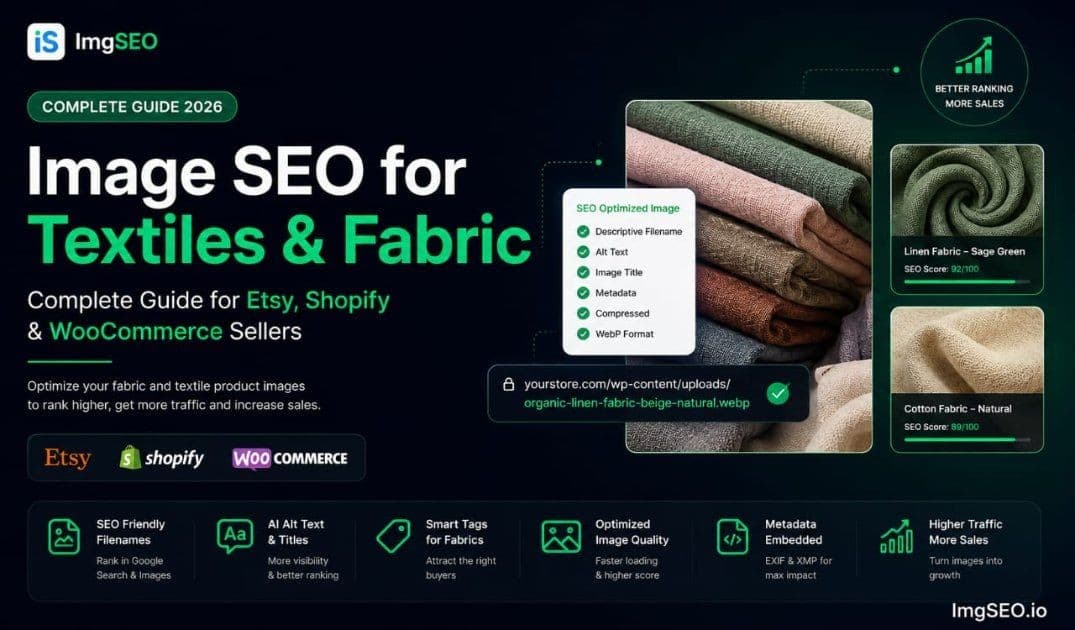
Fabric sellers spend hours getting the perfect drape shot, the right light on a linen texture, the exact white balance for an undyed natural weave. Then they upload those images without a filename, alt text, or a single keyword Google can read. The result: beautiful images that are invisible to search engines — a fabric image SEO problem most sellers don't know they have.
Without alt text, descriptive filenames, and image metadata, Google treats your fabric photos as unidentified images. It sees shapes and colors, but it does not know you are selling 185 GSM pre-washed linen by the yard versus a voile cotton at 45 GSM. Google Lens now processes over 20 billion visual searches per month, and 20% are shopping-related (Google VP Brendon Kraham, Search On keynote). Fabric buyers are searching that way. You need to be findable.
This guide covers the 8 fabric-specific attributes every alt text should include, plus step-by-step workflows for Etsy, Shopify, and WooCommerce.
Key Takeaways
- Fabric alt text should combine up to 8 attributes — fiber content, weight/GSM, weave, width, color/pattern, finish, use-case, and thread count/momme — not just "fabric" or a color name.
- Etsy now auto-generates generic alt text for any blank image field, so writing your own 100–180 character description is the actual competitive differentiator, not just an accessibility checkbox.
- Filenames matter directly on Shopify and WooCommerce (permanent in the CDN URL) but not on Etsy, where they're stripped — though a descriptive filename still helps because Pinterest reads it when a buyer pins your listing photo.
Quick Summary
- Google Images is a separate traffic channel from Etsy or Shopify search — most fabric sellers are only optimizing for one.
- 8 fabric attributes belong in every alt text: fiber content, weight/GSM, weave, width, color/pattern, finish, use-case, and thread count/momme.
- Google Lens processes 20B+ visual searches monthly; 20% are shopping-related (Google VP Brendon Kraham, Search On keynote).
- Platform rules differ: Etsy renames filenames on upload; Shopify CDN URLs are permanent; WooCommerce has four distinct media fields.
- Writing your own alt text on Etsy beats the generic auto-generated text Etsy now creates for blank fields.
Why Is Google Images a Separate Traffic Channel for Fabric Sellers?
Marketplace discovery and open-web image search are separate systems. Use the listing fields each marketplace currently provides, and use descriptive filenames, useful alt text, relevant page text, crawlable images, and eligible structured data on sites you control. Do not assume an undocumented marketplace ranking formula.
 Photo by Bernd Dittrich / Unsplash
Google states that it uses alt text with computer vision and page content to understand image subject matter (Google Search Central). Alt text remains an accessibility requirement and useful context, not a promise of ranking position.
Organic search is already Etsy's second-largest traffic channel, and 80% of Etsy's GMS came through direct or organic channels in 2023 (Etsy 2023 Annual Report). The fabric buyers arriving from Google are not an edge case. They are a major slice of the market.
Visual search can compare visible characteristics such as weave, color, and texture with indexed content. Clear, crawlable product images and accurate page context make a fabric page more understandable, but alt text does not guarantee a Lens match or exclude a competing image.
Which 8 Fabric Attributes Should Every Alt Text Include?
Fabric buyers don't search "nice fabric." They search "undyed washed linen 185 GSM for dressmaking" or "navy geometric print 100% quilting cotton 44 inches wide." Eight specific attributes drive those searches, and every one belongs in your alt text and filenames.
| Attribute | Examples | Why it matters | |-----------|----------|----------------| | Fiber content | 100% linen, cotton-linen blend, silk charmeuse | Primary search filter for fabric buyers | | Weight / GSM | 185 GSM, 8oz canvas, lightweight voile | Buyers search for specific sewing applications | | Weave type | plain weave, twill, satin, jersey knit, herringbone | Narrows Google Images results precisely | | Width / selvage | 44 inches, 54in, 145cm, 60 wide | Critical for quilting and apparel cutting math | | Color and pattern | navy geometric print, undyed natural, ditsy floral | Most common visual filter | | Finish | pre-washed, stonewashed, brushed, mercerized | Tactile buyers search these terms | | Use-case | quilting cotton, upholstery fabric, dressmaking linen | Channels intent-specific search traffic | | Thread count / momme | 400TC percale, 16 momme silk | Technical buyers and sewists use these precisely |
The formula:
[Fiber Content] + [Weight/GSM] + [Weave/Structure] + [Width] + [Color/Pattern] + [Finish] + [Use-Case]
Not every attribute applies to every product. Use the ones that are accurate and searchable for your specific fabric.
Before/After Alt Text Examples
Cotton quilting fabric:
- Bad:
fabric.jpg/ alt:"fabric" - Mediocre:
"Blue cotton fabric for quilting" - Good:
"Navy and white geometric print 100% quilting cotton, 44 inches wide, sold by the yard" - Best:
"Navy geometric print 100% cotton quilting fabric, 44in wide, fat quarter available, sharp contrast for patchwork blocks"
The "best" version includes fiber content, pattern description, width, sale format, and use-case — five search signals in one sentence.
Linen fabric:
- Bad:
"linen" - Good:
"Undyed washed linen fabric by the yard, 145cm wide, medium weight 185 GSM, softened finish" - Best:
"Undyed pre-washed linen fabric by the yard, 145cm wide, 185 GSM, stonewashed softened finish, ideal for dressmaking and home decor"
Silk charmeuse:
- Bad:
"silk" - Good:
"Crimson 100% silk charmeuse fabric, 54 inches wide, 16 momme weight" - Best:
"Crimson silk charmeuse by the yard, 54in wide, 16 momme weight, high sheen satin weave, drapes for evening wear or lingerie"
Cotton jersey knit:
- Good:
"Heather grey cotton jersey knit fabric by the yard, 60 inches wide, 4-way stretch, 180 GSM"
The GSM, width, and stretch information here are not filler — they are the exact terms sewists search when choosing knit fabric. For more on writing effective alt text, see our complete alt text guide.
How Do You Write Alt Text for Fabric on Etsy, Shopify, and WooCommerce?
Writing alt text for fabric listings follows the same 8-attribute formula on every platform, but the character limits, filename rules, and auto-generation behavior differ significantly between Etsy, Shopify, and WooCommerce. A 2024 audit found one-third of ecommerce homepage images have missing or repetitive alt text (Shopify Blog, 2024). Fabric sellers are no exception.
 Photo by Bernd Dittrich / Unsplash
Etsy Fabric Listings
Etsy allows 500 characters for alt text, but you only need 100–180. The field is labeled "Describe this photo for buyers who are visually impaired" in Etsy's listing manager. Click any listing image to access it.
The critical detail most Etsy sellers miss: as of late 2025, Etsy auto-generates alt text for any image where you leave the field blank (Etsy Help Center). That auto-text is based on Etsy's image recognition — it produces generic descriptions identical to what every other seller with a similar image gets. Writing your own is the competitive differentiator.
Alt text primarily supports accessibility and provides page-level image context. Etsy controls its internal search system, and external clicks should not be presented as a documented indirect Etsy ranking signal.
Etsy filenames: Etsy renames all uploads to internal IDs on upload. Your filename disappears. Zero direct SEO benefit inside Etsy.
Etsy image specs: At least 2,000px on the shortest side; ideal 3,000x3,000px; 4:5 portrait aspect ratio preferred; keep under 1MB for reliable uploading; color profile sRGB. Use all 10 image slots — each slot is a separate Google Images indexing opportunity.
Shopify Fabric Stores
On Shopify, filenames are permanent in the CDN URL. When you upload undyed-washed-linen-fabric-by-the-yard-185gsm.jpg, that filename becomes part of the product image URL. Google reads it. You cannot rename it after upload without deleting and re-uploading — which resets any ranking the original URL had accumulated. Get your filenames right before the first upload.
Set alt text in the current product-media interface and describe the meaningful image concisely. Interface limits and defaults can change, so verify Shopify's current guidance. Missing alt text is an accessibility and context problem, not a quantifiable ranking signal.
Captions display on your product page below the image and add surrounding text context that Google uses alongside alt text. For fabric, a caption like "Stonewashed pre-washed linen, 185 GSM, priced by the yard" reinforces your image alt text with on-page keyword context.
Shopify automatically serves WebP to modern browsers at the CDN level. Upload your best-quality JPEG at 75–85% compression; Shopify handles format conversion.
WooCommerce Fabric Shops
WordPress Media Library has four fields for every image, and understanding which one matters for SEO avoids a common mistake:
- Alt Text — the primary SEO field; Google reads this as the image description. Fill this first.
- Caption — displayed below the image on product pages; adds surrounding text Google uses.
- Title — appears as a tooltip on hover; minor SEO value.
- Description — internal only; not displayed to buyers or crawled by Google.
Set descriptive filenames before upload when practical. WordPress, CDNs, and marketplaces may transform paths or files, so verify the final URL instead of assuming WooCommerce preserves it or Etsy strips it.
If you sell to EU or UK buyers, the European Accessibility Act came into force in June 2025 (European Commission), creating a legal obligation to complete alt text on all product images. Accessibility and SEO align here: proper alt text serves both.
Yoast WooCommerce SEO actively checks for missing alt text and flags it in its SEO audit. Use those flags as a to-do list.
WebP via a plugin (Imagify, ShortPixel, or Smush) reduces file size 25–35% compared to equivalent JPEG with no visible quality loss (HTTP Archive via Imagify). See our full WooCommerce image SEO guide for a complete walkthrough.
Do Filenames Matter for Fabric Image SEO?
Filenames matter on Shopify and WooCommerce because the CDN URL contains your original filename — and Google reads that URL. On Etsy, filenames are renamed on upload and have zero direct SEO value inside Etsy. But there is one Etsy-specific reason to use descriptive filenames anyway.
The Etsy-Pinterest connection: When a buyer pins your Etsy listing photo to Pinterest, Pinterest reads your original filename for pin metadata. A descriptive filename gives Pinterest's algorithm useful keyword context. A camera-generated filename gives it nothing.
| Bad filename | Good filename | |-------------|---------------| | IMG_4392.jpg | navy-geometric-cotton-quilting-fabric-44in-wide.jpg | | product1.jpg | undyed-washed-linen-fabric-by-the-yard-185gsm.jpg | | blue_fabric.jpg | cornflower-blue-100pct-cotton-canvas-fabric-heavy-weight.jpg | | fabric_shop_img_001.png | vintage-floral-cotton-voile-fabric-white-pink-45in.jpg |
The formula:
[fiber]-[color/pattern]-[fabric-type]-[width]-[weight].jpg
Use hyphens, not underscores or spaces. Keep it under 60 characters. All lowercase.
Compression by destination: use a supported format and compare weave, pattern edges, gradients, and labels at the actual display size. Encoder settings and platform limits vary, so verify current upload requirements instead of using one quality percentage or file-size target.
Setting a filename convention before upload can reduce later rework. If an established public image URL changes, update references and preserve redirects where the platform supports them. Our image filename guide covers the remediation workflow.
How Should You Photograph Fabric for SEO?
Use multiple image slots to show genuinely different buyer-relevant views such as texture, selvage, drape, and a finished project. Eligible images may be discovered, but image count is not a documented ranking multiplier.
6 Essential Fabric Shot Types
Each shot type serves a distinct buyer question and a distinct Google Images keyword target:
-
Swatch close-up showing texture and weave — your most technically specific shot. Gets close enough that individual threads are visible. This is where GSM and weave terms earn their ranking power.
-
Full-width drape shot — shows color accuracy and how the fabric moves and falls. Essential for fashion fabric buyers evaluating drape behavior.
-
Selvage edge with ruler for scale — shows width measurement visually. Quilters and sewists check width before buying; a ruler in frame communicates this at a glance.
-
Pattern repeat detail (if applicable) — for prints and wovens, shows the repeat size and color accuracy up close. Pattern repeat is often a search term ("large floral repeat linen").
-
Finished project using the fabric — a garment sewn, a quilt block made, a cushion completed. This is your use-case image. It communicates "dressmaking linen" or "quilting cotton" in one shot and targets intent-specific Google Images searches.
-
Flat fold showing how the fabric is sold — folded fabric by the yard or fat quarter, styled simply. Matches the buyer's mental image of what they are purchasing.
Write unique alt text for each shot. The swatch close-up, selvage shot, and finished project shot are completely different images and need completely different alt text. Copying the same alt text across all ten images signals low-quality content and wastes your ranking opportunities.
Use all 10 Etsy image slots. Etsy allows up to 10 photos plus one video per listing. Every unused slot is a missed Google Images indexing opportunity. If you're new to product photography, our Etsy photography guide covers equipment and lighting basics.
Fabric Image SEO Checklist
Run through these steps before publishing a fabric listing. Together they support accurate merchandising, accessibility, crawlability, and efficient delivery; they are not ten independently weighted ranking signals.
Before finalizing any fabric listing on any platform:
- Filename set before upload — uses the
[fiber]-[color]-[type]-[width]-[weight].jpgformula; hyphens not underscores; all lowercase - Alt text written for every image — unique per image; includes fiber content, GSM/weight, width, color/pattern, and use-case
- No alt text is "fabric" or left blank — if you are on Etsy, your own text beats Etsy's auto-generated generic text
- Swatch/texture close-up included — individual weave or knit structure visible in frame
- Selvage or width reference included — ruler in frame or measurement stated in alt text
- Finished project shot included — communicates use-case for Google Images intent matching
- Useful Etsy image slots used — each shows distinct buyer-relevant information
- Shopify filenames set before first upload — CDN URL is permanent; you cannot rename after upload
- WooCommerce Alt Text field filled first — not Title, not Description; Alt Text is the primary SEO field
- A supported efficient format used — verify current platform limits and visual quality at the served dimensions
Frequently Asked Questions
Does alt text affect Etsy's internal search ranking?
Alt text supports accessibility and can provide image context where Etsy exposes it in the published page. Etsy controls its internal search system, so avoid claiming a direct or indirect ranking effect. Describe meaningful images accurately and follow the current listing guidance.
What's the ideal alt text length for fabric listings?
Target 100–180 characters — enough to include fiber content, weight, width, and use-case, short enough to stay readable. Etsy allows 500 characters; Shopify allows 512; best practice on Shopify is under 125. A complete fabric alt text like "Undyed pre-washed linen fabric by the yard, 145cm wide, 185 GSM, ideal for dressmaking" hits every key attribute in under 100 characters.
Can I use the same alt text for all my fabric photos?
Describe each meaningful image according to what it actually shows—a texture close-up, selvage edge, drape shot, or finished project. Avoid copy-pasted boilerplate because it is unhelpful for accessibility, but do not treat each image as a guaranteed separate ranking opportunity.
Does the filename matter if I sell only on Etsy?
Not for Etsy's internal SEO — Etsy renames all uploads to internal IDs, so your filename disappears inside Etsy. But it matters for Pinterest. When a buyer pins your listing photo, Pinterest reads your original filename for pin metadata. A filename like navy-geometric-cotton-quilting-fabric-44in-wide.jpg gives Pinterest's algorithm useful context. If you also sell on Shopify or WooCommerce, descriptive filenames matter directly for those CDN URLs.
What's the difference between alt text and image title in WooCommerce?
In WordPress Media Library, Alt Text is the primary SEO field — Google reads this as the image description. The Title appears as a tooltip on hover and has minor SEO value. The Caption displays below the image on the product page and provides surrounding text context that Google uses alongside the alt text. The Description is internal only and is not visible to buyers or crawled by Google. Fill Alt Text first, then Caption.
Start With Your Best Three Fabric Listings
Fabric sellers who optimize their images win two traffic channels at once — platform search and Google Images. Most competitors are only showing up in one. The gap between a blank alt text field and a complete one ("Navy geometric print 100% cotton quilting fabric, 44in wide, fat quarter available, sharp contrast for patchwork blocks") is the difference between an unidentified image and a ranked product photo.
The 8 attributes — fiber content, weight/GSM, weave type, width, color/pattern, finish, use-case, and thread count/momme — are not just SEO tactics. They are the exact terms fabric buyers search when they are ready to buy. Writing them into every alt text, every filename, and every image description means your fabric shows up when intent is highest.
Start with your best three listings. Write proper alt text for every image slot. Set filenames before uploading on Shopify and WooCommerce. On Etsy, override the auto-generated text with your own. Then work outward from there.
ImgSEO generates fabric-aware alt text and embeds it as metadata in your image files automatically. Upload your fabric product photo, get alt text built around fiber content, GSM, width, and use-case, and download the file ready to upload with all metadata embedded. Thirty images free, no credit card required.
For more on the broader image SEO strategy across product categories, see our guide on ecommerce image SEO strategy.