
Most Etsy sellers obsess over one thing: Etsy search rankings. They tweak titles, swap tags, and refresh keywords — and then wonder why traffic is flat.
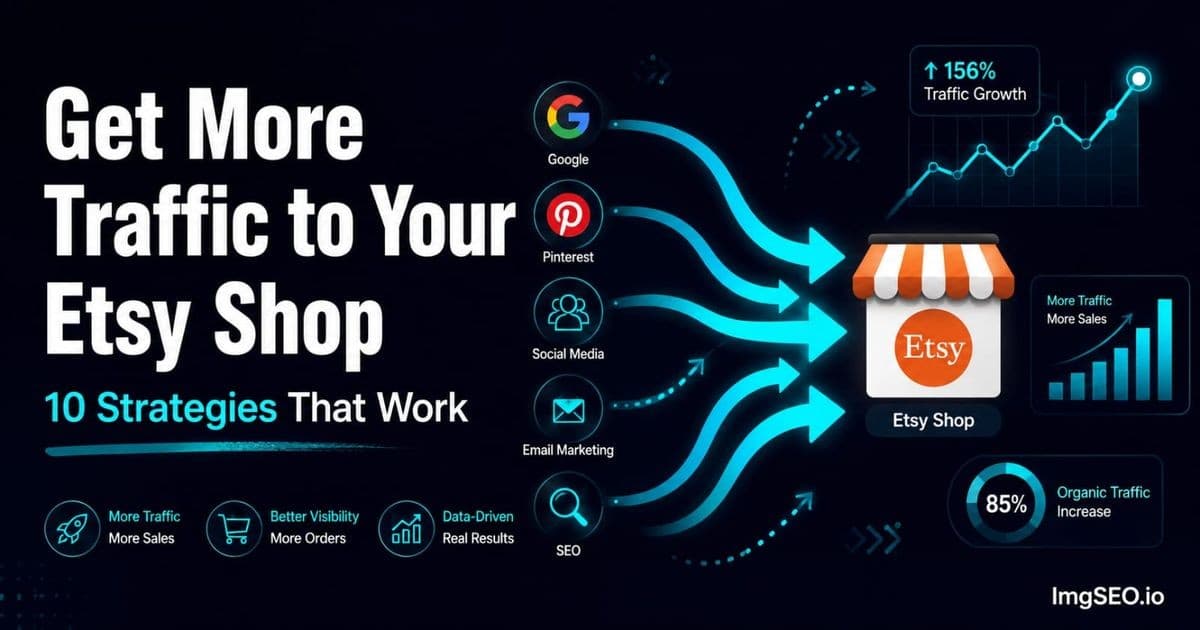
Here is what those sellers are missing: Etsy traffic comes from five distinct sources, and most shops are only working on one of them. The sellers who grow fastest do not just optimize for Etsy search — they build traffic from Google web search, Google Images, Pinterest, and direct sources simultaneously.
Etsy search is the biggest source for most shops, and it matters. But it is also the most volatile. A single algorithm update can cut your search traffic in half overnight. External traffic sources do not care about Etsy's algorithm. When you diversify, you protect what you built.
This guide covers the ten strategies that actually move the needle — including honest assessments of what does not work and a realistic timeline for what to expect.
Understanding Etsy Traffic Sources
The 5 Traffic Sources for Etsy
Before optimizing, you need to understand what you are optimizing for. Etsy traffic arrives from five places:
1. Etsy internal search — The largest source for most shops. Buyers type a query, Etsy returns results, your listing appears (or does not). Titles, tags, and engagement signals determine your position.
2. Google web search — Etsy.com has a domain authority above 90, which means your listings inherit serious Google ranking power. A well-written Etsy listing description can rank on page one of Google for long-tail product searches without any additional effort.
3. Google Images — The most overlooked traffic source in all of Etsy SEO. Google Images drives millions of product searches daily, and Etsy listing images appear in those results. Most sellers have zero image SEO. This means almost no competition for the traffic that is available.
4. Pinterest — The highest-quality external traffic for most Etsy niches. Pinterest users are in active shopping and discovery mode. Conversion rates from Pinterest to Etsy purchase are significantly higher than from Instagram or TikTok.
5. Social media — Instagram, TikTok, Facebook. The channel most sellers spend the most time on and get the fewest direct sales from. More on this shortly.
Why Diversification Matters
Etsy's algorithm changes without warning. In 2022 and again in 2024, sellers with top-ranking listings saw significant traffic drops overnight following search algorithm updates — with no explanation from Etsy and no clear path to recovery.
Shops with diversified traffic sources felt those drops much less. When Etsy search drops 40%, Pinterest and Google Images traffic keeps flowing. Multiple sources also mean compounding growth: each channel you add increases total traffic, and the effect builds over time.
Strategy 1: Etsy Search Optimization
The Foundation
If you have not done this, start here before anything else. These are non-negotiable:
Titles: Put your primary keyword in the first 40 characters. Etsy truncates titles in search results at roughly that length, so the most important keyword needs to appear before the cut. "Sterling Silver Moon Ring — Crescent Ring — Minimalist Jewelry — Gift for Her" puts the primary term first. "Gift for Her — Minimalist Jewelry — Sterling Silver Moon Ring" buries it.
Tags: Use all 13. Use multi-word phrases, not single words. "moon ring" is better than "ring." "sterling silver crescent moon ring" is better than "moon ring." Etsy matches tags to full buyer queries, so the more specific and phrase-like your tags, the more relevant searches you appear in.
See Etsy SEO for beginners for a full walkthrough of the foundational setup.
The CTR Multiplier
Here is what most title-and-tag guides do not tell you: once you are appearing in search results, your thumbnail determines whether buyers click.
Etsy's algorithm tracks click-through rate. If your listing appears 1,000 times in search results and gets 10 clicks, that is a 1% CTR. A competitor with the same impressions getting 30 clicks has a 3% CTR — and Etsy's algorithm interprets that as the higher-relevance result. Over time, the higher-CTR listing rises; yours falls.
A single thumbnail improvement can double or triple your CTR from the same number of impressions. Better CTR means more visibility, which means more impressions, which means more traffic. This compounds quickly.
Strategy 2: Google Web Search Traffic
How Etsy Listings Rank on Google
Etsy.com has built domain authority that individual seller websites take years to develop. When you publish an Etsy listing, it immediately inherits that authority. Google can and does rank individual Etsy listings on page one for specific product searches — especially long-tail queries like "personalized sterling silver name necklace for mom."
Your listing title becomes the Google page title. Your listing description provides the content Google reads and excerpts in search results.
Optimizing for Google Web Search
The most important thing to understand: the first 160 characters of your description become your Google meta description. This is what buyers read in Google search results before deciding whether to click.
Write your description's opening sentence with that in mind. Put the primary keyword in the first sentence. Make it read naturally to a buyer, but include the terms they would search on Google. "This sterling silver crescent moon ring is handcrafted in Austin, Texas" is better than "Welcome to my shop! This listing is for one ring."
For more on ranking your listings outside of Etsy, see how to rank your Etsy shop on Google.
Strategy 3: Google Images Traffic
The Most Overlooked Traffic Source
Google Images is where most Etsy sellers leave the largest amount of traffic on the table — and almost no one knows it.
When a buyer types "rustic wooden serving board" into Google Images, they see a grid of product photos from across the web. Etsy listing images appear in those results. Someone browsing Google Images for a product is looking at photos with buying intent, not general curiosity. They are one click away from your listing.
The catch: Google Images requires specific optimization signals to rank a photo. Most Etsy sellers provide none of them.
What Drives Google Images Traffic
Alt text is the most important factor. Alt text is the text description you attach to an image — it tells search engines what the photo contains. On Etsy, alt text is the "Describe this photo" field you see when you click on a listing image in your Shop Manager. Most sellers leave it blank. When alt text is empty, Google has no keyword signal to associate with that image, and it will not rank it for product-specific searches.
Image metadata embedded before upload provides additional ranking signals. EXIF and XMP fields in the image file itself can contain keyword-rich captions and descriptions that Google reads at crawl time. See how image SEO drives Etsy sales for a deep dive into exactly how this works.
Descriptive filenames matter before you upload. Etsy replaces your filename with an internal ID in the final URL, but Google reads the original filename on first crawl. "rustic-walnut-serving-board-wedding-gift.jpg" provides keyword context. "IMG_4821.jpg" provides none.
The Impact
A single well-optimized listing can generate 50 to 200 Google Images clicks per month for a medium-competition product. Multiply that across 50 listings — all optimized — and you are looking at 2,500 to 10,000 additional monthly visitors from a source most of your competitors have not touched.
ImgSEO handles alt text and metadata optimization in one step — upload your images, and it generates keyword-rich alt text and embeds the metadata before you upload to Etsy.
Strategy 4: Pinterest Traffic
Why Pinterest is Different
Pinterest is frequently lumped in with "social media" and dismissed when sellers see low Instagram conversion rates. This is a mistake. Pinterest is not a social platform — it is a visual search engine.
Pinterest users are actively shopping and planning. They are saving products they intend to buy, building gift wishlists, planning home renovations, collecting wedding inspiration. The buying intent on Pinterest is roughly three times higher than on Instagram. And unlike Instagram posts, which disappear from feeds within 24 to 48 hours, a Pinterest pin continues driving clicks for years.
Pinterest Traffic Setup
The setup matters. A business account enables rich pins, which pull your Etsy listing title, price, and availability directly onto the pin. This dramatically increases CTR because buyers see product details without leaving Pinterest.
Create five to seven keyword-focused boards relevant to your niche. "Sterling Silver Rings," "Minimalist Jewelry," "Moon Jewelry," "Gift Ideas for Her" — each board is a search category in Pinterest's algorithm. Pin each new listing immediately after publishing, and add existing listings to relevant boards consistently.
Vertical images with a 2:3 ratio perform significantly better on Pinterest than square or landscape images. If your Etsy photos are square, create a vertical Pinterest-specific version in Canva.
Write keyword-rich pin descriptions. "Handcrafted sterling silver crescent moon ring, perfect for layering or wearing solo. Minimalist fine jewelry made in the USA. Great gift for astrology lovers." That is a searchable description. "Love this ring!" is not.
For a full Pinterest-to-Etsy traffic setup, see how to drive Pinterest traffic to your Etsy shop.
Strategy 5: Etsy Ads
When Etsy Ads Make Sense
Etsy Ads are not a traffic problem solver — they are a traffic amplifier. They work when you have a listing that already converts. They burn money when you do not.
Three scenarios where Etsy Ads make sense:
New shop with zero traffic history: A small Etsy Ads budget gets your listings in front of buyers and generates the initial engagement signals (clicks, favorites, purchases) that Etsy's organic algorithm needs to rank you. Think of it as buying your way into the ranking data.
Proven converting listing: You have a listing that drives sales at a solid rate. Etsy Ads put that listing in front of more buyers during peak buying windows. The ROAS (return on ad spend) is predictable because you already know it converts.
Holiday season: The window from mid-October through mid-December is when Etsy traffic spikes dramatically. Ads during this window can deliver disproportionate returns because buyer intent is at its peak.
Smart Etsy Ads Strategy
Start with $1 to $5 per day on your top three listings. Run for two weeks without changing anything — you need enough data to see patterns. After two weeks, turn off ads on any listing that spent without generating purchases. Increase budget on listings with a strong return on ad spend.
When NOT to Use Etsy Ads
If your main listing image is poor, do not run ads. You are paying for clicks that will not convert, and the low conversion rate trains Etsy's algorithm to show your listing less even after you stop paying.
Fix your titles, tags, and thumbnails before you run ads. Ads amplify both good and bad signals.
Strategy 6: Social Media (Realistic Assessment)
The Honest Truth About Social Media for Etsy
Instagram and TikTok drive less Etsy traffic than most sellers expect and far less direct sales than the effort invested. This is not a knock on those platforms — it is a description of how people use them. Social media users are in entertainment and connection mode, not shopping mode. The purchase intent is low, and the conversion rate from social media click to Etsy purchase reflects that.
The typical Etsy seller who spends three hours per week creating Instagram content gets fewer monthly sales from Instagram than from a properly optimized Pinterest account they set up once and pin to twice a week.
Where Social Actually Helps
Social media builds brand recognition. Buyers who follow you on Instagram before making a purchase convert at higher rates when they eventually land on your shop. UGC — customer photos and unboxing videos — is genuinely valuable for listing images and social proof.
Pinterest is the exception to everything said above. It behaves like a search engine, and it delivers search-engine-quality traffic.
What to Post (When You Do Post)
If you are going to invest time in social media, focus on content that performs: process videos showing how you make your product get high engagement for maker shops. Before-and-after product photography. Behind-the-scenes content that builds brand personality. Avoid generic product-on-white-background posts — they get no engagement because buyers are already seeing those on Etsy.
Strategy 7: Email List
Why Email Beats Social for Traffic
You do not own your Instagram followers. You do not own your TikTok audience. If Etsy changes its algorithm or suspends your shop, you lose access to your buyers. An email list is the one channel no platform can take from you.
Email subscribers convert at three to five times higher than cold traffic. Someone on your email list has already bought from you or deliberately opted in — they want to hear from you. When you announce a new collection or limited-run product, that email drives an immediate spike in Etsy traffic and orders.
Building Your Email List from Etsy
The most reliable method: include a card in every order. "Thank you for your order — join our email list for 10% off your next purchase at [link]." A QR code on the card makes the signup frictionless.
You can also link to your email signup from your Etsy About section — buyers who are researching your shop will see it.
Mailchimp's free tier handles up to 500 contacts and 1,000 emails per month, which is more than sufficient for most small Etsy shops in their first year.
Strategy 8: New Listings Consistently
The New Listing Traffic Boost
Etsy gives new listings a temporary visibility boost in search results. This is well-documented by sellers who track their Etsy Stats — new listings typically see elevated impressions in the first one to two weeks. Publishing new listings consistently keeps this boost working in your favor continuously.
More listings also means more keywords covered. A shop with 100 listings appears in search results for vastly more queries than a shop with 10 listings, even if each individual listing's optimization is identical.
Target two to five new listings per week if your inventory allows it. Even one new listing per week compounds meaningfully over a year.
Listing Variations Strategy
This is one of the most underused traffic strategies on Etsy. Each color variant of a product can be its own listing. Each size can be its own listing. Each colorway gets its own title, its own tags, its own images, its own SEO opportunity.
"Rustic Wood Serving Board — Small" and "Rustic Wood Serving Board — Large" are two separate search opportunities. A buyer searching specifically for a small serving board sees the first; a buyer searching for large sees the second. One listing trying to serve both is optimized for neither.
Strategy 9: External Blog or Content
Content Marketing for Etsy Shops
This is the longest-term strategy on this list, and it is also the one with the highest ceiling. A blog or content presence that ranks on Google for topics related to your products can drive consistent, compounding traffic to your Etsy shop for years.
You do not need a professional blog or website setup. A Medium publication, a Substack newsletter, or a simple Squarespace blog connected to your brand is sufficient. One post per month about your craft, your materials, the use cases for your products, or how buyers can style or use what you sell.
A candle maker who writes "How to Make Your Home Smell Like a Spa" and links to their Etsy shop is capturing Google traffic from buyers who would never have found their Etsy listing through Etsy search.
Simple Content Strategy
Write about what your buyers care about, not what you care about as a maker. Your buyers do not care about your process — they care about what your product does for them. Write from that angle.
Pinterest is your distribution channel for this content. Pin each blog post with a vertical image and keyword-rich description. A piece of content that ranks on Pinterest continues driving traffic long after it was written.
Strategy 10: Seasonal Traffic Planning
Plan 6-8 Weeks Ahead
Etsy traffic spikes are predictable. Christmas, Valentine's Day, Mother's Day, and back-to-school all follow the same pattern every year. The sellers who capture peak traffic are the ones who prepared weeks before the peak arrived, not the ones scrambling to update listings when the season is already in full swing.
Google and Etsy both need time to index changes. Alt text you add today may take three to four weeks to show up in Google Images rankings. Tags you update today take time to work through Etsy's relevance algorithm. If you wait until November 1 to add Christmas keywords, you are two to four weeks late.
Seasonal Traffic Calendar
Work backward from each major season to know when to prepare:
- October (prepare August–September): Christmas and holiday gifts. This is the highest-traffic season on Etsy by a significant margin. Update titles, tags, images, alt text, and Pinterest boards to reflect gift-giving keywords.
- January (prepare December): Valentine's Day. Jewelry, personalized gifts, and experience gifts see significant spikes.
- March (prepare February): Mother's Day. One of the top three Etsy traffic events annually.
- July (prepare June): Back to school, dorm decor, teacher appreciation.
See the complete Etsy holiday SEO guide for a listing-level checklist for each major season.
What Does NOT Work (Save Your Time)
Sellers new to Etsy traffic often spend time on tactics that produce nothing or actively harm their shop. Here is what to skip:
Buying fake reviews is the fastest way to get your shop suspended. Etsy's detection has improved significantly and the risk is not worth any short-term benefit.
"Like for like" Etsy groups on Facebook — groups where sellers agree to favorite each other's listings in exchange for reciprocal favorites — generate zero real buyer traffic. Favorites from other sellers signal nothing meaningful to buyers, and Etsy's algorithm is sophisticated enough to distinguish engagement from genuine buyers versus other sellers.
Posting in Facebook groups without providing value reads as spam and gets ignored. If you participate in communities, participate authentically.
Changing titles and tags every week is counterproductive. Etsy's algorithm needs time to associate your listing with specific searches and measure performance. Constant changes reset the clock and prevent any ranking signal from building. Make changes, give them four to six weeks to show results, then evaluate.
For a deeper look at SEO myths that waste time, see the honest truth about Etsy SEO.
The Traffic Growth Timeline
Set realistic expectations. Traffic growth follows a pattern and the compounding happens over months, not days.
Weeks 1–2: Fix titles, tags, and thumbnails. Etsy search performance begins to improve as click-through rate data accumulates. You may see early movement in Etsy Stats impressions and clicks.
Weeks 3–4: Add alt text and image metadata to your top listings. Google begins re-crawling updated images. Google Search Console will start showing image impressions within this window.
Month 2: Pinterest traffic starts building. Early pins are indexed and surfaced to relevant Pinterest searches. Consistent pinning begins to compound.
Months 3–6: The compound effect across all channels becomes visible. Google Images traffic is established. Pinterest referrals are consistent. Etsy search rankings have stabilized at higher positions due to improved CTR and engagement signals. New listing frequency is building keyword coverage.
Month 6 and beyond: Multi-source traffic is the norm. Seasonal preparation is second nature. External traffic means Etsy algorithm changes no longer create existential anxiety.
FAQ
What is the fastest way to get more Etsy traffic?
Fix your thumbnails and add alt text to your top listings. A better thumbnail improves CTR immediately; alt text unlocks Google Images traffic. Both take a few hours and produce results within days to weeks.
Does Pinterest really drive Etsy traffic?
Yes — and it significantly outperforms Instagram and TikTok for most Etsy niches. Pinterest users are in shopping mode. Pins last years. For handmade goods, home decor, jewelry, and gifts, it is the most valuable external traffic source.
How long does it take to grow Etsy traffic?
Etsy search improvements show within one to two weeks. Google Images takes two to six weeks. Pinterest builds over two to three months. Full multi-source traffic takes three to six months but compounds month over month once established.
Should I use Etsy Ads to get more traffic?
Only after your listings convert. Etsy Ads amplify existing performance — they do not fix poor images or weak descriptions. Start with $1–5 per day on your three best listings and turn off ads on anything that spends without converting.
What is the best free way to get Etsy traffic?
Etsy search via title and tag optimization, Google Images via alt text and metadata, and Pinterest via consistent pinning. Google Images is the highest-opportunity channel because almost no competitors have optimized for it.
Does Google Images drive Etsy sales?
More than most sellers realize. Google Images traffic has high buying intent — someone looking at product photos on Google is close to a purchase decision. Etsy listing images that rank in Google Images convert at rates comparable to Etsy search traffic.
How many listings do I need to get consistent Etsy traffic?
There is no magic number, but 50 to 100 well-optimized listings typically produces consistent daily traffic. Below 20 listings, traffic tends to be sporadic. Each listing is a separate keyword and search opportunity.
Is social media worth it for Etsy traffic?
Pinterest, yes. Instagram and TikTok drive less direct traffic and fewer direct sales than most sellers expect. Treat them as brand-building tools; treat Pinterest as a traffic driver.
Conclusion
Etsy traffic comes from five sources — and the sellers who grow fastest work all of them, not just one.
The most powerful combination for most shops: Etsy search + Google Images + Pinterest. These three together capture buyers at every stage of the shopping process and from every major traffic channel. They compound on each other. And they protect your business from the inevitable Etsy algorithm changes that wipe out shops that depend on a single source.
Image SEO — alt text and metadata — is the piece most sellers skip entirely. It is also the piece that unlocks Google Images traffic, and it has almost no competition because so few sellers do it. ImgSEO handles the entire image SEO workflow in one step: upload your images, get optimized alt text and embedded metadata, upload to Etsy. Thirty images free, no card required.
Start with what you have not done yet. If you have not optimized titles and tags, do that first. If titles and tags are solid but you have never added alt text, that is your next move. If both are done and you have never set up Pinterest, that is where the next opportunity is.
For more on driving views to your shop, see how to get more Etsy views.