I've been selling on Etsy for five years. Sterling silver jewelry, small shop, nothing huge, but consistent — and consistent is the part that took me four years to figure out.
In that time I've read probably a thousand Etsy SEO posts. Forum threads, Reddit, YouTube videos with thumbnails screaming "ETSY ALGORITHM SECRET 2026." Most of it is wrong. Not maliciously wrong, just wrong in the way advice gets wrong when it gets repeated by people who heard it from someone who heard it from someone.
I'm not going to give you a numbered checklist. You've read forty of those already and your shop still isn't where you want it. Here's what I've actually learned from running tests on my own listings instead of just trusting what everyone repeats.
Quick Summary
- Swapping only the thumbnail (same tags, same title) took one listing from 40 views a month to 380 within three weeks — proof that click-through rate, not tags, drives Etsy ranking.
- Alt text does nothing for ranking inside Etsy's own search — its only job is making images findable in Google Images, a separate, mostly-untapped traffic channel.
- Etsy strips filenames and most metadata during processing, but embedded EXIF/XMP metadata gets read on Google's first crawl before that stripping happens — a narrow window most sellers never use.
The Myth That Tags Are Everything
Every Etsy SEO guide opens with tags. Use all 13. Use long-tail phrases. Match your tags to your title. Fine, none of that is wrong exactly.
But I had a listing with textbook-perfect tags sitting at 40 views a month for six straight months. Did everything "right." Researched keywords, matched title to tags, multi-word phrases, the whole routine.
Then I changed nothing about the tags and just swapped the thumbnail. Views went from 40 a month to 380 within three weeks.
Same tags. Same title. Same keywords Etsy was matching me against. The only thing that changed was whether people clicked once they saw the listing in search.
I later ran that same listing through five different thumbnail styles to see which ones actually pull clicks. The full breakdown of that test is here, and the gap between the best and worst was bigger than I expected.
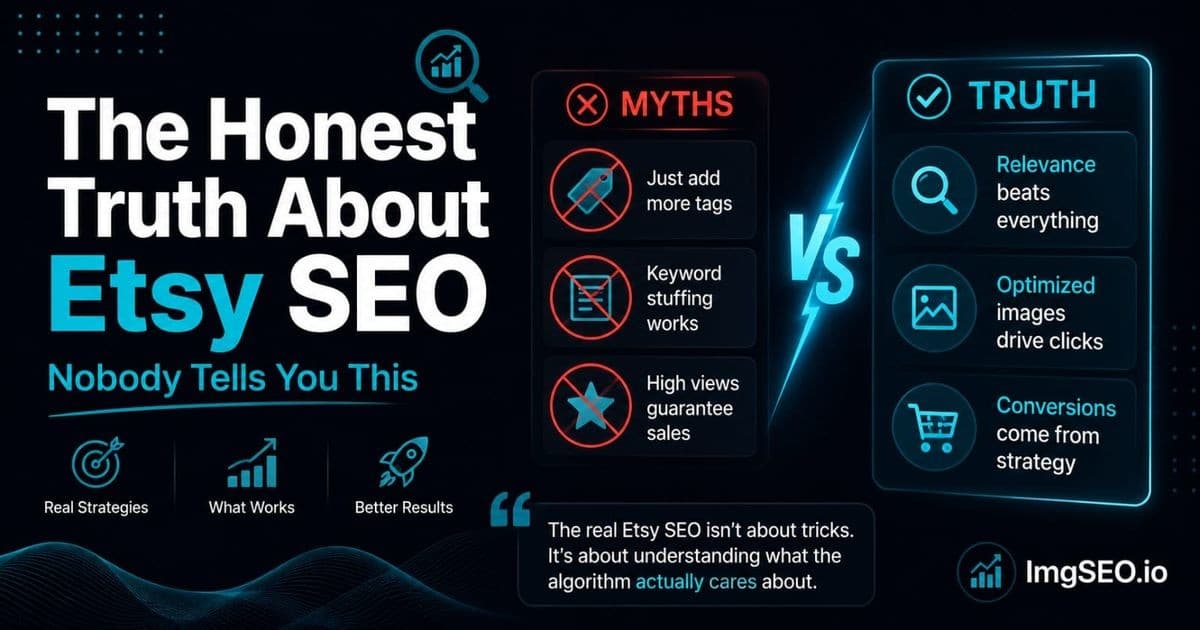
That's the part nobody tells you. Tags get you considered. They don't get you chosen. Etsy's algorithm is constantly testing your listing in front of real shoppers, watching what they do. And what they do is decide, in about half a second, whether your thumbnail is worth clicking on.
What Etsy actually rewards is engagement. Clicks, favorites, time on page, add-to-carts, purchases. Tags are just the entry ticket to get shown at all. After that, you're being graded on a completely different test, and most sellers never study for it.
Your Thumbnail Is More Important Than All Your Tags Combined
I'll say this directly because nobody else will: if you had to pick one thing to fix today, it's not your tags. It's your main image.
Here's the math nobody walks through. Etsy shows your listing in search. Some percentage of people click it — your CTR. If that percentage beats the average for similar listings, Etsy interprets that as relevance and shows you to more people. More impressions plus a good CTR equals even more clicks. It compounds.
A bad thumbnail breaks that loop at step one. It doesn't matter how perfect your tags are if nobody clicks through to let Etsy see whether you convert. You never get the chance to prove your listing is good, because the algorithm stopped paying attention to it after a few hundred unclicked impressions.
I think sellers obsess over tags instead of thumbnails because tags feel controllable. You can sit at your desk, do "keyword research," fill in 13 boxes, and feel like you did SEO. Fixing a thumbnail means admitting your photography might be the problem, and that's a harder thing to sit with than swapping a tag.
The "Etsy SEO Is Dead" Crowd Is Wrong
Every few months someone posts the same thing on Reddit. "Etsy SEO is dead, the algorithm only shows ads now, organic is impossible, I'm quitting." It gets 400 upvotes and a hundred comments agreeing.
I don't buy it. I've never had a year where my organic views dropped to zero, and I haven't changed my fundamental strategy in three years.
What actually happened to most of those shops, when you dig into their listings instead of just their complaint, is depressingly ordinary. Stale thumbnails they haven't touched in two years. Generic stock-feeling photos. No alt text on a single image. Titles stuffed so badly they don't even read as English.
Etsy SEO isn't dead. Their SEO was never actually good, and the algorithm just got better at noticing.
It's a more comfortable story to blame the platform than to open your own shop and admit the thumbnail you've had since 2023 isn't working anymore. I get it. I've done it too. But comfortable and true aren't the same thing.
Alt Text Is the Most Underused Tool on Etsy
Almost nobody talks about alt text. I mean almost nobody — go look through Etsy seller forums and count how many threads are about tags versus how many mention the "describe this photo" field. It's not close.
Here's what it actually does: it's the text Google reads when deciding whether your image shows up in Google Images search. Etsy strips your filename and most of your metadata during processing, but the alt text field you fill in stays attached and stays readable.
That matters because Google Images is a second traffic channel sitting right next to your Etsy listing, completely free, and almost nobody is using it. I checked my own shop stats once I started filling this in properly — images with good alt text started showing impressions in Search Console that just weren't there before for the same listings.
Writing it well takes under two minutes per image once you have the formula. Material, then product type, then style, then occasion or use case. "Sterling silver dainty stacking ring minimalist everyday wear" takes ten seconds to type and tells Google exactly what's in the photo. Compare that to leaving it blank, which is what most shops do on every single image they have.
If you want the full breakdown on writing alt text that actually pulls traffic instead of just existing, I went deep on this in how to get more Etsy sales with image SEO.
The Reviews Trap
Everyone tells new sellers to get reviews. Ask for them, follow up, offer a discount on the next order, whatever. Fine advice as far as it goes.
What nobody mentions is where bad reviews actually come from, and it's not usually product quality. It's expectation mismatch caused by your own photos.
A blurry or overly styled main image sets an expectation. Maybe the ring looks bigger in the photo than it is in real life, or the candle looks larger. Maybe the color looks different under your studio lighting than it does in a buyer's living room. That gap becomes a one-star review — about something that has nothing to do with how well you made the product.
"Smaller than expected" is one of the most common phrases in negative Etsy reviews across basically every handmade category. That's not a quality problem. That's an image problem wearing a quality complaint as a disguise.
The fix isn't asking for more reviews. It's adding a scale reference image so the gap between expectation and reality closes before the order even ships. Sellers chase review volume when they should be chasing review accuracy.
What Actually Moves the Needle
If I had to boil five years down to one combination, it's this: a thumbnail that gets clicked, alt text that gets you found on Google, and metadata that backs both of those up. Not tags. Not a perfect title. Not posting at a "magic time of day," which is not a real thing.
Metadata is the part almost nobody touches, and it's the closest thing to a secret weapon I've found, mostly because it requires zero ongoing effort once it's set up. EXIF and XMP fields get embedded into the actual image file before you upload — title, description, keywords — and Google reads that data the moment it first crawls your image. Etsy strips most of it during processing, so this window is small and most sellers never even know it exists.
The fix here genuinely takes about 30 minutes for your top ten listings. I ran my best sellers through ImgSEO to batch-generate alt text and embed metadata into the files before re-uploading, and it's the single highest-leverage half hour I've spent on this shop all year. Not because it's some magic trick — because almost nobody else bothers, so the gap between doing it and not doing it is bigger than it should be.
If you want a structured way to check where your own shop is leaking opportunity, the image SEO audit guide walks through exactly what to look at first.
The Inconvenient Truth About Etsy Success
Here's the part that's a little uncomfortable to say out loud, and I'll say it anyway.
Most sellers who fail on Etsy are not victims of a broken algorithm. I know that's not what anyone wants to hear when their shop is stuck at 12 views a month. I've been there. It's a miserable feeling and blaming Etsy feels better than the alternative.
But when I actually compare shops that grow against shops that stagnate, the pattern isn't mysterious. The growing shops update their thumbnails. They fill in alt text on every image, not just the main one. They reshoot the bad photo instead of defending it. They test things and look at the numbers instead of guessing and hoping.
The stagnant shops uploaded once, in good faith, and then never touched the images again. Same thumbnail for three years while the rest of the marketplace got more competitive around them.
It's not really about effort in the grand "hustle harder" sense everyone's tired of hearing. It's about whether you're willing to look at your own listing the way a stranger would and ask if it actually earns a click. Most sellers never ask that question. The ones who do tend to be the ones whose shops keep growing.
None of this requires a studio, a new camera, or a redesign of your whole brand. It requires looking honestly at your thumbnail, filling in a text field everyone skips, and embedding a few lines of metadata before you upload. That's most of what actually moved my shop, and it's available to literally every seller reading this right now, today, for free.
ImgSEO handles the alt text and metadata side in one pass if you'd rather not do it by hand — 30 images free, no card required. And if you want the longer version of how this connects to actual sales instead of just traffic, that's covered in how to get more Etsy sales with image SEO.