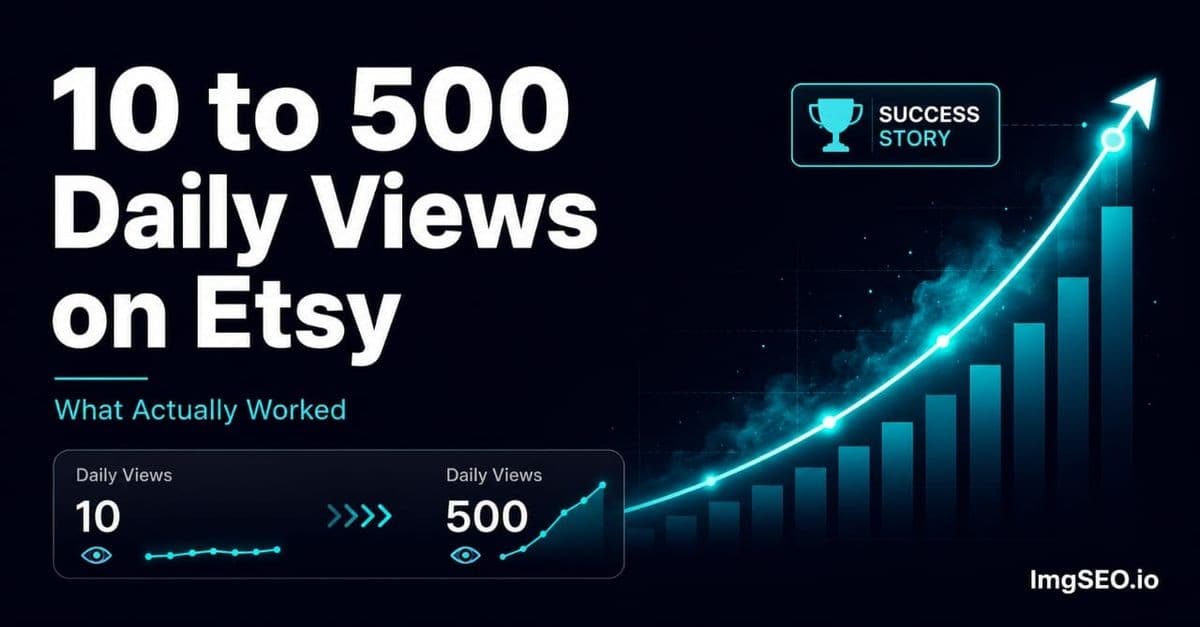
I opened my Etsy shop on a Tuesday in March with four listings and a lot of optimism. By the end of April I had 127 views total. Not per day. Total. For two months.
My daily view count was bouncing between 8 and 15. Some days it hit zero. I remember refreshing my Etsy Stats on my phone at 11pm like it was going to say something different the fifteenth time I checked.
This is the story of how I got from there to 500+ daily views. I am going to tell you exactly what I did, what failed completely, and what actually worked. The short version: I was ignoring my images almost entirely, and it was costing me everything.
Quick Summary
- Went from 127 total views in the first two months to over 200 daily views by day 90, and 500+ daily views by month six — with no ad spend or price changes.
- Filling in the previously-blank "Describe this photo" alt text field on all 20 images was the single highest-impact change; Google referral traffic first showed up about 12 days after adding it.
- Renaming files, embedding metadata with ImgSEO before re-upload, and retaking the main thumbnail all measurably improved click-through rate and Google Images indexing on top listings.
Where I Started
My shop sells hand-poured soy candles. I knew going in that candles were a competitive niche. I had done my research. I spent two weeks on my shop name, another week on my branding. I bought a ring light. I took photos against a white background because every "how to sell on Etsy" video told me to.
I launched with what I genuinely believed were good listings. Keyword-researched titles. Tags filled to the maximum. Prices I had benchmarked against competitors. Shipping policies copied from a seller I admired.
First week: 43 views, no sales.
Second week: 61 views, no sales.
By the end of month two I had made exactly one sale. To my mother. I did not count it.
The frustrating part was not the numbers themselves. It was that I could not figure out what I was doing wrong. I had followed the advice. I was doing the things. Why was nothing working?
What I Tried First (That Did Not Work)
I went deep on tags. I spent probably six hours one weekend reading about Etsy SEO, watching YouTube videos, trying tools that claimed to show me the "best" keywords. I rewrote every tag on every listing. I changed them again the following week when I read that the previous approach was wrong.
My views went from 11 per day to 13 per day. Maybe. The variance was so high it might have been random.
Then I tried copying competitor titles almost word for word. Not plagiarizing exactly, but using the same keyword structure as shops with thousands of sales. The logic seemed sound: if it works for them, it works for me.
Nothing changed.
I started an Instagram account. Posted three times a week for a month and a half. Got some likes from other candle sellers. Got zero Etsy traffic from it according to my stats. I am still not sure if I was using Instagram wrong or if Instagram just does not drive Etsy traffic the way people claim it does.
I also ran a sale — 20% off everything for a week. Got my first real sale from a stranger on day three of the sale. Then nothing again.
I kept reading that Etsy SEO takes time, that you need to be patient, that results come after 90 days. So I waited. And waited. And kept refreshing stats at 11pm.
The Thing I Was Completely Ignoring
Somewhere around month four I found a Facebook group for Etsy sellers. Mostly people sharing wins and asking questions about shipping. But one day somebody posted asking why their Google Images traffic had dropped after re-uploading photos.
Google Images traffic. I did not even know that was a thing.
I had been so focused on Etsy's own search algorithm that I had never once thought about Google. But this person was getting meaningful traffic from Google Images — enough that losing it was a problem worth posting about.
Someone in the comments mentioned alt text. Said you had to fill in the image description field on each listing image or Google had nothing to work with.
I went to my shop manager immediately and clicked on my first listing image. There was a field there I had genuinely never noticed. "Describe this photo for buyers who are visually impaired." It was blank on every single image I had ever uploaded. All four listings, five images each. Twenty blank fields.
I sat there for a minute feeling genuinely stupid. Then I started writing descriptions.
I did not overthink it that first time. I just wrote what was in each photo. "Hand-poured lavender soy candle in amber glass jar, 8 oz, natural cotton wick, shown on white marble surface." That kind of thing. Specific. Descriptive. I filled in all twenty images in about 40 minutes.
The First Sign Something Was Changing
Nothing happened immediately. I checked my stats the next morning and they were the same. I checked a week later and they were still the same. I started to think it had not worked.
Then around day 12, my Etsy Stats showed something new: traffic from Google. Not Etsy search, not direct — Google. A small number. Three visits that day. But I had never seen that source in my stats before. Ever.
I went to Google Images and searched for "lavender soy candle" and then tried more specific searches. Nothing on page one. But I started searching more specific things — "lavender soy candle amber jar," "hand poured soy candle cotton wick" — and eventually found one of my images on page three.
I had never appeared in Google Images at all before. Page three felt like a win.
Over the next two weeks, those Google referrals kept coming. Three visits turned into eight, then fifteen, then some days over twenty. My total daily views climbed above 20 for the first time. Then above 30.
It was slow. But it was moving for the first time in four months.
What I Did Next
I kept reading. I found out that the filenames on photos matter — or at least, they matter at the moment Google first crawls the image. Etsy replaces your filenames with their own internal IDs after upload, but Google may read the original metadata that is embedded in the file itself.
I had been uploading images straight from my phone with filenames like IMG_4892.jpg. Completely useless to Google.
I found ImgSEO and started using it before uploading new images. It embeds keyword-rich metadata — title, description, keywords — directly into the image file. So even after Etsy processes it, that information is still sitting in the file's EXIF and XMP data for Google to read.
I re-uploaded the main images for my top three listings. Took a Saturday morning.
I also added a scale reference photo to each listing — just a candle next to a hand so buyers could see the actual size. This had nothing to do with SEO directly, but my conversion rate on those listings went up and I think it helped my click-through rate in Etsy search too.
The one thing that made the biggest visible difference was retaking my thumbnail images. My original main photos were fine. But I went back and shot tighter, better-lit versions — less background, more product detail visible at small size. When I replaced those thumbnails, I could see the click-through rate improve in my Etsy Stats within a few days.
The Numbers After 90 Days
Ninety days after that Facebook group post about alt text, my daily views were consistently above 200.
Not every day. Some days were 150, some were 280. But the floor had moved. The 10-view days were gone.
I also had my first month with 20 sales. Still not a living, but it felt like proof that something real had changed.
My Google Search Console data was the most interesting thing to look at. I connected it to my Etsy shop URL and could see that I was now getting Google Images impressions — tens of thousands per month — on searches I had never appeared for before. (If you want to run the same diagnosis, I broke down how to read Etsy Stats and Search Console together in a separate guide.) The listings where I had done the most work on alt text and metadata were showing up for specific, buying-intent searches. "Lavender soy candle gift." "Natural wick soy candle small batch." Phrases where a buyer is ready to buy, not just browsing.
By month six, I hit 500 daily views for the first time. Then it held there, sometimes going higher.
I had not changed my prices. I had not run ads. I had not hired anyone. The shop was the same shop. The product was the same product. The only things that changed were my images and how I had described them to search engines.
What I Would Tell Someone Starting Out
Fix your alt text first. Before you do anything else. Open your Shop Manager, click on your listing images, and write a real description for every single one. Not a keyword dump — an actual sentence describing what is in the photo. Do this for your top five listings today. It took me four months to find this and I wish I had done it in week one.
Stop obsessing over tags. Tags matter, but they are also the thing every Etsy seller obsesses over, which means you are competing against a lot of other people who have also researched their tags. Alt text is where almost no one is paying attention. That is where the opportunity is. (I go deeper on why the usual tag-first advice is backwards in the honest truth about Etsy SEO.)
On the image side: rename your files before uploading, embed metadata if you can (I used ImgSEO for this — it's free for your first 30 images, takes a few minutes each, and the difference in Google Images indexing is real), and add a scale reference photo to every listing. Buyers need to know how big your product is and most listings do not show this clearly.
Retake your main thumbnail if it is not immediately readable at small size. The thumbnail is what determines if someone clicks. Everything else is secondary to getting that click.
If you want to go deeper on what most Etsy sellers get wrong with their images, the Etsy shop image SEO critique I wrote covers the most common mistakes I see — and they are almost all things I was doing too. And if you want a broader breakdown of how image SEO connects to sales, this guide on image SEO for Etsy sales in 2026 covers the full picture.
The path from 10 views to 500 views was not glamorous. It was a lot of small fixes to things I should have done from day one. But the fixes compounded, and now my shop actually shows up when people search for what I sell.
That is all I wanted.