Getting zero views is frustrating. Getting views and no sales is a different kind of frustrating — the kind that makes you think something is fundamentally broken with your shop.
None of those things are true. Views without sales is useful diagnostic data. Buyers are finding you. The algorithm is working. Something on your end is stopping the sale — and that's fixable.
Here's how to find it and fix it.
Key Takeaways
- The Etsy Seller Handbook benchmarks a healthy conversion rate at 1–5%; Marmalead puts 2–3% as average and 6%+ as elite (Etsy Seller Handbook, 2026; Marmalead, 2025)
- 78% of consumers rate product images as "very or extremely important" when deciding to purchase — second only to price (Salsify 2025 Consumer Research, 1,910 US and UK shoppers)
- 45% of consumers have abandoned a purchase specifically because of no or low-quality product images (Salsify 2022)
- 42% of shoppers try to determine product size from images but can't without a scale reference shot (Baymard Institute, Product Page UX research)
- Google organic search drives 21.31% of all etsy.com traffic — image alt text is how you tap it (Semrush, May 2026)
What "Views" vs "Visits" Actually Means on Etsy
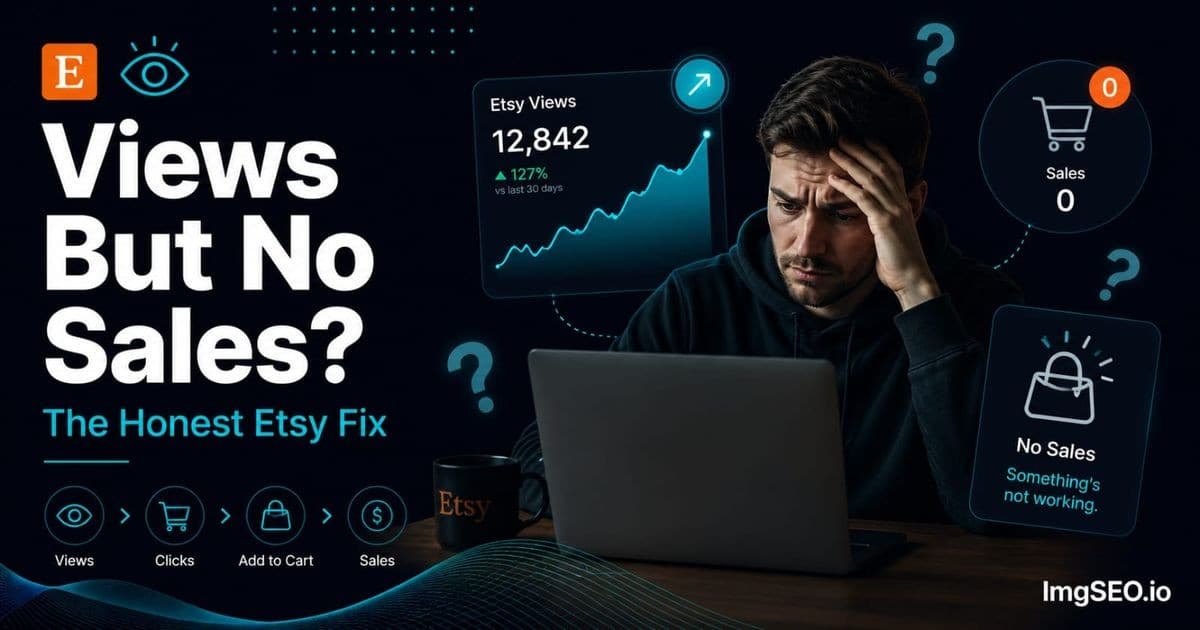
Most sellers track the wrong number — and it hides the real problem. In Etsy Stats, what they label "views" is actually page visits: a buyer clicked through to your listing and opened it. It is not impressions (how many times your listing appeared in search). Etsy doesn't show impression data directly. If you have 200 views a month and zero sales, 200 people opened your listing page and left without buying. That's a listing problem, not a reach problem.
The number you actually want is your visit-to-order conversion rate. Go to Etsy Stats, open any listing's individual data, and look at visits versus orders over 90 days. Divide orders by visits. That ratio tells you exactly how well your listing converts the traffic you already have.
According to the Etsy Seller Handbook, sellers should expect a conversion rate between 1% and 5%. Marmalead's 2025 benchmark puts 2–3% as average, 4–5% as strong, and 6%+ as elite. Below 1% with 200+ visits in the last 90 days is a clear signal — your listing page is the problem.
Is Your Thumbnail Killing Your Click-Through Rate?
If your listings get almost no visits relative to how long they've been active, the thumbnail is the problem — not the algorithm. Buyers decide whether to click in under a second. They're not reading your title or thinking it through. They're reacting to one question: do I immediately know what this is, and does it look like something I want?
A dark, moody, dramatically lit photo that looks stunning at full resolution becomes unidentifiable in a 150-pixel thumbnail competing with 20 other listings. Atmospheric shots — deep shadows, warm candlelight, slate backgrounds — work brilliantly when buyers already know your brand. When you're under 100 reviews and unknown, your thumbnail has to do all the work by itself.
The practical test: open your Etsy app right now. Look at each listing thumbnail at the actual size it appears in search. If you can't identify the product at a glance, buyers can't either — and they won't click.
The fix is boring and it works: shoot your main image near a window in daylight, use a white or light neutral background, fill the frame with the product. More specific photography fixes for sellers without a studio are covered in this guide.
Why Buyers Visit But Don't Buy: The Three Image Gaps
Once a buyer clicks through, three specific missing images kill most Etsy conversions. According to Baymard Institute's product page UX research, 56% of users' first action on a product page is to explore the images — before reading the title or description. And 45% of consumers have abandoned a purchase specifically because of no or low-quality product images, according to Salsify's 2022 consumer research.
The three gaps are almost always the same.
Gap 1: Size uncertainty. Baymard Institute found that 42% of online shoppers try to determine product size from images — but can't without a scale reference shot. This is the single most common abandonment driver for handmade products. You need one image showing the product held in a hand, placed next to a recognizable object, or shot with a ruler beside it. One image. Ten minutes to shoot. Removes the most common reason browsers don't buy.
Gap 2: Quality uncertainty. Buyers buying handmade want to see the craft. A close-up detail shot — the texture of glaze on a mug, individual stitches on an embroidered hoop, grain variation on a cutting board — signals quality in a way a full product shot can't. If all your images are zoomed out, buyers assume there's something you're hiding.
Gap 3: Trust gap. A lifestyle image — your candle lit on a bathroom shelf, your print framed in a real room, your ring worn on an actual hand — makes the product feel real and attainable. It also signals a real person behind the shop. Stock-looking white-background shots feel anonymous. A lifestyle image is trust-building in a single photo.
How Image Quality Affects the Price Buyers Expect to Pay
This one is uncomfortable to say, but it matters. If you're charging $45 for a hand-thrown ceramic mug and your photos look like they were taken under a kitchen light on a granite counter, you'll lose sales. Not because buyers don't want the mug. Because the photos communicate a $15 product, and the $45 price creates doubt.
Buyers don't consciously price a product from photos. But they price it subconsciously before they ever read your description. The image forms the first impression of value. If the photo quality doesn't match the price, your description has to overcome a hole it shouldn't be in.
This hits hardest for premium handmade sellers — jewelry above $75, ceramics above $50, fiber art above $100. The higher your price, the more your images need to justify it. Better copy won't fix this. Better images will.
You don't need a photographer. You need daylight, a clean surface, and a consistent background. The gap between $15-looking and $45-looking product photography is mostly lighting and background — not skill or equipment.
How to Read Your Etsy Stats to Diagnose the Real Problem
Go to Etsy Stats and pull visits and orders for your shop over the last 90 days. Divide orders by visits. That's your conversion rate. Here's how to read what you find.
Below 1% — your listing page is broken. With 200+ visits and near-zero conversions, something specific is stopping buyers. Start with images: is there a scale reference? A detail close-up? A lifestyle shot? Check your thumbnail on mobile. Check your price against similar listings with better photos.
1–3% — average range. You have room to improve. Adding a single missing image type to your lowest-converting listings can move this number within 30 days.
4–5% — strong. Your images are working. Optimize at the edges — stronger thumbnails, lifestyle variety, alt text for Google Images.
6%+ — elite. Your listing conversion is already winning. The effort now shifts to driving more traffic, not fixing conversion.
For listings with visits but zero orders over 90 days, treat each one as a separate problem. The guide on using Etsy analytics for image SEO covers the full diagnostic with data examples.
Which Image Fixes Give You the Most Return?
Here's the prioritized order based on impact-to-effort for a seller with existing traffic but low conversions.
1. Add a scale reference image to every listing missing one. Baymard Institute found that 28% of ecommerce sites fail to include any in-scale product image — and 42% of shoppers need one to make a size judgment. Shoot the product held in your hand. Upload it. Do this first, across every listing.
2. Add a lifestyle image to your top five listings. You don't need a model or styled shoot. A real-looking photo in a real context — your apartment, your backyard, natural light — converts better than nothing. Buyers want to see the product in the world.
3. Audit every thumbnail on mobile. Open your Etsy app and look at each listing at search-result size. Any listing where the product is hard to identify gets a new main image. Prioritize your highest-visit listings first.
4. Add close-up detail shots to listings missing them. Especially for ceramics, textiles, jewelry, or anything where texture or craftsmanship is part of the value. One macro image per listing is enough.
5. Use all 10 image slots. The Etsy Seller Handbook specifically notes that using all available listing photos gives shoppers more information. Don't leave slots empty.
How Google Images Brings You Buyers Etsy Search Never Will
Most Etsy sellers optimize only for Etsy's on-platform search and ignore Google entirely. That's leaving the second-largest traffic source to etsy.com untouched.
According to Semrush (May 2026), Google organic search drives 21.31% of all etsy.com traffic — second only to direct traffic at 50.34%. A portion of that Google traffic comes directly from Google Images, where your product photos surface in visual search. Buyers who land from Google Images have already searched for something specific and landed on exactly what they were looking for. That intent is harder to find in general Etsy search.
The mechanism is image alt text — a short description on each listing image that tells Google what it's looking at. Most Etsy sellers have never added alt text to any image. Adding it to your top 10 listings takes about 90 minutes.
Write each one as a real description: material, product type, context. "Sterling silver hammered ring shown on hand" outperforms "ring" in both search indexing and accessibility. ImgSEO generates and embeds this metadata automatically in one upload — you process the image, download it, and upload the optimized file to Etsy.
For the full strategy on turning image improvements into sustained sales, the guide on how to get more Etsy sales with image SEO covers the complete picture.
The Honest Truth About Why Some Shops Grow and Others Don't
Etsy is not broken. Sellers who get loud about the algorithm suppressing their shop almost always have the same listing problems: dark or cluttered thumbnails, no scale reference, no lifestyle context, no alt text, sometimes only two or three images per listing.
The algorithm isn't suppressing those shops. It's responding to buyer behavior — and buyers aren't clicking and purchasing because the listings don't give them enough to make the decision.
The shops that grow consistently have listings that answer buyer questions before buyers have to ask. What does it actually look like? How big is it? Is the quality what I'm hoping for? Each of those questions maps to a specific image type. When you answer all of them, buyers buy. When you don't, they scroll.
Start with your top five listings by visits. Add the missing image types. Check your conversion rate in 30 days. That's the whole fix.